
The 2019 Montgomery County History Conference

Each year in January, the Montgomery County Historical Society holds a day-long conference on various aspects of local history. Upwards of 200 people attend this annual event, which has been held since 2007. This year, I am very honored for the invitation to speak about the history of Reed Brothers Dodge at the History Conference on Saturday, January 26 at 12:45pm.
 The PowerPoint presentation will follow the dealerships historic timeline which showcases how Reed Brothers Dodge came into being, and how the company overcame the inevitable changes and challenges throughout almost a decade of being in business. More than 100 photographs will be featured, 60 of them rare, historic images taken by the dealership’s founder, Lewis Reed.
This one-day conference is a place for all people to explore and celebrate the many aspects of our past that shape our community to this day. The conference will be held at the Bioscience Education Center located at 20200 Observation Drive on Montgomery College’s Germantown Campus.
Registration is now open: REGISTER HERE
Thanksgiving Greetings
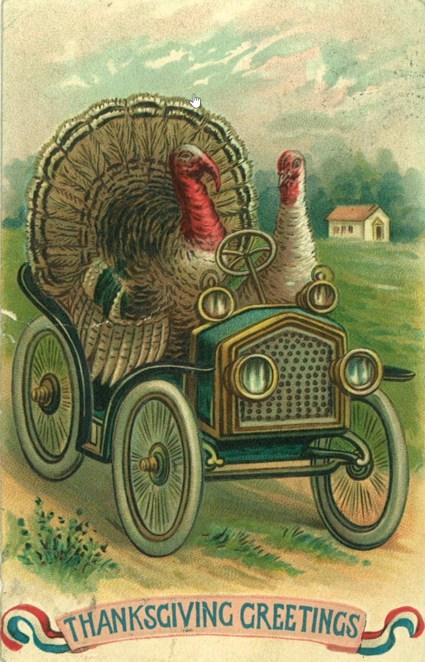
Ever seen two turkeys driving a car? 😀 It is probable that these guys know what’s coming and are leaving town in their classic automobile.
Wishing all my friends, followers, and visitors of this blog a warm and wonderful Thanksgiving with family and friends! For those who are traveling, I wish you a safe trip.
With best wishes,
Jeanne Gartner, Blog Author
November 14, 1914: First Dodge Automobile Built

Horace Dodge (left, rear) and John Dodge (right, rear) take delivery of the first Dodge automobile on Nov. 14, 1914.
One hundred and four years ago on this date –November 14, 1914 — the very first Dodge car, “Old Betsy”, rolled off the assembly line. On that day, the Dodge Brothers (Horace and John) were photographed riding in the rear seat of the first car to bear their last name. It cost $785, had a 110-inch wheelbase, and was powered by an L-head 4-cylinder engine that proved so reliable it was continued until 1920 with very little modification. Total production for 1914 was a mere 249 touring cars. The following year. Dodge offered a two-passenger roadster which also sold for $785 and the plant went into full production.
According to “The Dodge Brothers: The Men, the Motor Cars, and the Legacy” by Charles K. Hyde, here’s the full story:
The widely accepted history of the initial production of early Dodge Brothers automobiles in November 1914 is at odds with much of the evidence about the earliest Dodge Brothers cars. Automotive historians have thought that the first production car, later named “Old Betsy,” came off the assembly line at the Hamtramck factory on 14 November 1914. Guy Ameel, superintendent of final assembly for Dodge Brothers since the start of automobile production, served as John and Horace’s chauffeur that day. With the brothers in the back seat, Ameel stopped the first Dodge Brothers car in front of John Dodge’s mansion on Boston Boulevard in Detroit and a photographer recorded this important moment.
“Old Betsy” was more likely an experimental prototype car assembled several months before 14 November 1914 and not a production car at all…

The Dodge Brothers
The Dodge Brothers began an aggressive advertising campaign to promote their new automobiles and to attract potential dealers to sell their cars. Few people jumped onto the Dodge Brothers bandwagon earlier than Lewis Reed, and not many have lasted longer.
Lewis Reed received his franchise to sell Dodge Brothers Motor Cars from John and Horace Dodge; less than one year after “Old Betsy” rolled off the assembly line. He was just 27 years old. Since then, the business grew and transformed into the oldest Dodge dealership in Maryland history and one of the oldest in the entire nation.
Reed Brothers Baseball Team, 1920
Rockville’s first experience with baseball was during the Civil War on the fields where Richard Montgomery High School now stands. It was known as “Camp Lincoln” because of the Union encampment there, and Federal soldiers helped popularize the new game they brought from the North. One little known part of the history of the grounds is that during the Civil War, President Abraham Lincoln was afraid that Maryland would secede from the Union and that the District of Columbia would thus be bordered on both sides by Confederate states. He used the land of the fairgrounds for tents to maintain up to 10,000 Federal soldiers at a time in order to do his utmost to keep Maryland, especially via the major thoroughfare of Rockville Pike, within the Union.
After the Civil War, those fields – known as the Rockville Fairgrounds – continued to be a popular place for baseball. At the dawn of the 20th century, Reed Brothers Dodge had their own company baseball team that played on those same fields. The photos below were taken by Lewis Reed on a field at the Rockville Fairgrounds in the early 1920s.
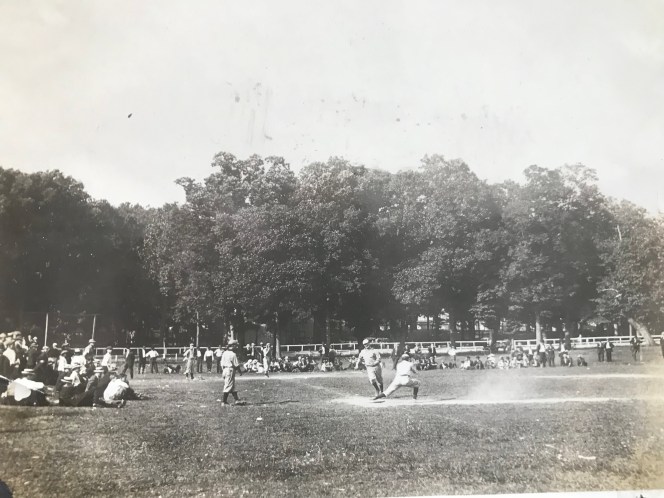
Reed Brothers Dodge Baseball Team on field at Rockville Fairgrounds, circa early 1920s. Photo by Lewis Reed
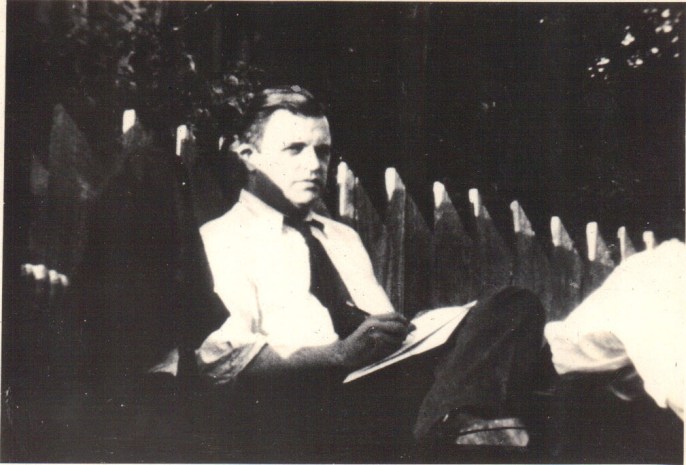
Leo (Pat) Murray (Parts Department Manager), keeping score. Photo by Lewis Reed

Reed Brothers Dodge Baseball Team on field at Rockville Fairgrounds, circa early 1920s. Photo by Lewis Reed
Note the player with the five finger glove in the photo above. Out of all of these photos, this is the only glove that can be seen on a player. The use of gloves wasn’t original to the first years of the game; needing a padded glove was viewed as pretty wimpy. (According to this article in the Smithsonian Magazine, one of the first players to wear a glove tried – and failed – to find one that would be invisible to fans.) By the 1880s gloves were accepted equipment, however, and soon inventors and manufacturers were coming up with new and improved gloves (more padding, deeper webbing…)

Reed Brothers Dodge Baseball Team, circa early 1920s. This photo was taken at Welsh Field, which is the site of the County Office Building. The house in the background was in right field. Photo by Lewis Reed
The Great Frederick Fair Parking Lot Shot, 1914

This fascinating scene of hundreds of cars parked in the Frederick Fair parking lot was taken by Lewis Reed in 1914. What is fascinating to me is, with all of these early cars painted in black, how on earth would you find your car in the parking lot?
This week (September 14-22) marks the 156th edition of the Great Frederick Fair, the largest and greatest county fair in the State of Maryland. There have been many changes since the first fair was held in 1822 when it was known as the Cattle Show and Fair: that was a two-day event, now it’s nine days. The location has changed and so has the name. Today, the Frederick County Fair is officially named the Great Frederick Fair. It’s been held in May, October and November, but now (and for many years) takes place in September — rain or shine.
Fair entertainment has certainly evolved over the years. In 1888, May Lillie, an “expert girl shot with a rifle” from the back of a running mustang, performed. In the early 1900s, acrobatic bears and monkeys, high-wire acts and vaudeville performers took the stage. In 1950, the highlight of the “Irish Horan and the lucky Hell Drivers” show was a “stock convertible catapulted from a giant cannon.” In 1965, it was Jack Kochman’s Hell Drivers performing stunts with cars.
The Thursday of the 1911 fair was noted as a record day with 15,000 people in attendance, 100 autos and 1,000 carriages, according to “The Great Frederick Fair” book. Today, fair attendance can range from 210,000 to 250,000 people during the nine-day fair.
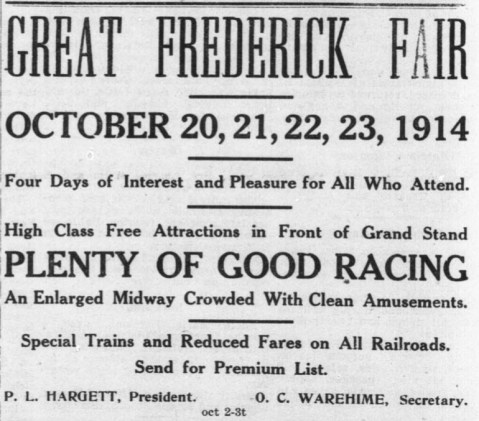
Newspaper ad advertising The Great Frederick Fair. THE DEMOCRATIC ADVOCATE OCTOBER, 1914
Source: Frederick News-Post
Books

Related Resources


Copyright Notice

Reed Brothers Dodge History (1915-2012) by Jeanne Gartner is licensed under a Creative Commons Attribution-NonCommercial 3.0 Unported License.
 Reed Brothers Dodge History 1915 – 2012
Recent Comments