
Happy Valentine’s (and Ferris Wheel) Day!

Ferris Wheel at Rockville Fair, circa 1920s. Photo by Lewis Reed
Did you know that February 14th is not only Valentine’s Day, but also Ferris Wheel Day? This unofficial national holiday is held on this day to honor the birth of the inventor of the Ferris Wheel, George Washington Gale Ferris, Jr. What better way to celebrate Ferris Wheel Day than enjoying this old photograph of the Ferris Wheel taken at the Rockville Fairgrounds, courtesy of Lewis Reed. The fairgrounds were just outside Rockville, about where Richard Montgomery High School is today. The Fair lasted four days, from August 21st to the 24th, and drew visitors from local counties, Washington, and Baltimore.
For the singles and the “enough already with the Valentines”, here is your perfect alternative excuse. Go wish all your friends and family a Happy Ferris Wheel Day!
Christmas Trees and Snow Villages from a Century Ago
With only a few days left until Christmas, I thought it might be fun to take a look at some photos from Lewis Reed’s collection that show us what Christmas trees used to look like a century ago. In those days, there was not wide-spread agreement on exactly what a tree should look like, which made for a lot of creativity. Not surprisingly, they were very different than the perfectly shaped tress we have on display today.
The trees were big back then and always fresh. They went right to the ceiling and were very wide. Early Christmas trees were generally fastened onto a flat board surrounded with fence-rails, snow villages and carpeted with cotton blankets of snow. The tree in the photo below has an abundance of tinsel, which grew in popularity to the point that, by the 1920s, it was common to nearly cover the tree in the decorative material.
So, what is tinsel (aka icicles) exactly? Originally made from strands of silver alloy, tinsel was in fact first used to decorate sculptures. It was only later that it became a Christmas tree decoration, employed to enhance the flickering of the candle flames. In the 1950s, tinsel became so popular that it was often used as a substitute for Christmas lights.
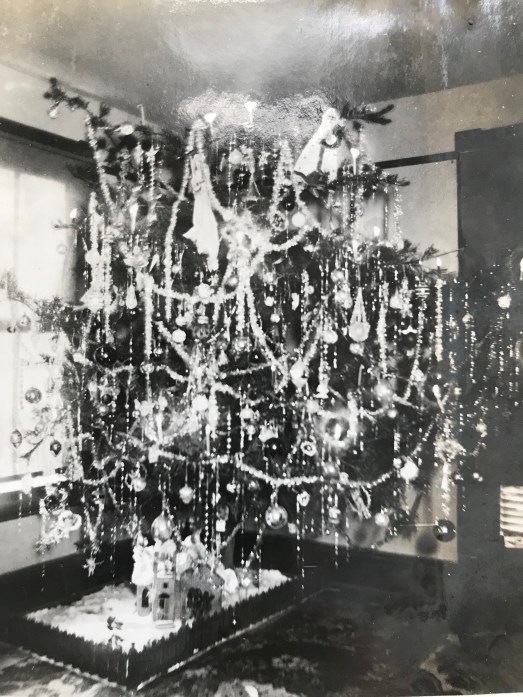
A small snow scene with what appears to be a miniature church is arranged at the foot of the Christmas tree. A popcorn garland adorns the tree. Photo by Lewis Reed
So, where did Washingtonians get their trees?
From The Evening Star, Washington, DC 23 December 1923:
Conduit Road on the long stretch between Glen Echo and Great Falls for many years has been a favorite hunting ground where hundreds and hundreds of families have customarily obtained scrub pine trees for Christmas week. Usually there is plenty of holly and some mistletoe to be found in the rugged and rolling hill lands which are the gateway to Great Falls.
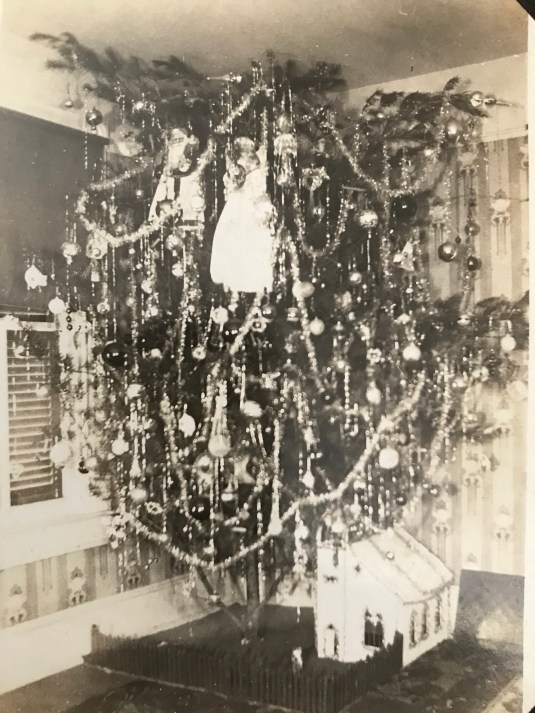
No room for a star on the top of this tree! And just look at those big Santa and Angel dolls. Other fun little details are notable, including a miniature church with picket fence is arranged at the base of the tree. Photo by Lewis Reed
There’s a fine art to decorating Christmas trees that’s been developing since over 100 years ago. People consider lights, garland, ornaments, skirt, and more. But one thing that’s hard to resist sometimes is just filling every available space with decorations. Clearly, that was the case years ago too. What I like about these trees is that they are so randomly shaped and even misshapen. Folks back then didn’t trim them down to a more aesthetically pleasing symmetry like we do today.
The tradition of building miniature Christmas village landscapes, including houses, animals, and other hand-crafted wooden figures, began with the Pennsylvania Dutch in the late 1800s. Mass-produced cardboard houses, sold in dimestores, became popular in the mid-20th century. Today, these villages in good condition can be highly collectible.
Below are photos of Lewis Reed’s snow village set up under the Christmas tree decorated with vintage ornaments, tinsel, and lights. I don’t remember the odd-shaped Christmas trees, but I do remember having a lot of fun helping my grandfather set up the miniature landscapes with the varied figures, little houses, and trees at Christmastime each year. It seemed like a holiday village right out of a storybook.

A rustic picket fence is used to set off the village display. Dangling strands of tinsel hang below the tree. Photo by Lewis Reed
The snow villages were set up in Lewis Reed’s basement on top of a big table beneath a small Christmas tree. He made the snow scenes entirely by hand using wire-covered cardboard and balled up paper to make hills and pathways. The little houses and figurines would fit into the landscape with cotton ‘snow’ all around; and lights would be wired underneath.
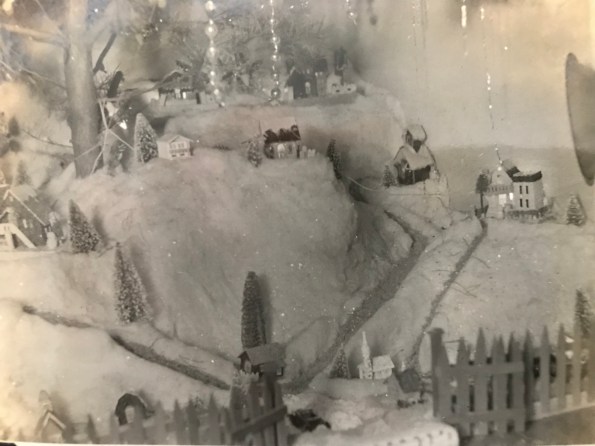
Little houses, churches, fences, trees, and pathways were added to the scene. Some of the houses have charming light effects in the windows. The roofs of the houses were decorated with fake snow. Photo by Lewis Reed
These Christmas villages were precursors of the Holiday Villages that were made popular by Department 56 that you see today.

Old-fashioned lights can be seen on the tree, along with lit windows in the houses. The miniature houses usually had holes in the back or the bottom through which tiny lights were placed to provide illumination. Photo by Lewis Reed
Wishing all of you who have stopped in to visit a very Merry Christmas and Happy New Year! Stay safe and enjoy the holiday season with friends and family!

Blog Milestone: 300K Page Views
 If you ever glance at the blog view counter on the right side of this page, you might have noticed that this blog just went over 300,000 views. After reaching this milestone, I would like to take the time to thank all of you who have visited, followed, shared, or commented on this blog. Visitors to this site on a daily basis continue to grow — we have been visited by folks from all fifty of the United States and 187 different countries world wide.
I have often been asked why I started this blog. For me, it’s because history is important. Sometimes we don’t know we need to do something until it’s handed to us, and once we have it, we suddenly see and feel its value. As we were getting ready to close the doors to the dealership for the last time in May 2012, I was standing in the empty showroom thinking about all the history, past achievements, and hardships the dealership had endured over the years. Few businesses can say they’ve lasted almost a century. It seemed a particularly pertinent time to start thinking about such a project, as it was a time of reminiscence, but also looking forward.
When I stop to think about what Reed Brothers Dodge has experienced over the last century, from World War I, The Great Depression, World War II, to three economic recessions, two energy crises, and numerous Chrysler setbacks — including the first Chrysler Bailout, the sale of Chrysler to Daimler, and the sale to the private equity firm Cerberus — I could not be more proud to be a part of such an amazing story. It takes resilience to weather 97 years in business. The dealership adapted itself multiple times in order to survive. Through the good times and the bad, Reed Brothers Dodge held on and prospered.
I felt it was important to take the time to ensure our history remained accessible for those who read it years from now, or decades from now, when I or other family members who know the story firsthand are no longer around to tell it. How Reed Brothers Dodge came into being, and how the company overcame the inevitable changes and challenges throughout almost a century of being in business — all adds up to a great story.
Creating this blog and sharing our business history has been the most rewarding endeavor of my life. I appreciate all of you for your continued support and making Reed Brothers Dodge History one of the places you visit during the course of your day.
Thanks for reading!
Jeanne Gartner, Blog Author
Sept 17, 1908: Testing the Wright Military Flyer at Fort Myer, VA
On this day in September 17,1908, the first military airplane in the world, built by the Wright brothers for the Army Signal Corps, made its first flight at Fort Myer, Virginia. Less than a thousand people witnessed the first flight at Fort Myer, because the general public was still doubtful that powered flight had been achieved. But Lewis Reed was there… and to commemorate that milestone, I have posted six original snippets of history that Lewis Reed captured through the lens of his camera that day.

Soldiers at Fort Myer prepare to pull the Wright Military Flyer out of its temporary hangar. Photo by Lewis Reed
Five years after the first successful flight at Kitty Hawk, Orville Wright and Thomas E. Selfridge test flew the Wright Flyer in a demonstration for the U.S. Army at Fort Myer, VA. The Army was considering contracting Wright’s aircraft to use as a military airplane, but, in order to win the contract, he needed to demonstrate the plane’s ability to carry a passenger. Twenty-six-year-old Lt Thomas E. Selfridge volunteered to be a passenger that day. Orville Wright succeeded in keeping the Wright Flyer aloft for one minute and 11 seconds. After more than four minutes in the air, the airplane crashed to the ground from a height of about seventy-five feet after a propeller blade broke and the machine went out of control. Orville Wright was severely cut and bruised and his passenger, Lt. Thomas Selfridge, became the first powered-aviation fatality.

Curtiss Model D with tricycle undercarriage. Photo by Lewis Reed

Curtiss Model D. Photo by Lewis Reed

Wright Model B with skids. Photo by Lewis Reed

Another early aircraft from 1909 was the Bleriot XI monoplane. In the background a Rex Smith Aeroplane Company School is advertised on the side of a building. Photo by Lewis Reed
A Rex Smith Aeroplane Company School can be seen on the side of the building in the background. The founder, Rex Smith, was an inventor and a patent attorney. The Rex Smith Biplane was used in the successful April 3, 1911 U.S. Army Signal Corps experiments in wireless communications. The Signal Corps did not buy any Smith Biplanes, they did however use them from time to time to train pilots to fly the Curtiss aircraft at the same field.

Airplane Hangars at Fort Myers, Virginia. Photo by Lewis Reed
The Wrights would prove their machine’s qualifications at Fort Myer. They met or exceeded all of the Army’s specifications, including flying at 40 miles per hour, carrying a combined passenger weight of 350 pounds, maneuvering in any direction in the air, landing without damage, and flying for at least an hour non-stop, which was a world record at the time.
Today, the Wright brothers are legends, with their accomplishments being the storybook example of American perseverance and ingenuity.
September 7, 1979: The First Chrysler “Bailout”
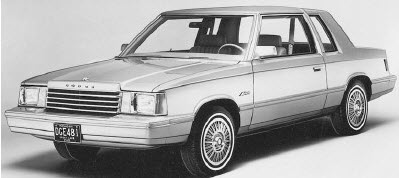
In the early 1980s, the Dodges Aries-K inspired Chrysler’s renaissance.
In 1979, Chrysler was at death’s door and petitioned the U.S. government for $1.5 billion in loan guarantees to avoid bankruptcy. It made gas guzzlers that nobody wanted to buy and it asked for $1.5 billion to keep itself going until a fleet of more fuel efficient cars could take up the sales slack. It was by far the largest government bailout in US history. On September 7, 1979 Chrysler formally petitioned the U.S. government for the loans, and on December 20, 1979 Congress ratified the appropriation in the “Chrysler Corporation Loan Guarantee Act,” which President Carter subsequently signed into law. It was an extremely painful period for Chrysler, but Reed Brothers survived the first Chrysler Bailout and resurgence under Lee Iacocca.
The K-Cars, the Dodge Aries and Plymouth Reliant, were, quite literally, the cars that saved Chrysler from the abyss in 1980. Their only real savior other than the K-Car was a government bailout. Though it came after bankruptcy, they managed to save the company with it by 1983. The K-Cars were inexpensive, reliable, and they delivered economical transportation for 6 people at an affordable price. Sales from the K-Car enabled Chrysler to emerge from bankruptcy and evolve into a profitable company.
Reeling from the combined effects of a recession and a global energy crisis, in 1979 Chrysler was forced to seek government loan guarantees. Meanwhile, Chrysler chairman Lee Iacocca took the company’s case straight to the people in a series of television commercials. Looking straight into the camera, the legendary auto executive pitched the company’s new K-cars with total conviction, asserting, “America, if you can find a better car, buy it.”
Buyers took up Iacocca’s challenge, flocking to the showrooms to buy their own K-cars. Nearly one million Aries were sold (and another million Reliants), allowing Chrysler to pay off its loans a full seven years early. Soon Iacocca was back on the airwaves with another ad campaign. This one was called “The Pride Is Back.”
These models were soon followed by what would become a home run product for Chrysler: minivans.
Nearly thirty years later, in 2008, Chrysler would receive billions in a new bailout from the U.S. government in the aftermath of the financial crisis that decimated automotive sales over the following few years. In 2009, Chrysler files for Chapter 11 bankruptcy protection. On May 14, 2009, Chrysler left 789 dealerships, about a quarter of its dealer base, out in the cold by rejecting their franchise agreements and giving them about a month to sell all their remaining new cars, factory parts and service equipment.
Whether a franchise is run by a second- or third-generation dealer, or is older than even Chrysler itself, didn’t seem to matter when Chrysler decided to cut dealerships ranks during their 2009 bankruptcy process. After almost 95 years selling Dodges, Reed Brothers was one of the 15 dealerships in Maryland and 789 dealerships nationwide notified by Chrysler that their franchise agreement would not be renewed. Chrysler was acquired in total by Fiat in 2014.
Source: Chrysler
Books

Related Resources


Copyright Notice

Reed Brothers Dodge History (1915-2012) by Jeanne Gartner is licensed under a Creative Commons Attribution-NonCommercial 3.0 Unported License.


Recent Comments