
UPDATE: Lewis Reed Photos to Appear on Science Channel ‘Impossible Engineering’

I just got word from the Production Assistant at Discovery that the new season of Impossible Engineering Series 4 is about to start airing in the US. Lewis Reed’s race car photographs will be a part of the “London Array Wind Farm” episode which is the second episode of the series. The show is scheduled to be broadcast on Thursday, January 10, 2019 on Discovery’s Science Channel.
The following 1923 dirt track race shots taken by Lewis Reed at the Rockville Fair will be used on the program that will feature a segment on the development of the race car.
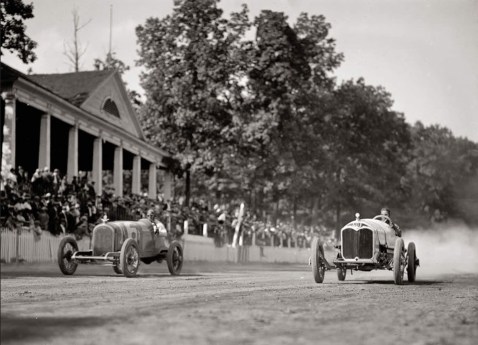
Photo by Lewis Reed
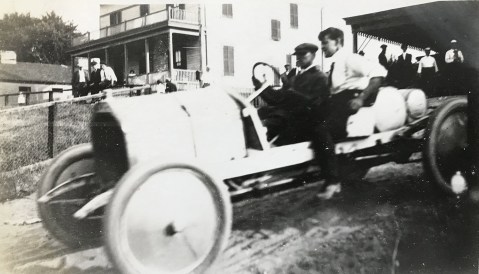
Photo by Lewis Reed
About Impossible Engineering
Behind every seemingly impossible marvel of modern engineering is a cast of historic trailblazers who designed new building techniques, took risks on untested materials and revolutionized their field. Brand new series, ‘Impossible Engineering’, is a tribute to their achievements. Each episode details how giant structures, record-beating buildings, war ships and space crafts are built and work. As the show revels in these modern day creations, it also leaps back in time to recount the stories of the exceptional engineers whose technological advances made it all possible. How would they have ever existed without the historical work of their ancestors? Interviews with their great advocates bring engineering history to life and retell how these incredible accomplishments shaped the modern world.
“Impossible Engineering” is produced for Science Channel by Twofour Broadcast.
Then & Now: Clinton Zion AME Church, Rockville
In 1867, several of Rockville’s African American families left Jerusalem Methodist Episcopal Church to start the African Methodist Episcopal (A.M.E.) Zion Church under the leadership of Reverend Charles Pipkins. In 1890, Pipkins and his congregation cut timbers and erected. a frame church on Middle Lane. Taken approximately 100 years apart, these photos show the Clinton Zion A.M.E. Church then and now.
Clinton Zion A.M.E. Church (THEN): In 1904, the congregation moved to the brick church seen in this black & white photograph located on North Washington Street and today’s Beall Avenue. The church was named Clinton A.M.E. Zion in honor of Reverend George Wylie Clinton (1859-1921), a prominent member and editor of the church’s periodical, Star of Zion.

Zion A.M.E. Church, Rockville, Maryland. Photo by Lewis Reed, ca. 1912.
Clinton Zion A.M.E. Church (NOW): The congregation sold the brick church in 1955 to make way for a shopping center, dedicating their present church on Elizabeth Avenue in Lincoln Park in the fall of 1956. The growth of Clinton was the impetus for the most recent expansion effort. Construction of the new sanctuary began in 1989 and the newly renovated edifice was dedicated on Sunday, May 13, 1990.
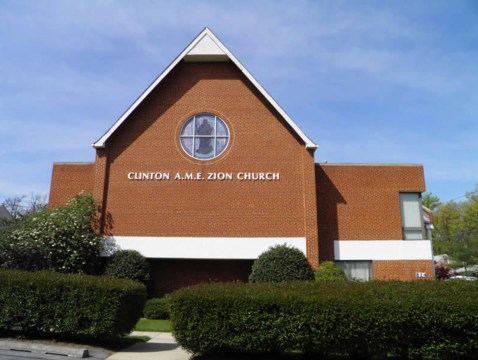
Zion A.M.E. Church, Rockville, Maryland. 2012
Source: Clinton AME Zion Church
Rockville Academy Basketball Team 1915-1916
Before opening his Dodge dealership in 1915, Lewis Reed was a well-known amateur photographer in Montgomery County. He would occasionally get phone calls local high schools asking him to take pictures of their athletic teams and graduating classes.
This photo taken by Lewis Reed depicts the Rockville Academy Basketball Team of 1915-1916. Finding photos and information of basketball teams before the 1920s is a difficult task. The only information on this team that I could find was in the May 1981 edition of “The Montgomery County Story” and the news clipping just below it from the Washington Times. From the newsletter:
In 1915, Rockville High School organized an athletic association. They planned teams in baseball, football, and basketball. They quickly lost their first game of basketball to Rockville Academy, 29 to 26.

Rockville Academy Basketball Team 1915-1916. Photo Lewis Reed
Back: Roy Hilton, Lester Witherow, Grubb, Hamilton, Edmonds
Middle: Lawrence Higgins, Joe Dawson, Brownell (Buck) Riggs, J. Vinson Peter, John McDonald
Front: John Dawson

The Washington Times January 24, 1915
The Montgomery County Historical Society has identified several people in the photograph. If anyone can help put a name to a face, please leave a comment.
Source: The Montgomery County Story
Reed Brothers Baseball Team, 1920
Rockville’s first experience with baseball was during the Civil War on the fields where Richard Montgomery High School now stands. It was known as “Camp Lincoln” because of the Union encampment there, and Federal soldiers helped popularize the new game they brought from the North. One little known part of the history of the grounds is that during the Civil War, President Abraham Lincoln was afraid that Maryland would secede from the Union and that the District of Columbia would thus be bordered on both sides by Confederate states. He used the land of the fairgrounds for tents to maintain up to 10,000 Federal soldiers at a time in order to do his utmost to keep Maryland, especially via the major thoroughfare of Rockville Pike, within the Union.
After the Civil War, those fields – known as the Rockville Fairgrounds – continued to be a popular place for baseball. At the dawn of the 20th century, Reed Brothers Dodge had their own company baseball team that played on those same fields. The photos below were taken by Lewis Reed on a field at the Rockville Fairgrounds in the early 1920s.
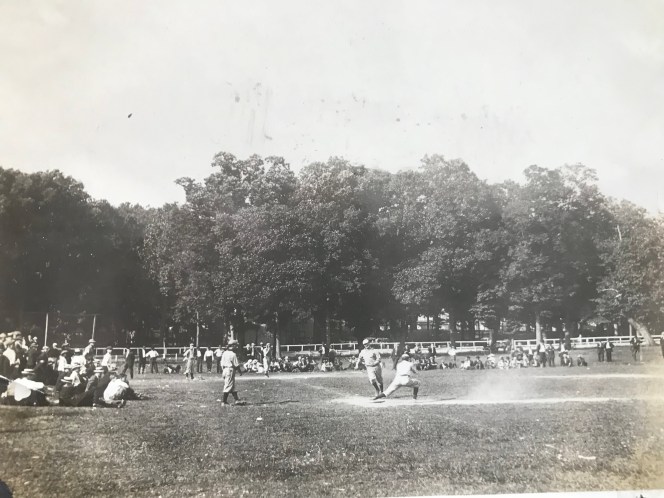
Reed Brothers Dodge Baseball Team on field at Rockville Fairgrounds, circa early 1920s. Photo by Lewis Reed
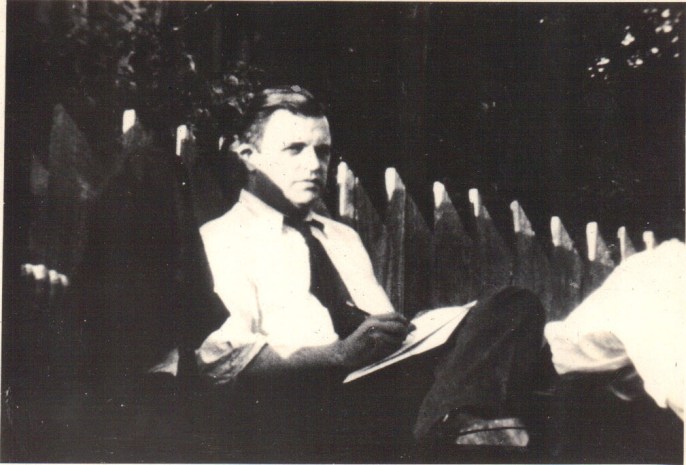
Leo (Pat) Murray (Parts Department Manager), keeping score. Photo by Lewis Reed

Reed Brothers Dodge Baseball Team on field at Rockville Fairgrounds, circa early 1920s. Photo by Lewis Reed
Note the player with the five finger glove in the photo above. Out of all of these photos, this is the only glove that can be seen on a player. The use of gloves wasn’t original to the first years of the game; needing a padded glove was viewed as pretty wimpy. (According to this article in the Smithsonian Magazine, one of the first players to wear a glove tried – and failed – to find one that would be invisible to fans.) By the 1880s gloves were accepted equipment, however, and soon inventors and manufacturers were coming up with new and improved gloves (more padding, deeper webbing…)

Reed Brothers Dodge Baseball Team, circa early 1920s. This photo was taken at Welsh Field, which is the site of the County Office Building. The house in the background was in right field. Photo by Lewis Reed
Montgomery County Saw & Grist Mills (1905-1910)
A key part of Montgomery County’s agricultural economy in the 18th and 19th centuries, grist mills ground wheat and corn into flour and meal for local farmers. Today, besides the more than 30 streets that are named for mills, all that is left are the remains that have been uncovered in our parks. All of the mill structures are in various stages of ruin and are barely visible today. The following photographs are a collection of fascinating historical images of Montgomery County Saw & Grist Mills taken by Lewis Reed from 1905-1910.

An unidentified lady poses in front of Black Rock Mill, circa 1905. Photo by Lewis Reed
Black Rock Grist & Saw Mill
Black Rock Mill was built by Thomas Hillary and has stood along the banks of Great Seneca Creek as a landmark since its construction in 1815-1816. The mill was in working operation for over a hundred years until a flood in 1920 destroyed a dam on Seneca Creek and damaged the mill. Today, it is a unique survivor of the many mills in Montgomery County harnessing the water-power of the creeks to grind wheat and corn into flour. It is one of only two mills standing in Montgomery County Maryland. As far as can be determined, Lewis Reed’s collection of about 20 Black Rock Mill photographs are some of the earliest known in existence.

Muncaster Mill. Photo by Lewis Reed
Muncaster Saw & Grist Mill 1760s
Joseph Elgar built saw and grist mill on Rock Creek, later known as Muncaster Mill. Muncaster Mill was built in the early 1800s and closed in 1925 due to competition from modern milling practices. It was burned to its foundation in 1935. At one time, as many as 12 other mills operated along Rock Creek but most disappeared before the Civil War. Muncaster Mill was the last mill to operate in what is now Rock Creek Park. During its lifetime, the mill served 30–50 farmers in the area. There were three millstones, each designed for a specific grinding job. One ground unshelled corn for animal feed; one coarsely ground wheat, barley, and oats; and one ground fine flour. For many years, there was also a sawmill, operated by a water turbine. The sawmill foundation was about 75 feet west of the grist mill site. The old miller’s house stood on Emory Lane near Muncaster Mill Road.
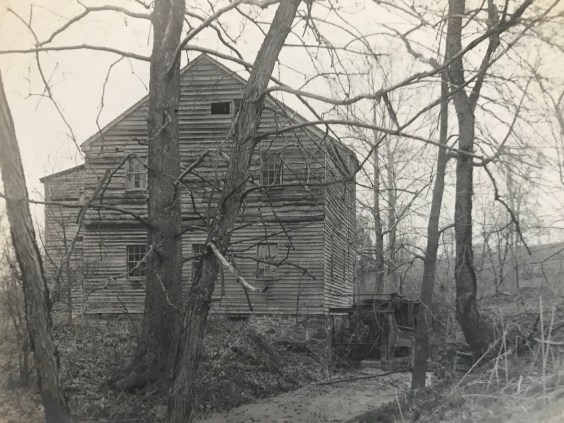
1910 Veirs Mill on Rock creek south of Veirs Mill Road operated from 1838-1880. Photo by Lewis Reed
Veirs Mill
The original Veirs Mill was built by Samuel Clark Veirs sometime after 1838 on the 400 acre farm which Veirs acquired in that year about two miles south of Rockville, on Rock Creek; the farm was part of an original land grant called “Prevention”. The sixth mill to be built on Rock Creek, Veirs Mill operated for approximately 80 years. The mill is identified as “Rock Creek Mills” and was located to what is now the intersection of Aspen Hill and Veirs Mill Roads. There are no above-ground remains of the Veirs Mill.

Hickerson Brothers Flour & Grist Mill 1910. Photo by Lewis Reed
Hickerson Brothers Grist Mill
Hickerson Brothers Grist Mill on Rock Creek south of Veirs Mill Road operated from 1838-1880. In 1925, Hickerson Brothers Lindsay and Clarence, operated a steam-powered grist mill near the B&O tracks until 1928-1929.

Clopper’s Mill. Photo by Lewis Reed
Clopper’s Mill
Clopper’s Mill was most active between 1850 and 1880, the arrival of the railroad and steam-powered mills had put an end to the water powered mills by the early 20th century. On April 15, 1865 Clopper’s Mill became part of national history when would-be assassin of the vice-president of the United States, George Atzerodt, spent the night there while fleeing from Washington D.C. after the assassination of President Lincoln. George was part of the gang assembled by John Wilkes Booth to eliminate the heads of the U.S. government. He was supposed to kill Vice-president Johnson at the Willard Hotel at the same time as Booth assassinated the President. But Atzerodt ran out of courage and instead made his way to Germantown. The mill was purchased by the state in 1955. The Clopper’s Mill ruins are significant as one of the few remaining distinguishable mills in the county. The ruins consist of stone and brick walls with no roof.

Liberty Mill. Photo by Lewis Reed
Liberty Mill. The Bowman Brothers built a steam-powered mill in 1888. When this mill burned down in 1914, an electric-powered mill was built and bought by the Liberty Milling Company in 1917. “Feed the Liberty Way” was the slogan for the mill which became the second largest mill in Maryland and supplied flour for the army during World War II. Cornmeal and animal feed were also made at the mill, and a mill store sold specialty mixes like pancake and muffin mix. After the war the mill went into decline, and was burned by arson May 30, 1972.
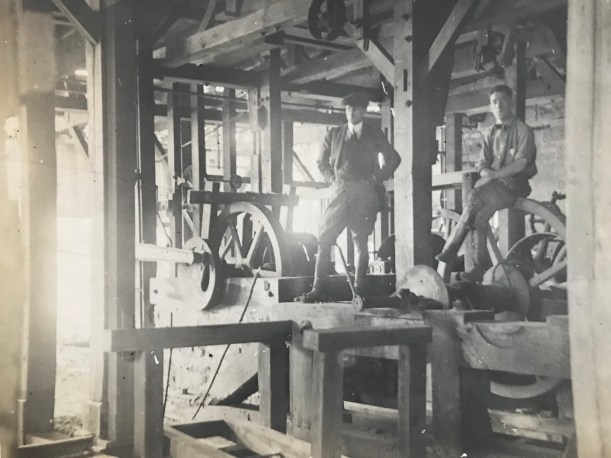
Rare peek at the inside of an old mill. Photo by Lewis Reed.
Source: Maryland Historical Trust
Books

Related Resources


Copyright Notice

Reed Brothers Dodge History (1915-2012) by Jeanne Gartner is licensed under a Creative Commons Attribution-NonCommercial 3.0 Unported License.
 Reed Brothers Dodge History 1915 – 2012
Recent Comments