
Darnestown One-Room Schoolhouse (1898)
Have you ever wondered what it would be like to attend a one-room school, to be in the same classroom as your older brother or younger sister, where all the kids, no matter how old, are in the same class? One-room schoolhouses are all but a memory now. But at the turn of the 20th century, they were where most rural students received their educations. One room schoolhouses were the pioneers of the early education period. At the period’s peak, just under 100 one- and two-room schools existed in Montgomery County.
One of the most amazing photographs in Lewis Reed’s collection is of the one-room schoolhouse where he and his brother, Edgar, went to school. This photograph is the only one known to exist of this school. The schoolhouse, now long gone, was located on Thomas Kelley’s Farm at Pleasant Hill (which today, would be located in the center of the Spring Meadows community). Lewis Reed grew up on a farm in rural Darnestown and for much of his young life had no running water or electricity. His father was an early settler and worked as a Cabinetmaker and Blacksmith. The Reed family farmhouse and blacksmith shop was located in off Route 118 in Darnestown.

Darnestown One-Room Schoolhouse. The chimney was probably to a wood-burning stove that was used to heat the building. Note the outhouse on the left. Photo from the Lewis Reed Collection
This small, one-room schoolhouse was within walking distance of my grandfather’s farmhouse. In those days, walking distance generally meant within a few miles. Lewis Reed attended this school with his brother, Edgar. First through sixth grades were taught by one teacher (Minnie McAtee) to about thirty or more students. Few students went beyond sixth or seventh grade; in fact, Lewis Reed’s education stopped after the sixth grade. He would later be home-schooled by his wife, Ethelene Thomas, who was a teacher in the Maryland public school system.
The age range for students was 6 to 16. The students were separated roughly by level of study in each particular subject, rather than by age as they are now: a child might have studied 3rd grade math while also doing 6th grade reading or history. Gender separation was maintained by seating girls and boys on opposite sides of the room. The larger boys were expected to help bring in the wood or coal and carry out the ashes. Misbehavior begot corporal punishment.
School usually took place between the hours of 8 a.m. and 4 p.m. The youngest children sat in the front, while the oldest students sat in the back. The teacher usually taught reading, writing, arithmetic, history, and geography. Students memorized and recited their lessons. The teacher’s desk may have been on a raised platform at the front of the room, however, and there would have been a wood-burning stove since there was no other source of heat. The bathroom would have been outside in an outhouse.

Circa 1898 class photo taken at Lewis and Edgar Reed’s one-room schoolhouse (Darnestown School). There were six grades in the school with one teacher. Minnie McAtee, teacher (right rear). Photo from the Lewis Reed Collection.
As for Minnie McAtee, according to The Baltimore Sun (Baltimore, Maryland) 05 June 1901, Miss McAtee resigned from the Montgomery County school system in 1901.
Born in Darnestown, Miss McAtee attended the Andrew Small Academy in Darnestown, after which she completed correspondence courses to further her education. For eight years, she taught in the one-room schoolhouse at Pleasant Hill, Darnestown.
The undated “Get Well Story” below was posted on the Find A Grave website in her memory. Anybody who took such good care of flowers as she did, most certainly must have been a great school teacher.
 At least 34 schoolhouses of this bygone era still stand today in Montgomery County, an astounding total considering how developed Montgomery County is today. The five schoolhouses in Montgomery County restored as museums — Boyds, Brookeville (one-room school), Kingsley, Seneca, and Smithville — are open to the public at various times during the year. Most are open during Heritage Days; check www.heritagemontgomery.org for the schedule.
Lewis Reed Photos to Appear on Science Channel ‘Impossible Engineering’
 I recently received an e-mail from the researcher on the new Science Channel series ‘Impossible Engineering’. They found Lewis Reed’s collection of early dirt track race photos that were taken at the Rockville Fairgrounds and asked permission to use a couple of them in an upcoming episode they are making on the development of the race car.
The following 1923 dirt track race shots taken by Lewis Reed will be used on the program.
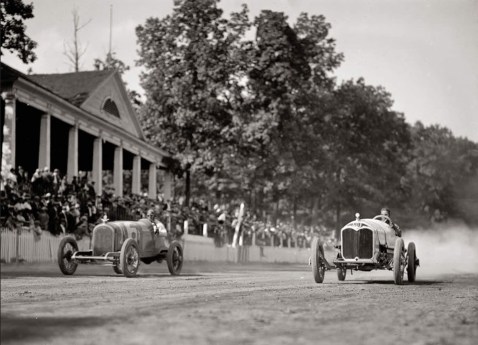
Rockville Fair, August 1923. Photo by Lewis Reed
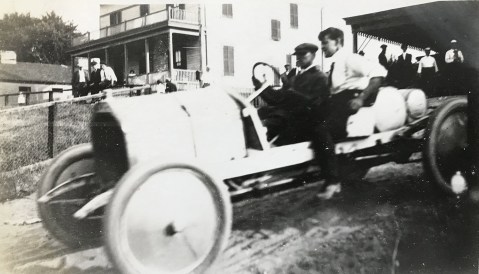
Rockville Fair, August 1923. Photo by Lewis Reed
About Impossible Engineering
Behind every seemingly impossible marvel of modern engineering is a cast of historic trailblazers who designed new building techniques, took risks on untested materials and revolutionized their field. Brand new series, ‘Impossible Engineering’, is a tribute to their achievements. Each episode details how giant structures, record-beating buildings, war ships and space crafts are built and work. As the show revels in these modern day creations, it also leaps back in time to recount the stories of the exceptional engineers whose technological advances made it all possible. How would they have ever existed without the historical work of their ancestors? Interviews with their great advocates bring engineering history to life and retell how these incredible accomplishments shaped the modern world.
“Impossible Engineering” is produced for Science Channel by Twofour Broadcast. No mention of when it will be aired, so stay tuned!
Montgomery County Maryland Almshouse aka Poor Farm

The Montgomery County Maryland Almshouse aka Poor Farm was established in 1789 and torn down in 1959. A modern jail is on its site on Seven Locks Road near Falls Road. Photo taken by Lewis Reed.
A Poor Farm in Montgomery County? Yep. Although a lot of people have never heard of “poor farms,” they were once common across the nation. Various terms have been used to describe the “house for the poor,” and often the titles were unique to the part of the country where the house was located.
This is the Almshouse (aka Poor Farm). The 50-acre tract which includes the pauper’s graveyard was once part of the Montgomery County Poor Farm, established in 1789 as a place where the poor and homeless went to live, work, and, if they died, to be buried.
At the time, the farm was located well beyond the bounds of what was then the town of Rockville. But growth eventually caught up with the property. The farm house was razed in 1959 to make way for a county jail, and another chunk of property was dedicated for I-270. At least 75 graves were identified during a 1983 survey of the property by state archeologists, but according to George R. Snowden, funeral director, there may be as many as 500 people buried in the potter’s field.
Although the county’s poor farm existed for almost 170 years, virtually nothing has been documented about it, said Jane Sween, a librarian with the Montgomery County Historical Society. The property was deeded to the county in 1789 and expanded in 1825. After the Civil War, the farm’s almshouse was rebuilt, and until it was razed a century later it was home to an average of 40 indigent people, she said. The state paid for burial but did not pay for grave markers or upkeep on the property.
The Montgomery County Poor Farm Cemetery is no longer in existence. The National Park Service conducted an archaeological dig in 1987, which resulted in the removal of 38 bodies to Parklawn Cemetery in Rockville, Maryland. Montgomery County sold the land to a private developer.
108 Years Ago at Rockville High School

1911 Originally known as Montgomery County High School, later as Rockville High School. Photo by Lewis Reed
In honor of this year’s commencement, here is a look back at some 1910 class photos from Montgomery County High School that were taken by Lewis Reed. This is a collection of group photos of school children, some with the teacher, taken in 1910 from Montgomery County High School (Old Rockville High School). I wanted to share these photographs, because they offer a visual history of a part of Rockville’s past taken more than 100 years ago.
Most of the photos are labeled with only the year, so if you have corrections to the names or can identify other individuals, please contact me or leave a comment below. Several students have been identified by the Montgomery County Historical Society, which I have included.
In this era, students from grades one through eleven attended the public school at Montgomery Avenue and Monroe Street. Named Montgomery County High School with the addition of upper grades in 1892, as the school board opened other facilities it became Rockville High School and then, in 1935, Richard Montgomery High School. Students came to the school by train, trolley, and later by school bus from all corners of the county.
Step back in time into a much simpler past and get a look at class photos of Rockville High School students from over 108 years ago. As always, click the photos to get a better look. Some of the expressions on these students faces are priceless!
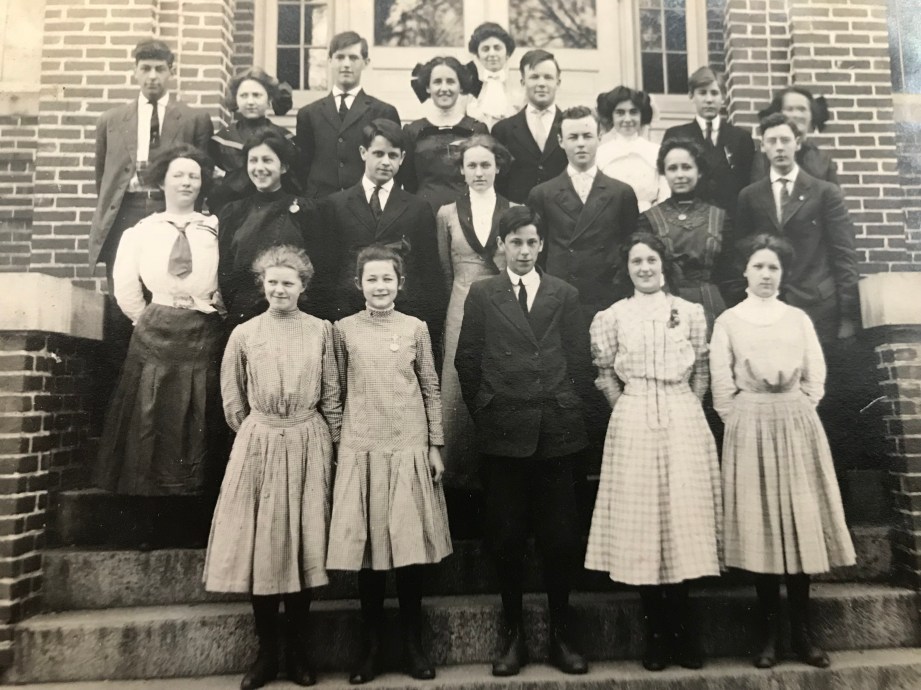
Old Rockville High School class c. 1910. Photo by Lewis Reed
Back row: Edward Story, Lena Ricketts, Tom Young, Louise Larcombe, Miss Ford, Fred Hays, Lucius Lamar, name unknown, name unknown.
Middle Row: name unknown, name unknown, Jesse Wathen, Jesse Higgins, name unknown, name unknown, Mary Hyatt, name unknown, name unknown.
Front Row: Maude England, Rebecca Lamar, (first name unknown) Garrett, Helen Pumphrey, (first name unknown) Lehman.
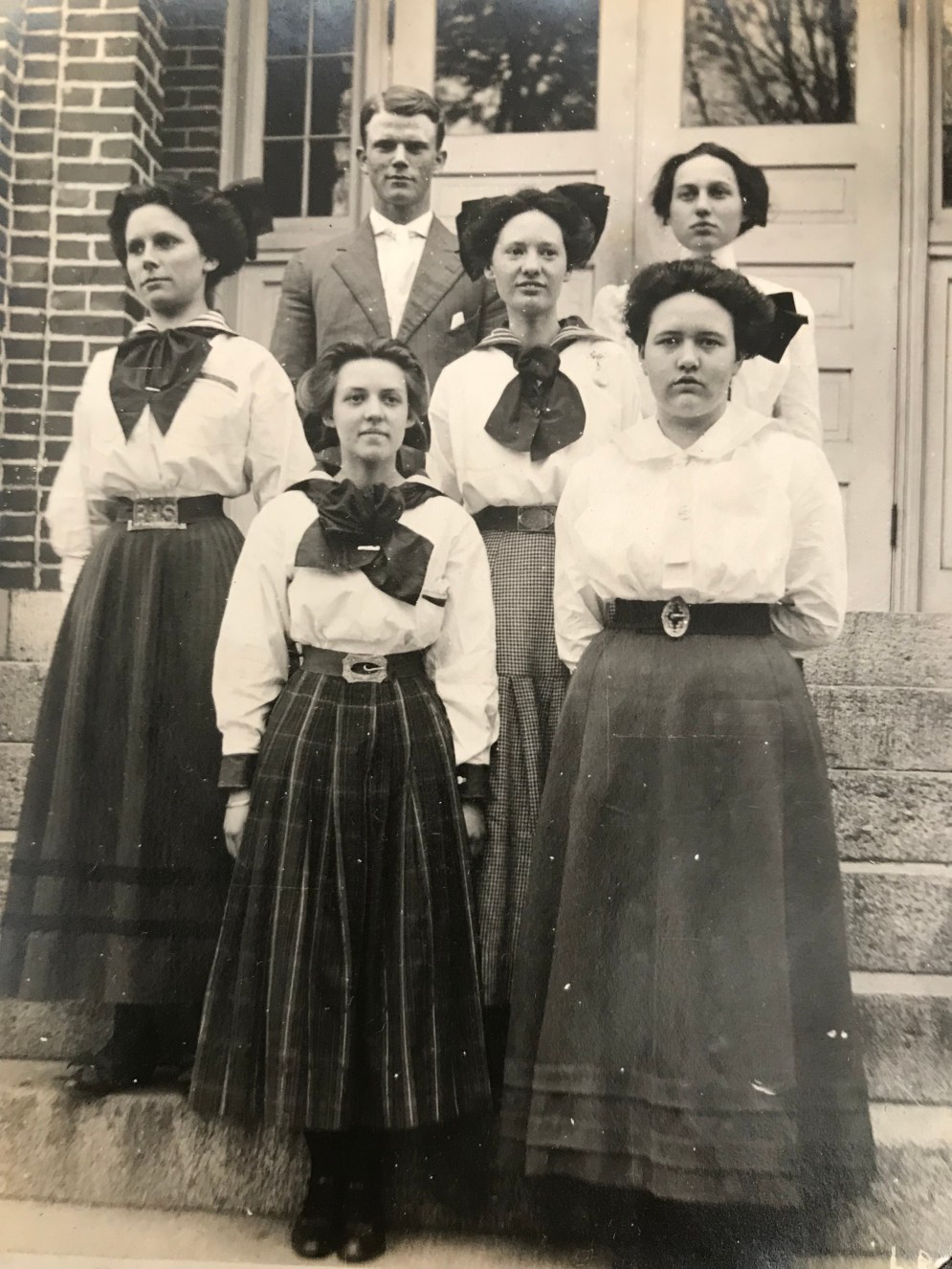
Old Rockville High School graduates 1910. Photo by Lewis Reed
Back: Harry Beall, Katherine Hughes.
Middle: names unknown
Front: Edith Prettyman, (first name unknown) Darby

Old Rockville High School First Baseball Team 1910. Photo by Lewis Reed
Front: Billy Beck, Tom Young, Ed Storey, Harry Beall, Roy Warfield.
Back: (first name unknown) Hicks, Lucius Lamar, name unknown, name unknown, Jesse Higgins, name unknown, name unknown, Fred Hays, Roger Whiteford.
Holding pennant: Griffith Warfield
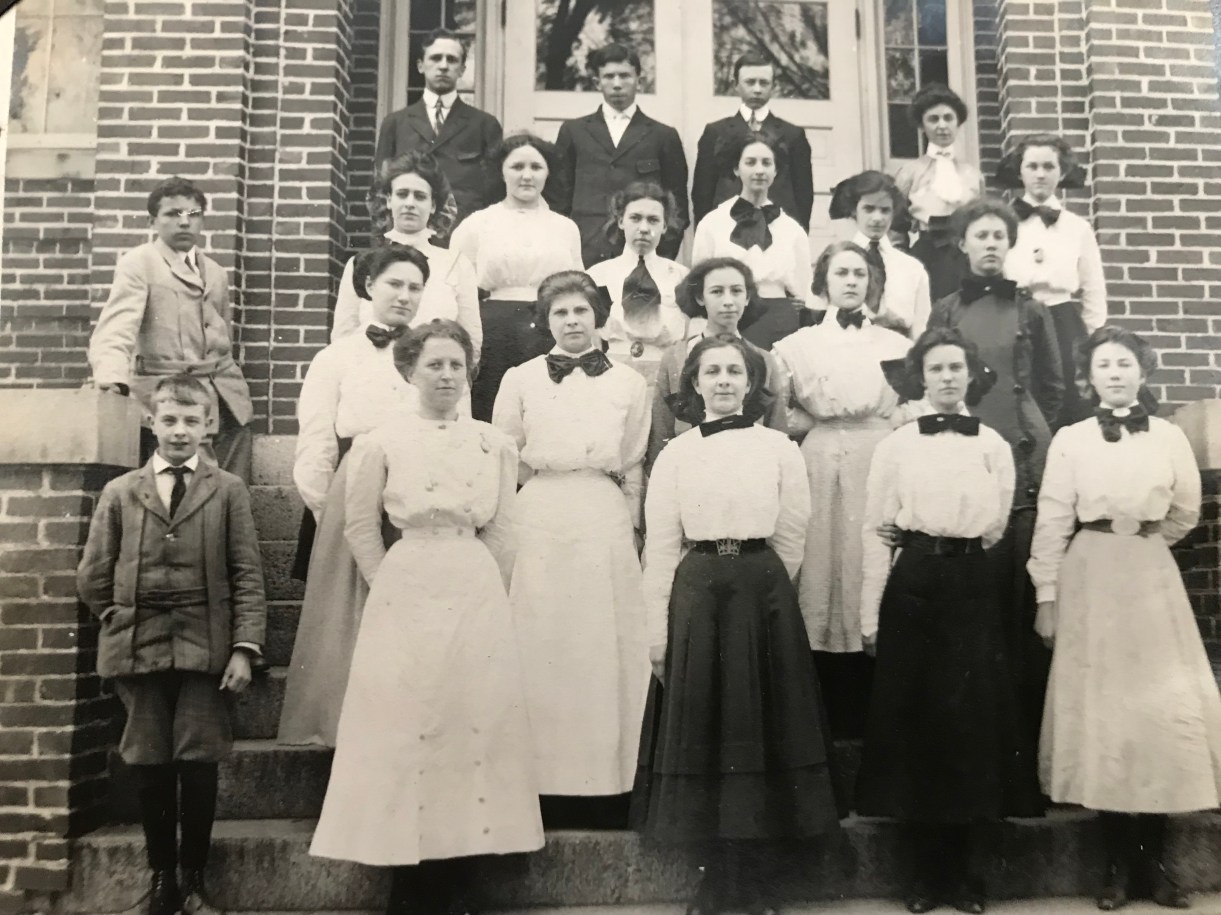
Montgomery County High School 1910

Montgomery County High School 1910

Montgomery County High School 1910
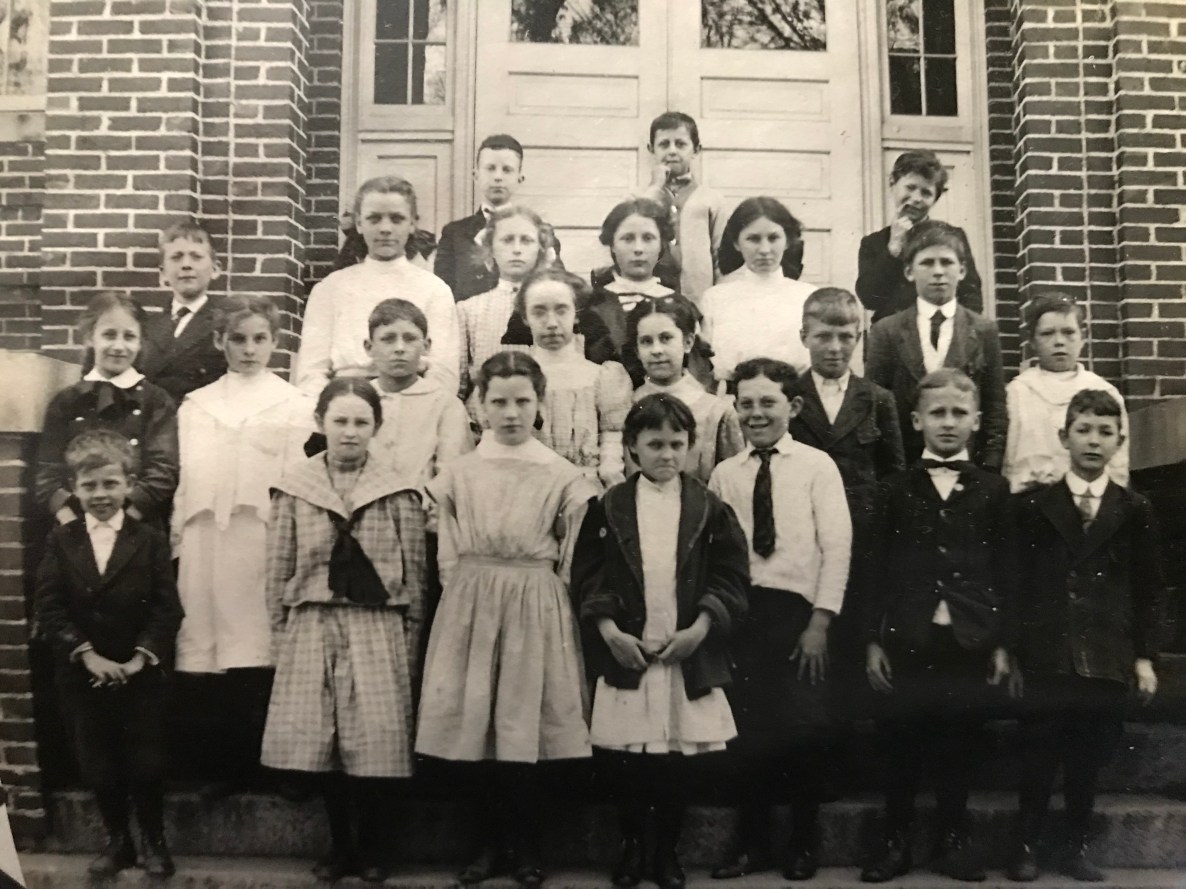
Montgomery County High School 1910
Then & Now: Halpine Store/Radio Shack 111 Years Apart
Looking at old photographs is like peering through an open window back into history. Not only do they give you a sense of wonder from traveling back in time, but also a staggering feeling of awe from seeing just how much things have changed. For this post, I have used one of Lewis Reed’s original photographs for “then” and a Google Maps street view image from today for “now”.
The Halpine Store (THEN): The Halpine Store, also known as the Lenovitz General Store, was built on Rockville Pike in 1898, taking advantage of the prime location on the trolley and railroad lines and the Pike. The store sold food, gasoline and other items to locals and Pike travelers. The man standing just in front of the trolley tracks is James H. Handy (b. 1890) who lived at Halpine and worked for Mr. Copeland on the Wilkins farm. Handy served in the U.S. Army during WWI, as a gunner for the 371st infantry, doing two tours of duty in France. In this photo, he is about 16 years old. Note the telephone or telegraph poles, and the trolley tracks paralleling the road. The nearby Halpine railroad station also brought customers to the area, and the store became the social/community gathering place for the Halpine area. Tradition has it that during the days of “Local Option” when the sale of alcoholic beverages was forbidden in the County, the men of Rockville traveled to the Halpine Store to gather on the broad front porch and sip its special brand of “coffee” served in tin cups.
The proprietors, Benjamin and Anna Lenovitz, lived on the second floor. The building burned in 1923 and a new fire-resistant brick building was rebuilt in its place. This building, at 1600 Rockville Pike, became a Radio Shack, selling computers and electronics.
Seen in the black & white photograph taken by Lewis Reed in 1906, is The Halpine-Lenovitz General Store at Rockville Pike and Halpine Road.

Halpine-Lenovitz General Store at Rockville Pike and Halpine Road, 1906. Photo taken by Lewis Reed.
The Halpine Store/Radio Shack (NOW): The same view one hundred and eleven years later. Rockville Pike is now six lanes, linking the once outlying Halpine and Montrose with Rockville’s town center in one long strip of commercial enterprises and office buildings.

Halpine Store/Radio Shack, Google Image Capture, Nov 2016
Source: Maryland Historical Trust
Books

Related Resources


Copyright Notice

Reed Brothers Dodge History (1915-2012) by Jeanne Gartner is licensed under a Creative Commons Attribution-NonCommercial 3.0 Unported License.
 Reed Brothers Dodge History 1915 – 2012
Recent Comments