
First Shenandoah Apple Blossom Festival, May 3, 1924
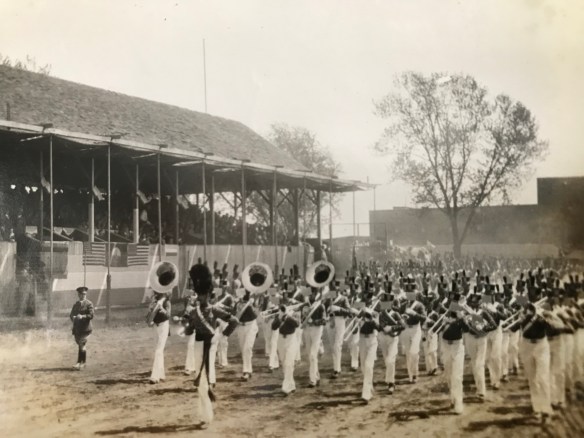
Here the parade participants circle the racetrack as spectators view the parade from a grandstand. There was no caption on this photo, but I’m guessing it might possibly be the VMI Regimental Band. Photo by Lewis Reed
Winchester, with its long history in the apple-growing industry, chose to honor the beauty and bounty of the apple blossom, beginning in the year 1924. On Saturday, May 3, 1924, the first Festival was a one-day event. To kick off the celebration, the parade assembled at the old fairgrounds just off Fairmont Avenue and marched through the streets of Winchester to the Royal Pavilion on the grounds of Handley High School.
Beginning in 1925, the first of three pageants was professionally produced by the John B. Rogers Production Company and staged on a dais at the fairgrounds. In 1928 the outdoor pageants were moved to the steps and esplanade of Handley High School. The pageant earned a reputation as being one of the most beautiful outdoor extravaganzas in the nation. The festival was suspended during World War II, and resumed in 1946 with its first celebrity grand marshals, Bing Crosby in 1948 and Bob Hope in 1949.
The below previously unpublished photos (dated 1925) from Lewis Reed’s album are what appears to be some of the very first photos of the Shenandoah Apple Blossom Festival held at the old fairgrounds in Winchester, Virginia. As always, click on an image to enlarge and scroll through gallery.


Source: thebloom.com
6 Years, 214 Posts & Thank You
 Today marks the 6-year anniversary of this blog. It’s been an honor to share the history of Reed Brothers Dodge – whether you’ve read our blog, followed us on Twitter, or “liked” us on Facebook. I would like to thank those mentioned below, and many others, for their kind words and the visibility they have provided.
To help review the past year I thought I’d search around on the Internet and see what others have been saying about us.
Included among the posts on our Facebook page:
“So neat to be part of Reed Brothers History!“
“ What great memories. Thanks so much for sharing.“
“What a great piece of history.”
“The photos are amazing!”
“What a wonderful thing you are doing with these photos.”
“Thank you ever so much for all these RBD History posts. I certainly am enjoying them.”
” Thank you for your many fine and historic posts to this site.”
Online and in print:
- Curator of the Dodge Brothers exhibit at Meadow Brook Hall:
Thank you so much for your support of Meadow Brook and out Dodge initiatives this year. I’ve admired your wonderful blog and the history you share. As we continue to build a Dodge museum, I truly hope to be able to collaborate with you to have an exhibit about your family.
- Meadow Brook Magazine, Fall 2017: To show support to preserving the Dodge legacy, the author of this blog has “adopted” a Dodge car — a 1925 Dodge Brothers Depot Hackney — one of the historic vehicles in the Meadow Brook Hall Dodge Brothers automobile collection.

Meadow Brook Magazine, Fall 2017
Reed Brothers Dodge Featured in Montgomery Magazine: Reed Brothers was very proud and honored to be featured in the month of April/May 2017 Montgomery Magazine, historic landmarks “Then & Now” section. The black and white photograph is Reed Brothers Dodge located at its original location in Old Rockville at the triangle at Veirs Mill Road and Rockville Pike – close to 100 years ago – with “That Good Gulf” gasoline drive-through filling station and Dodge Brothers Motor Car and Graham Brothers Truck signage.

Reed Brothers Dodge located at its original location in Old Rockville at the triangle at Veirs Mill Road and Rockville Pike. The photo was taken by Lewis Reed in the late 1920s.
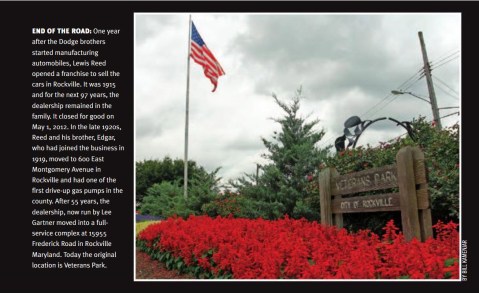
This is the dealership’s location today, now known as Veterans Park.
On National Television!
- Lewis Reed Photo in PBS Documentary: The Archival Producer for television’s most-watched history series, AMERICAN EXPERIENCE on PBS, found a photograph of the interior of a 1920’s trolley car taken by Lewis Reed and asked permission to use it in the documentary, “The Great War,” a six-hour, three-night event, that premiered Monday, April 10, through Wednesday, April 12, 9:00-11:00 p.m. ET in conjunction with the 100th anniversary of America’s entry into WWI.

Rare peak of the inside of a 1920’s trolley car and passengers featured in PBS documentary “The Great War”. Photo taken by Lewis Reed

Screen shot of credits from The American Experience series, “The Great War” on PBS
Last, but certainly not least, I would like to thank YOU for stopping by. I appreciate your patronage, whether it be via our blog, Facebook, Twitter, Pinterest or other social media.

Meet Edgar Reed
Meet Edgar Reed, partner with brother Lewis Reed, in Reed Brothers Dodge.

Edgar Reed as a young man
Edgar was born in Darnestown, Maryland on October 17, 1890. He was a veteran of World War I and an active citizen of Rockville. He served as a Sergeant in the Army Medical Corps and had been posted to General Hospital No. 11 in Cape May, New Jersey. Previous to his enlistment he had been employed by R.W. Vinson, Rockville druggist for eight years. In 1919, Edgar joined his brother Lewis Reed in the business and the name changed to Reed Brothers Dodge. Edgar was in the automobile business with his brother for 35 years.
As a prominent businessman active in local commercial, civic, and religious institutions, Edgar was a respected community leader. For many years, he served on the Town Council and was Chairman of Stewards at the Rockville Methodist Church. Edgar was an original incorporator and charter member of the Rockville Volunteer Fire Department when the fire company was organized in 1921. He was a charter member and Past President of the Rockville Rotary Club and was a director of the Farmers Banking & Trust Company in Rockville until the time of his death. He was the first President and one of 30 original members of the Dealers Automotive Association of Montgomery County.
Edgar was the executive of Reed Brothers and handled all of the technicalities of the business. He was generally in charge of new car and truck sales. Edgar Reed passed away on October 24, 1951 after a prolonged illness.
Hudson Motor Car Company
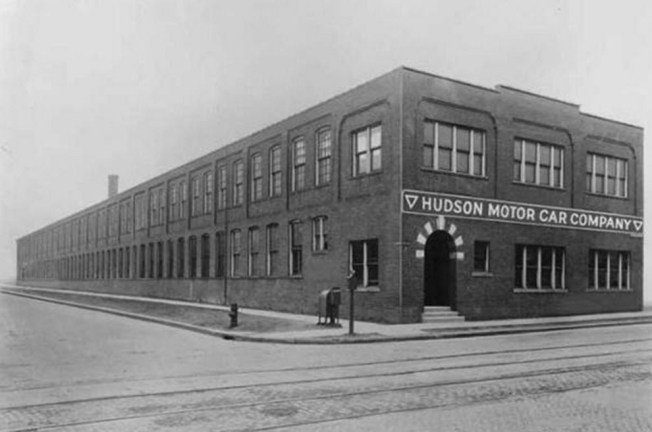
The Hudson Motor Car Company’s first plant in Detroit, MI. The company used this building from 1909 to 1912 when it moved to a larger plant. Image credit: Hudson Motor Car Company
Lewis Reed received his automotive training at the Pierce-Arrow factory at Buffalo, New York, the Dodge Hamtramck and Hudson Motor Car factories in Detroit, Michigan, and the Washington Auto College. A mechanical aptitude was necessary to be a dealer in the early 1900’s. When cars were shipped to the dealer from the manufacturer, they arrived partially assembled in railroad boxcars. It was the dealer’s responsibility to unpack and assemble the cars at the rail yard and drive them back to the dealership. Mechanics were often needed to repair the new cars if they broke down along the way.

1916 – The first shop force of Rockville Garage (from left: Lewis Reed, (first name unknown) Long and Phillip Reed.
Lewis Reed’s Rockville Garage sold more than just Dodges. During the early years, Reed Brothers represented several franchise nameplates along with Dodge, including Oldsmobile, Hudson and Essex. The Hudson and Oldsmobile were sold at Reed Brothers from roughly 1917 through 1923.
Hudson introduced the Essex brand in 1919. The Essex was intended to compete with Ford and Chevrolet for budget-minded buyers. The Essex offered one of the first affordable sedans and by 1925 the combined Hudson and Essex sales made Hudson the third largest automobile manufacturer in the United States.
The Hudson Motor Car Company made Hudson and other brand automobiles in Detroit, Michigan, from 1909 to 1954.
Here’s How Rockville’s Trolley Era Looked Over 115 Years Ago
This special post is a collection of early trolley car photos that were taken by Lewis Reed in the early 20th century. Trolleys existed in American cities before the Civil War, but a line did not connect Washington, DC to Rockville, Maryland, until 1900.
The agreement between the town of Rockville and the W&R Railway Co. ran for 35 years. From 1900 to 1935, street cars plied the track from the Washington terminus at Wisconsin and M Streets, N.W., up Wisconsin and then Old Georgetown Road, over a steel trestle just before the cars approached Georgetown Prep, through dense woods at Montrose and onto the Rockville Pike, through Rockville on Montgomery Avenue, to Laird Street, and back again. The cars could be driven from either end. In 1929, W&R ran 24 trips a day between 6:30 a.m. and 12:30 a.m. to connect Rockville and Washington. Major stops along the line included Georgetown, Alta Vista, Bethesda, Montrose, Halpine, the Fairgrounds, Courthouse Square, and Chestnut Lodge. Six switching stations and side tracks enabled street cars to pass as they went in different directions.
Below are a collection of photographs taken by Lewis Reed that shows what the old trolley cars looked like, highlighting what riding the trolley car was like in the early 1900s. From wood-paneled exteriors with ceiling fans to advertisements, here’s a nostalgic look back at Rockville’s Trolley car era through the lens of Lewis Reed. (click on photos to enlarge)

Western Avenue car barn for the streetcars that served the Georgetown-Tenelytown-Bethesda-Rockville line. Photo by Lewis Reed
A car barn is the streetcar equivalent of a garage for buses. It’s a covered facility in which streetcars were stored overnight, cleaned and given light repairs before the next day’s run. The car barn for the trolleys at the time was the second Western Avenue car barn for the streetcars that served the Georgetown-Tenelytown-Bethesda-Rockville line. It was located at on west side of Wisconsin at between Harrison and Jennifer. It was demolished and later replaced by a purpose-built bus garage which is still in use by WMATA. The National Capital Trolley Museum was instrumental in helping to identify the car barn in the photo above.
Leroy King described the street car below as one of Washington Railway’s majestic “Rockville” cars, at 4 switch in 1908. Note multiple unit jumper box under center front window.

Passengers board car #596 heading to Rockville in 1908. These distinctively styled cars, popularly know as ‘Rockville’ cars, were also used on Washington Railway’s Maryland line. Note the ‘people catcher’ or ‘lifeguard’ in the front. Photo by Lewis Reed, 1908
Traveling in snow was sometimes hazardous to trolley cars, as evidenced by the trolley pictured below which derailed the train tracks and plowed into a telephone pole at Montrose Road and Rockville Pike. Lewis Reed was there to capture the accident from two different perspectives using a five-by-four box camera which produced images on a glass plate.
In populated areas, street cars kept speeds to 12 mph (6 mph at intersections), but in open country they could get up to 40 mph.

Derailed trolley at Montrose Road and Rockville Pike. Photo by Lewis Reed
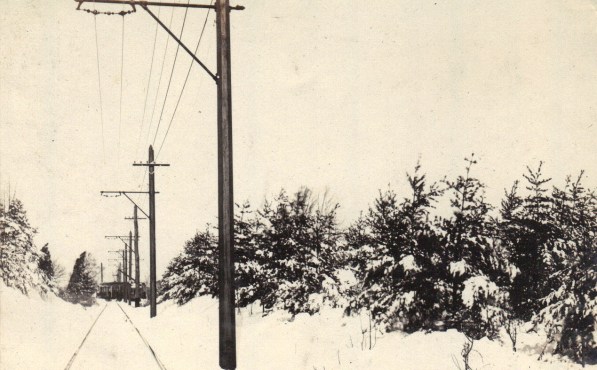
Derailed trolley through dense woods at Montrose Road and Rockville Pike. Photo by Lewis Reed
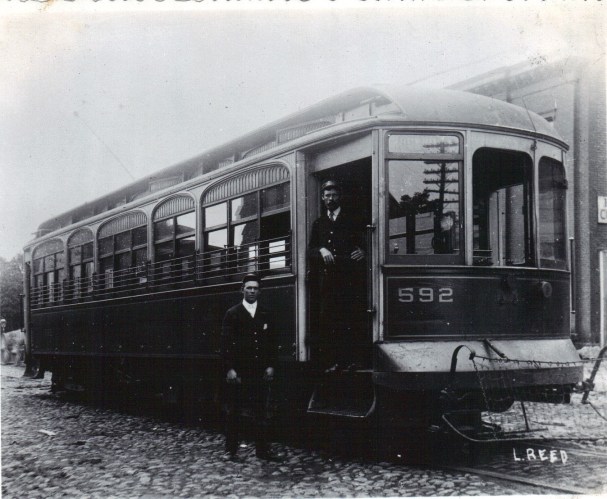
Rockville Trolley Car 592. Photo by Lewis Reed
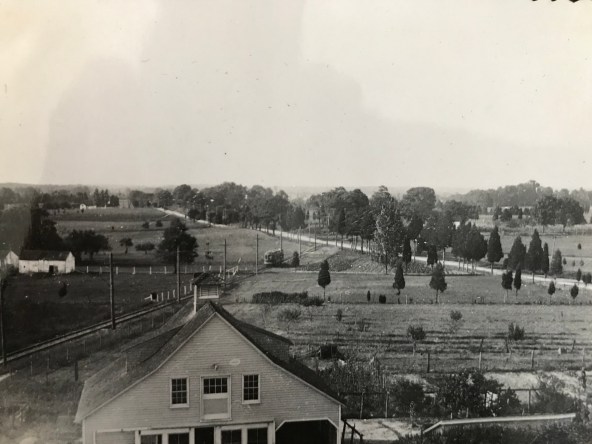
A trolley heads south from Rockville toward Tenallytown through open farmland. This view appears to be looking north and shows the area south of where Montrose Road intersects with Rockville Pike. The Pike is in the background. Photo by Lewis Reed, 1910

Trolley tracks on Rockville Pike south of Sherrer Farm. Note that one of the young men is holding a bicycle. Photo by Lewis Reed, ca. 1911
The Archival Producer for television’s most-watched history series, AMERICAN EXPERIENCE on PBS, found the photograph of the 1920’s trolley interior on this blog and asked permission to use it in the documentary, “The Great War,” a six-hour, three-night event, that premiered April 10-12, 2017 in conjunction with the 100th anniversary of America’s entry into WWI.
All of these prints were originally made from a glass plate negative, an early photographic technique which was in common use between the 1880s and the late 1920s. The early 1900s were considered by many to be the golden era of early photography, because of its new availability to the public and somewhat simplified production methods. Many of Lewis Reed’s early photographs are now part of the Montgomery County Historical Society photo archives.
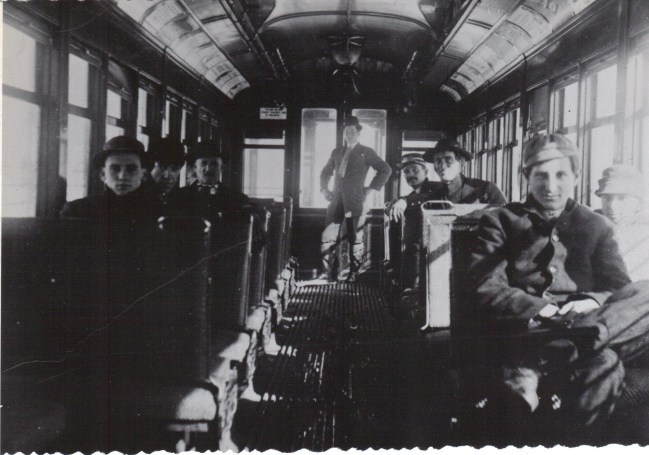
Interior of 1920’s Rockville trolley car. Photo taken by Lewis Reed
Panels for advertising line the edge of the ceiling on both sides of the trolley. Instead of AC, the interiors were cooled with wooden ceiling fans.
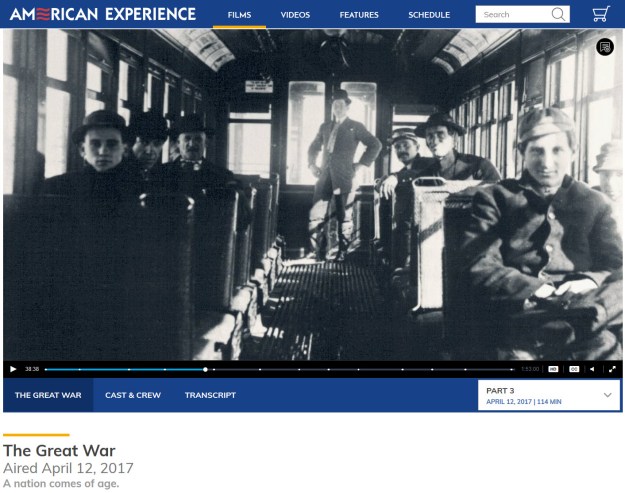
Rare peak of the inside of a 1920’s trolley car and passengers featured in PBS documentary “The Great War”. Photo taken by Lewis Reed
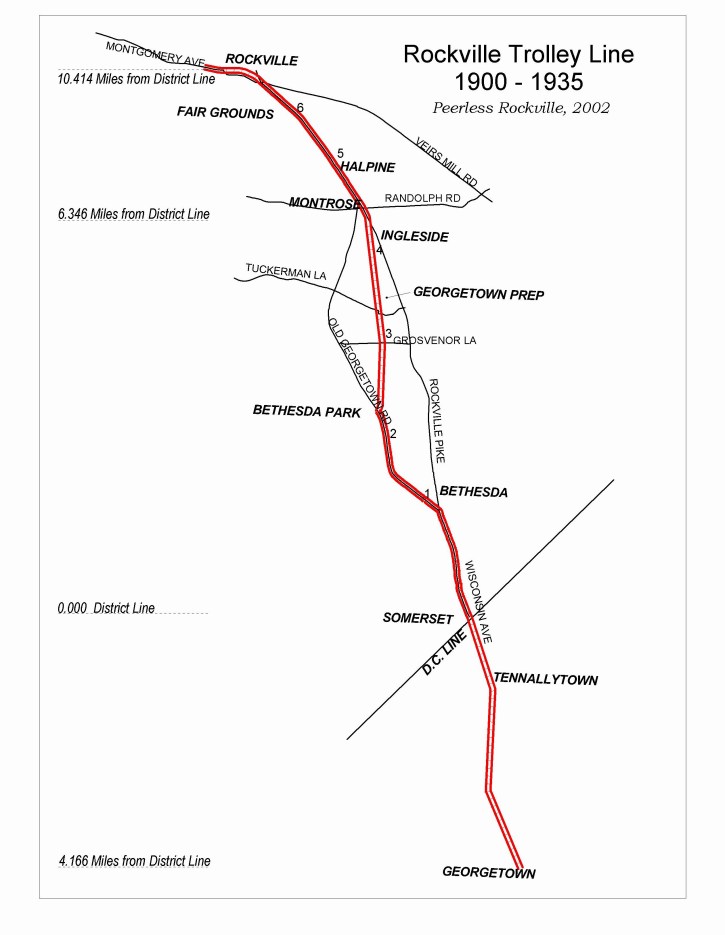
Rockville Trolley Line 1900-1935 – Peerless Rockville 2002
Sources: Rockville Pike History – City of Rockville
History of the Street Car Lines of Montgomery County
Books

Related Resources


Copyright Notice

Reed Brothers Dodge History (1915-2012) by Jeanne Gartner is licensed under a Creative Commons Attribution-NonCommercial 3.0 Unported License.
 Reed Brothers Dodge History 1915 – 2012
Recent Comments