
The First Plymouth Automobile Debuted on This Date 94 Years Ago
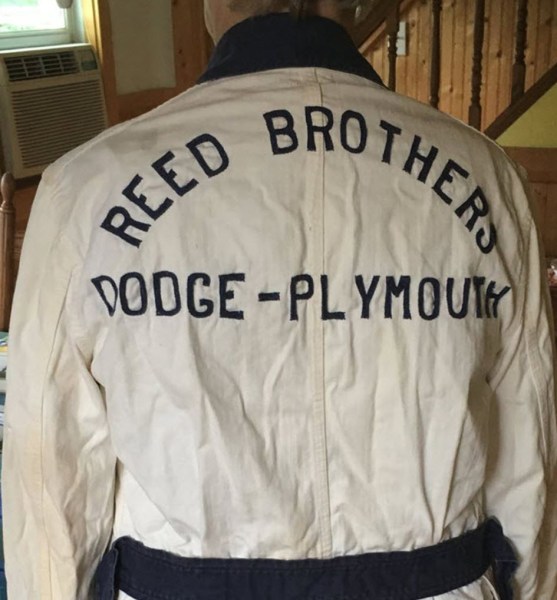
Plymouths were sold at Reed Brothers from 1930-1969. Pictured is an original 1940s Reed Brothers Dodge-Plymouth three-pocket shop coat made by Anderson Bros. of Danville, VA.
The first Plymouth automobile was introduced on July 7, 1928. Plymouth was Chrysler Corporation’s first entry in the low-priced field, which at the time was already dominated by Chevrolet and Ford. Plymouths were actually priced slightly higher than their competition, but offered all standard features such as internal expanding hydraulic brakes that the competition did not provide. While the original purpose of the Plymouth was to serve a lower-end marketing niche, during the Great Depression of the 1930s, the marque helped significantly in ensuring the survival of the Chrysler Corporation in a decade when many other car companies failed. Beginning in 1930, Plymouths were sold by all three Chrysler divisions (Chrysler, DeSoto, and Dodge).
Plymouth sales were a bright spot during this dismal automotive period, and by 1931 Plymouth rose to the number three spot among all cars. Plymouth almost surpassed Ford in 1940 and 1941 as the second most popular make of automobiles in the U.S.
In 1957, Virgil Exner’s new Forward Look design theme, produced cars with much more advanced styling than Chevrolet or Ford. 1957 total production soared to 726,009, about 200,000 more than 1956, and the largest output yet for Plymouth. However, the 1957–1958 Forward Look models suffered from poor materials, spotty build quality and inadequate corrosion protection; they were rust-prone and greatly damaged Chrysler’s reputation.
Most Plymouth models offered from the late 1970s onward, such as the Volaré, Acclaim, Laser, Neon, and Breeze, were badge-engineered versions of Chrysler, Dodge, or Mitsubishi models. By the 1990s, Plymouth had lost much of its identity, as its models continued to overlap in features and prices with Dodges. Plymouth’s product offerings and buyer appeal, and sales continued to fall.
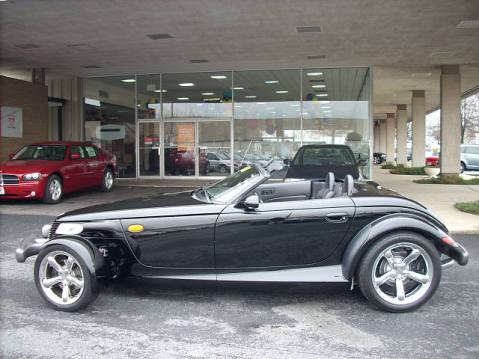
This Limited Edition 1999 Plymouth Prowler convertible was a vehicle from the dealership owners’ private collection. Photo by blog author.
By the late 1990s, only four vehicles were sold under the Plymouth name: the Voyager/Grand Voyager minivans, the Breeze mid-size sedan, the Neon compact car, and the Prowler sports car, which was to be the last model unique to Plymouth. The Prowler came about as part of Chrysler’s efforts (the last as it turned out) to differentiate Plymouth from the rest of its lineup in hopes of keeping the brand alive. It was hoped that it would be received well enough to garner some attention, some of which might spill over into some of their other models.
Plymouth rarely exceeded 200,000 cars per year after 1990. Consequently, DaimlerChrysler decided to drop the make after a limited run of 2001 models. This was announced on November 3, 1999.
Then & Now: Tenallytown & Rockville Pike Trolley Line
The latest installment in my Then & Now series takes us to south of Montrose Road where the Tenallytown and Rockville Pike trolley line intersects with Rockville Pike. The black & white photo was taken by Lewis Reed in 1910. The corresponding color photo is a Google Maps image, more than 100 years later. Matching the photos was a bit difficult as the location has changed so much, but you get the idea.
The Tennallytown and Rockville Railroad, which opened in 1890, was an extension of the Georgetown & Tenallytown Railway. The street car line was extended to Rockville in 1900 terminating at the fairgrounds. During the fair each fall, traffic was so heavy that two-car trains were run to accommodate the crowds. Later a further extension was made through Rockville on Montgomery Avenue to the Chestnut Lodge Sanitarium on the far side of town. In 1935, the Rockville trolley line ceased operation, leaving gasoline-powered buses as the only mode of public transportation serving this corridor until the Metrorail Red Line opened in 1984.
THEN: Tenallytown and Rockville Pike Trolley Line, 1910
In this photograph dated 1910, a trolley heads south from Rockville toward Tenallytown through open farmland. The view appears to be looking north and shows the area south of where Montrose Road intersects with Rockville Pike. The Pike is the white strip running diagonally behind the trolley car. The elevated vantage point, possibly from an adjacent rooftop or the roof of a barn, affords an excellent view of the rural countryside.

A trolley heads south from Rockville toward Tenallytown through open farmland. This view appears to be looking north and shows the area south of where Montrose Road intersects with Rockville Pike. The Pike is the white strip running diagonally behind the trolley car. Photo by Lewis Reed, 1910
NOW: The Bethesda Trolley Trail
Today, the six-mile Bethesda Trolley Trail connects Bethesda and Rockville for bicyclists, runners and pedestrians, following the route of the Tenallytown and Rockville Railroad, the former trolley line.

Woodglen Drive follows the old Bethesda Trolley Trail route today. The junction now is far from the tranquil road it once was. Google Maps image.
If there’s an historic wayside marker on the side of the road in Montgomery County, chances are, one of Lewis Reed’s images is on it. From Trolley to Trail Marker in Bethesda is one of many markers in Montgomery County that feature images from Lewis Reed’s collection of photographs.
From Trolley to Trail Marker in Bethesda
Location: Marker is in Bethesda, Maryland and can be reached from Norfolk Avenue near Rugby Avenue.
Duplicate: Another nearly identical marker is located at the exit ramp from westbound Montrose Parkway to northbound Rockville Pike (MD 355).
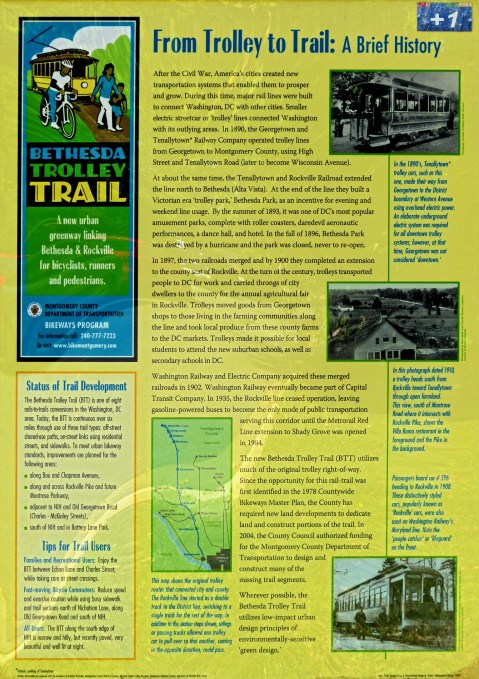
From Trolley to Trail Marker in Bethesda
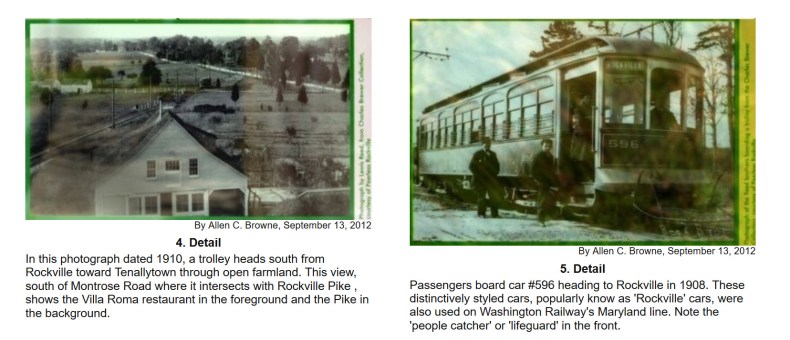
From Trolley to Trail Wayside Marker in Bethesda. Close up of photos on marker taken by Lewis Reed.
Happy National Ferris Wheel Day!

Ferris Wheel at Rockville Fair, circa 1920s. Photo by Lewis Reed
Did you know that February 14th is not only Valentine’s Day, but also National Ferris Wheel Day? This unofficial national holiday is held on this day to honor the birth of the inventor of the Ferris Wheel, George Washington Gale Ferris, Jr. What better way to celebrate Ferris Wheel Day than enjoying this old photograph of the Ferris Wheel taken at the Rockville Fairgrounds, courtesy of Lewis Reed. The fairgrounds were just outside Rockville, about where Richard Montgomery High School is today. The Fair lasted four days, from August 21st to the 24th, and drew visitors from local counties, Washington, and Baltimore.
For the singles and the “enough already with the Valentines”, here is your perfect alternative excuse. Go wish all your friends and family a Happy Ferris Wheel Day!
Dear Santa, Please Pause Here
This special post doesn’t have anything to do with Reed Brothers Dodge history, but it does have a lot to do with the founder’s daughter, Mary Jane (Reed) Gartner. In her younger years, Lewis Reed’s daughter (my mother) was a very talented ceramic and china painter. She painted the ceramic tray of Santa (below) for me Christmas of 2000 and entered it in the Montgomery County Agricultural Fair. Seventy-eight years old at the time, she won First Premium Prize. The tray is currently displayed in my dining room china cabinet and evokes memories of my childhood and makes me happy every time I look at it. I hope you enjoy this special post.

“Dear Santa, Please Pause Here” 2000 oil painting on ceramic tile by Mary Jane (Reed) Gartner.
Some background about the image
Have you ever heard of an artist named Haddon Sundblom? No? Well you’ve seen his work. You could say he’s one of the most famous character designers ever. He created the iconic Santa we all know and love. The image, “Santa, Please Pause Here” was originally created by Haddon Sundblom who was commissioned by Coca-Cola company to develop advertising images using Santa Claus. He may have been paid as much as $1,000 per painting—a lot of money at that time (you could buy a car for $700). Based on Clement Clark Moore’s descriptions of St. Nick in “’Twas the Night Before Christmas,” Sundblom’s Santa Claus emphasized the rosy cheeks and snow white beard along with the now familiar suit and hat. A wide leather belt and brown boots completed the look.
From 1931 to 1964, Sundblom’s creations for Coca-Cola had Santa pictured as doing everything from delivering toys (and playing with them!), pausing to read letters, visiting with children who had waited up to meet him on Christmas Eve, raiding the refrigerators of several homes, warming his feet by the fire, and other activities — always with a bottle of Coke in hand or nearby. The Sundblom Santa became so popular that the images spread from print ads onto billboards, posters, calendars, plush dolls, and more.
Below, is the original Coca-Cola Santa Claus painting and sketches by Haddon Sundblom.


In 2001, Haddon Sundblom’s Santa Claus was creatively brought to life in a Coca-Cola ad video tribute, animated by the Academy Award-winning animator Alexandre Petrov.
So the next time you envision Santa Claus and maybe even have a simultaneous unexplained craving for a Coca-Cola, please give a wink and nod to the artist Haddon Sundblom. He was instrumental in defining the image of Santa Claus for us all.
Wishing the very best of the holiday season to everyone, and of course, Merry Christmas!
Reference: Coca-Cola.com
Trees of Christmas Past
With only a few days left until Christmas, I thought it might be fun to take a look at a couple of photos from Lewis Reed’s collection that show us what Christmas trees used to look like a century ago. In those days, there was not wide-spread agreement on exactly what a tree should look like, which made for a lot of creativity. Not surprisingly, they were very different than the perfectly shaped tress we have on display today.
The trees were big back then and always fresh. They went right to the ceiling and were very wide. Early Christmas trees were generally fastened onto a flat board surrounded with fence-rails, snow villages and carpeted with cotton blankets of snow. The tree in the photo below has an abundance of tinsel, which grew in popularity to the point that, by the 1920s, it was common to nearly cover the tree in the decorative material.
And what is tinsel exactly? Tinsel was designed to mimic the way ice looks, and the earliest tinsel was made from strips of real silver. It was only later that it became a Christmas tree decoration, employed to enhance the flickering of the candle flames. In the 1950s, tinsel became so popular that it was often used as a substitute for Christmas lights.
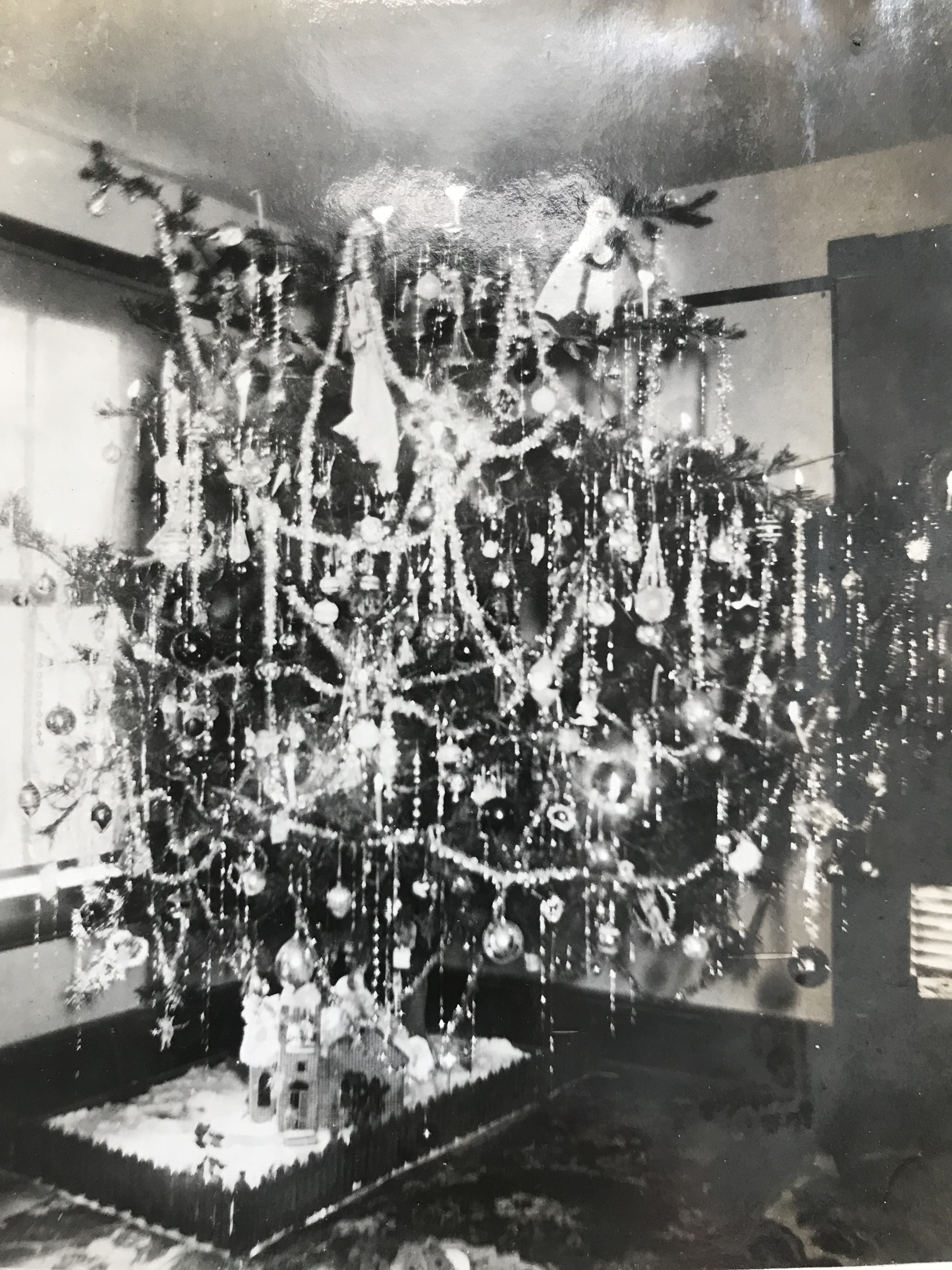
A small snow scene with what appears to be a miniature church is arranged at the foot of the Christmas tree. A popcorn garland adorns the tree. Photo by Lewis Reed
So, where did Washingtonians get their trees?
From The Evening Star, Washington, DC 23 December 1923:
Conduit Road on the long stretch between Glen Echo and Great Falls for many years has been a favorite hunting ground where hundreds and hundreds of families have customarily obtained scrub pine trees for Christmas week. Usually there is plenty of holly and some mistletoe to be found in the rugged and rolling hill lands which are the gateway to Great Falls.

No room for a star on the top of this tree! And just look at those big Santa and Angel dolls. Other fun little details are notable, including a miniature church with picket fence is arranged at the base of the tree. Photo by Lewis Reed
There’s a fine art to decorating Christmas trees that’s been developing since over 100 years ago. People consider lights, garland, ornaments, skirt, and more. But one thing that’s hard to resist sometimes is just filling every available space with decorations. Clearly, that was the case years ago too. What I like about these trees is that they are so randomly shaped and even misshapen. Folks back then didn’t trim them down to a more aesthetically pleasing symmetry like we do today.
Today, most Christmas trees are artificial and very symmetrical. Stringing lights and hanging ornaments are used mostly for decorating, since large bare spots are a thing of the past. Branches are clicked into place and limbs can be fanned out to accommodate whatever decorations you choose to add. Tinsel is long gone and lights now come in all types of sizes and styles. Tree lights can be set to not blink or programmed to flash in whatever sequence fits your mood. You have the control of exactly how you want your tree to look. It is a far cry from the trees of Christmas past.
Books

Related Resources


Copyright Notice

Reed Brothers Dodge History (1915-2012) by Jeanne Gartner is licensed under a Creative Commons Attribution-NonCommercial 3.0 Unported License.


Recent Comments