
Dear Santa, Please Pause Here
This special post doesn’t have anything to do with Reed Brothers Dodge history, but it does have a lot to do with the founder’s daughter, Mary Jane (Reed) Gartner. In her younger years, Lewis Reed’s daughter (my mother) was a very talented ceramic and china painter. She painted the ceramic tray of Santa (below) for me Christmas of 2000 and entered it in the Montgomery County Agricultural Fair. Seventy-eight years old at the time, she won First Premium Prize. The tray is currently displayed in my dining room china cabinet and evokes memories of my childhood and makes me happy every time I look at it. I hope you enjoy this special post.

“Dear Santa, Please Pause Here” 2000 oil painting on ceramic tile by Mary Jane (Reed) Gartner.
Some background about the image
Have you ever heard of an artist named Haddon Sundblom? No? Well you’ve seen his work. You could say he’s one of the most famous character designers ever. He created the iconic Santa we all know and love. The image, “Santa, Please Pause Here” was originally created by Haddon Sundblom who was commissioned by Coca-Cola company to develop advertising images using Santa Claus. He may have been paid as much as $1,000 per painting—a lot of money at that time (you could buy a car for $700). Based on Clement Clark Moore’s descriptions of St. Nick in “’Twas the Night Before Christmas,” Sundblom’s Santa Claus emphasized the rosy cheeks and snow white beard along with the now familiar suit and hat. A wide leather belt and brown boots completed the look.
From 1931 to 1964, Sundblom’s creations for Coca-Cola had Santa pictured as doing everything from delivering toys (and playing with them!), pausing to read letters, visiting with children who had waited up to meet him on Christmas Eve, raiding the refrigerators of several homes, warming his feet by the fire, and other activities — always with a bottle of Coke in hand or nearby. The Sundblom Santa became so popular that the images spread from print ads onto billboards, posters, calendars, plush dolls, and more.
Below, is the original Coca-Cola Santa Claus painting and sketches by Haddon Sundblom.


In 2001, Haddon Sundblom’s Santa Claus was creatively brought to life in a Coca-Cola ad video tribute, animated by the Academy Award-winning animator Alexandre Petrov.
So the next time you envision Santa Claus and maybe even have a simultaneous unexplained craving for a Coca-Cola, please give a wink and nod to the artist Haddon Sundblom. He was instrumental in defining the image of Santa Claus for us all.
Wishing the very best of the holiday season to everyone, and of course, Merry Christmas!
Reference: Coca-Cola.com
Then & Now: Barnesville (Sellman’s Depot”) Train Station, 1912
BARNESVILLE (“Sellman’s Depot”) B&O TRAIN STATION (THEN): Barnesville Station, constructed circa 1873, this frame building apparently housed the post office as well. The station house in 1874 was referred to as “Sellman’s Depot”, and was named for William 0. Sellman, owner of the lands on which the station was built. Development began around 1873 when the railroad came through and the town was gradually abandoned with the advent of interstate highways and automobiles. The station was demolished in the 1950’s.
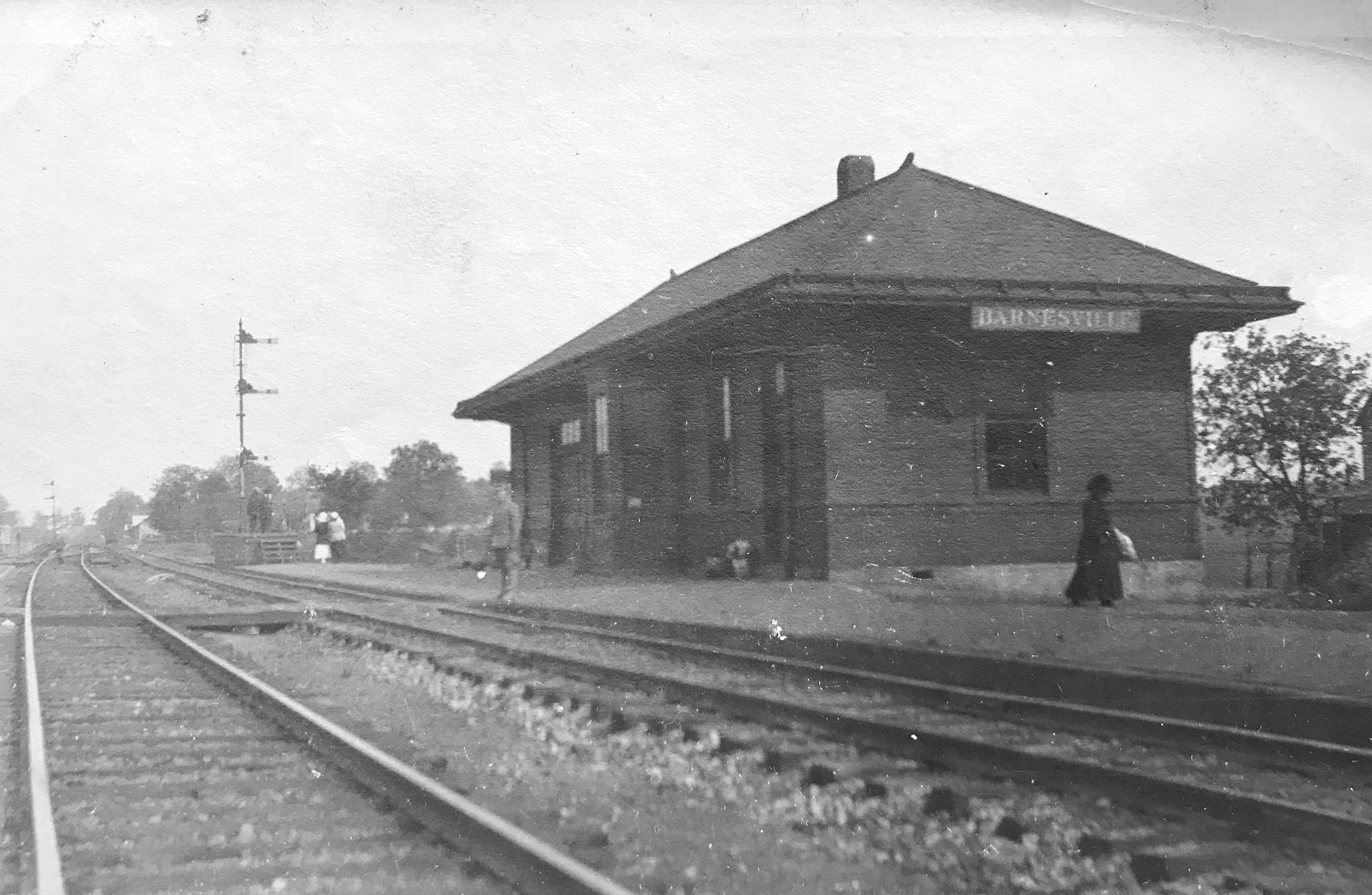
Barnesville (Sellman’s Depot”) Train Station. Photo by Lewis Reed, 1912.
BARNESVILLE MARC STATION (NOW): Built about 1930 as the first metering station for the Washington area gas supply, this building was saved from imminent destruction by concerned citizens dedicated to both the preservation of the visible past and revitalization of the railroad. On February 16, 1977 the historic metering station owned by the Washington Gas Light Company traveled 23 miles by road from Rockville to begin a new existence as the Barnesville railroad station. The squarish little structure had a makeover after the move. It was painted inside and out and and a wide overhanging roof was added just below the original roof line, giving the building more an authentic “train station” look, and it was re-dedicated on October 10, 1977. Snuggled up against the woods, surrounded by trees and shrubbery in a rural area just south of Barnesville on Route 109 (Beallsville Road), the station today is a pretty sight.

The metering station installed at Sellman station by the tracks which today serves as the Barnesville (MARC) Station. It was moved here from Rockville in 1977 for preservation. Image from Wikimedia Commons.
Source: The Montgomery County Story Newsletter, Vol. 37, No.1, February 1994. “Train Stations and Suburban Development Along the Old Baltimore and Ohio Railroad” by Jo Beck
Third Annual Goodyear Dealers Zeppelin Race July-August 1931
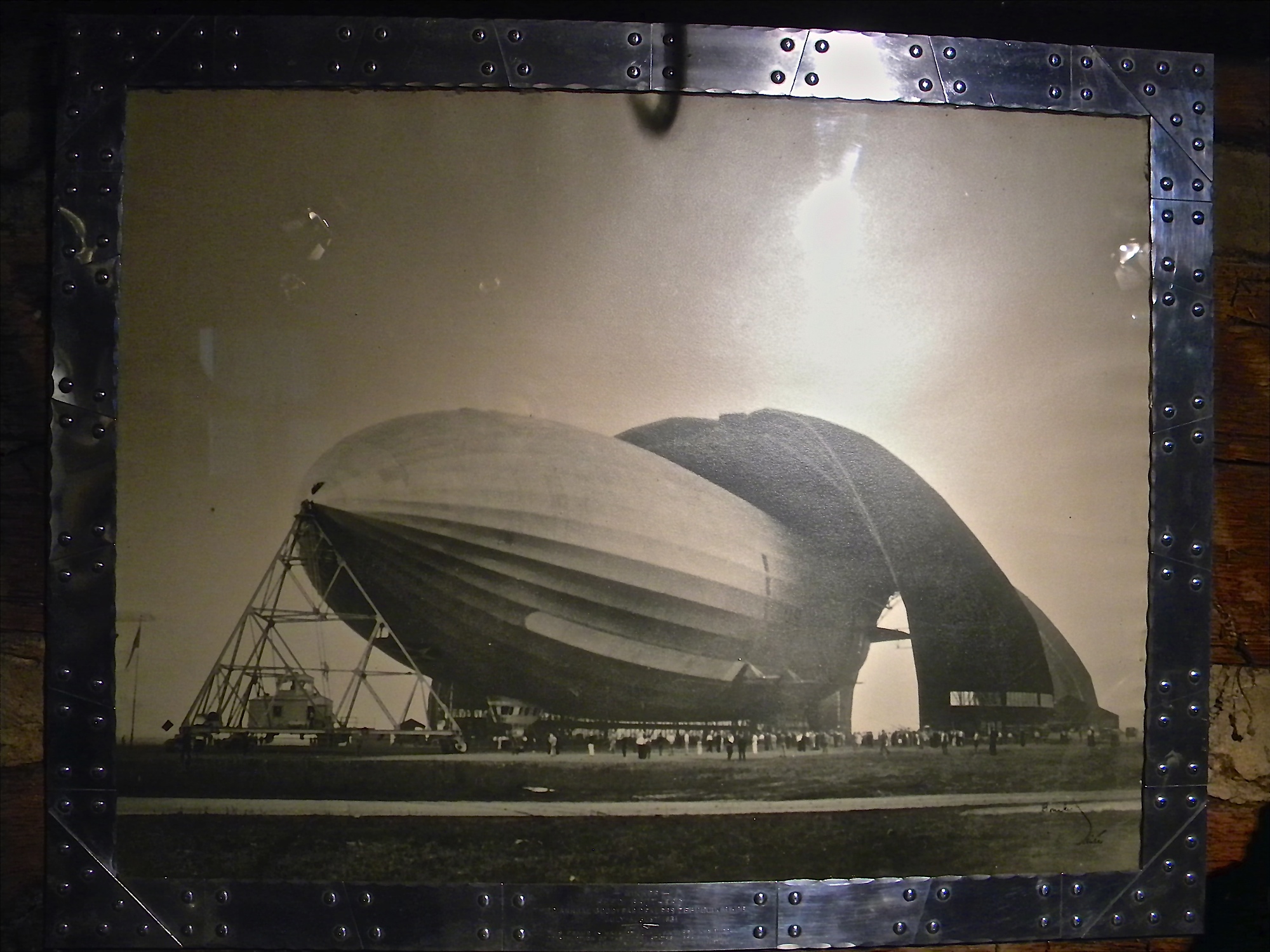
MARGARET BOURKE-WHITE, 1931 REED BROTHERS THIRD ANNUAL GOODYEAR DEALERS ZEPPELIN RACE WINNER
In 1931, the Goodyear Zeppelin Company produced a series of framed prints as rewards for Goodyear dealers as prizes for high sales. Sales was based on a two months quota, and participated in by thousands of dealers all over the country. The print shows the maiden launch of the USS Akron leaving the Goodyear Zeppelin air dock at Akron, Ohio. The engraved plaque at the bottom center of the frame reads, “Winner – Reed Brothers, Third Annual Goodyear Dealers Zeppelin Race. July – August 1931.” This frame is made of duralumin used in the girder construction of the United States Airship “AKRON” built by the Goodyear Zeppelin Corporation”. The print is signed in the lower right-hand corner by the famed 20th century photographer, Margaret Bourke-White. During the early years of the Depression, Goodyear was one of Bourke-White’s most important clients. She made this image of the airship Akron when it was removed from its hangar for the first time.
Built in 1929, the almost unbelievably huge Goodyear air dock in Akron, Ohio, was created as a space where blimps, airships, and dirigibles could be constructed. Evidently building such a massive space created problems, such as indoor rain, and putting the whole thing on rollers so that it could expand and contract with the seasons.
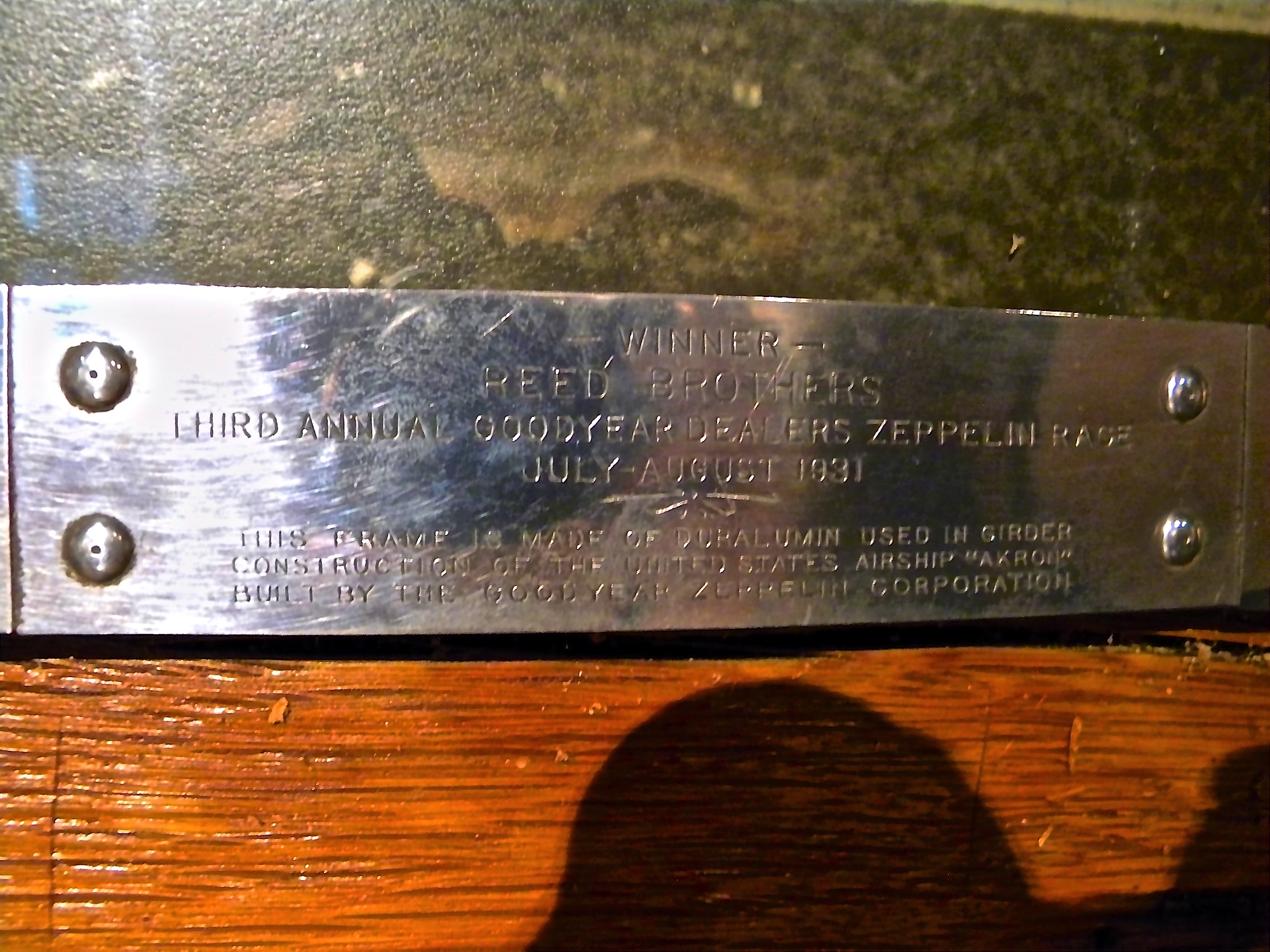
Inscription Plaque

Photo is signed in the lower right corner by famed 20th century photographer, Margaret Bourke White
The USS Akron, first of a class of two 6,500,000 cubic foot rigid airships, was built at Akron, Ohio. Commissioned in late October 1931, she spent virtually all of her short career on technical and operational development tasks, exploring the potential of the rigid airship as an Naval weapons system. During the remainder of 1931 and the early part of 1932, the Akron made flights around the eastern United States and over the western Atlantic, including one trial of her capabilities as a scouting unit of the fleet. While beginning a trip to the New England area, Akron encountered a violent storm over the New Jersey coast and, shortly after midnight on 4 April 1933, crashed tail-first into the sea. Only three of the seventy-six men on board survived this tragic accident. During the search for other possible survivors, the Navy non-rigid airship J-3 also crashed, killing two more men.
Note: Margaret Bourke-White (1904 1971) is best known as the first foreign correspondent to be permitted to take photographs of Soviet industry, the first female war correspondent, and the first female correspondent permitted to work in war zones.
40th Anniversary with Goodyear
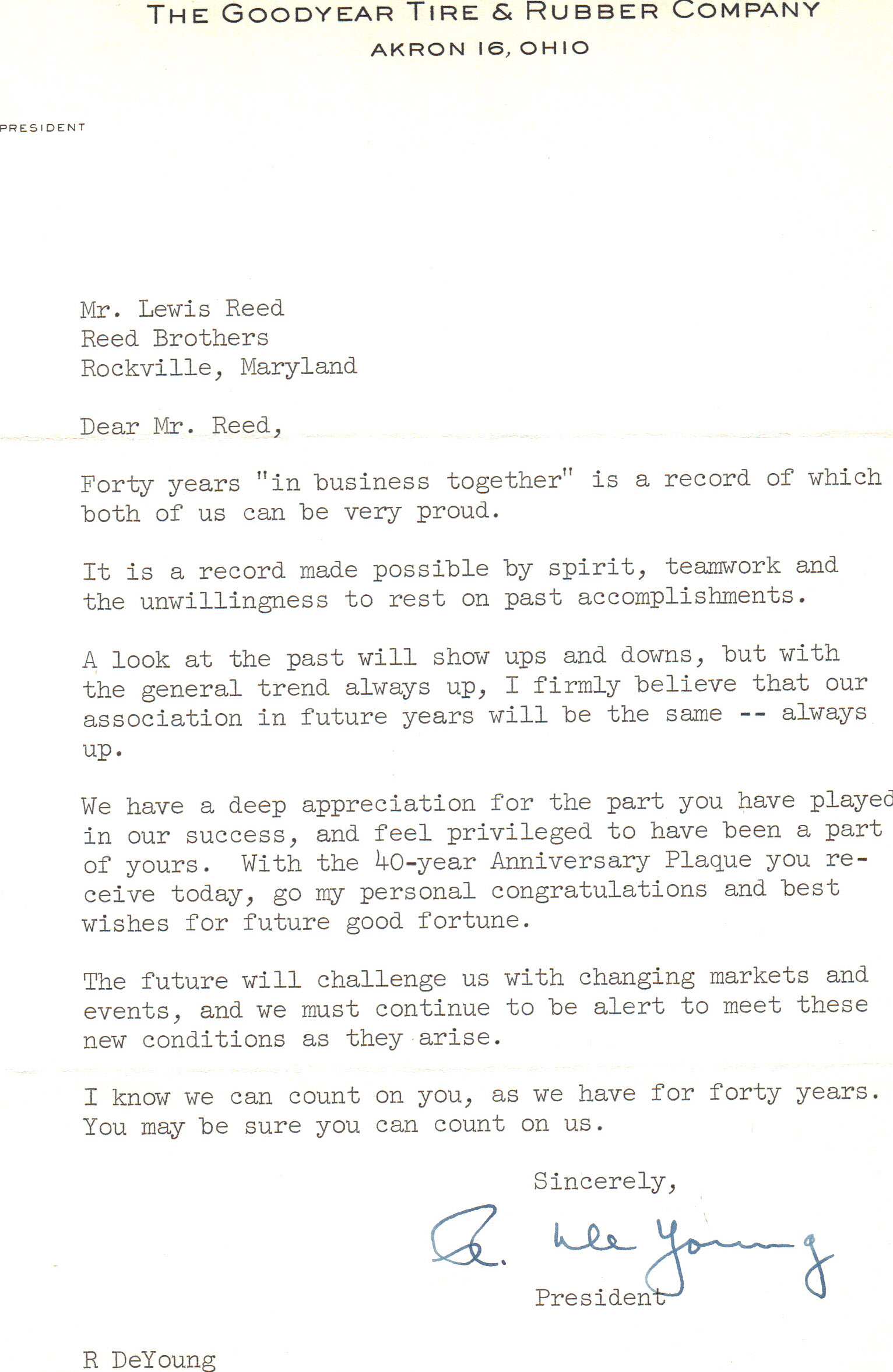
Lewis Reed was recognized by Goodyear Tire & Rubber Co. for reaching his 40th year as a Goodyear dealer. Reed Brothers Dodge began selling Goodyear tires in the 1920s. Below is a letter from Russell DeYoung thanking Lewis Reed for his 40 years “in business together”.
Then & Now: Clarksburg Main Street, 1913
This post is a continuation of a series of “Then & Now” images from Lewis Reed’s Photo Collection alongside photographs of how they appear today. Lewis Reed worked hard to preserve a visual history of Montgomery County, Maryland and surrounding area long before automobiles were even around. As early as 1910, he toured on his motorcycle across the state of Maryland and took photographs of many historic locations. Taken approximately 109 years apart, these photos takes us back in time to Clarksburg, Maryland at the intersection of the main road between Georgetown and Frederick and an old Seneca trail. The corresponding color photo is a google maps screenshot from the same location more than a century later.
CLARKSBURG MAIN STREET (THEN): In the early 20th century, Clarksburg was the third largest town in Montgomery County, after Rockville and Poolesville. Clarksburg had four general stores, two hotels, and an academy of learning. It also had a blacksmith, a doctor’s office, tanneries, shoemakers, winemakers, tailors, wheelwrights, fertilizer businesses, skilled farmers, master carpenters, and two town bands.
The black and white image was taken by Lewis Reed in 1913, where Clarksburg Road (to Boyds) met Frederick Road (Rt 355). Frederick Road has also been known as The Georgetown Road and the Great Road. The town of Clarksburg was laid out along Frederick Road. The road was used as the stagecoach line from Frederick to Georgetown and it remains as the present main street through Clarksburg. Turning wagon ruts/tire tracks are visible in the lower left corner. The first house on the right was the Horace Willson House (still standing). Left of the Willson house was Willson’s Store, built on the site of the town’s first trading post, established by town founder John Clark (still standing). Established April 1, 1800, this was the location of the first post office in Clarksburg, the second oldest in Montgomery County. In 1842, the old trading post building was replaced with a two-story general store. The dwelling beyond the pole served as a church parsonage (still standing) and just beyond stands the Clarksburg United Methodist Church. The church was used for church dinners, 4-H meetings, and community gatherings. The vehicle appears to be a very early Ford Model T.

Clarksburg Main Street (Frederick Road Rt 355). Photo by Lewis Reed, 1913.
CLARKSBURG MAIN STREET (NOW): Over 109 years have passed and three buildings in Lewis Reed’s photo still remain. The structure on the right in the current day photo below was the Lewis General Store and the yellow vacant house a little further down the road was the church parsonage. The recently renovated Lewis General Store received an award for best restoration of a historic commercial property from the county. The charming building boasts a tin ceiling, original counters; original beams from 1750 are exposed in some areas, wood floors, and many historic details throughout. The steps to the ME Church South are still visible today on Rt 335 near where it intersects with Spire Street (about where the car is in the image). The congregation claims to be the “oldest continuous Methodist congregation in Montgomery County”. Today, Clarksburg remains a small rural town, retaining many of its 19th century structures. It is among Montgomery County’s earliest, most intact historic towns.
Due to the Clarksburg Square Road extension that now connects to Frederick Road, the Horace Willson House was relocated approximately 70 feet to the south to preserve it. The building is currently a wine and beer shop.
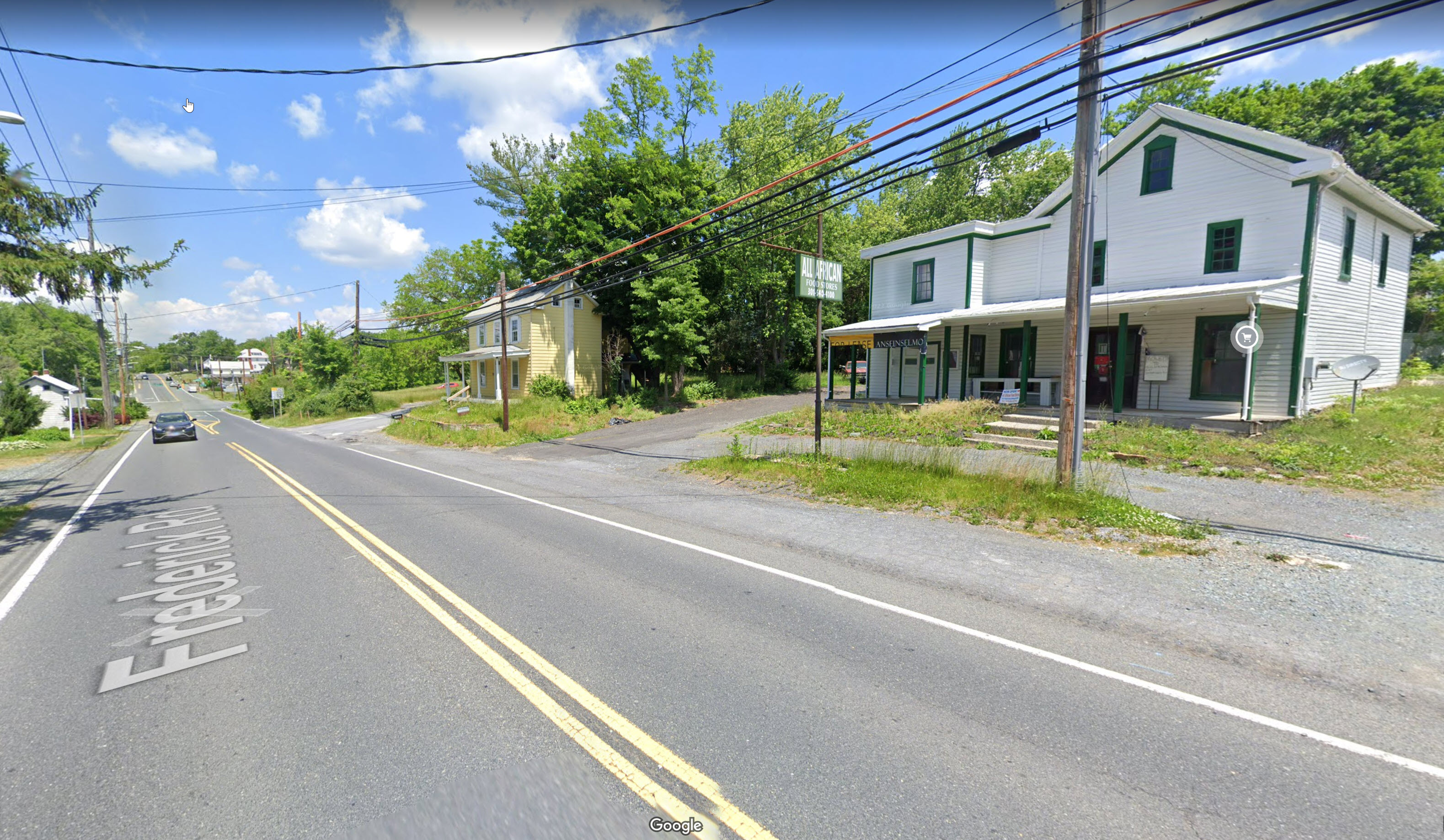
This current day image is a google maps screenshot from the corner of Redgrave Place and Rt 355.
Sources of Information:
Joan Edwards Ruff, Resident of Clarksburg for 45 years and granddaughter of Lillian and Elwood Barr
“The History of Clarksburg, King’s Valley, Purdum, Browningsville and Lewisdale Maryland” by Dona L. Cuttler
MHT Inventory Form13-10 Clarksburg Historic District
The First Plymouth Automobile Debuted on This Date 94 Years Ago
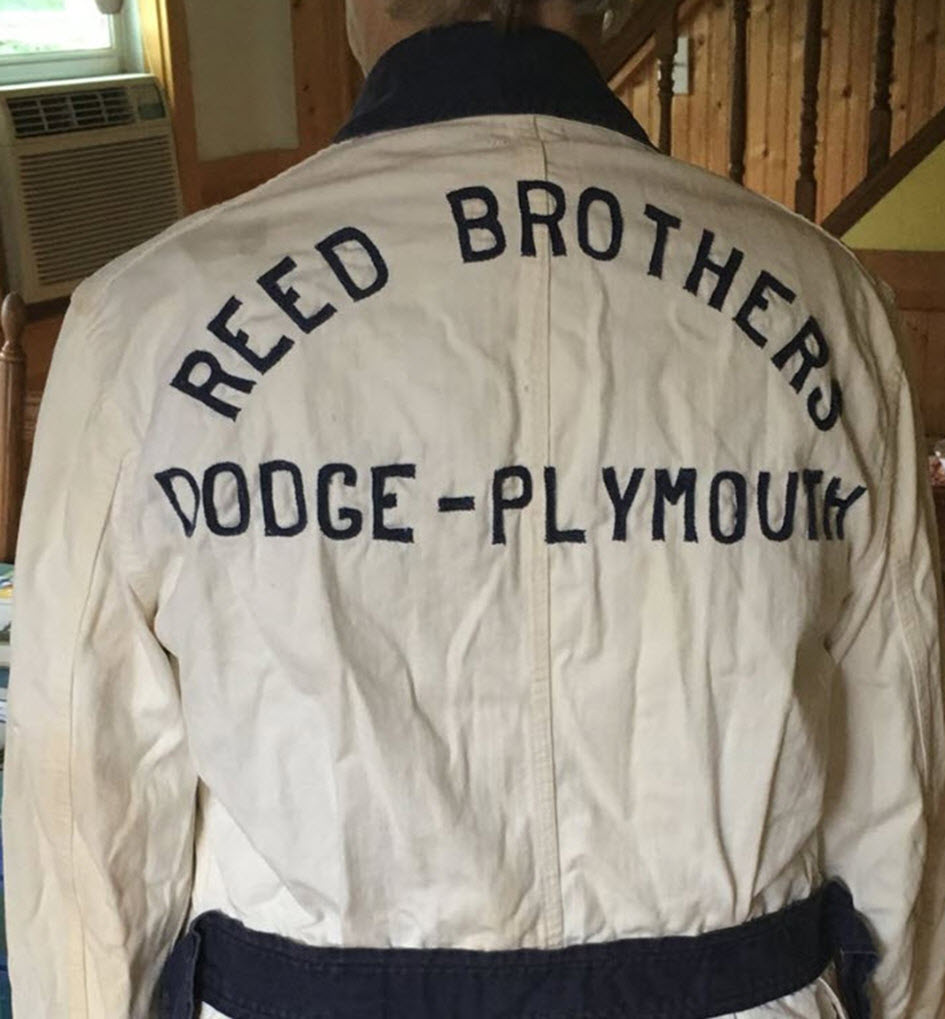
Plymouths were sold at Reed Brothers from 1930-1969. Pictured is an original 1940s Reed Brothers Dodge-Plymouth three-pocket shop coat made by Anderson Bros. of Danville, VA.
The first Plymouth automobile was introduced on July 7, 1928. Plymouth was Chrysler Corporation’s first entry in the low-priced field, which at the time was already dominated by Chevrolet and Ford. Plymouths were actually priced slightly higher than their competition, but offered all standard features such as internal expanding hydraulic brakes that the competition did not provide. While the original purpose of the Plymouth was to serve a lower-end marketing niche, during the Great Depression of the 1930s, the marque helped significantly in ensuring the survival of the Chrysler Corporation in a decade when many other car companies failed. Beginning in 1930, Plymouths were sold by all three Chrysler divisions (Chrysler, DeSoto, and Dodge).
Plymouth sales were a bright spot during this dismal automotive period, and by 1931 Plymouth rose to the number three spot among all cars. Plymouth almost surpassed Ford in 1940 and 1941 as the second most popular make of automobiles in the U.S.
In 1957, Virgil Exner’s new Forward Look design theme, produced cars with much more advanced styling than Chevrolet or Ford. 1957 total production soared to 726,009, about 200,000 more than 1956, and the largest output yet for Plymouth. However, the 1957–1958 Forward Look models suffered from poor materials, spotty build quality and inadequate corrosion protection; they were rust-prone and greatly damaged Chrysler’s reputation.
Most Plymouth models offered from the late 1970s onward, such as the Volaré, Acclaim, Laser, Neon, and Breeze, were badge-engineered versions of Chrysler, Dodge, or Mitsubishi models. By the 1990s, Plymouth had lost much of its identity, as its models continued to overlap in features and prices with Dodges. Plymouth’s product offerings and buyer appeal, and sales continued to fall.
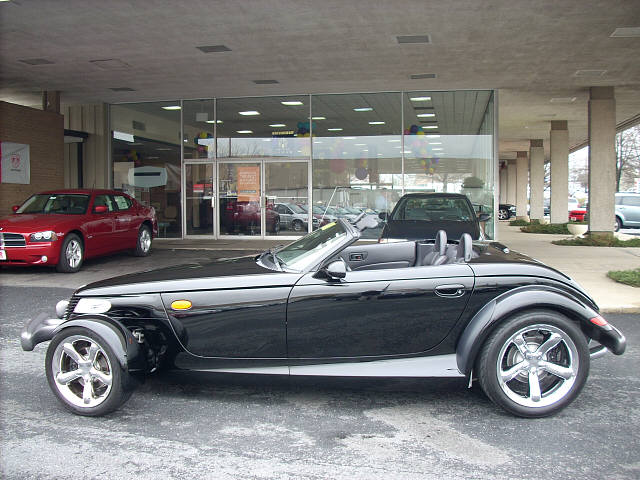
This Limited Edition 1999 Plymouth Prowler convertible was a vehicle from the dealership owners’ private collection. Photo by blog author.
By the late 1990s, only four vehicles were sold under the Plymouth name: the Voyager/Grand Voyager minivans, the Breeze mid-size sedan, the Neon compact car, and the Prowler sports car, which was to be the last model unique to Plymouth. The Prowler came about as part of Chrysler’s efforts (the last as it turned out) to differentiate Plymouth from the rest of its lineup in hopes of keeping the brand alive. It was hoped that it would be received well enough to garner some attention, some of which might spill over into some of their other models.
Plymouth rarely exceeded 200,000 cars per year after 1990. Consequently, DaimlerChrysler decided to drop the make after a limited run of 2001 models. This was announced on November 3, 1999.
Books

Related Resources


Copyright Notice

Reed Brothers Dodge History (1915-2012) by Jeanne Gartner is licensed under a Creative Commons Attribution-NonCommercial 3.0 Unported License.


Recent Comments