
Reed Brothers Beginnings at the “Triangle”
Woodrow Wilson was President of the United States; the Green Bay Packers did not yet exist; the United States was two years away from joining World War I; the cost of a stamp was two cents, and Reed Brothers Dodge in Rockville, Maryland was founded. It is a family business history that parallels the evolution of the American automobile industry itself.
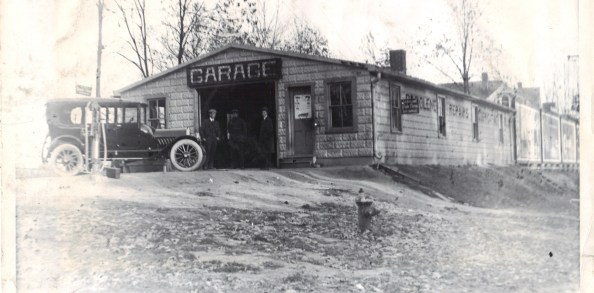
1915 Rockville Garage located at the intersection of Veirs Mill Road and Rockville Pike. The sign on the right side of the Garage reads Gasoline, Fisk Tires and Supplies. Note the single gas pump in front. Rockville Garage had the first Gulf gas station in the still-rural Washington D.C. area.
One hundred years ago, the direction of the auto industry was uncharted territory to be explored by many people. Lewis Reed was an enterprising young man who put his future in the fledgling automobile industry. Although the specific motivation for Lewis Reed to go into the automobile business is not clear, the 1910s was a period of exponential growth in the American automobile industry, and with a location on the major east-west route through Rockville, a town that was on its way to becoming a satellite community of Washington, D.C., he was well positioned for success.
The 1910 census indicates that 23-year old Lewis Reed was working as a machinist. In 1915, Lewis Reed and brothers Robert L. and Griffith Warfield established Rockville Garage after acquiring the building from Lee Ricketts and Sons who had the Overland Agency. In 1918, Lewis Reed bought out Rockville Garage from the Warfield’s and changed the name to Reed Brothers Dodge. Soon after opening the doors to his dealership, Lewis Reed started to expand. In 1917, a two-story addition was added. The first floor housed the Service Department and upper floor was used for parts storage. At the left side of the two story building was a narrow vehicle entrance that led to the service department in the rear. A house can be seen behind the addition. Lewis Reed later purchased the remaining five residential lots to expand his dealership in the back.
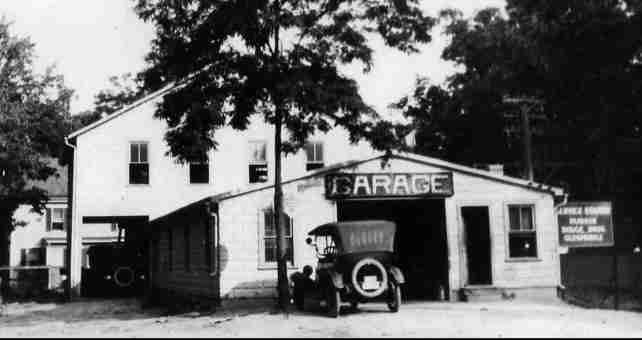
1917 Rockville Garage with two-story addition. Photo by Lewis Reed
In addition to Dodge Brothers Motor Cars, Rockville Garage carried Hudson and Oldsmobile. To survive the early days in the automobile business, most dealerships sold several makes of cars. Cross-selling was an acceptable business practice until the late 1940s when brand loyalty took hold. Also by then, the vast number of automobile manufacturers had been pared down. Reed Brothers got a new remodel in 1921, and an island with three new modern gas pumps were added. By this time, gasoline retailers had determined that placing gas pumps on an “island” in front of the station, where drivers could approach from either side, provided the most efficient station layout.
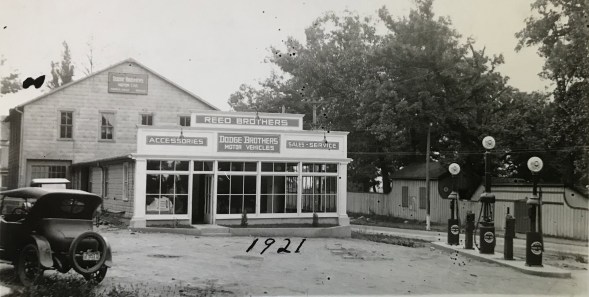
Reed Brothers Dodge got a new remodel in 1921. The original part of the garage was converted into a new car showroom and the service operation was moved out into the rear portion of the building. Note the modern gas pumps. Photo by Lewis Reed.
In the late 1920s, a second story was added to the showroom with a glazed front looking out onto Rockville Pike on the right. A modern drive-through canopy was added along with new gasoline pumps and Dodge Brothers Motor Car and Graham Brothers Truck signage. “That Good Gulf” was one of the the Gulf Refining Company’s marketing slogans for a number of years during the twenties and thirties. Another interesting detail is the placement of floodlights on the canopy roof pointing at the signs.

That Good Gulf Gasoline drive-through filling station with canopy and gasoline pumps were added in the late 1920s. Photo by Lewis Reed
The new car showroom below is filled with late 1920s Dodge Brothers new car models. The high ceilings and mezzanine floor gives an air of elegance to the showroom and the expanse of windows on the front extends the full width of the building. Locating a showroom “in relation to traffic” was of the utmost importance. The showroom faced the triangle at Veirs Mill Road and Rockville Pike which gave the dealership maximum visibility to the largest volume of cross traffic. Behind the large plate glass windows and an awning above was the product — the new car. It appears the showroom could accommodate 4-5 new automobiles. An upper floor mezzanine housed the dealership’s Parts Department and storage area. This level was accessed by a wide, open staircase. All of the elaborate design features inside, such as the high ceiling, wood railings, and mezzanine were usually reserved for upscale dealerships. To find this level of construction expense in a dealership selling mid-priced cars was extremely rare.
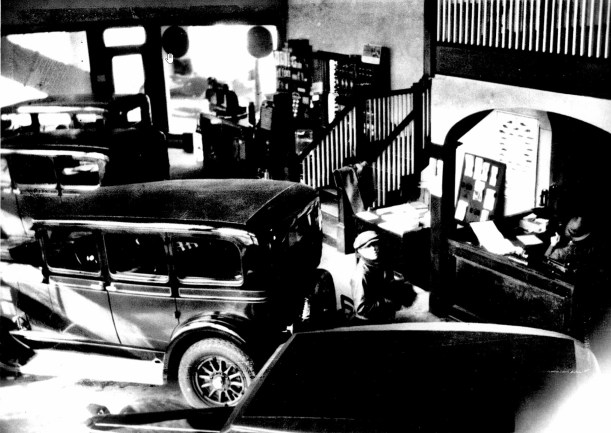
Late 1920s New Car Showroom. Photo by Lewis Reed
In 1930, Reed Brothers added the Plymouth line. Even though times were tough during the Great Depression, Reed Brothers was doing well enough to finance another facelift and renovation; the front of the Gulf Gasoline Station and the canopy was remodeled as shown below during the mid-thirties.
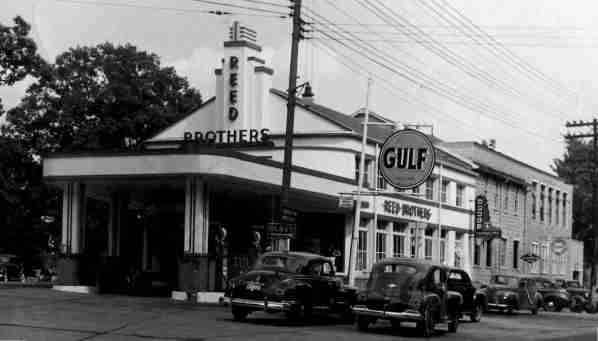
The forth update to the showroom and Gulf Gas Station during the mid-thirties. Plymouth signage can now be seen on the side of the building along with Dodge. Photo by Lewis Reed
After years of hard work that also helped to establish an excellent reputation, once again Reed Brothers Dodge needed to expand. At about the same time as the gas station was remodeled, Lewis Reed split up the sales and parts and service operations by constructing a complete new building; it was located at the intersection of at East Montgomery Avenue and Dodge Street. The showroom was ideally located at the intersection of two streets, with a large curving window placed within the field of vision of approaching traffic and designed in such as way as to increase drivers’ viewing time. The corner showroom window simulated a “corner statement.”
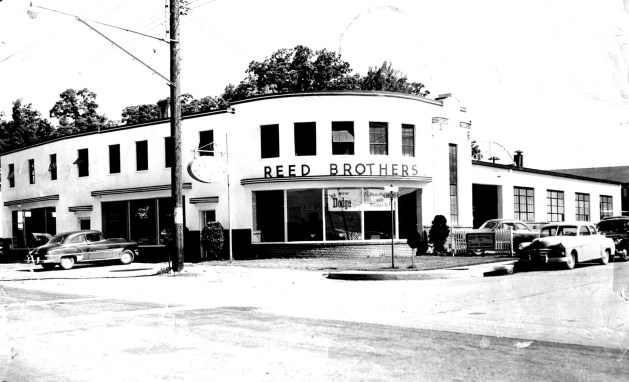
In 1936 Reed Brothers constructs a complete new building for the Parts and Service Departments. Photo by Lewis Reed.
At this point, eight new cars and trucks were being sold each month, along with a number of used car sales. Many purchases at the time, as had been the custom for years in the automobile business, were still initiated at a prospect’s home or job site; as many of the customers were farmers, the Reed’s had an active team of salesman in place who called on prospects right on their property.
Due to changes in the highway, Reed Brothers began an extensive remodeling and rebuilding program. Two-thirds of the original location at the junction of then Route 240 and Veirs Mill Road was razed and a modern Gulf Service Station was erected. Below is a mid-1960’s photo of the Reed Brothers Dodge Gulf Gasoline station. The famous Gulf “ice box” design dates back to late 1930’s and there were probably more of these built than any single one of the later Gulf designs.

The fifth update after 1953 reconstruction of new Gulf Gas Station. Photo by Lewis Reed.
Two great entrepreneurs, Lewis and Edgar Reed, built and sustained a business that lasted for more than a half-century at one location under one ownership, and earned a place not just in the history of Maryland, but in American automobile history as well. For 55 years at the triangle, Reed Brothers Dodge became a community icon and a local landmark for motorists traveling to and through Rockville.
Original 1928 Incorporators: Gaithersburg-Washington Grove Volunteer Fire Department
Fire protection has been a recognized need in Montgomery County since the early 1800s, although there were not any formal organized volunteer or career fire departments until almost 100 years later.
Organization began to take place in Gaithersburg in the late 1880s as the town grew in response to the coming of the railroad and by September 1892, the town wanted a more formal fire organization. Six citizens were appointed to find a way and the means to organize a volunteer fire department, which they did immediately. A month later, the Volunteer Fire Company of Gaithersburg was responding to fires. There were, of course, no firehouses that housed on-duty firefighters of scheduled shifts for volunteers, and when the alarm rang all volunteers would come running. Eden Selby, who was the town barber around 1900, would drop what he was doing when he heard the church bells ring and run to duty, which would often leave customers with unique hairstyles unless they chose to wait in the chair for him to return. During the 1920s, fires destroyed much of Gaithersburg’s downtown – the Post Office, Etchison’s Store, Brewer’s Real Estate offices and Thomas Hardware, Feed and Fertilizer – and in 1928 the present Gaithersburg-Washington Grove Fire Department was created by charter.
Original incorporators when the fire company was chartered were Lewis Reed, William Barnett, Garry Bell, Herbert Diamond, William Dutrow, Ernest C. Gartner, Merle Jacobs, Frank Severance, Clyde Thomas and Thomas Troxell.

The Frederick Post, Frederick, MD April 2, 1928
I was doing some online research and stumbled upon the Kensington (Maryland) Volunteer Fire Department’s web page. Their history is quite amazing, actually. Especially when I realized that their first truck was purchased from Reed Brothers Dodge. It was not a complete truck when purchased, however.
From the Kensington Volunteer Fire Department’s “History” webpage:
1922 was the birth of the Kensington Volunteer Fire Department. With little money, a Dodge truck was purchased from Reed Brothers Dodge in Rockville. A custom fire body was then built and fitted on the truck by Jacobs Brothers in Gaithersburg who ran the Wheelwright Shop on East Diamond Avenue. To raise money, the volunteers held carnivals. The Fire Department incorporated in 1925, and two years later moved into a permanent home in the basement of the National Guard Armory.
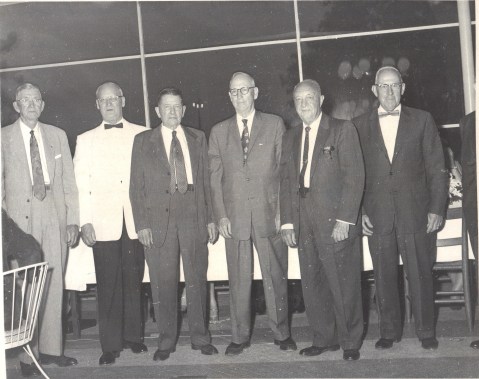
Past Officers of the Gaithersburg-Washington Grove Fire Department. Pictured left to right: name unknown, Ernest C. Gartner, Charles Fox, Clyde Thomas, Dr. Frank Broschart, Lewis Reed
Lewis Reed was a Charter Member and Past President of the Gaithersburg-Washington Grove Volunteer Fire Department. The wall plaque below displays Past Presidents and Past Chiefs. Lewis Reed was President from Feb.1933-Feb 1937. His name plate is 5th down on the left.

Gaithersburg-Washington Grove Volunteer Fire Department Past Presidents and Past Chiefs
In 1967, the first career fire fighters joined the department. Today, the brave volunteers, career fire fighters and emergency medical personnel of the Gaithersburg-Washington Grove Fire Department continue in the courageous footsteps of their noble predecessors as they heroically serve our community.
Source: Fire Protection in Montgomery County: Bucket Brigade to High Tech
The 2019 Montgomery County History Conference

Each year in January, the Montgomery County Historical Society holds a day-long conference on various aspects of local history. Upwards of 200 people attend this annual event, which has been held since 2007. This year, I am very honored for the invitation to speak about the history of Reed Brothers Dodge at the History Conference on Saturday, January 26 at 12:45pm.
 The PowerPoint presentation will follow the dealerships historic timeline which showcases how Reed Brothers Dodge came into being, and how the company overcame the inevitable changes and challenges throughout almost a decade of being in business. More than 100 photographs will be featured, 60 of them rare, historic images taken by the dealership’s founder, Lewis Reed.
This one-day conference is a place for all people to explore and celebrate the many aspects of our past that shape our community to this day. The conference will be held at the Bioscience Education Center located at 20200 Observation Drive on Montgomery College’s Germantown Campus.
Registration is now open: REGISTER HERE
How Reed Brothers Started & Survived Almost a Century
It was 103 years ago, in October 1915, that Lewis Reed signed a franchise agreement with brothers Horace and John Dodge in Detroit. He was just 27 years old. Since then, the business grew and transformed into the oldest Dodge dealership in Maryland history and one of the oldest in the entire nation. In 1914, Lewis Reed became a partner in Rockville Garage, a business he purchased in 1918. His brother Edgar joined the business in 1919 upon his return from World War I, and the name became Reed Brothers Dodge.

This photograph of the original 1915 Rockville Garage shows a 1916 Model 44 Oldsmobile parked in front. The original owners of Rockville Garage are standing in front. From left: Roy Warfield – Lewis Reed – Griffith Warfield.
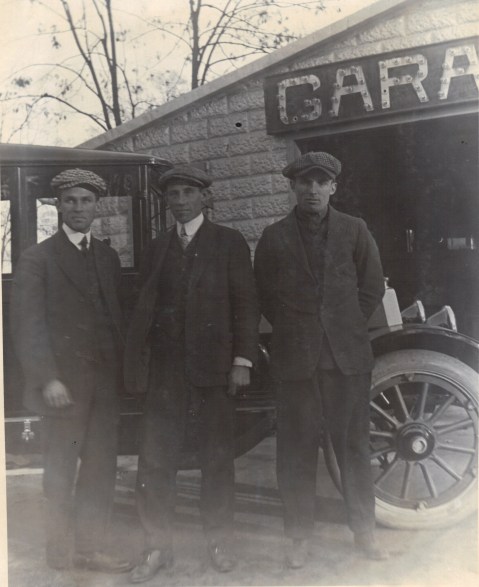
1916 – Original owners of Rockville Garage. From left: Roy Warfield – Lewis Reed – Griffith Warfield.
A mechanical aptitude was necessary to be a dealer in the early 1900’s. When cars were shipped to the dealer from the manufacturer, they arrived partially assembled in railroad boxcars. It was the dealer’s responsibility to unpack and assemble the cars at the rail yard and drive them back to the dealership. Mechanics were often needed to repair the new cars if they broke down along the way. Lewis Reed was an expert auto mechanic. He received his automotive training at the Pierce-Arrow factory in Buffalo, New York, the Dodge Hamtramck and Hudson Motor Car factories in Detroit, Michigan and the Washington Auto College.

1916 – The first shop force of Rockville Garage (from left: Lewis Reed, (first name unknown) Long and Phillip Reed.
The Great Depression
In 1928, when Walter P. Chrysler took over after Horace and John Dodge died, Lewis Reed became an original member of the Chrysler family. By 1929, when the stock market crashed and Great Depression began, no one could afford to buy cars. Like most other businesses, the Great Depression hit hard and Reed Brothers had to rely on its Service Department to make ends meet. But, the dealership survived through these lean times.
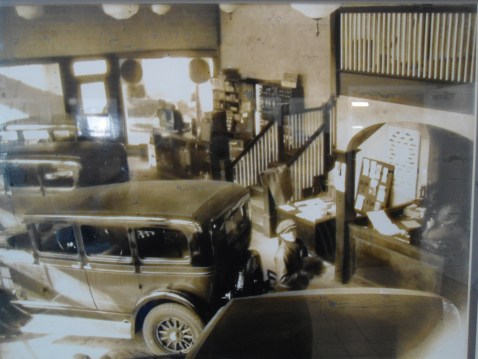
Late 1920s New Car Showroom
This new car showroom above is filled with late 1920s Dodge Brothers new car models. The showroom faced the triangle at Veirs Mill Road and Rockville Pike (now known as Veterans Park) which gave the dealership maximum visibility to the largest volume of cross traffic. Behind the large plate glass windows and an awning above was the product — the new car.
There were no salesman’s desks in the showroom until after World War II. Lewis Reed allotted specific sales territory to his salesmen in four different directions from the dealership. The salesmen spent all day in the outlying areas of Poolesville, Rockville, Barnesville and Spencerville demonstrating cars to potential customers. At that time, Reed Brothers was selling about eight new cars a month and most sales resulted from knocking on people’s doors. It was direct person to person sales contact, relationship building and trust – all built and sealed on a handshake. Three of the four salesmen at the time were Francis O. Day, Raleigh S. Chinn and Benjamin J. Thompson.
United States Enters World War II
Reed Brothers faced another setback during World War II. All U.S. car manufacturers stopped production in order to concentrate on military equipment. Reed Brothers had no new cars to sell for three plus years. Many car dealers went bankrupt at this time. Lewis Reed converted his car showroom into a display room and sold GE washing machines and other large appliances to fill the gap. At this time, Reed Brothers had in their employ eight Veterans of World War II.
The Customers
Ask anyone who has been in the car business for a while how they create lasting customer relationships. They’ll tell you it’s through conversation. In Lewis Reed’s day, a customer would come into the showroom and sit for hours and talk about local sports teams, the weather or family. But they’d never mention an automobile. Then, the customer would come back, maybe talk a second day. And on the third day, they’d get down to talking about a car. But it was all cautious, deliberate and very polite.

Lewis Reed (right) in new car showroom talking with a customer
The Cars
New car introduction was always one of the most exciting times at Reed Brothers. It was a once-a-year celebration that everyone looked forward to attending. For the salesman, it meant additional car sales. To the dealership, it was another method to reach out to hundreds of current and potential customers, not only for new car sales, but also to advertise the dealership’s other services. Many sales were made during new car introduction by those customers who had to be the first on their block to own one of the new models.
To attract drive-by motorists, large signs were placed in the showroom windows hyping the new year models: Dart, Lancer and Polara. Back in the day, there was tremendous brand loyalty. Customers who bought Dodges, usually bought them for life. In fact, many former customers traded every year and would buy a car on the spot. In the 1960s, new car introduction was a much more important part of the American automotive buying habit.

1961 – Lewis Reed (left) and James Gartner, Salesman, stand in front of the new car showroom
Setbacks
Reed Brothers Dodge successfully navigated through numerous Chrysler setbacks during the 1970’s and 80’s, including the first Chrysler Bailout, the sale of Chrysler to Daimler, and the sale to the private equity firm Cerberus. Reed Brothers met the challenges of gasoline shortages, high interest rates, severe inflation, and weakening consumer confidence which drove Chrysler into financial crisis. This survival is testimony that the dealership not only conquered setbacks, but often rebounded to reach new levels of success.
When you look back and consider what has taken place in the world in the past 100 years or so, you gain a perspective of what Lewis Reed faced. He overcame a lot of obstacles throughout his life. He steered his dealership through World War I, The Great Depression and World War II. When Reed Brothers had no new cars to sell for three and a half years and many dealers went bankrupt, he converted his car showroom into a display room and sold GE washing machines and other appliances.
Transformation
Chrysler filed for Chapter 11 bankruptcy protection. Chrysler terminated 789, or about 25% of its dealerships by June 9. The cuts resulted in an estimated 38,000 job losses. Whether a franchise was run by a second- or third-generation dealer, or is older than even Chrysler itself, didn’t seem to matter when Chrysler decided to cut dealerships ranks during their 2009 bankruptcy process. After almost 95 years selling Dodges, Reed Brothers was one of the 15 dealerships in Maryland and 789 dealerships nationwide notified by Chrysler that their franchise agreement would not be renewed.
During this time when many car dealers had to close their doors, Reed Brothers made behind-the-scenes tweaks to withstand the economic downturn and the loss of their franchise. The signs standing outside on Rockville Pike still said Reed Brothers Dodge, but inside, a new business was forming: Reed Brothers Automotive.
A business landmark in the Rockville area since 1915, Reed Brothers underwent a change in its structure – and its name – but still catered to the local community as it had for decades. Reed Brothers changed its name from Reed Brothers Dodge to Reed Brothers Automotive, and continued on as a used car dealer and repair shop until 2012.
Legacy
Over 100 years later, the only name that remains familiar to Rockville car buyers is Lewis Reed. Reed Brothers Dodge was one of the longest running automobile dealers in Montgomery County Maryland, serving Rockville and the area for over 97 years. Along with St. Mary’s Church (1813), King Farm (1925), Red Brick Courthouse (1891), and the B&O Railroad Station (1873) — Reed Brothers Dodge (1915) — became a “Peerless Place” in 2015, the year marking its 100th Anniversary. Today, Bainbridge Shady Grove Metro Apartments pays homage to the oldest Dodge dealership in Maryland history with commemorative art on the former site of the iconic Reed Brothers dealership.
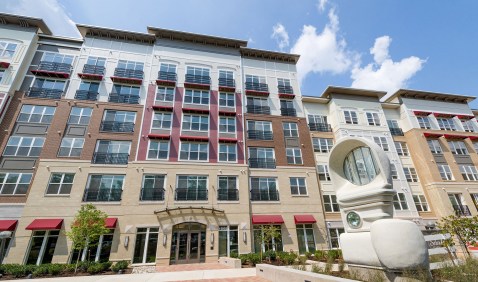
Bainbridge Shady Grove Metro Apartments now stands on the former site of the Reed Brothers Dodge dealership at 15955 Frederick Road. But a sculpture now installed on the property pays tribute to the oldest Dodge dealership in Maryland history. More than 20 feet high, and over 6 feet wide, the public art is inspired by 1939 Dodge headlamps, and the fender of a 1957 Dodge pickup truck.
Bainbridge Shady Grove Metro lives up to its motto: “Great Stories Start Here.”
Reed Brothers Baseball Team, 1920
Rockville’s first experience with baseball was during the Civil War on the fields where Richard Montgomery High School now stands. It was known as “Camp Lincoln” because of the Union encampment there, and Federal soldiers helped popularize the new game they brought from the North. One little known part of the history of the grounds is that during the Civil War, President Abraham Lincoln was afraid that Maryland would secede from the Union and that the District of Columbia would thus be bordered on both sides by Confederate states. He used the land of the fairgrounds for tents to maintain up to 10,000 Federal soldiers at a time in order to do his utmost to keep Maryland, especially via the major thoroughfare of Rockville Pike, within the Union.
After the Civil War, those fields – known as the Rockville Fairgrounds – continued to be a popular place for baseball. At the dawn of the 20th century, Reed Brothers Dodge had their own company baseball team that played on those same fields. The photos below were taken by Lewis Reed on a field at the Rockville Fairgrounds in the early 1920s.
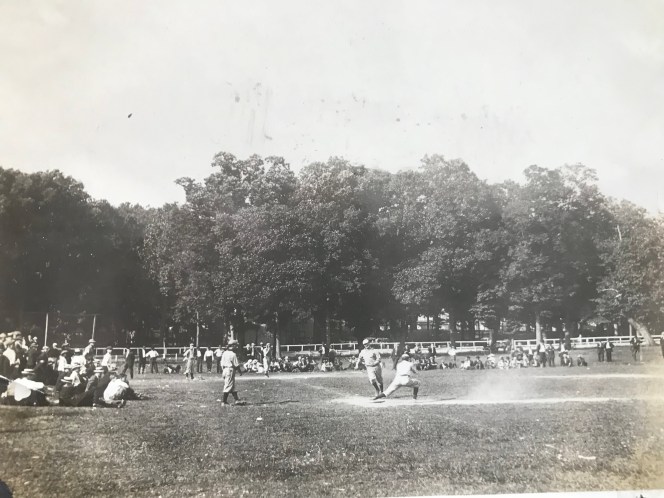
Reed Brothers Dodge Baseball Team on field at Rockville Fairgrounds, circa early 1920s. Photo by Lewis Reed
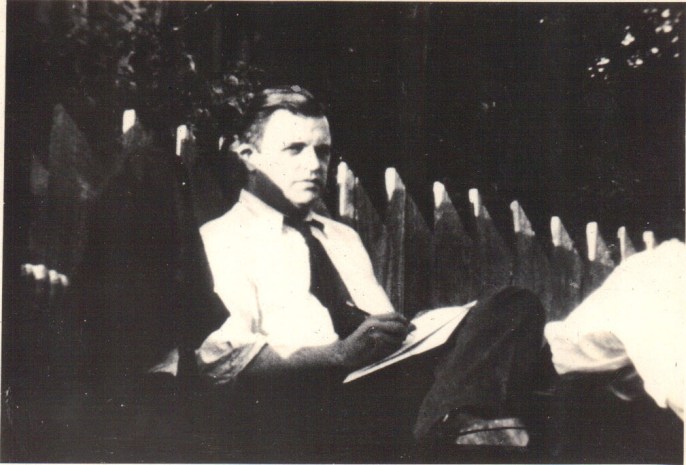
Leo (Pat) Murray (Parts Department Manager), keeping score. Photo by Lewis Reed

Reed Brothers Dodge Baseball Team on field at Rockville Fairgrounds, circa early 1920s. Photo by Lewis Reed
Note the player with the five finger glove in the photo above. Out of all of these photos, this is the only glove that can be seen on a player. The use of gloves wasn’t original to the first years of the game; needing a padded glove was viewed as pretty wimpy. (According to this article in the Smithsonian Magazine, one of the first players to wear a glove tried – and failed – to find one that would be invisible to fans.) By the 1880s gloves were accepted equipment, however, and soon inventors and manufacturers were coming up with new and improved gloves (more padding, deeper webbing…)

Reed Brothers Dodge Baseball Team, circa early 1920s. This photo was taken at Welsh Field, which is the site of the County Office Building. The house in the background was in right field. Photo by Lewis Reed
Books

Related Resources


Copyright Notice

Reed Brothers Dodge History (1915-2012) by Jeanne Gartner is licensed under a Creative Commons Attribution-NonCommercial 3.0 Unported License.
 Reed Brothers Dodge History 1915 – 2012
Recent Comments