
Roots of a 97 Year Old Auto Business
Lewis Reed, founder of Reed Brothers Dodge, grew up on a farm in rural Darnestown and for much of his young life had no running water or electricity. He was the son of a Blacksmith, raised in a family that survived on knowledge and hard work. Philip (1845-1918), father of Lewis Reed was an early settler in Darnestown who came from the Medley’s District of Poolesville in 1880. The Reed family farmhouse was located west of the James Windsor Store and Post Office as indicated on the map. In 1880, Philip Reed bought this lot from Windsor on which he built his house. The house was later owned by Kelley Rice who ran the farm at “Pleasant Hills.”  In 1870, at age 25, Philip Reed’s occupation is listed as a Blacksmith and Cabinet Maker. Darnestown residents of that time included a doctor, a merchant, a blacksmith and a wheelwright. It seems Philip may not have considered his primary occupation as a wheelwright, but I do know he worked with both cabinetmaker and blacksmith skills. Blacksmiths were once important members of this thriving crossroads community. They provided a vital trade that continued up to the mid-20th century. It wasn’t until I traced the Reed family tree, that I found that the Blacksmithing trade goes back about four generations. Back then, it was commonplace for sons to follow their father’s professions.
“T. H. S. Boyd, The History of Montgomery County, Maryland, from Its Earliest Settlement in 1650 to 1879” gives a population of 200 in the Darnestown area in 1879. The inhabitants of the town at that time are recorded in G.M. Hopkins’ Atlas from which the map reproduced above is taken.
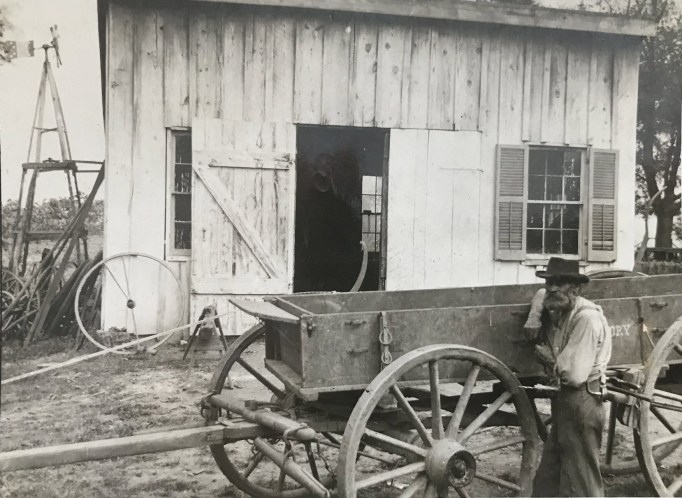
Formerly located on Darnestown Road near the intersection of Seneca Road, Lewis Reed’s father, Philip (1845-1918), operated a blacksmith, wheelwright, and cabinet making business next to his home. Photo by Lewis Reed.
Lewis Reed’s passion for cars began at a very early age. He was a young man full of curiosity, with an insatiable desire to know details, how things worked, and why. Early vehicles were terrifyingly loud and could be heard coming from at least a mile away on rural country roads. As a child, he would watch cars go past the family farm and then take off running across the fields to catch up with them until they would go out of sight. The “normal” speed during this time was so slow that drivers had difficulty keeping their cars from stalling out. It was my mother, Mary Jane Gartner (Lewis Reed’s daughter) who told me this story.

Philip Reed family farmhouse and blacksmith shop. Photo by Lewis Reed
At the beginning of the 20th century, farming was done with the power of horses and the skills of a blacksmith were important to the local economy. The shop was a popular destination, to wait for repairs of equipment, have horses shod and hear the latest news.
According to the 1910 U.S. Federal Census, Philip Reed worked as a Blacksmith in Darnestown until about age 65, after which time he moved his family to the Park Avenue community in Rockville. In July 1910, Philip purchased lot #3 of the east side of Park Avenue. In 1916, Lewis purchased lots 4-9 and started a garage and automobile dealership which became Reed Brothers Dodge. In 1923, he sold lots 4-7 to Edgar at which time Edgar then constructed a bungalow home and resided there until sold in 1947.

The Park Subdivision in Rockville, Lot #3 purchased by Philip Reed in 1910
From Miscellaneous For Sale Section: The Washington Post, (Washington, D.C.) April 21, 1910
 The classic anvil and hammer, in addition to tongs, forms, wedges, and chisels were all key tools of the Blacksmith; many of which were hand-made by each individual blacksmith. If they did not possess the tools required for a specific job, blacksmiths would make their own. Over the span of a blacksmith’s career, he could accumulate hundreds of different tools that existed solely for the completion of one particular item.

A young Lewis is shown inside his father’s Blacksmith Shop, ca. early 1900. The identity of the man on the right is unknown. Photo by Lewis Reed.
Special note: Lewis Reed’s love of photography began at a very young age, at a time when most families did not own a camera. The oldest photo in his collection is dated 1898, which would have made him around 11-12 years old when he started using a camera. I am relatively certain that Lewis took the photograph above himself by stabilizing the camera on a nearby tripod or some other object, and because of the long exposure times in early photography, he was able to run into the shot himself for a minute or more.
When the car was first invented there was no such thing as an automotive mechanic. When a car broke down, people turned to blacksmiths and bicycle mechanics for repair work. When using horses for farming and transportation came to an end, it forever changed the blacksmith’s role in the community. The traditional, small town blacksmith’s shop gradually went out of business, or evolved into the first automobile repair shops, as the horsepower of mechanical engines replaced the power of horses. Having grown up in a blacksmith family, Lewis Reed was well positioned to move to the new technology.

1916 – Rockville Garage first shop force. Lewis Reed, (first name unknown) Long and Phillip Reed. Photo by Lewis Reed.
One hundred years ago, the direction of the auto industry was uncharted territory to be explored by many people. Lewis Reed was an enterprising young man who put his future in the fledgling automobile industry. Although the specific motivation for Lewis to go into the automobile business is not clear, the 1910s was a period of exponential growth in the American automobile industry, and with a location on the major east-west route through Rockville, a town that was on its way to becoming a satellite community of Washington, D.C., he was well positioned for success. The 1910 census indicates that 23-year old Lewis Reed was working as a machinist.
In 1914, Lewis Reed became a partner in Rockville Garage with Robert L. and Griffith Warfield, a business he purchased in 1918. His brother Edgar joined the business in 1919 upon his return from World War I, and the name became Reed Brothers Dodge. In October 1915, Lewis Reed signed a franchise agreement with brothers Horace and John Dodge in Detroit. He was just 27 years old. Since then, the business grew and transformed into the oldest Dodge dealership in Maryland history and one of the oldest in the entire nation.
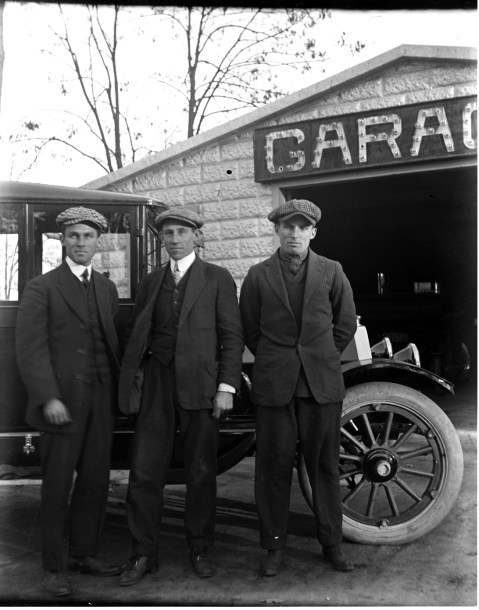
1916 – The original owners of Rockville Garage. From left: Roy Warfield – Lewis Reed – Griffith Warfield. Photo by Lewis Reed.
Over 100 years later, the only name that remains familiar to Rockville car buyers is Lewis Reed. Reed Brothers Dodge was one of the longest running automobile dealers in Montgomery County Maryland, serving Rockville and the area for over 97 years. Along with St. Mary’s Church (1813), King Farm (1925), Red Brick Courthouse (1891), and the B&O Railroad Station (1873) — Reed Brothers Dodge (1915) — became a “Peerless Place” in 2015, the year marking its 100th Anniversary. Today, Bainbridge Shady Grove Metro Apartments pays homage to the oldest Dodge dealership in Maryland history with commemorative art on the former site of the iconic Reed Brothers dealership.
Credit to: Jane C. Sween, The Montgomery County Story, “Darnestown, As It Was” (Feb 1982)
Other sources of information: Newspapers.com, Montgomery History, and Montgomery County Land Records
Sept 17, 1908: Testing the Wright Military Flyer at Fort Myer, VA
On this day in September 17,1908, the first military airplane in the world, built by the Wright brothers for the Army Signal Corps, made its first flight at Fort Myer, Virginia. Less than a thousand people witnessed the first flight at Fort Myer, because the general public was still doubtful that powered flight had been achieved. But Lewis Reed was there… and to commemorate that milestone, I have posted six original snippets of history that Lewis Reed captured through the lens of his camera that day.

Soldiers at Fort Myer prepare to pull the Wright Military Flyer out of its temporary hangar. Photo by Lewis Reed
Five years after the first successful flight at Kitty Hawk, Orville Wright and Thomas E. Selfridge test flew the Wright Flyer in a demonstration for the U.S. Army at Fort Myer, VA. The Army was considering contracting Wright’s aircraft to use as a military airplane, but, in order to win the contract, he needed to demonstrate the plane’s ability to carry a passenger. Twenty-six-year-old Lt Thomas E. Selfridge volunteered to be a passenger that day. Orville Wright succeeded in keeping the Wright Flyer aloft for one minute and 11 seconds. After more than four minutes in the air, the airplane crashed to the ground from a height of about seventy-five feet after a propeller blade broke and the machine went out of control. Orville Wright was severely cut and bruised and his passenger, Lt. Thomas Selfridge, became the first powered-aviation fatality.

Curtiss Model D with tricycle undercarriage. Photo by Lewis Reed

Curtiss Model D. Photo by Lewis Reed

Wright Model B with skids. Photo by Lewis Reed

Another early aircraft from 1909 was the Bleriot XI monoplane. In the background a Rex Smith Aeroplane Company School is advertised on the side of a building. Photo by Lewis Reed
A Rex Smith Aeroplane Company School can be seen on the side of the building in the background. The founder, Rex Smith, was an inventor and a patent attorney. The Rex Smith Biplane was used in the successful April 3, 1911 U.S. Army Signal Corps experiments in wireless communications. The Signal Corps did not buy any Smith Biplanes, they did however use them from time to time to train pilots to fly the Curtiss aircraft at the same field.

Airplane Hangars at Fort Myers, Virginia. Photo by Lewis Reed
The Wrights would prove their machine’s qualifications at Fort Myer. They met or exceeded all of the Army’s specifications, including flying at 40 miles per hour, carrying a combined passenger weight of 350 pounds, maneuvering in any direction in the air, landing without damage, and flying for at least an hour non-stop, which was a world record at the time.
Today, the Wright brothers are legends, with their accomplishments being the storybook example of American perseverance and ingenuity.
Happy Anniversary to Lewis and Ethelene Reed
Happy Anniversary to Lewis and Ethelene Reed, married 100 years ago on this day June 15, 1920! Shortly after their wedding, the newlyweds left on an extended motor trip to Niagara Falls and other points north. They will be at home after July 1, in Gaithersburg, near the place of business of the groom.

In addition to this photo of their wedding, here is a clipping from the Frederick Maryland “The Daily News”, describing the ceremony.
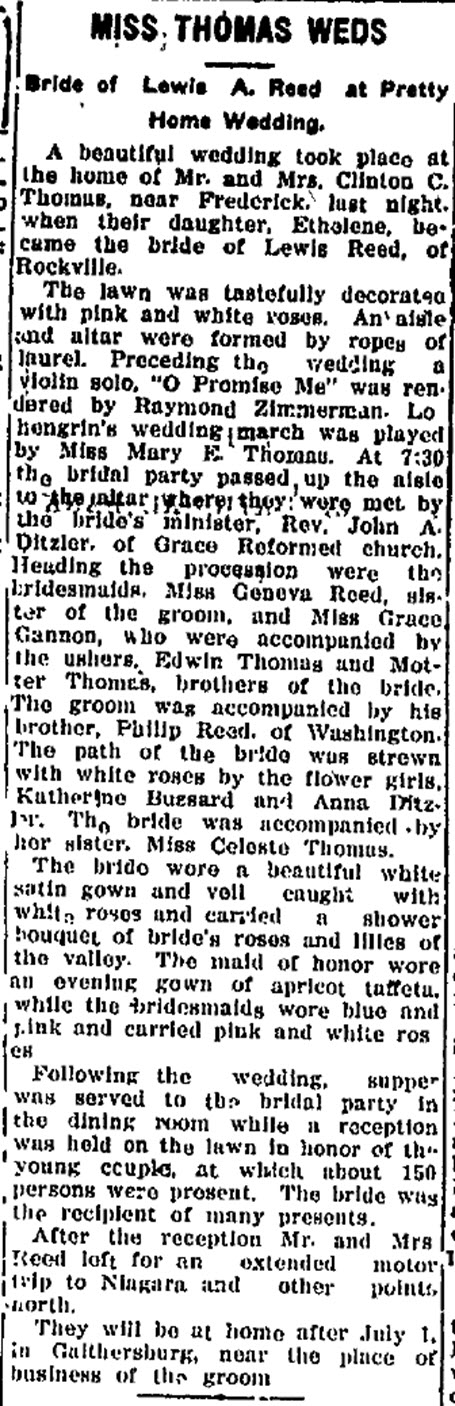
The Daily News, Frederick, Maryland, Wednesday, June 16,1920
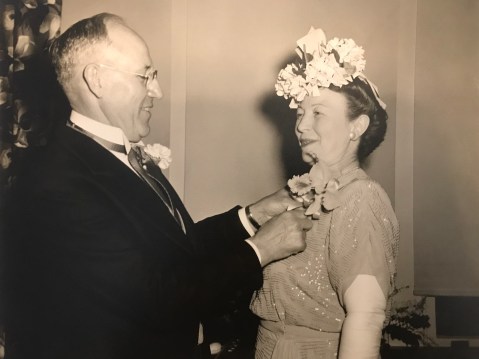
Lewis and Ethelene Reed on April 10, 1948 on their daughter’s wedding day
Pierce-Arrow Motor Car Company
 Prior to World War I and before he opened his Rockville Garage, Lewis Reed worked as a chauffeur, receiving some of his training at the Pierce-Arrow factory in Buffalo, New York, whose car he is pictured with below. Pierce-Arrow was once one of the most recognized and respected names in the automobile industry. For 38 years, the Pierce-Arrow Motor Car Company produced some of the finest automobiles made. Their models could easily cost ten times the price of a standard touring car.
Pierce-Arrow became known for its luxury autos, as film stars and heads of state made sure to have at least one Pierce in their collection (William H. Taft made the Arrow the first official car associated with the White House). Later, however, since Pierce-Arrow didn’t have a moderate-priced line, the company suffered during the Depression and closed its Buffalo factory, which has since been declared a landmark.
In the factory’s early days, the roof held a giant illuminated billboard spelling out the word “PIERCE” with a giant arrow displayed behind it.

1914 – Chauffeur Lewis Reed (left) is shown with a circa 1910-1911 Pierce-Arrow Model 48 and unidentified family
Happy Birthday to Lewis Reed, Founder of Reed Brothers Dodge

This ca. 1965 photo of Lewis Reed was taken in the new car showroom at Reed Brothers Dodge original location at the triangle at Veirs Mill Road and Rockville Pike.
Lewis Reed was born in Darnestown, Maryland on November 25, 1887 and was the founder of Reed Brothers Dodge. When Lewis Reed opened his car dealership in October 1915, he never knew he was starting a family tradition that would be carried out for 97 years and three generations. He founded what would become the oldest Dodge dealership under the same family ownership in the state of Maryland, and one of the oldest in the entire nation.
Lewis Reed was just 27 years old when he started selling cars built by brothers Horace and John Dodge in Detroit. Few people jumped onto the Dodge Brothers bandwagon earlier than Lewis Reed, and not many have lasted longer. Reed Brothers was franchised as a Dodge dealership and service facility less than one year after the first Dodge automobile rolled off the assembly line.
Lewis Reed was the first to sell Dodge cars in Montgomery County, Maryland and his company was the first Gulf gas dealer in the Washington, D.C. area. During the early years, Reed Brothers represented several franchise nameplates along with Dodge, including Oldsmobile, Hudson and Essex. The Hudson and Oldsmobile were sold at Reed Brothers from roughly 1917 through 1923.
Before becoming interested in automobiles, Lewis Reed was one of the original employees of the Computing-Tabulating-Recording Company, a Georgetown-based manufacturing firm that eventually became International Business Machines, Inc. He received his automotive training at the Pierce-Arrow factory in Buffalo, New York, the Dodge Hamtramck and Hudson Motor Car factories in Detroit, Michigan and the Washington Auto College.
A Charter Member and Past President of the Gaithersburg-Washington Grove Volunteer Fire Department, Lewis Reed was also a member of the advisory board of the Rockville branch of the First National Bank of Maryland, and belonged to the Masonic Lodge of Rockville, the Pentalpha Chapter of the Eastern Star, and the Rockville Rotary Club.
At his death on January 28, 1967 at the age of 79, the Senate of Maryland passed Senate Resolution No. 10, expressing “the deepest regret and sympathy of every member of this body,” describing Reed as “a kindly and loyal person completely devoted to his duties” which he carried out “with fairness and human understanding.” The resolution was sponsored by Senator Thomas M. Anderson, Jr. and Senator Louise Gore.
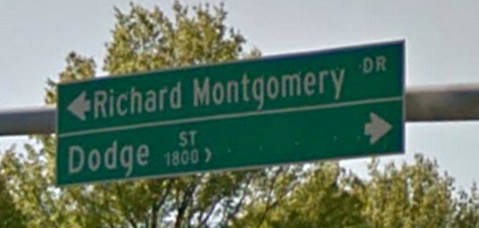 When you look back and consider what has taken place in the world in the past 100 years or so, you gain a perspective of what Lewis Reed faced. He overcame a lot of obstacles throughout his life. He steered his dealership through World War I, The Great Depression and World War II. When Reed Brothers had no new cars to sell for three and a half years and many dealers went bankrupt, he converted his car showroom into a display room and sold GE washing machines and other appliances. Reed Brothers Dodge occupied two locations, the original at the Veirs Mill Road and Rockville Pike intersection and the second at 15955 Frederick Road in front of the Shady Grove Metro.
Lewis Reed set an outstanding example through his success, but more importantly through his sacrifices and commitment to the community he served. Today, Bainbridge Shady Grove Metro Apartments pays homage to the oldest Dodge dealership in Maryland with commemorative art on the former site of the iconic Reed Brothers dealership.
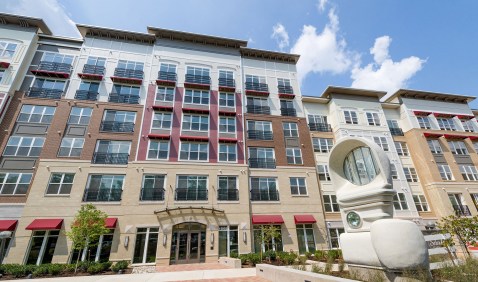
Bainbridge Shady Grove Metro Apartments now stands on the former site of the Reed Brothers Dodge dealership at 15955 Frederick Road. But a sculpture now installed on the property pays tribute to the oldest Dodge dealership in Maryland history. More than 20 feet high, and over 6 feet wide, the public art is inspired by 1939 Dodge headlamps, and the fender of a 1957 Dodge pickup truck.
Books

Related Resources


Copyright Notice

Reed Brothers Dodge History (1915-2012) by Jeanne Gartner is licensed under a Creative Commons Attribution-NonCommercial 3.0 Unported License.


Recent Comments