
First Shenandoah Apple Blossom Festival, May 3, 1924
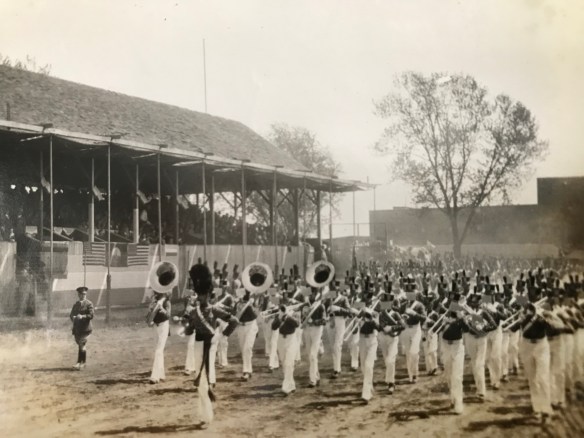
Here the parade participants circle the racetrack as spectators view the parade from a grandstand. There was no caption on this photo, but I’m guessing it might possibly be the VMI Regimental Band. Photo by Lewis Reed
Winchester, with its long history in the apple-growing industry, chose to honor the beauty and bounty of the apple blossom, beginning in the year 1924. On Saturday, May 3, 1924, the first Festival was a one-day event. To kick off the celebration, the parade assembled at the old fairgrounds just off Fairmont Avenue and marched through the streets of Winchester to the Royal Pavilion on the grounds of Handley High School.
Beginning in 1925, the first of three pageants was professionally produced by the John B. Rogers Production Company and staged on a dais at the fairgrounds. In 1928 the outdoor pageants were moved to the steps and esplanade of Handley High School. The pageant earned a reputation as being one of the most beautiful outdoor extravaganzas in the nation. The festival was suspended during World War II, and resumed in 1946 with its first celebrity grand marshals, Bing Crosby in 1948 and Bob Hope in 1949.
The below previously unpublished photos (dated 1925) from Lewis Reed’s album are what appears to be some of the very first photos of the Shenandoah Apple Blossom Festival held at the old fairgrounds in Winchester, Virginia. As always, click on an image to enlarge and scroll through gallery.


Source: thebloom.com
A Family Photo Postcard Jackpot

Postcard front was taken by Lewis Reed at Pope’s Creek Maryland on the Potomac River ca. 1915

Postcard addressed to Ethlene Thomas from L. Reed. Note the cost of the postage stamp is just one penny.
Lewis Reed’s albums contain several hundred of these photo postcards dating from approximately 1907-1915. What makes this particular photo postcard so special is, it was sent from Lewis Reed to Ethlene Thomas. Lewis Reed married the former Ethlene Thomas of Frederick County on June 15, 1920. This is a real photo postcard — one in which the photographic paper on which the photo was developed was itself then sent as the postcard. The stamp is a one penny stamp with the image of Benjamin Franklin. The Benjamin Franklin series stamp was issued by the U.S. Post Office between 1908 and 1922.
What I love about the address is how it’s addressed merely to “Miss Ethlene Thomas, New Market, Frederick Co, MD. I have a feeling, however, that the postcard would have found it’s way even had “New Market” been left off the card.
The card reads:
Dear Friend,
You can look for me Friday afternoon between 6 and 7 o’clock or sooner, if it is not raining. I will be there sooner if I can.
As ever, L. Reed
Kodak made photo paper in standard 3 1/2 by 5 1/2 postcard size with “Post Card” printed on the back. Lewis Reed developed all of his own photographs. He had a darkroom in his house — in the kitchen, to be exact — and worked at night to develop the negatives. This gave him the ability to take the paper into his dark room and produce a real photo postcard. This one is definitely a treasure.
Meet Lewis Reed, Photographer


Before opening his Dodge dealership in 1915, Lewis Reed was a well-known photographer in Montgomery County Maryland. At the turn of the century, before automobiles were even around, Lewis Reed toured up and down the East Coast on his motorcycle, taking photographs of landscapes, monuments, historic places, and people.
Some of the historic locations in his photograph collection includes the Black Rock Grist Mill, Smithsonian Institution, Montgomery County Maryland Almshouse, United States Capitol, Key Bridge, Union Station and other important sites in and around the Maryland, Virginia, and Washington, D.C. area. There are also photographs of many non-Maryland locations including Virginia, West Virginia, Pennsylvania, Georgia, New York, Boston, Georgia, North Carolina, and Canada. Especially stunning are images of the aftermath of the 1936 Gainesville Georgia tornado, one of the deadliest tornadoes in American history. As his photograph collection reveals, Lewis Reed was on the scene for some of the most important events in the history of the twentieth-century, and he always had his camera with him.
Lewis Reed developed all of his own photographs. He had a darkroom in his house — in the kitchen, to be exact — and worked at night to develop the negatives.
His photography has appeared in highly regarded history books such as, Montgomery County: Two Centuries of Change by Jane C. Sween, Rockville: Portrait of a City by Eileen S. McGuckian, and Gaithersburg: History of a City. His photographs have been featured in the Norris-Banonis Automotive Wall Calendar, on the national television show, American Pickers, and on television’s most watched history series, American Experience on PBS.
In a way, his photographs — more than 2500 in all — serve as an unwritten diary of his early adventures as an amateur photographer. My greatest pleasure now — more than 100 years later — is being able to share them.
The Reed Family (Blacksmithing in Darnestown c. 1870)

Philip Reed outside of his Blacksmith Shop in Darnestown, Maryland c. early 1900s. Photo by Lewis Reed
Philip Reed (1845-1918), father of Lewis Reed, was an early settler in Darnestown, Maryland. He was a Blacksmith. Blacksmiths were once important members of the Darnestown community. They provided a vital trade that continued up to the mid-20th century. Born in Darnestown, Maryland on March 17, 1845, he was raised in a family that survived on knowledge and hard work. In 1870, at age 25, his occupation is listed as a Cabinet Maker and Blacksmith. Darnestown residents of that time included a doctor, a merchant, a blacksmith and a wheelwright. It seems Philip Reed may not have considered his primary occupation as a Wheelwright, but I do know that he had a Blacksmith shop on his land and he worked with both cabinet maker and blacksmith skills.
A blacksmith is a metal worker who creates objects from iron or steel by heating the metal and using tools to hammer, bend, and cut it. Civil war armies used blacksmiths to shoe horses and repair things such as wagons, horse tack, and artillery equipment.
A wheelwright is someone who makes and repairs wheels. Early wagon and cart wheels were made of solid wood, but increasingly had iron parts, such as hubs and rims. It would not be unusual for one man to be both a blacksmith and a wheelwright, for wheelwrights were sometimes described as a cross between a carpenter and a blacksmith.

Reed farmhouse and blacksmith shop in Darnestown, MD (Route 118). Photo by Lewis Reed
Forget Valentine’s, Happy Ferris Wheel Day!

Ferris Wheel at Rockville Fair, circa 1920s. Photo by Lewis Reed
Did you know that February 14th is not only Valentine’s Day, but also Ferris Wheel Day? This unofficial national holiday is held on this day to honor the birth of the inventor of the Ferris Wheel, George Washington Gale Ferris, Jr. What better way to celebrate Ferris Wheel Day than enjoying this old photograph of the Ferris Wheel taken at the Rockville Fairgrounds, courtesy of Lewis Reed. The fairgrounds were just outside Rockville, about where Richard Montgomery High School is today. The Fair lasted four days, from August 21st to the 24th, and drew visitors from local counties, Washington, and Baltimore.
For the singles and the “enough already with the Valentines”, here is your perfect alternative excuse. Go wish all your friends and family a Happy Ferris Wheel Day!
Books

Related Resources


Copyright Notice

Reed Brothers Dodge History (1915-2012) by Jeanne Gartner is licensed under a Creative Commons Attribution-NonCommercial 3.0 Unported License.
 Reed Brothers Dodge History 1915 – 2012
Recent Comments