
A Look Back at the Forgotten Art of Hand-Tinted Photography
The hand-tinted photos of Lewis Reed and his daughter, Mary Jane, are examples of the photographic process that most of the people reading this will have never experienced: hand-tinting.
The golden age of hand-colored photography occurred between 1900 and 1940. Before the days of true color photography, these views were immensely popular. While hand coloring doesn’t help you identify or date an image, it does enhance a photograph’s appearance and add to its history.
Before the advent of color photography, photographers painstakingly applied color to black and white photos in order to show a truer visual depiction of a photo image. All of the photographs featured here were taken by Lewis Reed in the early 1900s and were hand-tinted by his daughter, Mary Jane, likely in the late 1930s to 1940. She colored the photos with special photographic watercolor and a paintbrush. Rather than coloring the entire image—a time-consuming task—she carefully selected details that would make the image lively and attractive. The fact that these photos, all of which are over 100 years old, are still in relatively good condition is a strong testament to the lasting power of hand-tinted photographs.
Do you recognize the road pictured below? Few modern residents of Montgomery County would guess, but this is a shot down Veirs Mill Road in the early 1900s. Mary Jane Reed added some depth to the image with subtle earth tones, in the colorized version.

Veirs Mill Road looking east before it was paved. Original photograph by Lewis Reed, 1911.
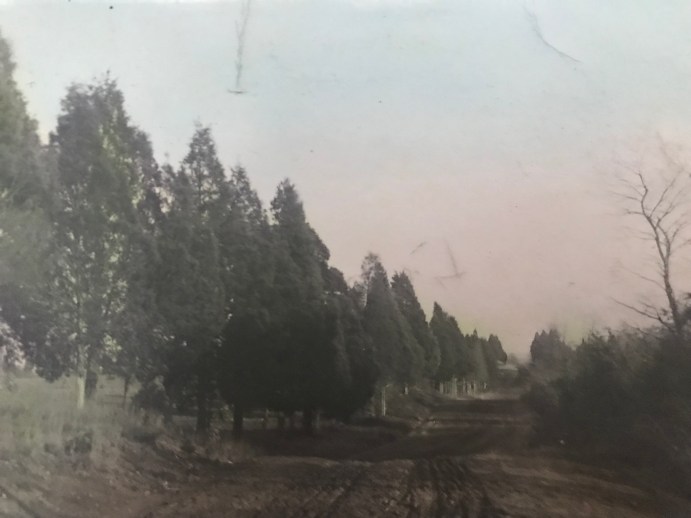
Colorized version of the photograph above by Lewis Reed. The photo was hand-tinted by Mary Jane (Reed) Gartner, making it look like a color photo.
Below, Lewis Reed’s c. 1909 photograph of his little cousin, Amanda Reed, sitting amongst the hydrangeas — the original before, and the colorized version after.

Amanda Reed before hand-tinting. Original photograph by Lewis Reed.

Amanda Reed after hand-tinting by Mary Jane (Reed) Gartner. Pastel was apparently a good choice for coloration.
To a visual artist like a dedicated photographer, the inability of the black-and-white camera to capture the richness of colorful blooms or the vibrancy of a summer scene must have been endlessly frustrating.
Lewis Reed’s daughter Mary Jane seemed particularly fond of hand-tinting photographs of flowers — it must have given her a lot of pleasure to “restore” color to her father’s beautifully composed shots. View some more of her work below.

Roses before hand-coloring. Original photograph by Lewis Reed.

Roses after hand-coloring
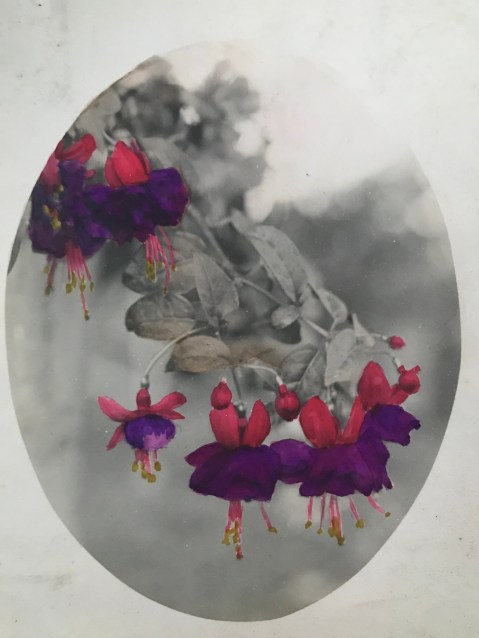
Hand-colored flowers
Below are two different versions of tinting a similar image. In Version 2, some of the flowers at the top were removed from the vase (by Lewis Reed, before taking a second shot) for a different aesthetic effect. The color artist used bolder colors to enhance that effect.

Original arrangement before hand-tinting. Original photograph by Lewis Reed.

Version 1: Arrangement after hand-tinting by Mary Jane (Reed) Gartner
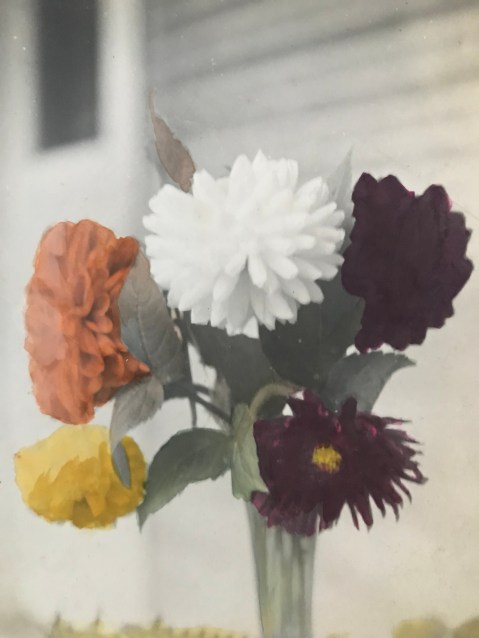
Version 2: Arrangement after hand-tinting by Mary Jane (Reed) Gartner

This is a hand-tinted version of Rock Creek taken by Lewis Reed in the early 1920s.
Other examples of hand-tinting are included in the following collection of Lewis Reed’s Black Rock Mill photographs. Black Rock Mill was built by Thomas Hillary and has stood along the banks of Great Seneca Creek as a landmark since its construction in 1815-1816. The mill was in working operation for over a hundred years until a flood in 1920 destroyed a dam on Seneca Creek and damaged the mill. Today, it a unique survivor of the many mills in Montgomery County harnessing the water-power of the creeks to grind wheat and corn into flour. It is one of only two mills standing in Montgomery County Maryland.

Black Rock Mill bridge hand-tinted by Lewis Reed’s daughter, Mary Jane.
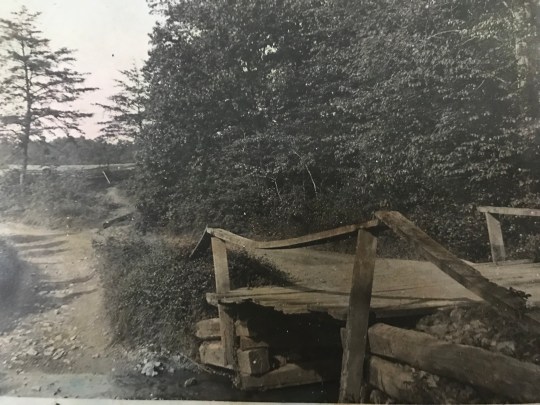
Bridge over Seneca Creek. Photo by Lewis Reed and hand-tinted by his daughter, Mary Jane

Strolling down a lane on a beautiful summer’s day. Black Rock Mill hand-tinted photo
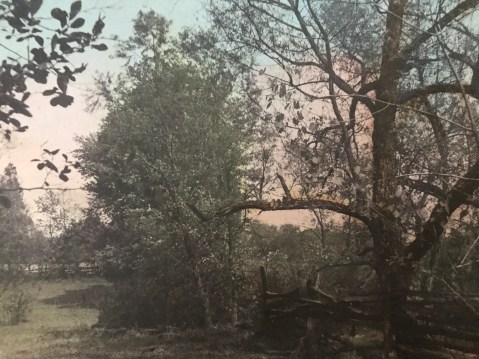
Black Rock Mill hand-tinted photo
The art of hand-tinted photos was introduced along side the daguerreotype in 1839. In the 19th century it was most common for the professional photographer to tint the photograph or tintype just after printing. Later photo artists introduced new techniques using oil, watercolor and other types of paint to achieve the desired result. With the Great Depression, the sale of professional hand-tinted photographs declined, but the home artist continued to have access to hand-tinting kits. Today, we can look back and appreciate the time and creativity it took to edit these photos without Photoshop.
Find photos like these and much more on Montgomery History’s online exhibit, “Montgomery County 1900-1930: Through the Lens of Lewis Reed“.
Then & Now: Smithsonian Institution Castle
This post is a continuation of a series of “Then & Now” images from Lewis Reed’s Photo Collection alongside photographs of how they appear today. Lewis Reed worked hard to preserve a visual history of Montgomery County, Maryland and surrounding area long before automobiles were even around. As early as 1905, he toured on his motorcycle across the states of Maryland, Virginia, and Washington, D.C. and took photographs of many historic locations. Taken approximately 115 years apart, you can see how the Smithsonian Institution Castle looks both the same and completely different from over a century ago.
Smithsonian Institution Castle (THEN): The Smithsonian Institution Building, popularly known as the “Castle,” was designed by architect James Renwick, Jr. Initially, the Castle was intended to be built in white marble and then in yellow sandstone. The architect and the building committee finally agreed on using Seneca red sandstone from the Seneca Quarry, located in Montgomery County, Maryland. When it was completed in 1855, it sat on an isolated piece of land cut off from downtown Washington, DC, by a canal. In the ensuing decades, the Castle became the anchor for the National Mall, as additional museums and government buildings were constructed around it.

Smithsonian Institution Castle. Photo taken by Lewis Reed in 1907
Smithsonian Institution Castle (NOW): The same view over a century later. The Smithsonian Institution Castle, located near the National Mall in Washington, D.C. behind the National Museum of African Art and the Sackler Gallery, houses the Smithsonian Institution’s administrative offices and information center.

Smithsonian Institution Castle today
Happy National Ferris Wheel Day!

Ferris Wheel at Rockville Fair, circa 1920s. Photo by Lewis Reed
Did you know that February 14th is not only Valentine’s Day, but also National Ferris Wheel Day? This unofficial national holiday is held on this day to honor the birth of the inventor of the Ferris Wheel, George Washington Gale Ferris, Jr. What better way to celebrate Ferris Wheel Day than enjoying this old photograph of the Ferris Wheel taken at the Rockville Fairgrounds, courtesy of Lewis Reed. The fairgrounds were just outside Rockville, about where Richard Montgomery High School is today. The Fair lasted four days, from August 21st to the 24th, and drew visitors from local counties, Washington, and Baltimore.
For the singles and the “enough already with the Valentines”, here is your perfect alternative excuse. Go wish all your friends and family a Happy Ferris Wheel Day!
Bromo-Seltzer Tower: Then & Now
Baltimore and the surrounding area sure has changed a lot in its centuries-long history. But many traditions and landmarks from decades ago are still around today, give or take a few variations. In this “Then & Now” feature, I have combined one of Lewis Reed’s original photograph’s for “then” and matched it with a corresponding contemporary shot for “now”. In the following photographs, you can see the difference 100 years can make.
So… you’re the inventor of a popular headache remedy living in the city of Baltimore around 1910. You have a factory on Lombard Street, a few blocks from the harbor. You want to create something memorable for the city. Of course, you also want to promote that headache remedy…
What do you do?
If you are Captain Isaac Emerson, inventor of Bromo-Seltzer, you hire a well-known architect and build a massive clock tower next to your factory.
Bromo-Seltzer Tower (THEN): When it was built in 1911, the 15-story Emerson Tower—better known locally as the Bromo-Seltzer Tower—was the tallest building in Baltimore. The tower was inspired by the Palazzo Vecchio in Florence, Italy, and took its name from Captain Isaac Edward Emerson, the inventor of Bromo-Seltzer, a popular cure for headaches and indigestion. Until 1936, the tower was topped by a 51-foot illuminated Bromo-Seltzer bottle that was supposedly visible from twenty miles away.
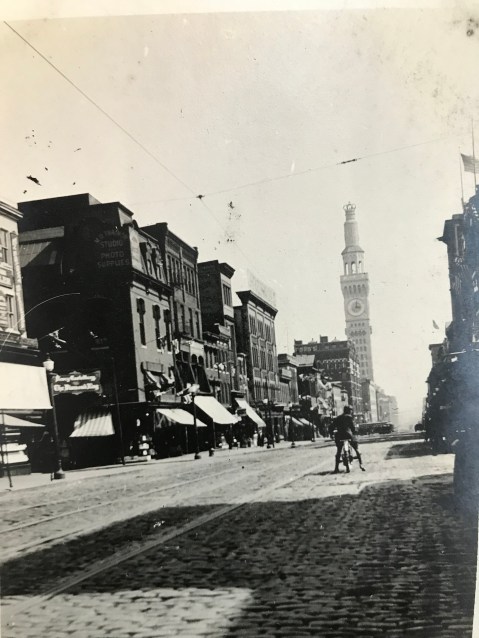
Bromo-Seltzer Tower, Baltimore, Maryland. Photo by Lewis Reed, 1914
Bromo-Seltzer Tower (NOW): The Bromo Seltzer Arts Tower has been transformed into studio spaces for visual and literary artists. Inside the Tower is the Emerson/Maryland Glass Museum which houses the largest collection of Bromo Seltzer and Maryland Glass bottles in existence. The Emerson Bromo-Seltzer Tower was placed on the National Register of Historic Places in 1973.
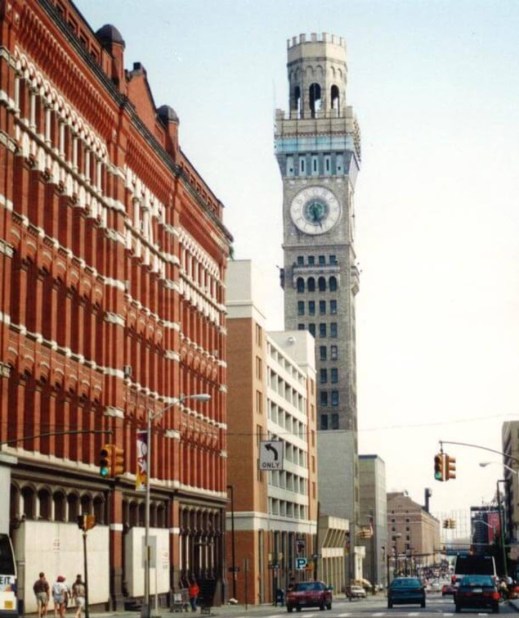
Bromo Seltzer Arts Tower today
Can’t Find Your Car? Frederick Fair Parking Lot, 1914

This fascinating scene of hundreds of cars parked in the Frederick Fair parking lot was taken by Lewis Reed in 1914. What is fascinating to me is, with all of these early cars painted in black, how on earth would you find your car in the parking lot?
Can’t find your car, sir? Apparently not a new phenomenon as seen in this 1914 photo of the Great Frederick Fair parking lot, especially since the majority of cars were of only one paint color, your basic black.
This week (September 17-25) marks the 159th edition of the Great Frederick Fair, the largest and greatest county fair in the State of Maryland. There have been many changes since the first fair was held in 1822 when it was known as the Cattle Show and Fair: that was a two-day event, now it’s nine days. The location has changed and so has the name. Today, the Frederick County Fair is officially named the Great Frederick Fair. It’s been held in May, October and November, but now (and for many years) takes place in September — rain or shine.
Fair entertainment has certainly evolved over the years. In 1888, May Lillie, an “expert girl shot with a rifle” from the back of a running mustang, performed. In the early 1900s, acrobatic bears and monkeys, high-wire acts and vaudeville performers took the stage. In 1950, the highlight of the “Irish Horan and the lucky Hell Drivers” show was a “stock convertible catapulted from a giant cannon.” In 1965, it was Jack Kochman’s Hell Drivers performing stunts with cars.
The Thursday of the 1911 fair was noted as a record day with 15,000 people in attendance, 100 autos and 1,000 carriages, according to “The Great Frederick Fair” book. Today, fair attendance can range from 210,000 to 250,000 people during the nine-day fair.
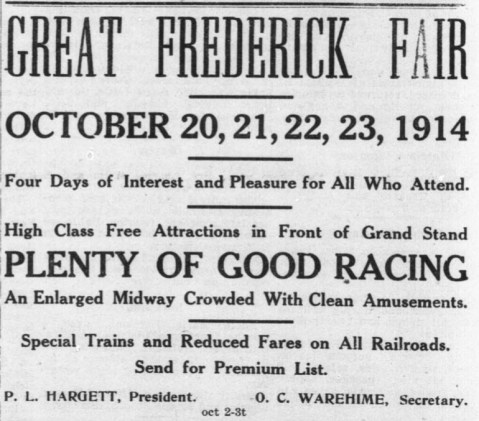
Newspaper ad advertising The Great Frederick Fair. THE DEMOCRATIC ADVOCATE OCTOBER, 1914
Source: Frederick News-Post
Books

Related Resources


Copyright Notice

Reed Brothers Dodge History (1915-2012) by Jeanne Gartner is licensed under a Creative Commons Attribution-NonCommercial 3.0 Unported License.
 Reed Brothers Dodge History 1915 – 2012
Recent Comments