
Valentines Day and Ferris Wheels!

Ferris Wheel at Rockville Fair, circa 1920s. Photo by Lewis Reed
Did you know that February 14th is not only Valentine’s Day, but also Ferris Wheel Day? This unofficial national holiday is held on this day to honor the birth of the inventor of the Ferris Wheel, George Washington Gale Ferris, Jr. What better way to celebrate Ferris Wheel Day than enjoying this old photograph of the Ferris Wheel taken at the Rockville Fairgrounds, courtesy of Lewis Reed. The fairgrounds were just outside Rockville, about where Richard Montgomery High School is today. The Fair lasted four days, from August 21st to the 24th, and drew visitors from local counties, Washington, and Baltimore.
For the singles and the “enough already with the Valentines”, here is your perfect alternative excuse. Go wish all your friends and family a Happy Ferris Wheel Day!
Lewis Reed Photo on Discovery’s Science Channel
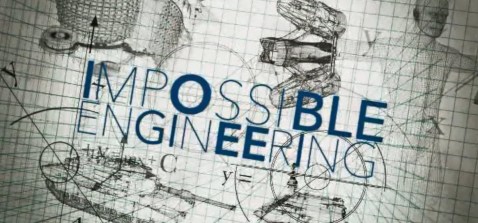 In case you missed it, I got word that Lewis Reed’s 1923 race car photographs were taken out of the U.S. version of Episode 4 ‘London Array’ Series of Impossible Engineering that was scheduled to be broadcast on Thursday, January 24th on Discovery’s Science Channel. The race car photographs were a part of the “London Array Wind Farm” episode that featured a segment on the development of the race car.
According to TwoFour Broadcasting, this has been happening with this series as Discovery requires a shorter episode length than the rest of their broadcasters. However, one of Lewis Reed’s photos made it in the UK version, and the rest of the world. TwoFour was kind enough to send me a DVD copy of the UK version of the London Array episode that shows the archive featured in the show. Below are screen shots taken directly from the DVD.

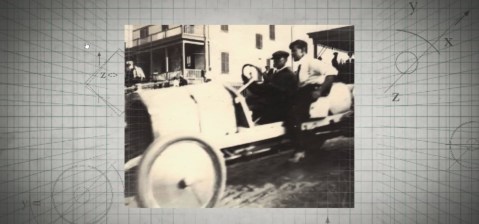
Lewis Reed’s photo from the 1923 Rockville Fair Auto Races extracted from the Science Channel Impossible Engineering DVD.

Screen shot of credits from Discovery Science Channel Impossible Engineering
Impossible Engineering celebrates engineering wonders detailing how they were built and how they work. The show unveils the past, present and future builds that have and will continue to change our world.
“Impossible Engineering” is produced for Science Channel by Twofour Broadcast.
UPDATE: Lewis Reed Photos to Appear on Science Channel ‘Impossible Engineering’

I just got word from the Production Assistant at Discovery that the new season of Impossible Engineering Series 4 is about to start airing in the US. Lewis Reed’s race car photographs will be a part of the “London Array Wind Farm” episode which is the second episode of the series. The show is scheduled to be broadcast on Thursday, January 10, 2019 on Discovery’s Science Channel.
The following 1923 dirt track race shots taken by Lewis Reed at the Rockville Fair will be used on the program that will feature a segment on the development of the race car.
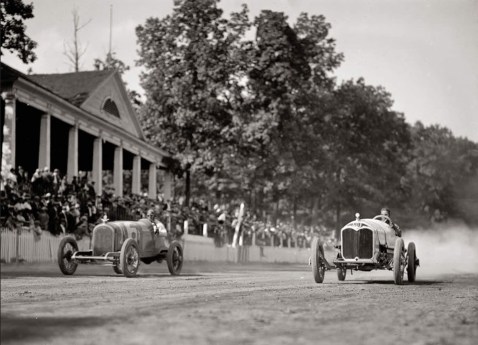
Photo by Lewis Reed
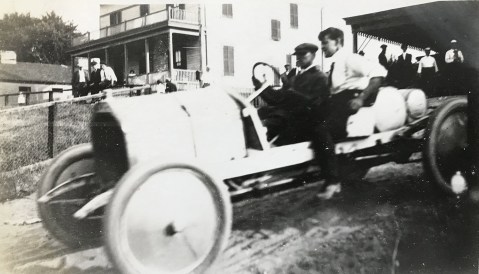
Photo by Lewis Reed
About Impossible Engineering
Behind every seemingly impossible marvel of modern engineering is a cast of historic trailblazers who designed new building techniques, took risks on untested materials and revolutionized their field. Brand new series, ‘Impossible Engineering’, is a tribute to their achievements. Each episode details how giant structures, record-beating buildings, war ships and space crafts are built and work. As the show revels in these modern day creations, it also leaps back in time to recount the stories of the exceptional engineers whose technological advances made it all possible. How would they have ever existed without the historical work of their ancestors? Interviews with their great advocates bring engineering history to life and retell how these incredible accomplishments shaped the modern world.
“Impossible Engineering” is produced for Science Channel by Twofour Broadcast.
Reed Brothers Baseball Team, 1920
Rockville’s first experience with baseball was during the Civil War on the fields where Richard Montgomery High School now stands. It was known as “Camp Lincoln” because of the Union encampment there, and Federal soldiers helped popularize the new game they brought from the North. One little known part of the history of the grounds is that during the Civil War, President Abraham Lincoln was afraid that Maryland would secede from the Union and that the District of Columbia would thus be bordered on both sides by Confederate states. He used the land of the fairgrounds for tents to maintain up to 10,000 Federal soldiers at a time in order to do his utmost to keep Maryland, especially via the major thoroughfare of Rockville Pike, within the Union.
After the Civil War, those fields – known as the Rockville Fairgrounds – continued to be a popular place for baseball. At the dawn of the 20th century, Reed Brothers Dodge had their own company baseball team that played on those same fields. The photos below were taken by Lewis Reed on a field at the Rockville Fairgrounds in the early 1920s.
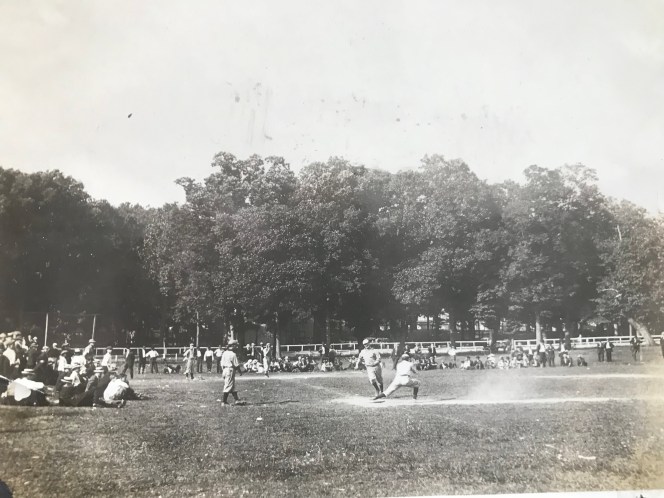
Reed Brothers Dodge Baseball Team on field at Rockville Fairgrounds, circa early 1920s. Photo by Lewis Reed
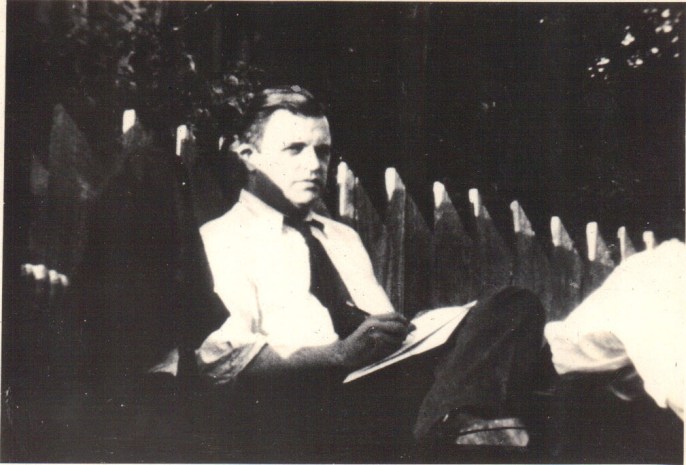
Leo (Pat) Murray (Parts Department Manager), keeping score. Photo by Lewis Reed

Reed Brothers Dodge Baseball Team on field at Rockville Fairgrounds, circa early 1920s. Photo by Lewis Reed
Note the player with the five finger glove in the photo above. Out of all of these photos, this is the only glove that can be seen on a player. The use of gloves wasn’t original to the first years of the game; needing a padded glove was viewed as pretty wimpy. (According to this article in the Smithsonian Magazine, one of the first players to wear a glove tried – and failed – to find one that would be invisible to fans.) By the 1880s gloves were accepted equipment, however, and soon inventors and manufacturers were coming up with new and improved gloves (more padding, deeper webbing…)

Reed Brothers Dodge Baseball Team, circa early 1920s. This photo was taken at Welsh Field, which is the site of the County Office Building. The house in the background was in right field. Photo by Lewis Reed
Then & Now: Rockville Fair Dirt Track Oval
The black and white photograph of the Rockville Fair auto races below was taken by Lewis Reed in 1923. The photograph was from the first incarnation of the Fair, held by the Montgomery County Agricultural Society (1846-1932) in Rockville and often known simply as the “Rockville Fair.” For this “Then & Now” feature, I have combined Lewis Reed’s original photograph for “then” and matched it with a corresponding contemporary shot for “now” to see how the location has changed throughout almost 95 years.
Rockville Fair Dirt Track Oval (THEN): Like many fairgrounds, the Rockville Fairgrounds included an oval track. Fairground race tracks, typically one-mile or half-mile dirt racing ovals with wide, sweeping curves and grandstands for spectators, were easily adapted for bicycles, harness racing, and the sport of car racing. Harness racing was one of the main attractions, but after the introduction of the automobile in the early 20th century, car races took over. The fairgrounds were just outside Rockville, where Richard Montgomery High School is today.

Crowds at the auto racetrack, Rockville Fair, August 1923. Photo by Lewis Reed
Rockville Fair Dirt Track Oval (NOW): In 1946, after the construction of Richard Montgomery High School, the old oval race track became a football field and stadium.
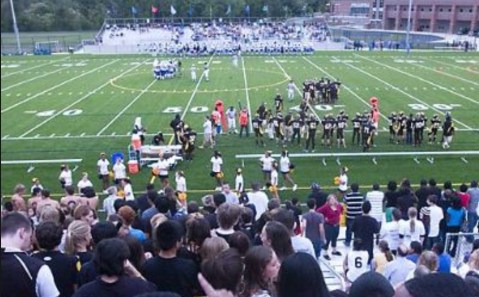
Richard Montgomery High School football field and stadium today
Books

Related Resources


Copyright Notice

Reed Brothers Dodge History (1915-2012) by Jeanne Gartner is licensed under a Creative Commons Attribution-NonCommercial 3.0 Unported License.
 Reed Brothers Dodge History 1915 – 2012
Recent Comments