
New Blog Feature: Rockville’s Past Through the Lens of Lewis Reed
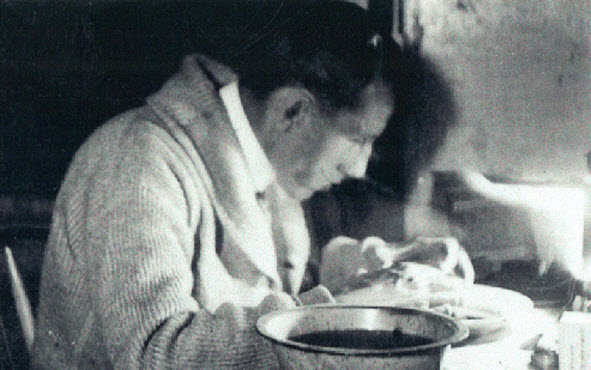
Lewis Reed (founder of Reed Brothers Dodge) was a well-known photographer in Montgomery County. Many of his photographs are now part of the Montgomery County (Maryland) Historical Society photo archives. He even developed his own photographs.
Looking back at photography from the past is a fascinating experience for me. Since I started this blog, I have had the opportunity to look through my grandfather’s extensive collection of photographs from historical locations in Maryland, Washington, DC and Virginia. Some of the photos are more than 100 years old! Lewis Reed was a well-known photographer in the county and many of his early photographs are now part of the Montgomery County Historical Society photo archives. The Jane C. Sween Library was recently given a collection of 280 glass plate negatives, showing Montgomery County in the early 20th century.
Every now and then the light bulb goes off and a new idea is born. It occurred to me that with the vast number of photographs in his albums, that this blog would be a great place to highlight some of them. With that in mind, I will be spotlighting photographs from his albums occasionally that may not pertain to Reed Brothers Dodge.
I have no formal history training, just a general interest in local history where I grew up. I will not try to be an historian; I will post a photo and supply a few sentences of context. All of them will in some way will offer a visual history of a part of Rockville’s past. I look forward to sharing them with you.
Dodge Brothers March
Sing a song of old Detroit, for she’s the flashing, dashing pioneer of motor glory …

Dedicated by Victor Herbert to the Late Mr. Horace E. Dodge in Respectful Appreciation of His Generous Efforts Towards the Advancement of American Music; Published Especially for Dodge Brothers.
I love this march and the history behind it — it is such a typical success story of the early part of the 20th century. The Detroit Symphony Orchestra (DSO) owes much of its prestige to half of the auto-building Dodge Brothers, John and Horace. It was Horace, the more mechanically-inclined of the two — and a decent enough amateur musician, by all accounts — that helped pay for a permanent conductor hired in 1918 to give the symphony world-class status. More importantly, he contributed $150,000 toward the cost of a new concert hall and led the successful fund-raising campaign for the building. Detroit’s Orchestra Hall, which opened in October 1919.
The Symphony was what finally smoothed the way into Detroit high society for Horace. Prior to that, the brothers were repeatedly blackballed — they were hard-drinking brawlers who didn’t much care what other people thought of them. (Their first major success was in manufacturing parts for Henry Ford’s assembly line. John Dodge was asked why the brothers abandoned that lucrative work to make their own cars. “Think of all those Ford owners who will someday want an automobile,” he snarked.) By the time the brothers suddenly died in 1920 — both from complications of the influenza then raging world-wide, although Horace’s condition was precipitously undermined by John’s death—such was their renown that none other than Victor Herbert paid tribute with “The Dodge Brothers March.”
The Dodge Brothers company distributed both the sheet music and, according to one source, 100,000 recordings of the piece.
Below are the lyrics and sound recording (without voice) of the march:
DODGE BROTHERS MARCH LYRICS
From the hills of San Jose San Jose
To the lights of gay Broadway gay Broadway
Sing a song of old Detroit
For she’s the flashing dashing pioneer of motor glory
Born of thunder steel and flame
All the world now hails her name hails her name
Here’s to Dodge and old Detroit
We pledge the glory of their fame
From the hills of San Jose San Jose
To the lights of gay Broadway gay Broadway
Sing a song of old Detroit
For she’s the flashing dashing pioneer of motor glory
Born of thunder steel and flame
All the world now hails her name hails her name
Here’s to Dodge and old Detroit
We pledge the glory of their fame
What better way to tap into the soul of an era than through music?
References:
The Dodge Brothers: The Men, The Motor Cars, And The Legacy
Johns Hopkins University, Levy Sheet Music Collection, Box 075, Item 028
The city of Detroit, Michigan, 1701-1922
1976 Showroom & Car Lot
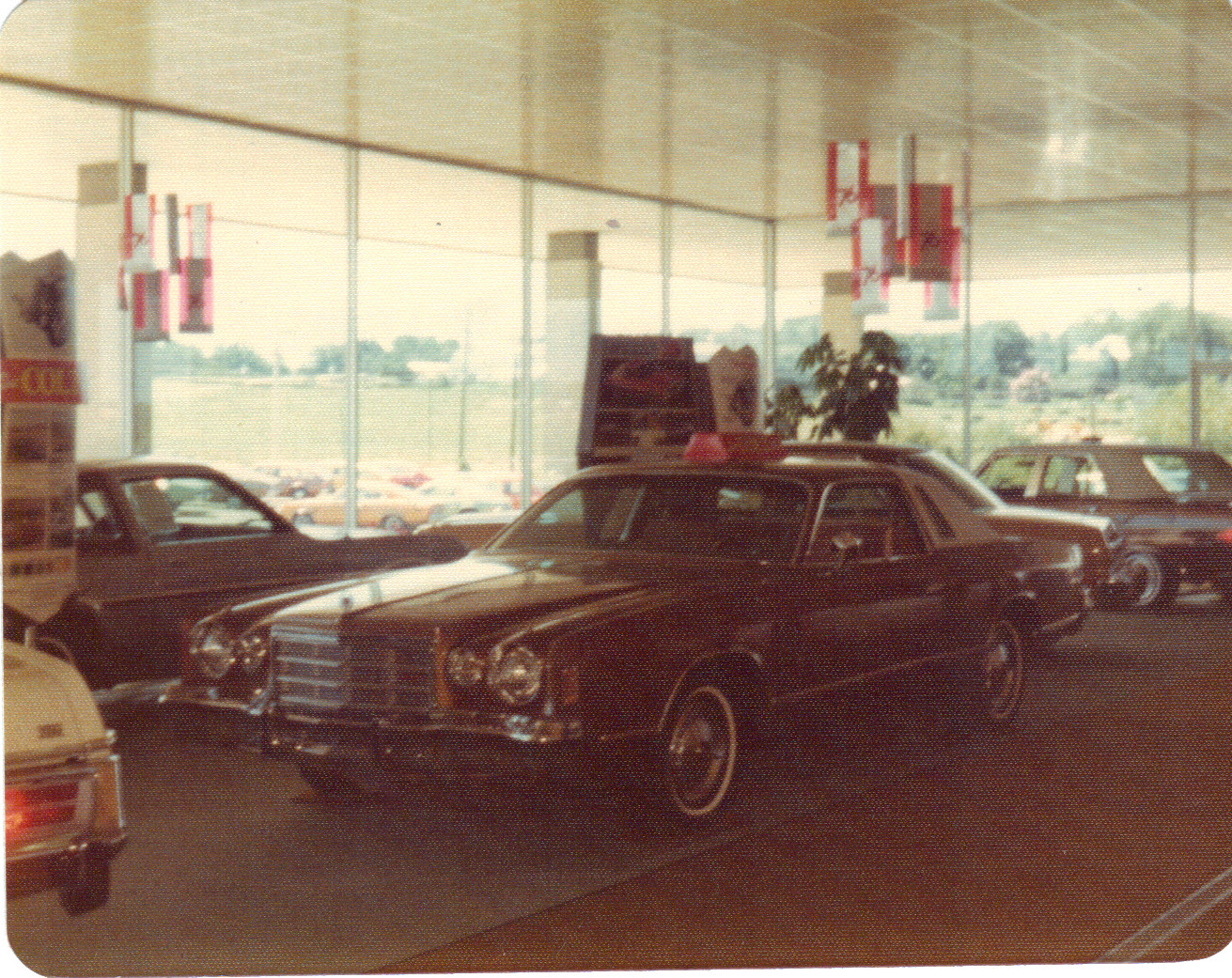
A 1976 Dodge Charger displayed on showroom floor
I found these two gems while looking through some of my old photo albums. The top photo shows what appears to be a 1976 Dodge Charger displayed on the showroom floor at Reed Brothers. Usually, the flashiest of the new models, spit-shined to perfection, would be displayed inside the showroom. Banners touting the new models were also strung up in the showroom.
In the second photo, nothing screams 1970s like the line of beige and baby blue cars all lined up in rows on the side lot. Across the road is the big barn that said, “MILK FOR THOMPSON’S DAIRY” on the field that is now the new urban development known as King Farm. I remember Lawson King’s dairy cows. Lots of them! They used to graze in the fields just a few feet from the roadway right across the road. At its peak, King Farm was the largest milk producer in the area and had been in agricultural use for nearly 75 years before it was approved for development in 1996.
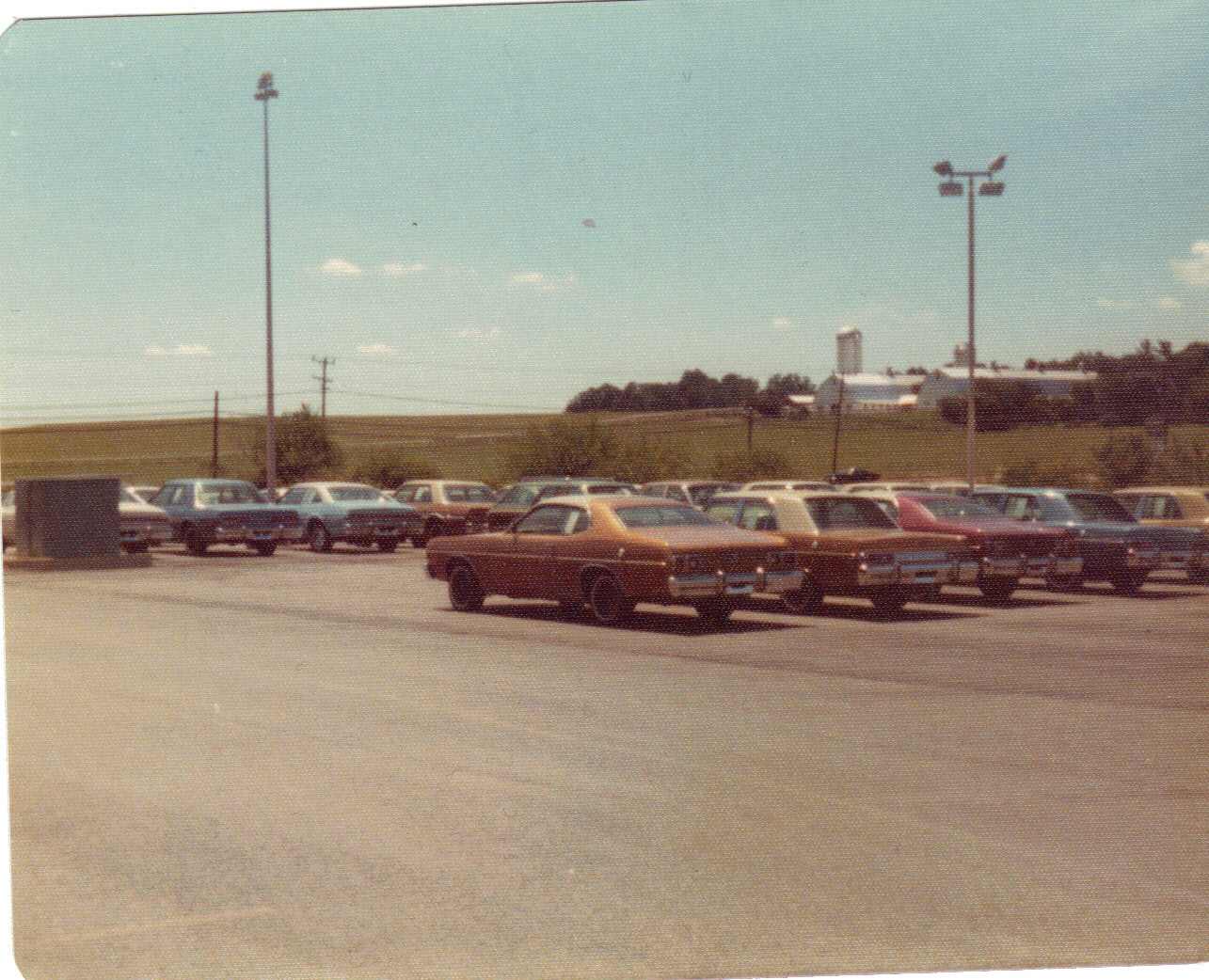
Cars lined up awaiting prospective buyers
Original Employees
This circa 1920s image shows some of the original sales and service staff of Lewis Reed’s Rockville Garage. Note that in the photo some of the men are wearing Gulf Gasoline attendant uniforms. The photo was taken in front of the vehicle entrance that led to the service department at the original Rockville Garage. (click on image to enlarge)
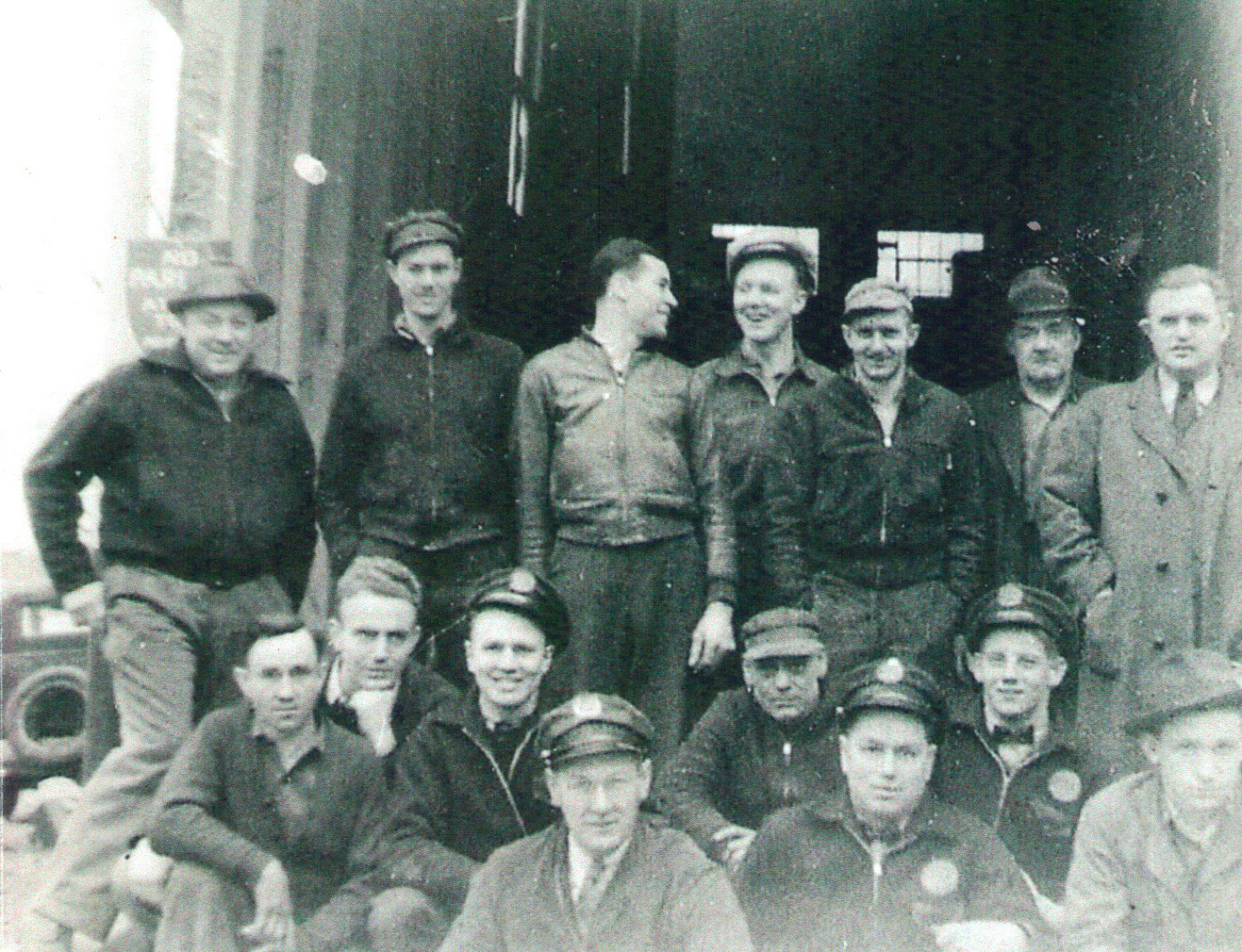
Rockville Garage Sales & Service Staff circa 1920s. Back Row, standing left to right: name unknown, Charles Case Merry, Lester Wilson, Leonard Beall, John William Norris, name unknown, Leo C. Murray. Second Row: name unknown, name unknown, Otis Beall (Leonard’s brother), Philip Reed, Clyde Souders, Arthur Souders. Front row: middle. Walter (Bud) Beall. Lewis Reed’s brother, Philip, came to work for Reed Brothers as a mechanic in 1916. The men dressed in uniforms were Gulf gas station attendants. The identities of the other people in the photo are unknown.
Other Original Employees
Raleigh S. Chinn, Rockville, started as Salesman with Reed Brothers in 1920
Evelyn Beane, Administrative Secretary
Paul F. Wire, Bookkeeper
W. Lester Wilson, Rockville, started in 1918 as Shop Foreman and stayed for 28 years
Alfred Fraley, Redland, started in 1917 as a mechanic and stayed for more than 30+ years
Benjamin J. Thompson, Colesville, started in 1917 as Salesman and stayed for 30+ years
Phillip Reed (a brother), started in 1916 as a mechanic. Phillip was a part of the first shop force and stayed with the company until 1944
Grafton Reed (a brother), worked as a mechanic in 1921
Leo (Pat) Murray started in 1925 and was the Parts Department Manager. Pat worked at Reed Brothers for more than 21 years
Richard C. Burdette, Rockville, mechanic
John Burdette, Gaithersburg, Gas Station Attendant
Marvin Riggs Shultz Sr, Gulf Gas Station Manager, started in 1941. In 1965, he became a new car salesman. He stayed with Reed Brothers for 43 years and holds the distinction of being the company’s longest-tenured employee.
Mary Ann (Slater) Beall, Rockville, Bookkeeper
Guy Merry
Aubrey Souders
Seasons Greetings and Happy Holidays!

I would like to take this time to wish you a very Happy Holiday season. As another year winds down, I wish you all a holiday filled with peace and happiness and a prosperous New Year.
All the very best for a wonderful 2014,
from,
The special video I have posted below is without a doubt one of The United States Air Force Band’s finest accomplishments. If you have not seen this, you are in for a real treat. If you have seen it, watch and listen to it again. You won’t be disappointed I assure you. It was my honor and joy to be a part of this organization for 30 years. I am so proud of their continued accomplishments and so very grateful to have been among their ranks.
The United States Air Force Band has officially gone viral with its first-ever flash mob broadcast from the National Air and Space Museum in Washington, D.C. – watch and be joyous!
Books

Related Resources


Copyright Notice

Reed Brothers Dodge History (1915-2012) by Jeanne Gartner is licensed under a Creative Commons Attribution-NonCommercial 3.0 Unported License.


Recent Comments