
U.S. Capitol Then & Now… 108 Years of Change
You might not realize how much Washington DC has changed until you look back and see what it looked like in the past. I thought it would be fun to revisit an historic location using one of Lewis Reed’s original photographs for “then” and a stock image from today for “now” to see what differences are visible. In the following photographs, you can see how the United States Capitol looks both the same and completely different from a century ago.
U.S. Capitol (THEN): Seen in the black & white photograph taken by Lewis Reed in 1910, is the United States Capitol in Washington, DC. Visible in both photos is the white marble Peace Monument that stands in the circle to the west of the U.S. Capitol at Pennsylvania Avenue and First Street, NW. A streetcar can also be seen in the black & white photo. The Pennsylvania Ave streetcar line ran from Georgetown, across Pennsylvania Avenue, past the White House, up to Capitol Hill, and then down to the Navy Yard. With no stop signs, speed limits, or lane lines, the streets of the early 1900s were completely different.
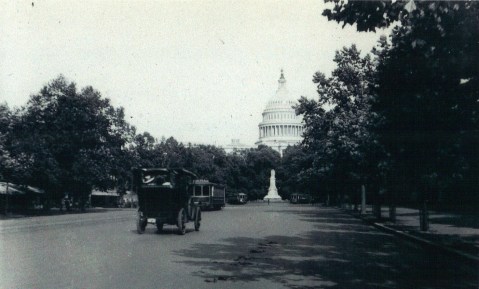
U.S. Capitol as seen from Pennsylvania Ave in 1910. Photo by Lewis Reed
U.S. Capitol (NOW): The same view over a century later hasn’t changed much… except for the traffic and Segway riders with fanny packs.
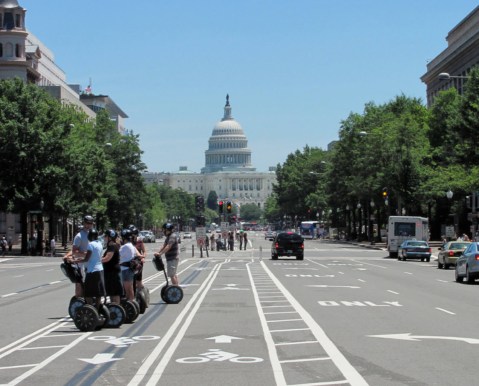
On Pennsylvania Ave and U.S. Capitol building today. A Segway tour is stopped along the bike lanes.
Meet Edgar Reed
Meet Edgar Reed, partner with brother Lewis Reed, in Reed Brothers Dodge.

Edgar Reed as a young man
Edgar was born in Darnestown, Maryland on October 17, 1890. He was a veteran of World War I and an active citizen of Rockville. He served as a Sergeant in the Army Medical Corps and had been posted to General Hospital No. 11 in Cape May, New Jersey. Previous to his enlistment he had been employed by R.W. Vinson, Rockville druggist for eight years. In 1919, Edgar joined his brother Lewis Reed in the business and the name changed to Reed Brothers Dodge. Edgar was in the automobile business with his brother for 35 years.
As a prominent businessman active in local commercial, civic, and religious institutions, Edgar was a respected community leader. For many years, he served on the Town Council and was Chairman of Stewards at the Rockville Methodist Church. Edgar was an original incorporator and charter member of the Rockville Volunteer Fire Department when the fire company was organized in 1921. He was a charter member and Past President of the Rockville Rotary Club and was a director of the Farmers Banking & Trust Company in Rockville until the time of his death. He was the first President and one of 30 original members of the Dealers Automotive Association of Montgomery County.
Edgar was the executive of Reed Brothers and handled all of the technicalities of the business. He was generally in charge of new car and truck sales. Edgar Reed passed away on October 24, 1951 after a prolonged illness.
Warning For Driving Faster Than a Walk
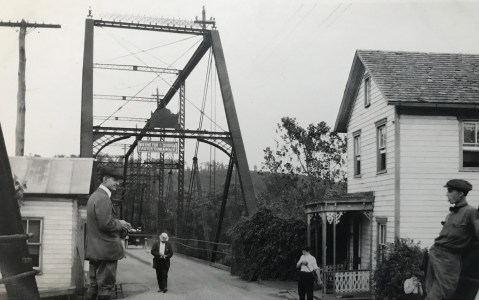
Photo by Lewis Reed
This undated photograph from Lewis Reed’s Collection evokes a sense of nostalgia for slower-paced times. Literally slower: The sign over the bridge entrance reads – “$10 fine for driving faster than a walk” — quite a hit to the money pouch in those days.
Hudson Motor Car Company
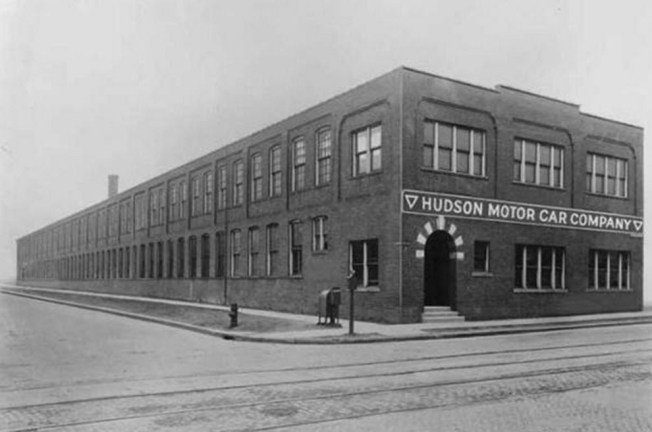
The Hudson Motor Car Company’s first plant in Detroit, MI. The company used this building from 1909 to 1912 when it moved to a larger plant. Image credit: Hudson Motor Car Company
Lewis Reed received his automotive training at the Pierce-Arrow factory at Buffalo, New York, the Dodge Hamtramck and Hudson Motor Car factories in Detroit, Michigan, and the Washington Auto College. A mechanical aptitude was necessary to be a dealer in the early 1900’s. When cars were shipped to the dealer from the manufacturer, they arrived partially assembled in railroad boxcars. It was the dealer’s responsibility to unpack and assemble the cars at the rail yard and drive them back to the dealership. Mechanics were often needed to repair the new cars if they broke down along the way.

1916 – The first shop force of Rockville Garage (from left: Lewis Reed, (first name unknown) Long and Phillip Reed.
Lewis Reed’s Rockville Garage sold more than just Dodges. During the early years, Reed Brothers represented several franchise nameplates along with Dodge, including Oldsmobile, Hudson and Essex. The Hudson and Oldsmobile were sold at Reed Brothers from roughly 1917 through 1923.
Hudson introduced the Essex brand in 1919. The Essex was intended to compete with Ford and Chevrolet for budget-minded buyers. The Essex offered one of the first affordable sedans and by 1925 the combined Hudson and Essex sales made Hudson the third largest automobile manufacturer in the United States.
The Hudson Motor Car Company made Hudson and other brand automobiles in Detroit, Michigan, from 1909 to 1954.
A Family Photo Postcard Jackpot

Postcard front was taken by Lewis Reed at Pope’s Creek Maryland on the Potomac River ca. 1915

Postcard addressed to Ethlene Thomas from L. Reed. Note the cost of the postage stamp is just one penny.
Lewis Reed’s albums contain several hundred of these photo postcards dating from approximately 1907-1915. What makes this particular photo postcard so special is, it was sent from Lewis Reed to Ethlene Thomas. Lewis Reed married the former Ethlene Thomas of Frederick County on June 15, 1920. This is a real photo postcard — one in which the photographic paper on which the photo was developed was itself then sent as the postcard. The stamp is a one penny stamp with the image of Benjamin Franklin. The Benjamin Franklin series stamp was issued by the U.S. Post Office between 1908 and 1922.
What I love about the address is how it’s addressed merely to “Miss Ethlene Thomas, New Market, Frederick Co, MD. I have a feeling, however, that the postcard would have found it’s way even had “New Market” been left off the card.
The card reads:
Dear Friend,
You can look for me Friday afternoon between 6 and 7 o’clock or sooner, if it is not raining. I will be there sooner if I can.
As ever, L. Reed
Kodak made photo paper in standard 3 1/2 by 5 1/2 postcard size with “Post Card” printed on the back. Lewis Reed developed all of his own photographs. He had a darkroom in his house — in the kitchen, to be exact — and worked at night to develop the negatives. This gave him the ability to take the paper into his dark room and produce a real photo postcard. This one is definitely a treasure.
Books

Related Resources


Copyright Notice

Reed Brothers Dodge History (1915-2012) by Jeanne Gartner is licensed under a Creative Commons Attribution-NonCommercial 3.0 Unported License.
 Reed Brothers Dodge History 1915 – 2012
Recent Comments