
May 2, 1929 Montgomery County Tornado Disaster (Aftermath)
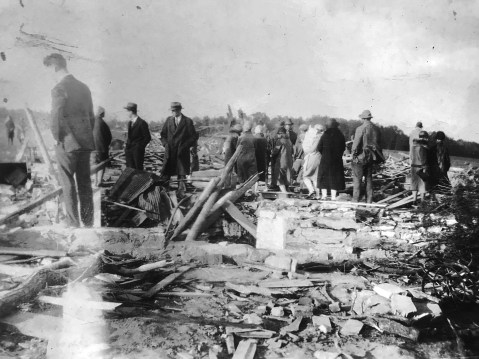
Spectators view the destruction at the Benson farm, May 1929. Photo by Lewis Reed
Ninety years ago today, one of the worst tornado outbreaks in area history devastated a part of Montgomery County Maryland. At about 9 p.m. on Thursday, May 2, 1929, northeastern Montgomery County was struck by an F3 tornado, part of a large storm system that caused devastation from Florida to Ohio. The weekly Montgomery County Sentinel reported on May 10th that the “wind storm of cyclonic power . . . was of limited width and serpentine on its course. Everything in its path met with destruction.” These previously unpublished photographs were taken by Lewis Reed “after the tornado of May 2, 1929”.

May 1929. Photo by Lewis Reed
The damage in the county was limited to the rural Unity area, north of Brookeville. The Sentinel article detailed each affected farm, noting that “thousands of persons from far and near visited the scene for several days to look upon the indescribable wreckage.”

May 1929. Photo by Lewis Reed
From the Sentinel: “The storm showed its first violence upon the farm of Mr. J. William Benson. There it destroyed every building – the dwelling house, large barn, 117 feet long, including an attached shed, and all other outbuildings.” The farm was unoccupied, but furniture belonging to “a prospective tenant” was destroyed. Mr. Benson’s apple orchard was also significantly damaged, and the article claimed that “many [trees] were lifted into the air, carried over woods and landed several miles away.”
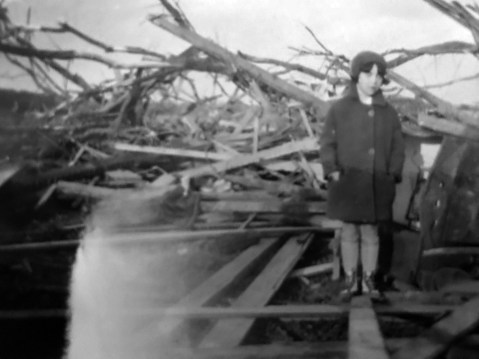
Lewis Reed’s daughter, Mary Jane, May 1929. Photo by Lewis Reed
The fire departments of Rockville, Gaithersburg and Sandy Spring responded to the call made by farm worker James Leizear, who “extricated himself from the wreckage” and ran half a mile to a neighbor’s house to summon help.
The Post reported on May 4th that 28 people in Maryland and Virginia had been killed by tornadoes during the storm; most of the casualties were in Virginia, where an elementary school was struck full-force and at least 18 children died. In Montgomery County, the local Red Cross Chapter formed a citizen committee to raise funds “for relief of the sufferers.”

May 1929. Photo by Lewis Reed
Note: These photographs were undated and unlabeled in my grandfather’s collection. My mother, Mary Jane (Reed) Gartner, who is seen above when she was almost 7 years old, positively identified these photographs and just about pinpointed the location! She is almost 97 years old! It’s amazing the things you remember from your early childhood.
Information Source: A Fine Collection
7 Years, 296 Posts & Thank You
 Today marks the 7-year anniversary of this blog. It’s been an honor to share the history of Reed Brothers Dodge – whether you’ve read our blog, followed us on Twitter, or “liked” us on Facebook. I would like to thank those mentioned below, and many others, for their kind words and the visibility they have provided.
To help review the past year I thought I’d search around on the Internet and see what others have been saying about us.
Included among the posts on our Facebook page:
“I love pictures, especially the old ones. People, places and things…the pictures bring such cool history and personal ones, the fond memories.
Online and in print:
Antique Motorcycle Club of America, Forum: “Reed Brothers was a pretty important local business owners in my area. The Reed Brothers, shown in the photo attached, are the two center riders with touring caps and ties started a garage in Rockville in 1915 and received a Dodge Motors contract to sell and service the new automobile….. Lewis was a pretty extraordinary amateur photographer.”
Meadow Brook Hall: For the second year, to show support to preserving the Dodge legacy, the author of this blog has “adopted” a Dodge car — a 1915 Dodge Brothers Touring Car — one of the historic vehicles in the Meadow Brook Hall Dodge Brothers automobile collection. Meadow Brook Hall in Rochester Hills, Michigan was the estate of one of the world’s wealthiest and influential women of her time, Matilda Dodge Wilson. Matilda was the wife of John F. Dodge, co-founder of the Dodge Brothers Motor Car Company.
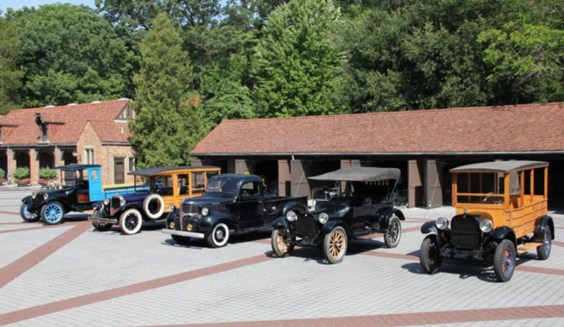
Photo courtesy of Meadow Brook Hall
The inscription on the Adoption Certificate reads:
adopted by Jeanne Gartner in memory of her grandfather, Lewis Reed, who founded Reed Brothers Dodge in Rockville, Maryland in October 1915.
The vehicle was adopted for a period of one year, beginning November 14, 2018 through November 13, 2019 (November 14 is the anniversary of the day John and Horace Dodge revealed their first car in 1914). The adoption will help Meadow Brook make necessary repairs, provide preventative maintenance and pay insurance for the Depot Hack, ensuring it’s there to inspire, educate and “drive” this and future generations. Lewis Reed is a perfect and most fitting parent.
“Just A Car Guy”: It’s pretty cool to see a well-known car blog like “Just A Car Guy” has noticed our history blog and has been sending visitors our way via a link on their page under, “Sites I recommend for their quality”: Reed Brothers Dodge History. I am proud and honored to be regarded among these terrific automotive websites.
On National Television!
- Lewis Reed Photo Featured on Maryland Public Television (MPT): Lewis Reed’s aerial photograph of entire original Reed Brothers Dodge dealership at the intersection of Veirs Mill Road and Rockville Pike was used in the Maryland Farm & Harvest series which was aired on December 18, 2018 at 7:00 pm on MPT. The photo illustrated what Rockville Pike looked like at the time, during a segment about 97-year-old farmer Charles Koiner who grew up in the Rockville area.
Screen shot of credits from Maryland Farm & Harvest video on MPT
- Lewis Reed Photo on Discovery’s Science Channel, Impossible Engineering: A Lewis Reed’s photo from the 1923 Rockville Fair Auto Races was a part of the Episode 4 ‘London Array’ Series of Impossible Engineering that was broadcast on Thursday, January 24, 2019 on Discovery’s Science Channel. The photograph was used on the program that featured a segment on the development of the race car.

Lewis Reed’s photo extracted from the Science Channel Impossible Engineering DVD
Last, but certainly not least, many thanks to all of you who have visited, followed, shared, or commented on this blog. I appreciate all of you for your continued support and making Reed Brothers Dodge History one of the places you visit during the course of your day.

Then & Now: Thomas & Co. Cannery in Gaithersburg
“Then and Now” photos are an excellent way to explore the passage of time. In this special post, I have combined one of Lewis Reed’s original photograph’s for “then” and matched it with a corresponding contemporary shot for “now”. Taken approximately 100 years apart, these photos show the Thomas and Company Cannery in Gaithersburg, then and now.
Thomas & Company Cannery (THEN): The largest and longest-lived cannery in Montgomery County, the Thomas and Company Cannery operated from 1917 until 1962. While Baltimore had been the center of the canning industry in the 19th century, the outbreak of World War I created a need to rationalize. Frank and Clyde Thomas were leaders in the 20th century canning industry in Maryland. In 1917, the Thomas family opened a cannery in Gaithersburg, the first in Montgomery County. The factory was the focus of local industry and economy, providing an important market for farmers, and employment for local migrant workers.
The factory canned peas, pumpkin and corn, supplied both the local retail market and the war effort during WW I and II. During the war years, the cannery expanded operations and functioned on a three shift schedule to provide vegetables for shipment to troops. After the war, the cannery continued to produce vegetables under the brand names MY-T-NICE, EVER-GOOD, BARBARA FRITCHIE and ON-TOP corn, peas and succotash.
Built along the B & O Railroad to facilitate shipping, the brick cannery had three main parts: the central processing station, the shipping section and boiler plant. The cannery was designated a Gaithersburg landmark in 1987.

Circa 1917 photo taken behind the Thomas and Company Cannery in Gaithersburg. The Cannery was the first and largest vegetable cannery in Montgomery County. It closed in 1963 after fire damage and lay empty until its recent restoration. Photo by Lewis Reed.

Thomas & Company Cannery (NOW): The building saw various uses after the closing of the Cannery, but then lay empty until its recent restoration for office and commercial use.

Source: Maryland Historical Trust
How Old Cars Were Heated

LaidLaw Motor Robes, The Evening Star, Washington, D.C. December 11, 1923
Nobody really thinks about it today. If your car is too cold, then simply switch on the “heater” and soon your car will be warm. However, it wasn’t always that way. What passengers did back then, in the early days of motoring, was bundle up as if one was outdoors. This meant heavy clothing, winter gloves and snow boots. It wasn’t long, however, before car makers realized that a few comforts, like heat in the passenger compartment, or even some type of heated seating, would help sell cars.

Circa 1920 Hudson Six with Maryland Dealer License Plate No. 618 on front. Photo by Lewis Reed
In order for occupants of early 1920’s cars to remain warm during the cold winter months, especially when it was snowing, it was necessary for them to dress warmly and cover themselves with blankets. Note the car in the photo below is mostly open-bodied, with no windows and certainly no heat. Tire chains are on the rear tires. I cannot say with any certainty, but I believe it is Lewis Reed’s car with his wife and baby daughter, Mary Jane, sitting inside all bundled up.

Buffalo Zoo Bear Pits, Buffalo, New York, ca. early 1920s. Photo by Lewis Reed.
While this had been the accepted way to do things for centuries, it did not take long for automotive engineers to realize that heat from the car engine could also be used to warm the interior of the vehicle. Heaters became standard equipment on the more expensive cars and over time they were fitted to most cars. You could buy and fit after market car heaters to suit cheaper cars like the Fords and Chevrolets.
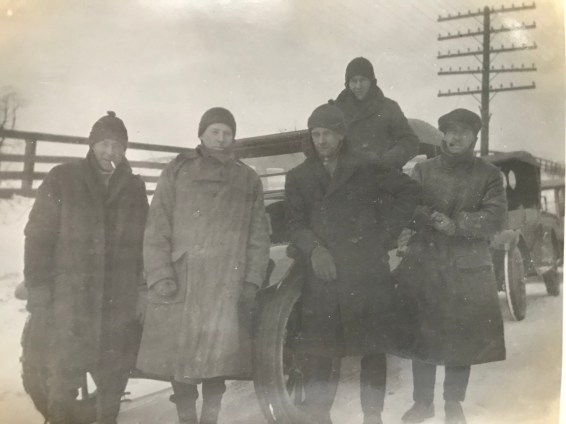
There weren’t heaters in these old cars, so motorists had to really bundle up. Photo by Lewis Reed
Below are some advertisements from an Automotive magazine of 1922 that show the two different ways motorists used to keep warm – the rug and the heater.
LAIDLAW MOTOR ROBES
An essential appointment in your own car. A seasonable gift for a friend.
BEAUTIFUL AND COMFORTABLE
You have your car insured against every possible contingency of accident, fire, theft, etc.,—but how about its occupants– can you guarantee their comfort against winter’s storm and cold?
LAIDLAW MOTOR ROBES are COLD INSURANCE, you pay no premiums on their price, yet you receive protection of warmth, comfort and luxury.
LAIDLAW MOTOR ROBES are made in an infinite variety of color and fabric, lined or not, as you wish. Monogrammed at but slight additional cost. Prices exceptionally low. Quality exceptionally high. Order now for holiday gifts.
Comfortable Driving at Zero!
THE KINGSTON CAR HEATER stands between you and the coldest wind that blows. It is a heater that keeps your car warm at zero weather, that warms the car with pure, fresh air, that can be instantly adjusted to meet your wants, that is beautifully and substantially built — an ornament to any car.
Note the new low price
DEALERS everywhere should order their stock of Kingston Heaters at once. Last year when cold weather came the demand was so great that some orders were delayed. This year, with greatly increased production, with a finer heater, and with the new low price the sales of Kingston Heaters will break all records.
FORD Model Complete $3.75
Chevrolet, Overland, Dodge $5.00

Then & Now: Cherry Blossoms on the Tidal Basin
Time passes, but the cherry blossoms always come back. Seeing the cherry blossoms is a time-honored D.C. tradition that dates back to 1912, when Tokyo gifted 3,020 cherry trees to the U.S. in an act of friendship. While many of the original trees have been replaced, the Tidal Basin’s beauty has persisted for more than a century. Each spring, more than 1.5 million visitors descend upon Washington, D.C. each year to admire the 3,000-plus trees. The three-week-long National Cherry Blossom Festival, which runs from March 20 – April 14, 2019, is full of events that honor both American and Japanese cultures and represents a close bond forged between the two countries that began with Tokyo Mayor Yukio Ozaki’s gift of the trees back in 1912.
Here’s a great “then and now” comparison shot of the Cherry Blossoms on the Tidal Basin in Washington, D.C. from the 1930s and 2019.
Cherry Blossoms on the Tidal Basin (THEN): From Lewis Reed’s collection of photographs. Cherry blossoms in bloom along the Tidal Basin, circa 1930s with my mother, Mary Jane (Reed) Gartner.

Cherry blossoms in bloom along the Tidal Basin with my mother, Mary Jane (Reed) Gartner. Photo by Lewis Reed, ca. 1930s
Cherry Blossoms on the Tidal Basin (NOW): The “now” photo is a google image of approximately the same location… some 80 years later. According to the National Park Service, the 2019 cherry blossom peak bloom period began on April 1. The best viewing of the cherry blossom trees typically lasts four to seven days after peak bloom begins, but the blossoms can last for up to two weeks under ideal conditions.

Cherry blossoms in bloom along the Tidal Basin today.
Fun facts about Washington, DC’s cherry blossoms
- The first donation of 2,000 trees, received in 1910, was burned on orders from President William Howard Taft. Insects and disease had infested the gift, but after hearing about the plight of the first batch, the Japanese mayor sent another 3,020 trees to DC two years later.
- The first two trees were planted on the north bank of Tidal Basin in March 1912, and they still stand today. You can see them at the end of 17th Street Southwest, marked by a large plaque.
- It’s against the law to pick the cherry blossoms in Washington DC. While there aren’t any subtle wire fences or stern security guards like in a museum, any attempts to create your own corsage may very well land you a fine.
- The majority of the cherry blossom trees around the Tidal Basin are of the Yoshino variety. But another species, the Kwanzan, usually blooms two weeks after the Yoshino trees, giving visitors a second chance to catch the blossoms.
- The average lifespan of a cherry blossom tree is only 20 to 30 years, but nearly 100 of the original trees from 1912 still thrive at the Tidal Basin due to the maintenance of the National Park Service.
- No, they’re not all from 1912, reinforcements are sometimes necessary. New trees have been regularly planted, including in 1965, the late 1980s, 1999 and from 2002 to 2006, according to the NPS.
Books

Related Resources


Copyright Notice

Reed Brothers Dodge History (1915-2012) by Jeanne Gartner is licensed under a Creative Commons Attribution-NonCommercial 3.0 Unported License.


Recent Comments