
Lewis Reed Glass Plate Negatives Collection
Lewis Reed’s love of photography began at a very young age, at a time when most families did not own a camera. The oldest photo in his collection (Fearon’s Pharmacy, pictured below) is dated 1898, which would have made him around 11-12 years old when he started using a camera.

Vinson’s Drug Store Fearon’s Pharmacy (as named in the window). (also Owen’s and Vinson’s at other times). L to R Tom Talbott, Wardlow Mason, Otho Talbott, unknown, Dr. Fearon. Photo by Lewis Reed, ca. 1898.
The print below was originally made from Lewis Reed’s glass negatives collection. His full collection dates from about 1898 to 1960, and includes 280 glass negatives and 2500+ photographic prints, the majority of them more than 100 years old. The early 1900s were considered by many to be the golden era of early photography, because of its new availability to the public and somewhat simplified production methods. Many of Lewis Reed’s early photographs are now part of Montgomery History’s photo archives.
The following is an excerpt taken from the Summer 2011 edition of the Montgomery County Historical Society Newsletter.
The Sween Library was recently given a collection of 280 glass plate negatives, showing Montgomery County in the early 20th century. Lewis Reed was a well-known photographer in the county as well as owner (along with his brother Edgar) of Reed Brothers, the Rockville automobile dealership. The collection was donated to the Society by Mr. Reed’s daughter, Mary Jane Reed Gartner.
There are scenes of different areas of the county, buildings, events such as the county fair, and local people. These are a welcomed addition to our growing graphics collection.

Print made from a Lewis Reed glass negative, showing the Reed Brothers dealership in 1922. On the top left, you can see a crack in the glass.
The photograph below shows Lewis Reed and his family posing in front of a camera set up on a tripod. Lewis Reed is holding a dry glass plate encased inside a holder in his left hand to protect it from the light. Because Lewis used dry plates, he could carry them to locations and expose them, then carry them back to his darkroom to process them. He developed all of his own photographs in a darkroom in his house — in the kitchen, to be exact — and worked at night to develop the negatives. He likely needed considerable chemical and technical knowledge to develop the plates and print photographs.
On location, once he had identified the subject of the potential photograph, the dry glass plate holder would be inserted into the camera, the cover would be removed from the holder to reveal the negative, the lens cover quickly removed to take the photograph and re-covered, and finally the plate holder cover replaced before it was taken out of the camera. Lewis Reed wrote in pencil on the back of the holder a brief subject description. The image on the negative would then be stored to develop at a later point in a darkroom.
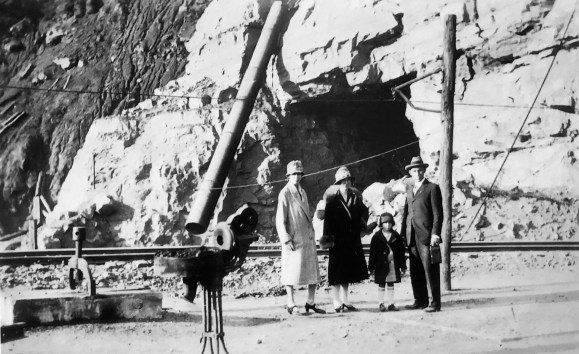
Nel Thomas Hollis, Ethelene Reed, daughter Mary Jane, and Lewis Reed at West Virginia Coal Mine, ca. 1926.
Photography became a lifelong passion for Lewis Reed that expanded in later years to include movies that he made not only of his family, but on his several trips to various parts of the world. The majority of photo prints from his albums were taken during the early part of the 20th century (ca. 1900-1930). His entire collection spans more than six decades and showcases his love for people, automobiles, events, landmarks, and travel throughout the first half of the 20th century.
He had a great eye for composition and seemed to be drawn to historical events and landmark locations, including the Smithsonian, Capitol, Union Station, Old Post Office, Library of Congress, Raleigh Hotel, grading of Massachusetts Ave in DC, and Key Bridge. There are also photographs of many non-Maryland locations including the historic landmark “Lucy the Elephant”, Gettysburg Battlefield/Monuments, Mount Vernon, Pennsylvania Monument and United States Regulars Monuments while under construction, and Quebec Bridge (the 8th Wonder of the World).
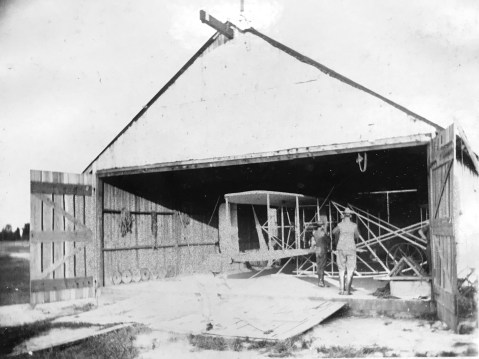
Wright Brothers Military Flyer in its hangar at Fort Myer, Virginia. Photo by Lewis Reed, 1908
Other highlights include Montgomery County Grist Mills, Rockville’s first pipe stem water tower, 1939-1940 New York World’s Fair, and rare photos of the Wright Brothers Flyer in a demonstration at Fort Myer, VA. Especially stunning are images of the aftermath of the 1936 Gainesville Georgia tornado, one of the deadliest tornadoes in American history. He also took aftermath photos of the 1929 Montgomery County F3 Tornado that devastated northeastern Montgomery County.
If there’s an historical wayside marker on the side of the road in Montgomery County, chances are, one of Lewis Reed’s images is on it. Some of the markers that display his photographs include the Andrew Small Academy Marker in Darnestown, The Origins of Darnestown Marker, Baltimore & Ohio Railroad Station Marker in Gaithersburg, From Trolley to Trail Marker in Bethesda, Clinton A.M.E. Zion Church Marker in Rockville and the 19th Century Crossroads Marker in Darnestown.
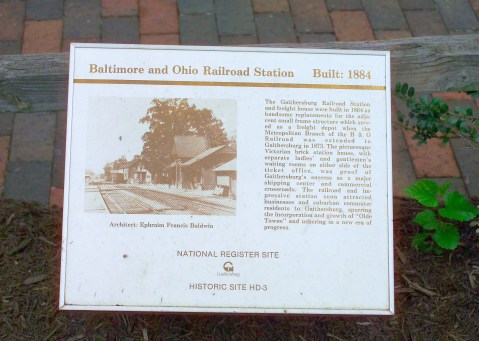
B&O Railroad Station Historical Marker located on South Summit Avenue in Gaithersburg, MD.

Baltimore & Ohio Railroad Station in Gaithersburg. Original photograph displayed on the marker taken by Lewis Reed in 1911.
Of particular interest is Lewis Reed’s collection of manipulated photographs. He was 100 years ahead of his time by creating special effects to images long before the convenience and efficiency of digital photography and Photoshop were ever imaginable. Lewis Reed used a wide variety of effects, including hand-tinting, double exposure, applied handwork, and creating images that made it look as if there were ghosts in the picture. It’s pretty amazing how his early photography shows such versatility and creativity considering the limited tools that were available at the time.

A double exposure image of Lewis Reed’s brother, Edgar, seated on both sides of a table. Photo by Lewis Reed
In the double exposure photo above, Lewis Reed’s brother, Edgar, is playing cards with himself. The thing to look out for is to see that nothing inanimate in the scene is moved during the time of making the two pictures — in this case, you can tell the angle of the camera changed slightly when Edgar moved to the other side of the table for the second shot.
His photographs comprise a remarkable historic record of Montgomery County life in the early 20th century.
Early Images of Gaithersburg and Surrounding Area
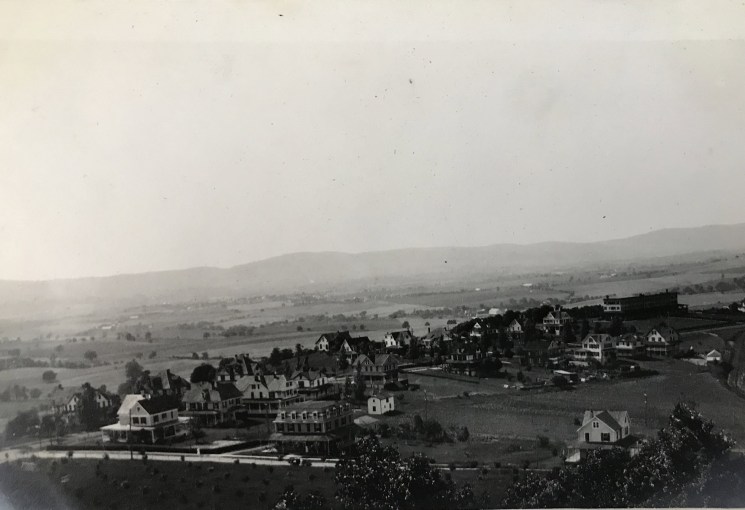
Early 1900s aerial view of Braddock Heights. Photo by Lewis Reed.
Old photos have an amazing way of showing us what life was like years ago and depicting how our communities once looked. You might not realize how much things have changed until you look back and see what it looked like in the past. Lewis Reed grew up in Darnestown and later lived in Gaithersburg, so many of his photographs depict that specific region of Montgomery County. Take a journey back in time through the lens of Lewis Reed and see what Gaithersburg and the surrounding area looked like more than one hundred years ago. As always, click the photos to get a better look.
Philip Reed Blacksmith Shop and Farmhouse in Darnestown, early 1900s
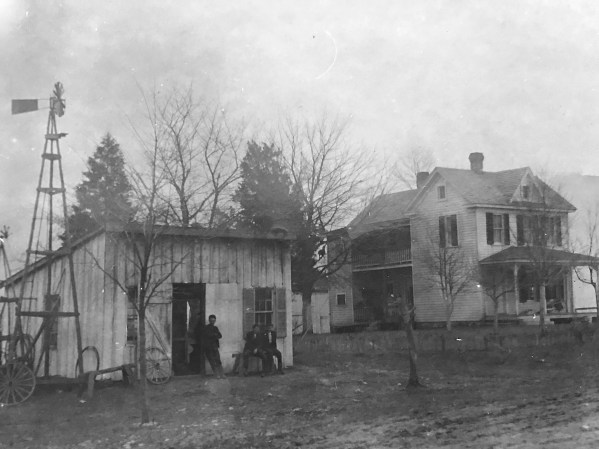
Philip Reed farmhouse and blacksmith shop located on Darnestown Road near the intersection of Seneca Road. Photo by Lewis Reed, early 1900.
Philip Reed (1845-1918), father of Lewis Reed, was an early settler in Darnestown and operated a blacksmith, wheelwright, and cabinet making business next to his home. Darnestown residents of that time included a doctor, a merchant, a blacksmith and a wheelwright. As late as 1910, there were still approximately 60 blacksmith shops in the county.
Hunting Hill, 1903
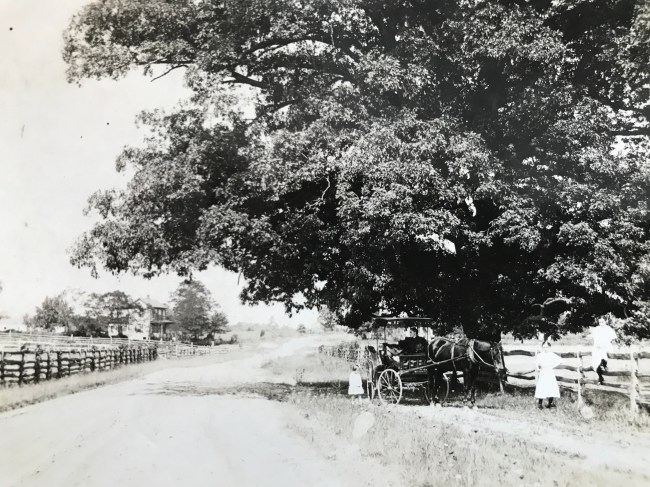
Buggies traversed rutted dirt roads across the Montgomery County countryside — sometimes their occupants needed a rest in the shade from the jolting motion of the carriage and the pounding heat of the sun. The photo above was taken by Lewis Reed on Hunting Hill Road ca. 1903.
The area along Darnestown Road between Travilah and Muddy Branch Roads was once a small rural community known as Hunting Hill. The village included a blacksmith shop, two general stores, and a schoolhouse. This photograph of Darnestown Road looking west shows the Magruder house at the corner of Travilah Road.
General Store at Quince Orchard, 1906
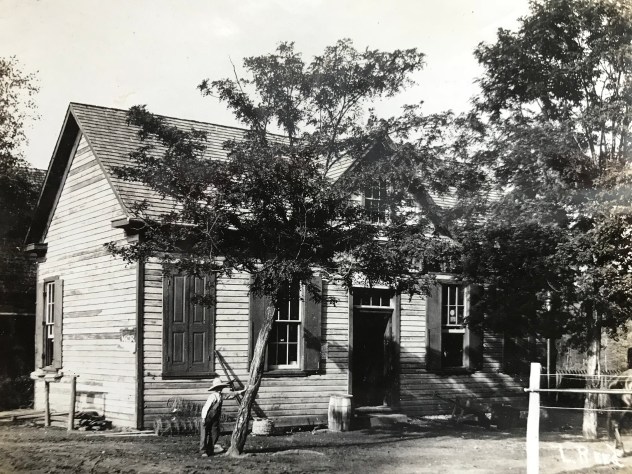
General Store at Quince Orchard. Photo by Lewis Reed, 1906
A small school for white children was established on the northeast corner of Darnestown and Quince Orchard Roads around 1850. It was damaged during the Civil War and eventually burned down in 1873. The school was rebuilt on the same site in 1875 but was moved across the road next to Pleasant View Methodist Church in 1902 after the fire destroyed the school for black children. The General Store at Quince Orchard was built on the same site shortly after the school building was moved.
Barnesville B&O Train Station, 1912

Barnesville B&O Train Station, 1912. Photo by Lewis Reed.
The original station building was torn down in the late 1950s, and for many years there was no shelter at this popular up-county stop. It was finally decided to move to the site a 16-by-22-foot historic metering station owned by the Washington Gas Light Company, with the gas company, the county, and the city and residents of Barnesville sharing the costs. The squarish little structure had a makeover after the move. It was painted inside and out and a wide overhanging roof was added just below the original roof line, giving the building more an authentic “train station” look, and it was re-dedicated on October 10, 1977. Snuggled up against the woods, surrounded by trees and shrubbery in a rural area just south of Barnesville on Route 109 (Beallsville Road), the station today is a pretty sight.
Martin Thompson House, 1907
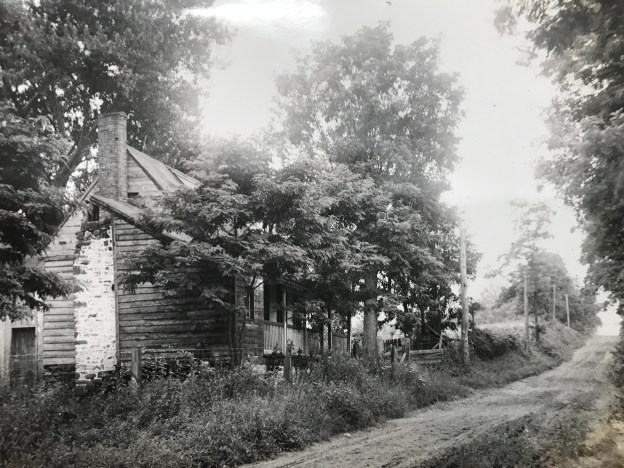
Route 28, Darnestown Road Circa 1907 – Martin Thompson House, owned by Lewis Reed’s maternal grandfather. Photo by Lewis Reed.
The home in the photo was owned by James Martin Thompson (1825–1902), Lewis Reed’s maternal grandfather. It was then called “Pleasant Hills”, which was located just opposite of the Thomas Kelly farm. In the early days, it was common practice for a family to give a name to their property. The house was accessed from Darnestown Road by a long tree-lined drive.
Route 28, in Darnestown is depicted in this photo before paving. What is now Route 28 is one of the earliest roads in the county, and was one of the main ways farmers in Poolesville, Darnestown, Dickerson, and Barnesville reached the courthouse in Rockville. Darnestown Road has existed since before the Civil war, and it remained a mud path for years into the automobile age.
Most houses in the Darnestown “Pleasant Hills” area were not very large and most were made of wood rather than brick. According to the 1860 Federal Census, Martin Thompson’s occupations were listed as Carpenter and Farmer living in Darnestown, Montgomery County, Maryland.
This photograph won an honorable mention in a contest sponsored by Rotary International for Lewis Reed.
Germantown Road at Seneca Creek, 1907
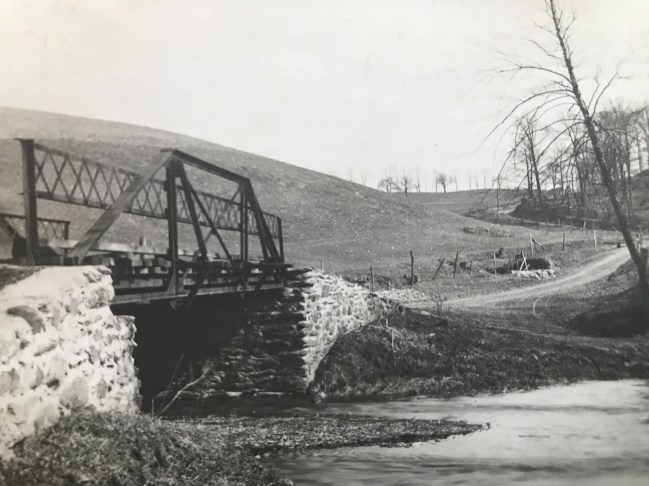
Germantown Road at Seneca Creek looking West. Photo by Lewis Reed, 1907

Germantown Road at Seneca Creek. Photo by Lewis Reed, 1907.
This view of Route 118 looking west shows the old one-lane stone bridge over the creek. In the 1930s, many of these old bridges were replaced with concrete bridges, and concrete roads were installed. Today, the rolling hills are covered with trees, and hikers can enjoy the Seneca Creek Ridge Trails, which runs directly through the land in this photograph.
Diamond Avenue in Gaithersburg, 1911

Left to Right: Belt’s Store, (sign) Charlie Foo’s Laundry, Nicholl’s Harness Shop, Etchison’s Drug Store (now Diamond Drugs), First National Bank of Gaithersburg, Jacob Miller’s Livery Stable. Photo by Lewis Reed, 1911
After the arrival of the Baltimore and Ohio Railroad in 1873, Gaithersburg’s business district had diversified to include John Belt’s mercantile store, reportedly the largest general store in the county. Many of the business owners probably lived above their shops. When constructed in 1903, the Belt building was the most ornate and substantial commercial structure in Gaithersburg.
Etchison’s Drug Store was one of the two first commercial buildings that sprang up near the business center of Gaithersburg. Earlier, two upstairs rooms of the drug store had been occupied as the dental office of Bates Etchison, DDS. Dr. Etchison would on occasion throw extracted teeth out his window, to the curious amazement of young boys below.
The second of the two nineteenth century commercial buildings was the Nicholl’s Harness shop. Nicholls Harness Shop claimed to have the best selection of harnesses and related merchandise in the state. Charlie Foo, a Chinese immigrant, owned and operated a laundry shop. The First National Bank of Gaithersburg opened on the northeast corner of Diamond and Summit Avenues in 1891.
Gaithersburg B&O Train Station, 1911

Baltimore & Ohio Railroad Station in Gaithersburg. Photo by Lewis Reed, 1911.
The station was originally built as the Gaithersburg B&O Railroad Station and Freight Shed in 1884, for the Metropolitan Branch of te Baltimore and Ohio Railroad (B&O). A freight house, which currently houses the Gaithersburg Community Museum, allowed farmers to easily ship their products. Over the years, the station buildings gradually fell into disrepair and by the 1960’s were slated for demolition. According to the Gaithersburg city website, they were purchased by the city from the Chessie Systems in 1984 and restored. The Station and Freight House have been listed in the National Register of Historical Places since 1978.
Montgomery County Almshouse, 1912

Montgomery County Almshouse. Photo by Lewis Reed, 1912
Before nursing homes, there were almshouses. The Montgomery County Almshouse was built in 1789 to provide for the County’s Indigent. The Almshouse never housed a large number of people. Over the years, the maximum number of residents appeared to range between 20 and 30. Occasionally, the Almshouse sheltered migrants, hitchhikers, or others in need of short-term temporary quarters. The 50-acre tract also included a pauper’s graveyard. As the 19th century began to unwind, women and church groups began founding Homes for the Aged.
Clarksburg Main Street, 1913
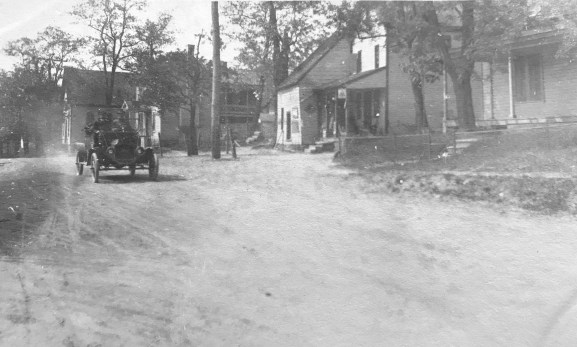
Main street (Frederick Road Rt 355) Clarksburg, 1913. Photo by Lewis Reed
By the early 20th Century, Clarksburg was the third largest town in Montgomery County after Rockville and Poolesville. Clarksburg had four general stores, two hotels, and an academy of learning. It also had a blacksmith, a doctor’s office, tanneries, shoemakers, winemakers, tailors, wheelwrights, fertilizer businesses, skilled farmers, master carpenters and two town bands.
Thomas & Company Cannery, 1917

Circa 1917 photo taken behind the Thomas and Company Cannery in Gaithersburg. The Cannery was the first and largest vegetable cannery in Montgomery County. It closed in 1963 after fire damage and lay empty until its recent restoration. Photo by Lewis Reed.
The largest and longest-lived cannery in Montgomery County, the Thomas and Company Cannery operated from 1917 until 1962. While Baltimore had been the center of the canning industry in the 19th century, the outbreak of World War I created a need to rationalize. Frank and Clyde Thomas were leaders in the 20th century canning industry in Maryland. In 1917, the Thomas family opened a cannery in Gaithersburg, the first in Montgomery County. The factory was the focus of local industry and economy, providing an important market for farmers, and employment for local migrant workers.
The factory canned peas, pumpkin and corn, supplied both the local retail market and the war effort during WW I and II. During the war years, the cannery expanded operations and functioned on a three shift schedule to provide vegetables for shipment to troops. After the war, the cannery continued to produce vegetables under the brand names MY-T-NICE, EVER-GOOD, BARBARA FRITCHIE and ON-TOP corn, peas and succotash.
Built along the B & O Railroad to facilitate shipping, the brick cannery had three main parts: the central processing station, the shipping section and boiler plant. The cannery was designated a Gaithersburg landmark in 1987.
Walker Avenue in Gaithersburg, late 1920s
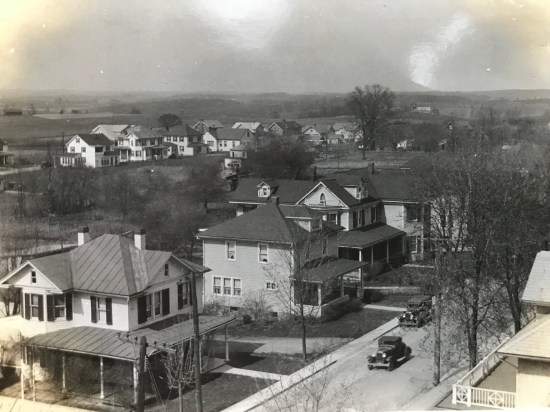
Walker Avenue in Gaithersburg taken from the steeple of Grace United Methodist Church, late 1920s. Photo by Lewis Reed
This photo of Walker Avenue in Gaithersburg was taken by Lewis Reed from the steeple of Grace United Methodist Church in the late 1920s. The street is named after John Walker, whose farm became Walker Avenue when he decided to subdivide the front end in 1904. Walker was mayor of Gaithersburg from 1906 to 1908 and again from 1918 to 1924. In June 1913, Walker Avenue was the first street in Gaithersburg to have electric streetlights installed along its full length. This period saw major advances in technology, communication, and transportation. Most of its houses were built between 1904 and 1930.
Thomas Hardware Store, 1928

Thomas Hardware Store, originally built and operated by Thomas I. Fulks. Photo by Lewis Reed, 1928
The above photo was taken by Lewis Reed when the first system of water mains and sewers were installed by the WSSC in Gaithersburg, circa 1926-1928. The store in the background is the Thomas Hardware Store, originally built and operated by Thomas Iraneous Fulks. The water pipes to be laid are resting by the side of the road. The child on the right in the photograph is Lewis Reed’s daughter, Mary Jane (Reed) Gartner. T. I. Fulks was a businessman and farmer. He worked as a bookkeeper for the Gaithersburg Milling and Manufacturing Company and then opened a hardware store at 219 East Diamond Avenue.
Asbury Methodist Village, late 1920s

“Methodist Home for the Aged”. Photo by Lewis Reed, ca. late 1920s
Asbury Methodist Home for the Aged, predecessor of the Village, was established in Montgomery County almost 100 years ago. When care for the elders of the community failed, aged citizens with no funds were designated paupers and sent to the Montgomery County Almshouse on Seven Locks Road in Rockville.
Built in 1926 on the 106-acre dairy farm of William Magruder, called Rolling Acres, Asbury Methodist Home for the Aged opened its doors for residents on April 15, 1926, and the first five elderly residents moved in. The community changed its name to Asbury Methodist Village in 1969. Today, Asbury Methodist Village is the largest continuing care retirement community in Montgomery County, Maryland, and the 14th largest in the United States.
Montgomery County F3 Tornado (Aftermath) May 2, 1929
At about 9 p.m. on Thursday, May 2, 1929, northeastern Montgomery County was struck by an F3 tornado, part of a large storm system that caused devastation from Florida to Ohio. The weekly Montgomery County Sentinel reported on May 10th that the “wind storm of cyclonic power . . . was of limited width and serpentine on its course. Everything in its path met with destruction.” These photographs were taken by Lewis Reed “after the tornado of May 2, 1929”.
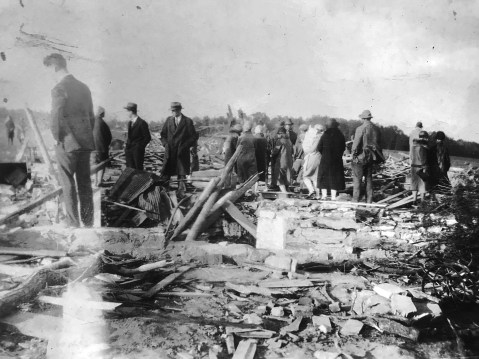
Spectators view the destruction at the Benson farm, May 1929. Photo by Lewis Reed
The damage in the county was limited to the rural Unity area, north of Brookeville. The Sentinel article detailed each affected farm, noting that “thousands of persons from far and near visited the scene for several days to look upon the indescribable wreckage.”

May 1929. Photo by Lewis Reed
From the Sentinel: “The storm showed its first violence upon the farm of Mr. J. William Benson. There it destroyed every building – the dwelling house, large barn, 117 feet long, including an attached shed, and all other outbuildings.” The farm was unoccupied, but furniture belonging to “a prospective tenant” was destroyed. Mr. Benson’s apple orchard was also significantly damaged, and the article claimed that “many [trees] were lifted into the air, carried over woods and landed several miles away.”
The fire departments of Rockville, Gaithersburg and Sandy Spring responded to the call made by farm worker James Leizear, who “extricated himself from the wreckage” and ran half a mile to a neighbor’s house to summon help.
The Post reported on May 4th that 28 people in Maryland and Virginia had been killed by tornadoes during the storm; most of the casualties were in Virginia, where an elementary school was struck full-force and at least 18 children died. In Montgomery County, the local Red Cross Chapter formed a citizen committee to raise funds “for relief of the sufferers.”
Rockville’s Park Avenue Motorcycle Club, 1912

First motorcycle club in Rockville, Maryland. One Harley Davidson, one Indian, and Three Excelsior motorcycles on Park Avenue, 1912. Lewis Reed, far left.
Take a step back in time with this glimpse into an almost forgotten era of Montgomery County history in the early 20th century… the motorcycle era.
Motorcycle clubs began forming in the early 1900s as manufacturers stressed the social, sporting, and healthy outdoors potential of the motorcycle. Both Lewis and Edgar Reed, along with brother-in-law Bernard Hanshew, began their riding adventures with a group of friends from the Park Avenue community in Rockville in the early 1900s.
Historically, riding motorized bikes, like horses, began as a gentleman’s sport. In the early days of motorcycling, propriety dictated that a gentleman be presentable when he went out for a spin. Full-length boots derived from horseback riding and a sporty cap with goggles were adapted to the new pursuit of motorcycle riding.

On Park Avenue, ca. 1912. L-R: “Happy” Hicks, Lewis and Edgar Reed, Frank Higgins, and Alvin Luctor.
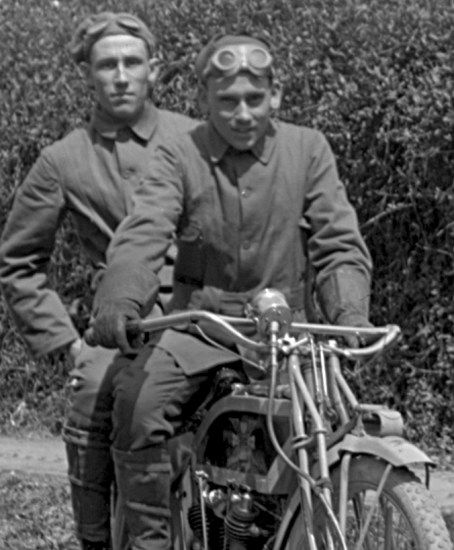
Lewis (back) & Edgar Reed
Early motorcyclists were often pictured in riding groups. From its beginnings, motorcycling developed very much as a social activity. Gentlemen of the day often used it to spice up their sunny weekends and impress ladies.

The Reed motorcycle gang on Rt 118 in Darnestown.

Edgar Reed and an unidentified lady on an Excelsior motorcycle.

Motorcyclists on Rt 118 in Darnestown. Edgar Reed, middle

Left – right: Lewis Reed with camera, Edgar Reed, Bernard Hanshew. The photo was taken 1914 in Harper’s Ferry, West Virginia. The wooden frame Victorian-style train station dating from 1889 can be seen in the background.
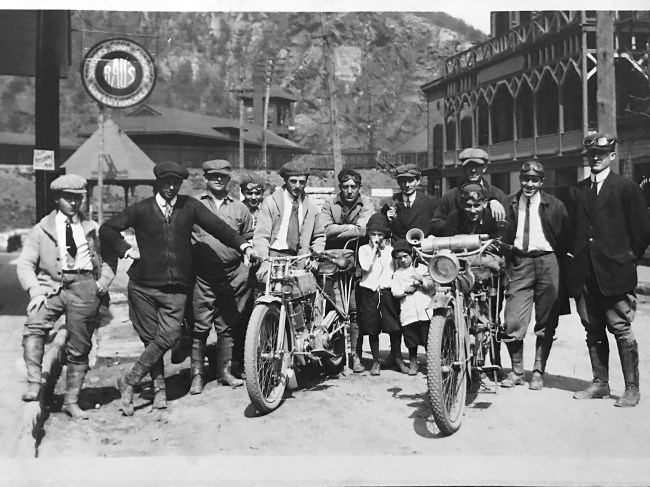
Harper’s Ferry, West Virginia, 1914
Batter Up! Reed Brothers Company Softball Team
From a distance, it looks and sounds like a regular baseball game: the crack of the bat, the cheering from the bench, the sliding into home plate. But a closer look at the field shows something is very different. They’re playing on a rough grass field, no one is using a batting helmet, fielding glove, or catcher’s mask.

Reed Brothers Softball Team playing on a field set up inside the Rockville Fair racetrack oval, circa early 1920s. Photo by Lewis Reed
From the 1920s through the 1940s, Reed Brothers had their own company softball team that played on the fields at the Rockville Fairgrounds where Richard Montgomery High School now stands. In 1939, the Rockville Fire Department and Reed Brothers Dodge, two top-ranking teams, inaugurated the Montgomery Softball Association championship series at the newly renovated Welsh Field in Rockville. Situated in the heart of Rockville’s business district, the field was renovated and illuminated in 1939.
Participating teams at the time included Pepco, Takoma Phil-Gas Company, Marine Barracks, Rockmont Motor Company, St Mary’s Boys’ Club, Lawyers and Businessmen, among others.

The Evening Star, 9 May 1939

Reed Brothers Dodge Softball Team playing on Welsh Field in Rockville, circa early 1920s. Photo by Lewis Reed
Note the player with the five finger glove in the photo above. Out of all of these photos, this is the only glove that can be seen on a player. The use of gloves wasn’t original to the first years of the game; needing a padded glove was viewed as pretty wimpy. (According to an article in the Smithsonian Magazine, one of the first players to wear a glove tried – and failed – to find one that would be invisible to fans.) By the 1880s gloves were accepted equipment, however, and soon inventors and manufacturers were coming up with new and improved gloves (more padding, deeper webbing…)

Reed Brothers Dodge Softball Team, circa early 1920s. This photo was taken at Welsh Field, which is the site of the County Office Building. The house in the background was in right field. Photo by Lewis Reed
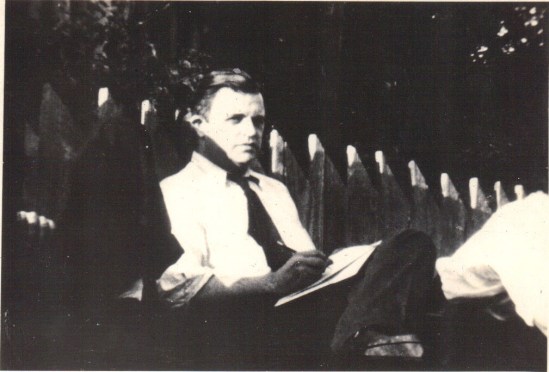
Leo (Pat) Murray, the company’s first Parts Department Manager, is keeping score on the sidelines. Pat worked at Reed Brothers for more than 21 years. Photo by Lewis Reed
From the about the 1920s through the 1940s, Reed Brothers Dodge also sponsored a bowling team that competed locally in the Rockville Duck Pin League. Participating teams at the time included Post Office, Chevrolet, Fire Department, Question Marks, Mechanics, Reed Brothers, Holy Rollers, and Potomac.

The Evening Star Feb 9, 1932
Online Exhibit: Daily Life in 20th Century MoCo
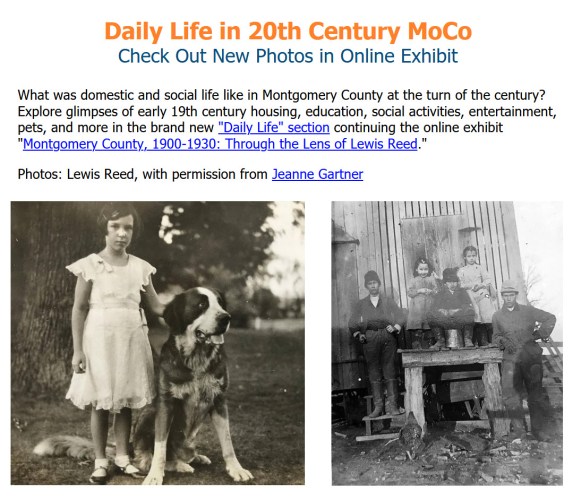 Montgomery History has launched a new “Daily Life“ section of their recent exhibit, “Montgomery County 1900-1930: Through the Lens of Lewis Reed“. A pioneering automobile dealer and one of the most prolific photographers in Montgomery County, Maryland at the turn of the 20th century. The photographs in this newly launched section reveal how residents lived, worked, played, and went to school in Montgomery County at the turn of the 20th Century. Categories include House & Home, Social Visits, Fun & Games, Family Pets, Music, and School Days. Visit https://sites.google.com/…/lewis-reed…/daily-life and immerse yourself in hundreds of photographs of days gone by! The majority of the photos in the “Fun and Games” section are of Lewis Reed’s daughter, Mary Jane. Like many parents, he never missed a chance to take a photo of his daughter, who frequently appears in many of his photos. This exhibit was co-developed by Blog Author, Jeanne Gartner and Montgomery History Librarian & Archivist, Sarah Hedlund.
Books

Related Resources


Copyright Notice

Reed Brothers Dodge History (1915-2012) by Jeanne Gartner is licensed under a Creative Commons Attribution-NonCommercial 3.0 Unported License.


Recent Comments