
Roots of a 97 Year Old Auto Business
Lewis Reed, founder of Reed Brothers Dodge, grew up on a farm in rural Darnestown and for much of his young life had no running water or electricity. He was the son of a Blacksmith, raised in a family that survived on knowledge and hard work. Philip (1845-1918), father of Lewis Reed was an early settler in Darnestown who came from the Medley’s District of Poolesville in 1880. The Reed family farmhouse was located west of the James Windsor Store and Post Office as indicated on the map. In 1880, Philip Reed bought this lot from Windsor on which he built his house. The house was later owned by Kelley Rice who ran the farm at “Pleasant Hills.”  In 1870, at age 25, Philip Reed’s occupation is listed as a Blacksmith and Cabinet Maker. Darnestown residents of that time included a doctor, a merchant, a blacksmith and a wheelwright. It seems Philip may not have considered his primary occupation as a wheelwright, but I do know he worked with both cabinetmaker and blacksmith skills. Blacksmiths were once important members of this thriving crossroads community. They provided a vital trade that continued up to the mid-20th century. It wasn’t until I traced the Reed family tree, that I found that the Blacksmithing trade goes back about four generations. Back then, it was commonplace for sons to follow their father’s professions.
“T. H. S. Boyd, The History of Montgomery County, Maryland, from Its Earliest Settlement in 1650 to 1879” gives a population of 200 in the Darnestown area in 1879. The inhabitants of the town at that time are recorded in G.M. Hopkins’ Atlas from which the map reproduced above is taken.
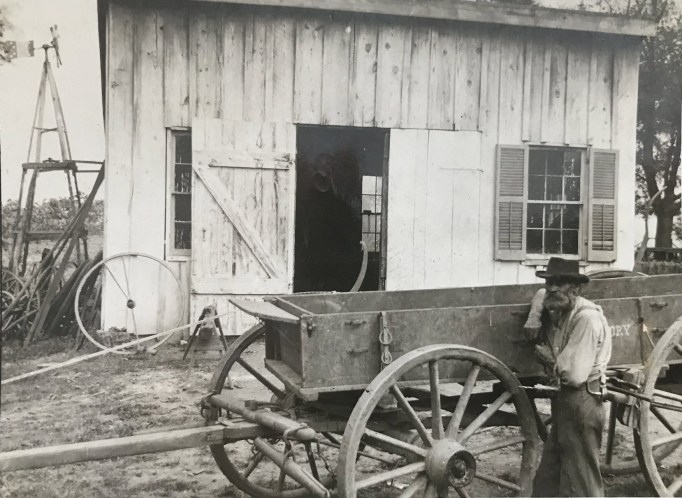
Formerly located on Darnestown Road near the intersection of Seneca Road, Lewis Reed’s father, Philip (1845-1918), operated a blacksmith, wheelwright, and cabinet making business next to his home. Photo by Lewis Reed.
Lewis Reed’s passion for cars began at a very early age. He was a young man full of curiosity, with an insatiable desire to know details, how things worked, and why. Early vehicles were terrifyingly loud and could be heard coming from at least a mile away on rural country roads. As a child, he would watch cars go past the family farm and then take off running across the fields to catch up with them until they would go out of sight. The “normal” speed during this time was so slow that drivers had difficulty keeping their cars from stalling out. It was my mother, Mary Jane Gartner (Lewis Reed’s daughter) who told me this story.

Philip Reed family farmhouse and blacksmith shop. Photo by Lewis Reed
At the beginning of the 20th century, farming was done with the power of horses and the skills of a blacksmith were important to the local economy. The shop was a popular destination, to wait for repairs of equipment, have horses shod and hear the latest news.
According to the 1910 U.S. Federal Census, Philip Reed worked as a Blacksmith in Darnestown until about age 65, after which time he moved his family to the Park Avenue community in Rockville. In July 1910, Philip purchased lot #3 of the east side of Park Avenue. In 1916, Lewis purchased lots 4-9 and started a garage and automobile dealership which became Reed Brothers Dodge. In 1923, he sold lots 4-7 to Edgar at which time Edgar then constructed a bungalow home and resided there until sold in 1947.

The Park Subdivision in Rockville, Lot #3 purchased by Philip Reed in 1910
From Miscellaneous For Sale Section: The Washington Post, (Washington, D.C.) April 21, 1910
 The classic anvil and hammer, in addition to tongs, forms, wedges, and chisels were all key tools of the Blacksmith; many of which were hand-made by each individual blacksmith. If they did not possess the tools required for a specific job, blacksmiths would make their own. Over the span of a blacksmith’s career, he could accumulate hundreds of different tools that existed solely for the completion of one particular item.

A young Lewis is shown inside his father’s Blacksmith Shop, ca. early 1900. The identity of the man on the right is unknown. Photo by Lewis Reed.
Special note: Lewis Reed’s love of photography began at a very young age, at a time when most families did not own a camera. The oldest photo in his collection is dated 1898, which would have made him around 11-12 years old when he started using a camera. I am relatively certain that Lewis took the photograph above himself by stabilizing the camera on a nearby tripod or some other object, and because of the long exposure times in early photography, he was able to run into the shot himself for a minute or more.
When the car was first invented there was no such thing as an automotive mechanic. When a car broke down, people turned to blacksmiths and bicycle mechanics for repair work. When using horses for farming and transportation came to an end, it forever changed the blacksmith’s role in the community. The traditional, small town blacksmith’s shop gradually went out of business, or evolved into the first automobile repair shops, as the horsepower of mechanical engines replaced the power of horses. Having grown up in a blacksmith family, Lewis Reed was well positioned to move to the new technology.

1916 – Rockville Garage first shop force. Lewis Reed, (first name unknown) Long and Phillip Reed. Photo by Lewis Reed.
One hundred years ago, the direction of the auto industry was uncharted territory to be explored by many people. Lewis Reed was an enterprising young man who put his future in the fledgling automobile industry. Although the specific motivation for Lewis to go into the automobile business is not clear, the 1910s was a period of exponential growth in the American automobile industry, and with a location on the major east-west route through Rockville, a town that was on its way to becoming a satellite community of Washington, D.C., he was well positioned for success. The 1910 census indicates that 23-year old Lewis Reed was working as a machinist.
In 1914, Lewis Reed became a partner in Rockville Garage with Robert L. and Griffith Warfield, a business he purchased in 1918. His brother Edgar joined the business in 1919 upon his return from World War I, and the name became Reed Brothers Dodge. In October 1915, Lewis Reed signed a franchise agreement with brothers Horace and John Dodge in Detroit. He was just 27 years old. Since then, the business grew and transformed into the oldest Dodge dealership in Maryland history and one of the oldest in the entire nation.
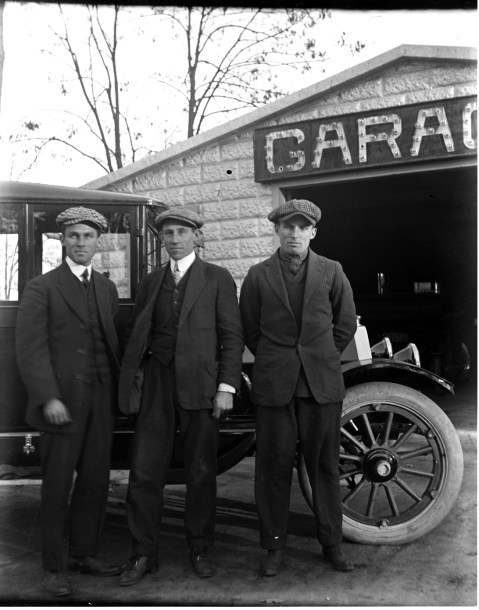
1916 – The original owners of Rockville Garage. From left: Roy Warfield – Lewis Reed – Griffith Warfield. Photo by Lewis Reed.
Over 100 years later, the only name that remains familiar to Rockville car buyers is Lewis Reed. Reed Brothers Dodge was one of the longest running automobile dealers in Montgomery County Maryland, serving Rockville and the area for over 97 years. Along with St. Mary’s Church (1813), King Farm (1925), Red Brick Courthouse (1891), and the B&O Railroad Station (1873) — Reed Brothers Dodge (1915) — became a “Peerless Place” in 2015, the year marking its 100th Anniversary. Today, Bainbridge Shady Grove Metro Apartments pays homage to the oldest Dodge dealership in Maryland history with commemorative art on the former site of the iconic Reed Brothers dealership.
Credit to: Jane C. Sween, The Montgomery County Story, “Darnestown, As It Was” (Feb 1982)
Other sources of information: Newspapers.com, Montgomery History, and Montgomery County Land Records
Looking Back 50 Years Ago Today: 55th Anniversary and Grand Opening
 Today marks 50 years since the Grand Opening of Reed Brothers Dodge new showroom and service facility. When the state widened the roads in 1970, Lee Gartner purchased 4.37 acres of land from Eugene Casey and relocated Reed Brothers Dodge to a new state-of-the-art showroom and Dodge/Chrysler/Jeep service complex on Route 355 at 15955 Frederick Road in Rockville Maryland.

Turning out to honor the company were several hundred dignitaries, officials, businessmen and friends. The new building, a complete automotive sales and service facility marked Reed Brothers 55th year of selling Dodge’s. The state-of-the-art dealership contained the newest customer-focused features throughout which combined technology and comfort. (click on any photo to scroll through gallery)


The new dealership provided a modern new vehicle showroom, 30 service bays, a comprehensive detail and car wash area, Parts Department, Body Shop, the newest technologies to service customer’s vehicles and provided customers with a convenient location to purchase and service their vehicle needs.

Design and construction of the new dealership was managed by the Glen Construction Company.
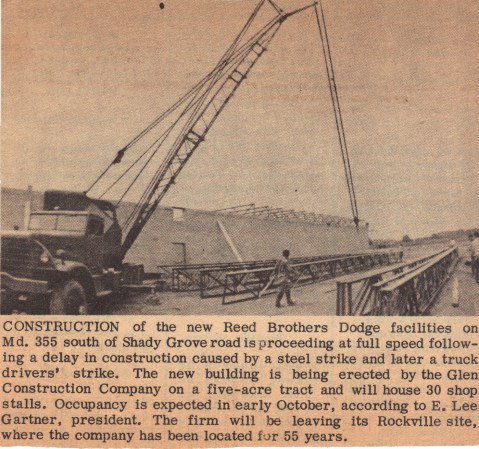 After 42 years of serving Rockville at this location, the dealership property went to settlement on August 30, 2012. Reston, Virginia-based Silverwood Companies put the former Reed Brothers Dodge dealership under contract, then won annexation into the City of Rockville, and ultimately conveyed the property to apartment builder, The Bainbridge Companies. Today, Bainbridge Shady Grove Metro pays homage to almost a Century of history by celebrating the golden age of the automobile with commemorative art on the former site of the iconic Reed Brothers Dodge dealership.
Before There Was Photoshop, There Was Lewis Reed…
If you take a look at the state of photography today, such as the advances of digital cameras and the artful image manipulation by Photoshop, it is easy to forget that back in the 1900s photographers couldn’t just go into a computer program and change their images any way they wanted. They did what they could with the tools they had. Double image exposure was one tool Lewis Reed had in his photography tool belt. He was doing crazy things to images and creating humorous effects over 100 years ago. With double exposure technique, you could create certain effects like placing the same person on both sides of a picture simultaneously. Photographs were pieced together in the darkroom from separate photographs.
Spotting these manipulated photos in Lewis Reed’s extensive collection has been both easy and difficult. It wasn’t until I viewed the high resolution scan that the modification jumped out at me. The photograph below taken at Black Rock Mill, highlights Lewis Reed’s photo manipulation. (click image to enlarge)

This is a double exposure photograph of Lewis Reed and the same two ladies with bundles of flowers appearing twice – standing on a bridge over Seneca Creek at Black Rock Mill – and on the left at the foot of the bridge. Photo by Lewis Reed, ca. 1905
With double-exposure technique, Lewis Reed learned how to make a subject appear twice in a frame, as if they had an identical twin. To capture these images, he would snap a picture of the subject in one position. Then, he would have to move into another pose before the following photo was shot. Rotating lens caps and special glass plates (the precursor to film) were also part of the process. The final image was then pieced together and developed in the darkroom from the separate photographs. The result was a playful and surreal approach to early photographs.
Double exposure technique often left a telltale vertical line running down the center of the image that is lighter than the left and right sides — a fuzzy stripe separating the two exposures. This is the area where the two exposures overlapped. The picture is lighter where the images overlap because the exposure value is doubled (causing over-exposure) in that specific vertical area. The left half of the image (standing at the foot of the bridge) ends where the light band becomes dark on the right side. And vice versa for the right half of the image (standing on top of the bridge).
Today we are accustomed to Photoshop and people manipulating images, but back in the early 1900’s photo manipulation was used as a form of whimsy.
Lewis Reed Photos in Film Premiere: The Three (Known) Lynchings of Montgomery County, Maryland
These are screenshots of three of Lewis Reed’s photographs that appeared in the premiere screening of “The Three (Known) Lynchings of Montgomery County, Maryland” held Sunday, November 15, 2020 at a virtual event sponsored by the Montgomery County Lynching Memorial Project. (click any image to view photo gallery)


Jay Malin, filmmaker and photographer:
I haven’t seen anything else that gives as good an idea of what Darnestown or Rockville or an ordinary road in the county looked like in the day of the horse and buggy…. As a photographer, I know we most often fail to photograph the aspects of daily life that would really be of interest to future generations. So to have a photo of a horse and buggy on a county road or of the almshouse, which is probably the last thing most people would have thought to photograph, is really great.
I know if my grandfather was here today, I am certain he would be truly humbled and pleased that his photography is being used to help educate future generations.
Lewis Reed’s photos have also been featured in historical television programming, including on the national television show American Pickers, Science Channel Impossible Engineering, Maryland Public Television, and the American Experience History Series on PBS.
Montgomery County Lynching Memorial Project
Jay Mallin Photos
Blog Milestone: 300K Page Views
 If you ever glance at the blog view counter on the right side of this page, you might have noticed that this blog just went over 300,000 views. After reaching this milestone, I would like to take the time to thank all of you who have visited, followed, shared, or commented on this blog. Visitors to this site on a daily basis continue to grow — we have been visited by folks from all fifty of the United States and 187 different countries world wide.
I have often been asked why I started this blog. For me, it’s because history is important. Sometimes we don’t know we need to do something until it’s handed to us, and once we have it, we suddenly see and feel its value. As we were getting ready to close the doors to the dealership for the last time in May 2012, I was standing in the empty showroom thinking about all the history, past achievements, and hardships the dealership had endured over the years. Few businesses can say they’ve lasted almost a century. It seemed a particularly pertinent time to start thinking about such a project, as it was a time of reminiscence, but also looking forward.
When I stop to think about what Reed Brothers Dodge has experienced over the last century, from World War I, The Great Depression, World War II, to three economic recessions, two energy crises, and numerous Chrysler setbacks — including the first Chrysler Bailout, the sale of Chrysler to Daimler, and the sale to the private equity firm Cerberus — I could not be more proud to be a part of such an amazing story. It takes resilience to weather 97 years in business. The dealership adapted itself multiple times in order to survive. Through the good times and the bad, Reed Brothers Dodge held on and prospered.
I felt it was important to take the time to ensure our history remained accessible for those who read it years from now, or decades from now, when I or other family members who know the story firsthand are no longer around to tell it. How Reed Brothers Dodge came into being, and how the company overcame the inevitable changes and challenges throughout almost a century of being in business — all adds up to a great story.
Creating this blog and sharing our business history has been the most rewarding endeavor of my life. I appreciate all of you for your continued support and making Reed Brothers Dodge History one of the places you visit during the course of your day.
Thanks for reading!
Jeanne Gartner, Blog Author
Books

Related Resources


Copyright Notice

Reed Brothers Dodge History (1915-2012) by Jeanne Gartner is licensed under a Creative Commons Attribution-NonCommercial 3.0 Unported License.


Recent Comments