
Reed Brothers Baseball Team, 1920
Rockville’s first experience with baseball was during the Civil War on the fields where Richard Montgomery High School now stands. It was known as “Camp Lincoln” because of the Union encampment there, and Federal soldiers helped popularize the new game they brought from the North. One little known part of the history of the grounds is that during the Civil War, President Abraham Lincoln was afraid that Maryland would secede from the Union and that the District of Columbia would thus be bordered on both sides by Confederate states. He used the land of the fairgrounds for tents to maintain up to 10,000 Federal soldiers at a time in order to do his utmost to keep Maryland, especially via the major thoroughfare of Rockville Pike, within the Union.
After the Civil War, those fields – known as the Rockville Fairgrounds – continued to be a popular place for baseball. At the dawn of the 20th century, Reed Brothers Dodge had their own company baseball team that played on those same fields. The photos below were taken by Lewis Reed on a field at the Rockville Fairgrounds in the early 1920s.
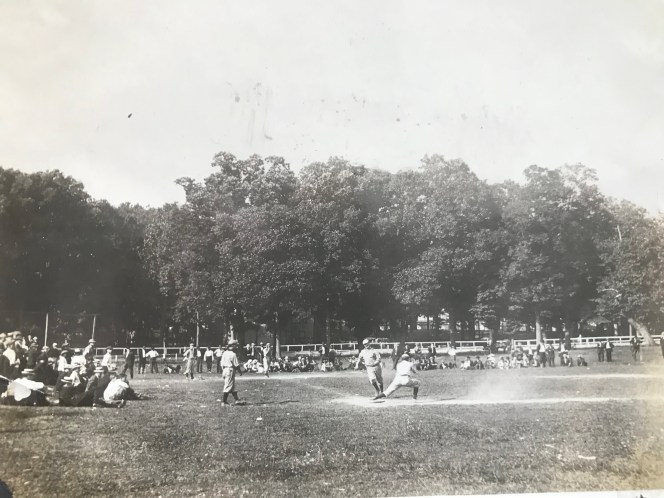
Reed Brothers Dodge Baseball Team on field at Rockville Fairgrounds, circa early 1920s. Photo by Lewis Reed
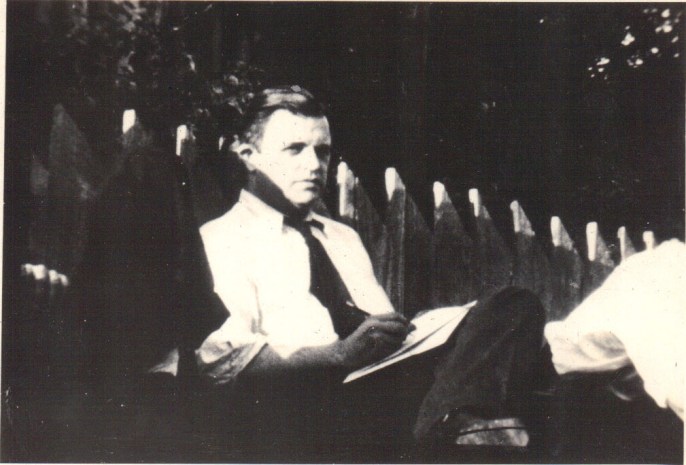
Leo (Pat) Murray (Parts Department Manager), keeping score. Photo by Lewis Reed

Reed Brothers Dodge Baseball Team on field at Rockville Fairgrounds, circa early 1920s. Photo by Lewis Reed
Note the player with the five finger glove in the photo above. Out of all of these photos, this is the only glove that can be seen on a player. The use of gloves wasn’t original to the first years of the game; needing a padded glove was viewed as pretty wimpy. (According to this article in the Smithsonian Magazine, one of the first players to wear a glove tried – and failed – to find one that would be invisible to fans.) By the 1880s gloves were accepted equipment, however, and soon inventors and manufacturers were coming up with new and improved gloves (more padding, deeper webbing…)

Reed Brothers Dodge Baseball Team, circa early 1920s. This photo was taken at Welsh Field, which is the site of the County Office Building. The house in the background was in right field. Photo by Lewis Reed
The Great Frederick Fair Parking Lot Shot, 1914

This fascinating scene of hundreds of cars parked in the Frederick Fair parking lot was taken by Lewis Reed in 1914. What is fascinating to me is, with all of these early cars painted in black, how on earth would you find your car in the parking lot?
This week (September 14-22) marks the 156th edition of the Great Frederick Fair, the largest and greatest county fair in the State of Maryland. There have been many changes since the first fair was held in 1822 when it was known as the Cattle Show and Fair: that was a two-day event, now it’s nine days. The location has changed and so has the name. Today, the Frederick County Fair is officially named the Great Frederick Fair. It’s been held in May, October and November, but now (and for many years) takes place in September — rain or shine.
Fair entertainment has certainly evolved over the years. In 1888, May Lillie, an “expert girl shot with a rifle” from the back of a running mustang, performed. In the early 1900s, acrobatic bears and monkeys, high-wire acts and vaudeville performers took the stage. In 1950, the highlight of the “Irish Horan and the lucky Hell Drivers” show was a “stock convertible catapulted from a giant cannon.” In 1965, it was Jack Kochman’s Hell Drivers performing stunts with cars.
The Thursday of the 1911 fair was noted as a record day with 15,000 people in attendance, 100 autos and 1,000 carriages, according to “The Great Frederick Fair” book. Today, fair attendance can range from 210,000 to 250,000 people during the nine-day fair.
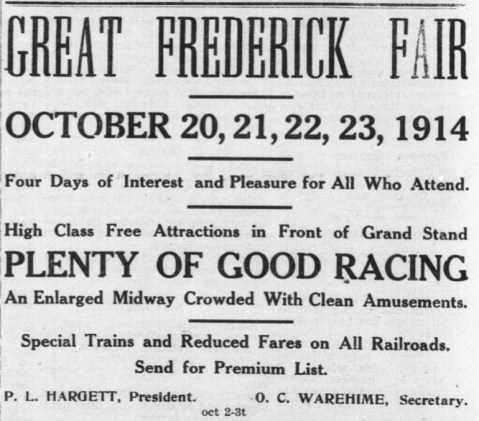
Newspaper ad advertising The Great Frederick Fair. THE DEMOCRATIC ADVOCATE OCTOBER, 1914
Source: Frederick News-Post
Lewis Reed’s ‘Ghost’ Photograph

Surrealistic, ghost-like effect of Lewis Reed (right) standing next to a tree in the middle of train track. From Lewis Reed’s Photograph Collection
Lewis Reed had a passion for photography and had the know-how to try out a few of the trick shots that were popular at the time — including creating double exposures that made it look as if there were ghosts in the picture.
When I saw this photograph — which is slick enough to fool anyone not paying attention to detail — I became curious. How on earth did he do that? So I did some research to get some information on what went into this type of photography. This technique often left a telltale vertical line along the center of the image — a fuzzy stripe separating the two exposures.
Supernatural effects were mainly accomplished using double exposure. When developing the photos, a pre-prepared glass plate would be used which already had the image of a person on it. This would be the ‘ghost’. It would then be inserted into the camera in front of an unused plate which was used to shoot the photo. The developed negative comes out with both images on it — an incompletely exposed ghostly image as well as a sitter, looking perfectly unaware.
I think it’s really amazing how Lewis Reed’s early photography shows such versatility and creativity.
Lewis Reed Photo: Lady & Toddler on a 1913 Excelsior
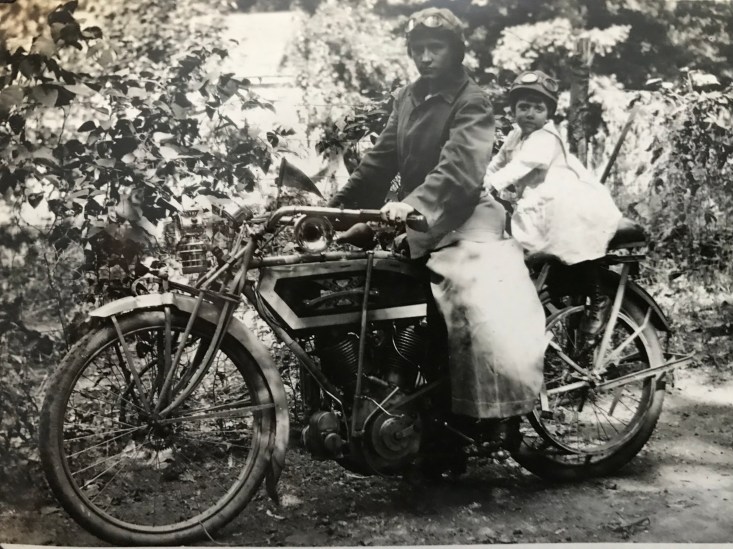
Unknown lady and toddler posing on an Excelsior motorcycle. Photo by Lewis Reed
Back in the early part of the last century when the motorcycle was still new and a novelty, it was often used for Kodak moments.
Lewis Reed has a number of photographs showing relatives and other unknown people on their motorcycles in the period of the early 1900s through the early 1920s. This photo taken by Lewis Reed is an unknown lady and a toddler (mother/daughter?) posing on an Excelsior motorcycle. The motorcycle was easy to identify because of the logo, but I could not pinpoint the exact year it was made. I tend to think it might be a circa 1913-1914 model Excelsior.
This is, without question, one of the best posed photos on a motorcycle that I have come across in my grandfather’s albums. The toddler’s sporty little cap and goggles make the image. Just imagine how excited she must have been to sit on that big machine.
The motorcycle seems to be well equipped with extras including: a headlamp, a handlebar-mounted Klaxon horn, and a well padded passenger seat on the back.
New Blog Feature: Then & Now
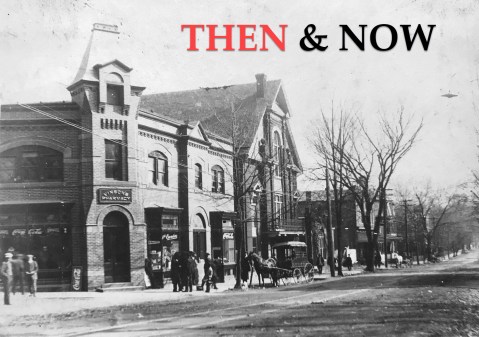
Looking back at photography from the past is a fascinating experience for me, and with a newfound interest in history, it occurred to me that with the vast number of historical photographs in Lewis Reed’s Collection, that this blog would be a great place to feature a series of Then & Now photography. I started doing this about a year ago as a research tool, now I mostly do it because of my passion for history and fascination with the subject. With that in mind, I will occasionally be spotlighting some “Then & Now” images from his collection that will show photographs of buildings, street scenes, and other historical locales alongside photographs of how they appear today.
Some of the historic locations in this series includes the Smithsonian, Capitol, Union Station, Old Post Office, Library of Congress, Raleigh Hotel, Key Bridge and other important sites in and around the Maryland, Virginia, and Washington, D.C. area. There are also photographs of many non-Maryland locations including the historic landmark “Lucy the Elephant”, Gettysburg Battlefield, Mount Vernon, Pennsylvania Monument and United States Regulars Monuments under construction, and Quebec Bridge (the 8th Wonder of the World).
I have no formal history training, just a general interest in local history where I grew up. I will post one of Lewis Reed’s photographs matched with a corresponding contemporary shot of the same area, and supply a few sentences of context. All of them will in some way will offer a visual history of how things have changed over the years. I look forward to sharing them with you.
Books

Related Resources


Copyright Notice

Reed Brothers Dodge History (1915-2012) by Jeanne Gartner is licensed under a Creative Commons Attribution-NonCommercial 3.0 Unported License.


Recent Comments