
Then & Now: Baltimore & Ohio Railroad, Point of Rocks Tunnel
This post is a continuation of a series of “Then & Now” images from Lewis Reed’s Photo Collection alongside photographs of how they appear today. Lewis Reed worked hard to preserve a visual history of Montgomery County, Maryland and surrounding area long before automobiles were even around. As early as 1905, he toured on his motorcycle across the states of Maryland, Virginia, and Washington, D.C. and took photographs of many historic locations. Taken over 112 years apart, you can see how the Point of Rocks Train Tunnel in Maryland looks almost the same from over a century ago.
Point of Rocks Tunnel (THEN): Just west of the Point of Rocks Train Station is the Point of Rocks Tunnel. The original single-track main line is the track on the far left which goes around the cliff. A boxcar is visible just to the left of the tunnel opening. The tunnel was completed in 1902 when it became necessary to add a second track. The tunnel portal has a brick facade with the bricks forming the words, “Point of Rocks” above the opening. Just over the river bank from the original main line was the Chesapeake & Ohio Canal (C&O). Space is tight there and the railroad and canal folks were often at odds. A wall between the two was constructed to help ensure the trains did not scare the mules pulling the canal boats.
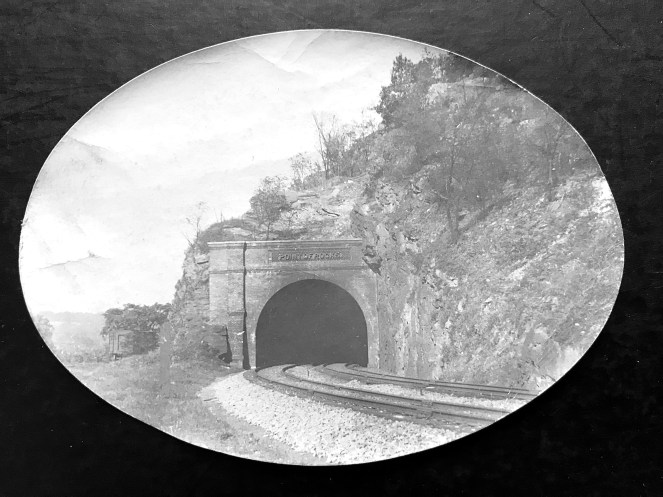
Point of Rocks Train Tunnel, 1911. Photo by Lewis Reed
Point of Rocks Tunnel (NOW): The tunnel was enlarged in 1902 to accommodate larger trains. In the early 1960s, the eastbound track was moved to the outside of the tunnel to accommodate still larger trains. This was done by blasting the rocks on the old alignment outside the tunnel, enlarging the road bed, and dumping the excavation rocks into the canal bed, where they remain today.
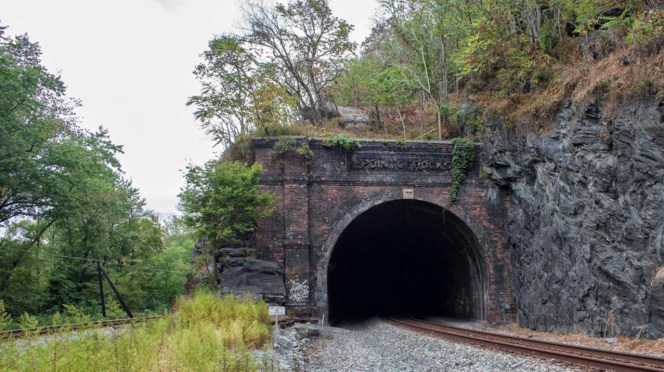
Point of Rocks Train Tunnel today
Point of Rocks Maryland, 1911

Point of Rocks, 1911. Photo by Lewis Reed
In 1835, the community of Point of Rocks, originally known as Trummelstown, was laid out at the foot of the Catoctin Mountains along the route of the C&O Canal and the B&O Railroad in order to provide dwellings for workers building the railroad and canal. The community was soon thereafter renamed for a nearby notable geographic feature of projecting rocks formed at the point where the Catoctin mountain range reached the Potomac River. This feature is no longer visible today, as it has been largely removed to accommodate the construction of the railroad and Point of Rocks Tunnel. The coming of the transportation routes and the construction of an adjacent bridge crossing and railroad spur over the Potomac River in 1852 lead to the growth of the town. By 1858, dwellings, a store, a hotel and a number of warehouses and flour mills that received grain from northern Virginia farmers for transport to Washington were located along the north side of the railroad.
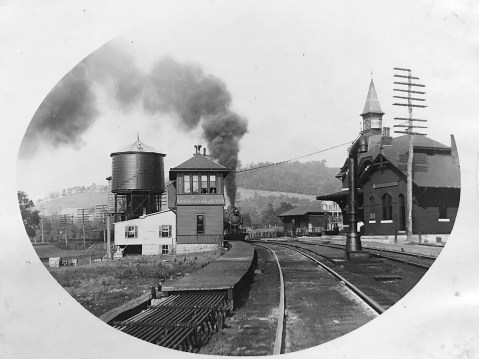
Point of Rocks Railroad Station, 1911. Photo by Lewis Reed
The growth of the Point of Rocks area was further prompted by the erection of the largest iron forge in the tri-state area on the opposite bank of the Potomac in Loudoun County, Virginia. In the mid-19th century, the operation employed over 250 men, many of whom crossed over the bridge from Maryland. The town also served passenger traffic on the railroad and became one of a number of resort towns along the Potomac River. By 1873, warehouses, hotels, and other commercial building lined both sides of the railroad and canal in an area south of the present-day village. In 1873, a location about a mile to the southeast of Point of Rocks became the junction of the B&O Railroad’s Metropolitan Branch and the Old Main Line passenger trains. The station name was first Point of Rocks, then changed to Washington Station in 1876, and reverted back to Point of Rocks in 1923.
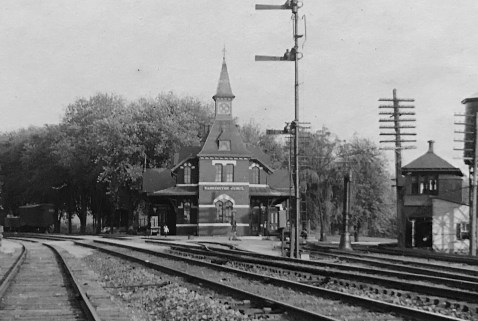
Point of Rocks Railroad Station, 1911. Photo by Lewis Reed
The growth of the low-lying village was inhibited throughout the 19th and 20th centuries by several floods. By 1910, few remnants of the original village remained, with most of the village now being located on higher ground. In 2009, the earliest extant buildings date to the late 19th century.
Veirs Mill Road Prior to Paving, 1911
Do you recognize the road pictured below? Few modern residents of Montgomery County would guess, but it is a shot of Veirs Mill Road before it was paved.

Veirs Mill Road looking east at Cedar Lane prior to paving, 1911. Photo by Lewis Reed.
Veirs Mill Road began in the 1700s as a prominent trading route leading from the mouth of the Monocacy River through Rockville to the tobacco port of Bladensburg. The road intersected with the Brookeville-Washington Turnpike (present-day Georgia Avenue), established in 1828. Veirs Mill Road was named for the saw and grist mill built in 1838 by Samuel Clark Veirs on Rock Creek, an important early waterway in the Washington, DC region.
In the early 19th century, most roads were dreadful. Rural roads were often little more than muddy trails. The popularity of the car coincided with the improvement of public roads around Rockville. By 1929, when Montgomery County residents owned 13,000 cars, the Rockville Pike and Montgomery Avenue had both been paved, but the less-traveled Veirs Mill Road remained a narrow dirt road for decades after that.
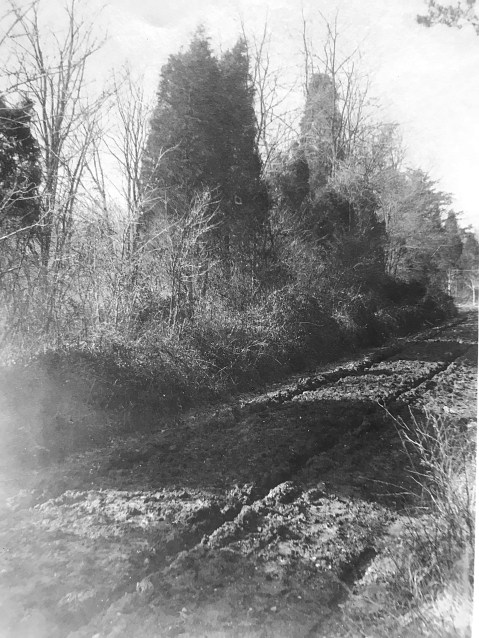
Veirs Mill Road at Cedar Lane showing deep ruts in the surface, 1911. The wagon wheels and tires of the time were very thin, and would sink straight into ruts, sometimes getting stuck. Photo by Lewis Reed.
From the “Times” (Washington):
Stalled in the mud… “Although he put on the entire 20-horsepower of his machine and called in assistance of several neighbors, it was not until shovels and crowbars had been procured to move his car… he was able to resume his journey. This experience not only caused more than an hour’s delay in reaching the city but the wear and tear on himself, those who rendered assistance, and incidentally, the machine. Thus, at least two months of the life of a $3,000 auto was spent in simply traversing a short stretch of roadway.”
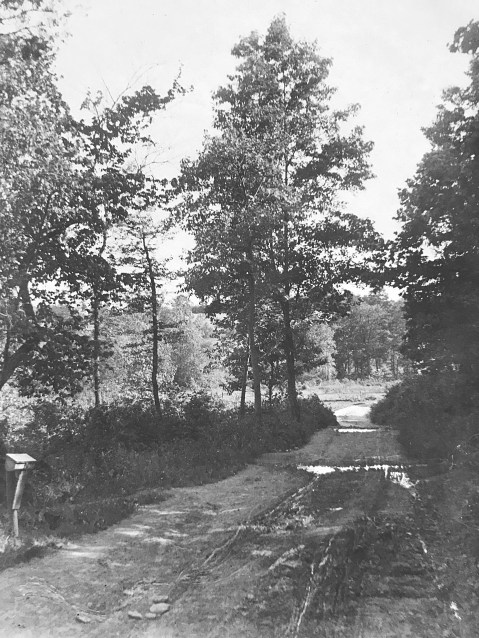
A view down Cedar Lane in Bethesda, 1911. Photo by Lewis Reed.
Rockville Pike’s reputation as “one of the worst pieces of main highway in the state” eventually helped initiate Maryland’s Good Roads Movement, alongside a nationwide initiative to improve America’s roads. Responding to citizen demands, the newly created State Roads Commission incorporated the Rockville Pike into the state highway system.
In 1956, President Eisenhower passed legislation to implement (arguably) the greatest public-works project in U.S. history: the Interstate Highway System.
With this, every major city in America would be connected via highway construction, and mobility within the U.S. would ideally become limitless: a giant leap from the dirt roads and muddy paths that existed at the beginning of the century.
Find photos like these and much more on Montgomery History’s online exhibit, “Montgomery County 1900-1930: Through the Lens of Lewis Reed“.
Short History: Formation of Rockville Chamber of Commerce
Edgar Reed was one of the first members of the Rockville Chamber of Commerce when it was formed in August 1925. Sixty business and professional men of Rockville and vicinity gathered at the Montgomery County Country Club and elected officers for the Rockville Chamber of Commerce. Edgar was elected to the Executive Board and as Chairman of the Better Business Bureau committee.
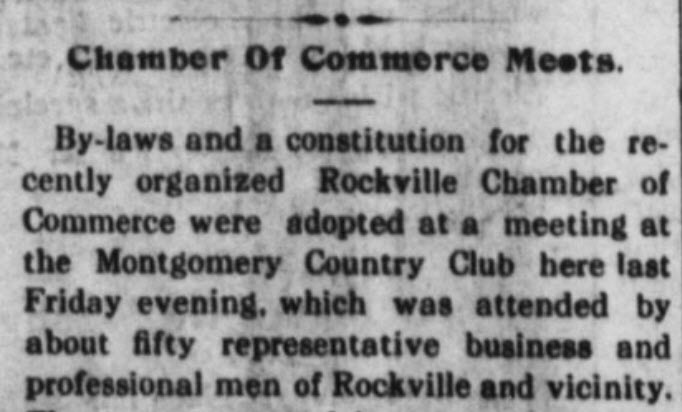
The Montgomery County Sentinel. Sept 25, 1925
From The Montgomery County Sentinel, September 25, 1925:
The purpose of the organization is set forth as “advancing the commercial, industrial and civic interests of Rockville and vicinity and to promote integrity and good faith in matters of business.”
The President was authorized to appoint committees on sanitation, public utilities, perks and playgrounds, schools, program and publicity, and the appointment of committees to cooperate with various organizations of the county for the celebration on October 2, 1926, of the 150th anniversary of the creation of Montgomery County; to investigate all stock selling schemes in the county, and to collect and invoice statistics concerning Rockville and possibilities for its future development.
The group attempted to resolve traffic and parking problems, advocate public improvements, and generally upgrade the town. Members served on the town council and generously supported the Rockville Volunteer Fore Department. Under the leadership of W. Valentine Wilson and others, the group espoused progressive ideas on behalf of improved education, economic development, and civic improvement. In 1926, Wilson commissioned a twelve-minute long movie featuring the best of Rockville—its business establishments, new firehouse, and dairy production, boasting “clean cows—clean udders—clean milk.” Organizing the Chamber marked a coming of age of Rockville’s business community. Common ground for the merchants further bonded the small town.
An integral part of the Rockville area’s past, present and future, the Rockville Chamber of Commerce is the voice of the thousands of businesses that proudly call Rockville their home.
Sources of Information:
Montgomery County Sentinel
Rockville Portrait of a City by Eileen S. McGuckian
The Automobile College of Washington

From the August 11, 1909 issue of The Horseless Age Magazine (Google Books)
In addition to the Pierce-Arrow factory in Buffalo, New York and the Dodge Hamtramck and Hudson Motor Car factories in Detroit, Michigan, Lewis Reed received automotive training at The Automobile College of Washington.
The Automobile College of Washington was organized in 1909 for the purpose of training young men to fill positions as automobile engineers. The school had a repair department and a machine shop with modern motors for demonstration, where each student was taught in the mechanical construction, use, operation, and repair of the very latest four-cylinder automobiles. Some of the cars used in the school were the Washington A-1 Touring Car, Pope Tribune, Ricketts Model G 6-cylinder, Peerless 35hp, and Mitchell 25hp.
The November 7, 1909 edition of The Washington Times announced that the school was the pioneer institution of its kind in the city. Young men without previous experience were taught to be chauffeurs to not only drive, but also maintain and repair the automobiles. The Automobile College of Washington was more than likely the institution where Lewis Reed received his chauffeur training.

The Evening Star, November 07, 1909
Books

Related Resources


Copyright Notice

Reed Brothers Dodge History (1915-2012) by Jeanne Gartner is licensed under a Creative Commons Attribution-NonCommercial 3.0 Unported License.
 Reed Brothers Dodge History 1915 – 2012
Recent Comments