
Three Cars, Three Nights at the Rockville VFD Carnival
For generations of Rockville residents, summer once meant carnival time. Each year, the Rockville Volunteer Fire Department Carnival transformed its grounds along Rockville Pike into a gathering place filled with rides, games, music, food, and crowds of families and friends.
But in August 1956, the excitement reached another level.
During the final three nights of that year’s carnival, three brand-new automobiles were given away, one each night.
And one of them came from Reed Brothers Dodge.
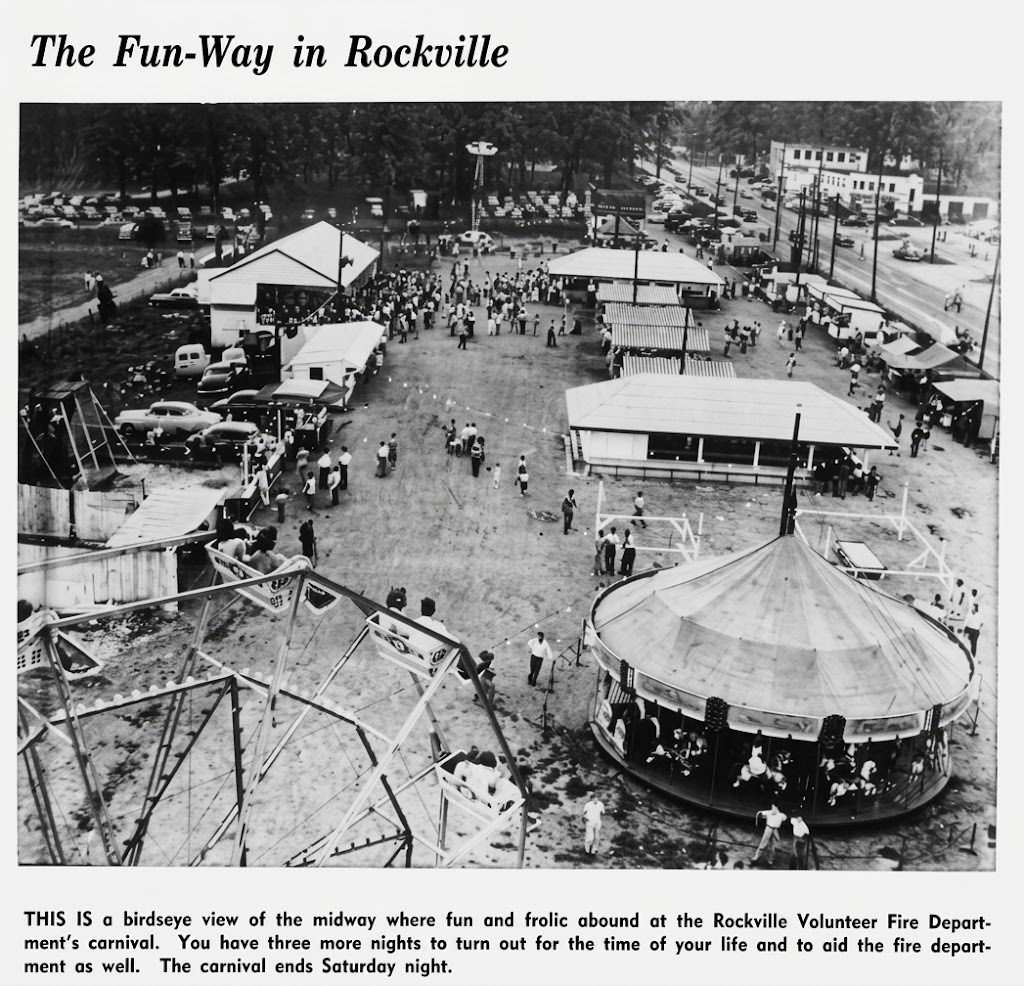
The Rockville Volunteer Fire Department Carnival midway along Rockville Pike was a familiar summer gathering place for generations of local residents.
The Rockville Volunteer Fire Department had been holding its annual carnival since 1932. What began as a fundraiser grew into a Rockville tradition, eventually occupying approximately ten acres along Rockville Pike, directly across the highway from Reed Brothers Dodge.
Unlike a traveling carnival, much of the Rockville operation was permanent. Fire department members constructed and maintained the familiar red-and-white buildings on the grounds, along with a large dance pavilion built in 1947. For most of the year the property stood quiet. When carnival week arrived, the lights came on and the grounds were transformed.
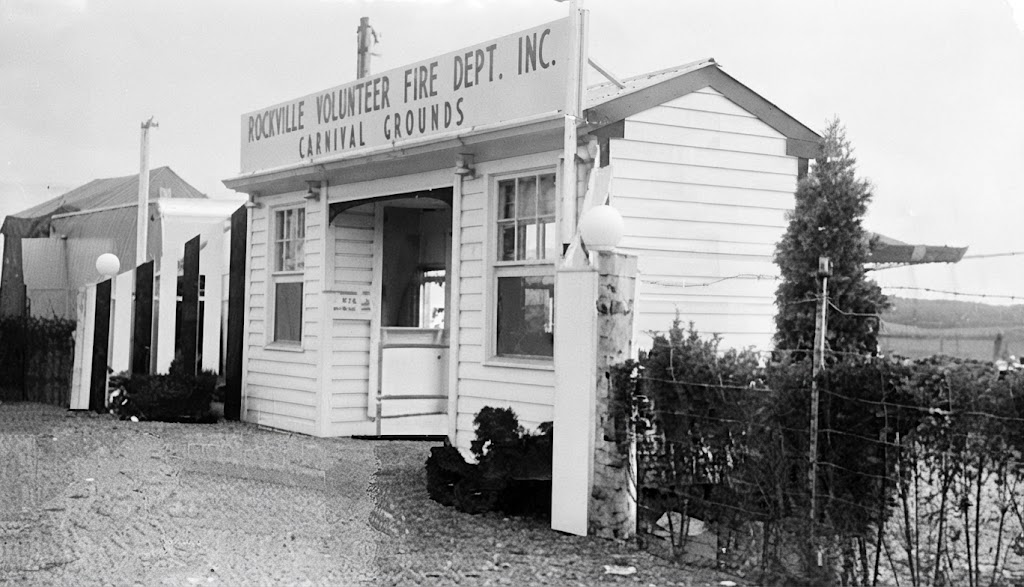
Carnival entrance from the Pike, c. 1950. Photo credit: RVFD Photo Archives.
Reed Brothers was more than simply a neighbor across the Pike. The Reed family’s connection with the Rockville Volunteer Fire Department dated to the department’s organization in 1921. Edgar Reed and his brother Philip were among its original members, establishing a relationship between the Reed family and the fire department that continued for decades.
By then, Lewis Reed and Edgar Reed were operating Reed Brothers Dodge just across the road. The dealership had been selling Dodge automobiles in Rockville since 1915, and the two institutions would become familiar landmarks along Rockville Pike as the town grew around them.

Closer view of the carnival grounds reveals Reed Brothers Dodge directly across Rockville Pike. The dealership and carnival were longtime neighbors, while the Reed family’s connection with the Rockville Volunteer Fire Department dated to its organization in 1921.
By the 1950s, the automobile giveaway had become one of the most anticipated traditions of the Rockville VFD Carnival. A brand-new car was a spectacular grand prize, and local automobile dealers helped keep the tradition going over the years.
Few carnivals, however, could have matched what happened in 1956.
On August 16, the Montgomery County Sentinel announced the carnival’s final three nights with a headline certain to attract attention:
“Three Cars Given Away At Rockville Carnival.”
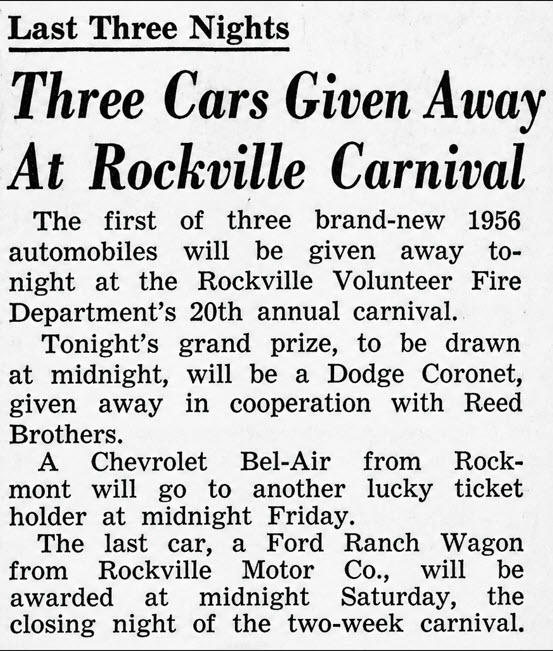
The Montgomery County Sentinel reported on August 16, 1956, that three new automobiles would be given away during the carnival’s final three nights.
Montgomery County was expanding rapidly, new neighborhoods were appearing, and the family automobile was becoming an essential part of everyday life.
A new car wasn’t simply another carnival prize. It was the grand prize.
For Reed Brothers, participating in the automobile giveaway was a natural extension of its longstanding connection to the fire department and the community. By 1956, the dealership had been selling Dodge automobiles in Rockville for more than forty years, and its buildings, signs, and rows of new cars were a familiar sight directly across the Pike from the carnival grounds.
The three automobiles were not the only attractions. The 1956 carnival offered rides, games, dancing, live entertainment, food, and prizes ranging from cooking utensils to stuffed bears. Admission was just 20 cents for adults, while children were admitted free.
Behind all the festivities was an important purpose. The Sentinel described the carnival as the culmination of a year’s work by members of the fire department and its principal source of financial support. At the time, the department received no tax money for its services.
Every admission, meal, game, and prize ticket helped support the firefighters who served the community.
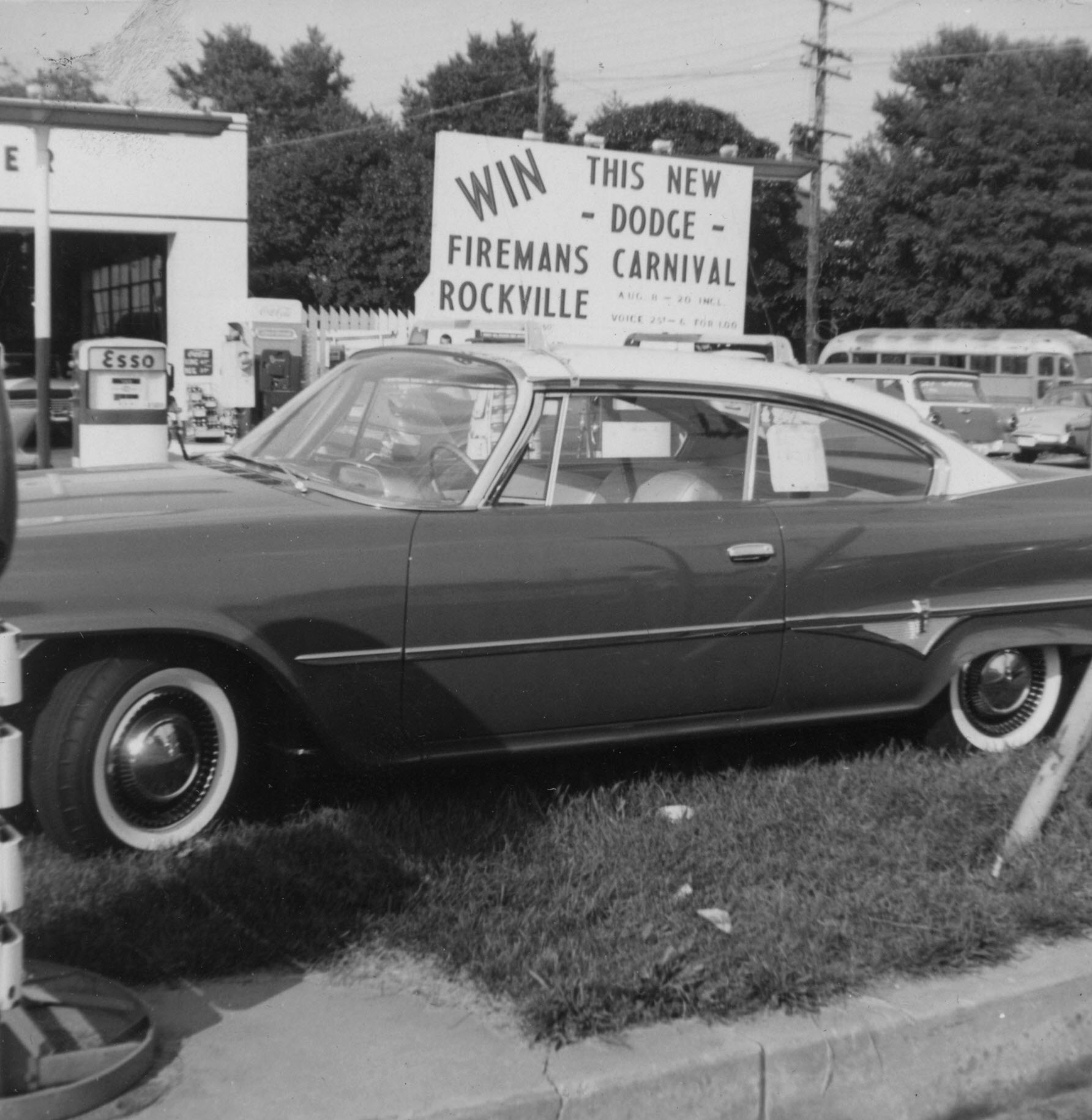
A new Dodge offered as a grand prize at a later Rockville VFD Carnival. Automobile giveaways were a popular carnival tradition for many years. Photo credit: RVFD Photo Archives.
New automobiles would continue to be among the carnival’s most exciting prizes in the years that followed.
The Rockville VFD Carnival eventually disappeared as the community and the demands upon the fire department changed. Reed Brothers Dodge remained across the Pike for decades longer.
Today, photographs and newspaper accounts preserve a glimpse of an earlier Rockville, when the annual firemen’s carnival brought the community together and buying a carnival ticket might result in considerably more than a stuffed bear.
You might just drive home in a brand-new Dodge.
Sources:
Montgomery County Sentinel, August 16, 1956
Rockville Volunteer Fire Department historical archives
Reed Brothers Dodge History archives
The Day Auto Racing Came to Rockville: Rare Photos from 1923
On Saturday, August 25, 1923, spectators gathered at the Rockville Fairgrounds for something never before seen there: automobile racing.
Professional drivers brought their high-powered racing machines to the half-mile dirt track for the first automobile races ever held at the Rockville Fair. Standing trackside with his camera was Rockville automobile dealer and photographer Lewis Reed, who captured a remarkable series of photographs of the action.
More than a century later, his images preserve the day auto racing came to Rockville.
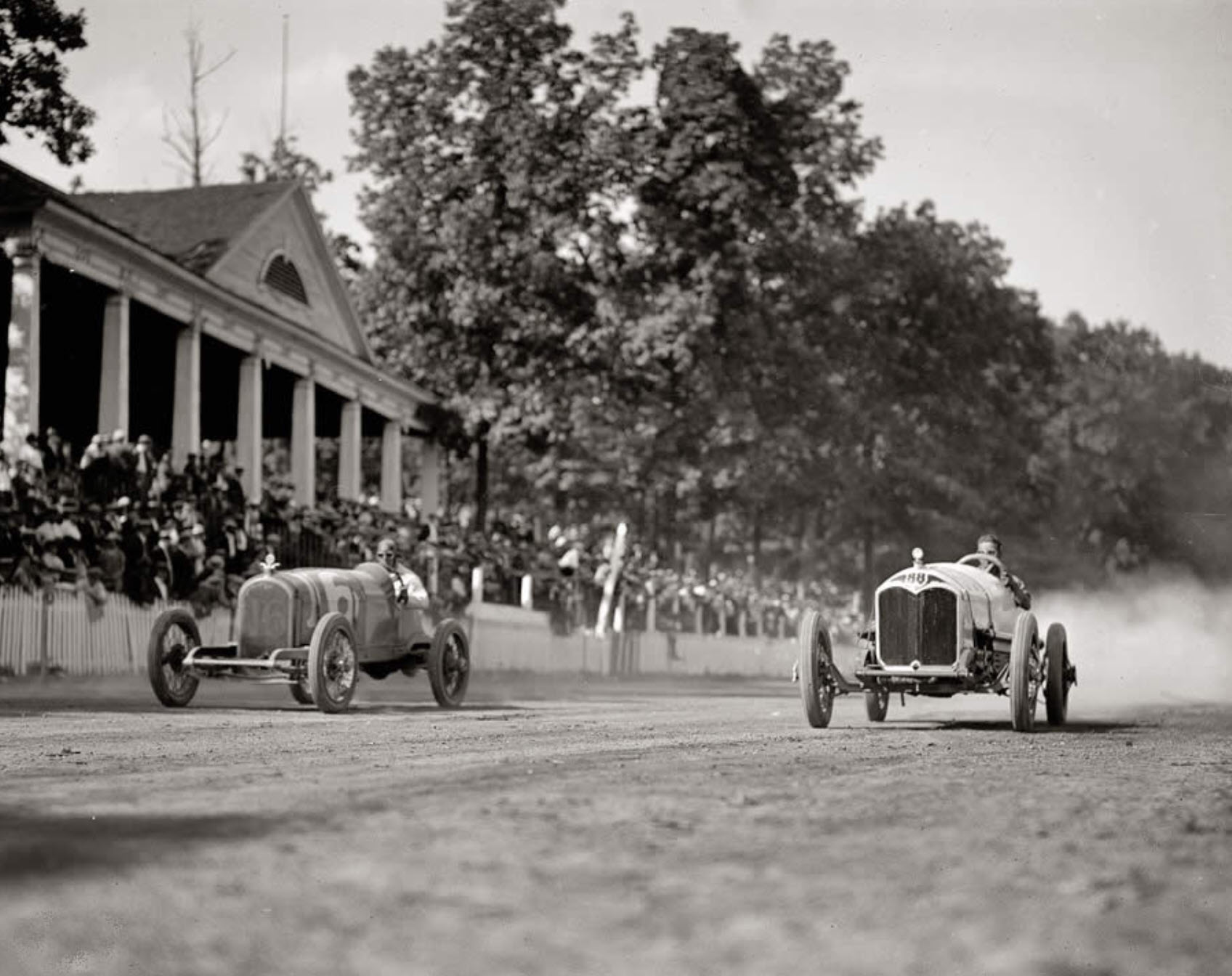
Rockville drew a large crowd for its first automobile races at the Rockville Fair, August 25, 1923. Photo by Lewis Reed.
Rockville’s First Auto Races
The automobile races were the featured attraction on the final day of the 1923 Fair. Contemporary newspaper accounts described them as an innovation for Rockville and confirmed that they were the first automobile races ever held there.
Seven high-powered cars competed in events ranging from one to ten miles, driven by some of the leading professional racers of the day. Canadian dirt-track racer Frank Ripple was among the featured drivers and was expected to attempt speed records in a powerful machine equipped with a 140-horsepower airplane engine.
The new attraction proved popular. Except for Thursday, traditionally the Fair’s biggest day, the Saturday automobile races reportedly drew the largest crowd of the five-day event.
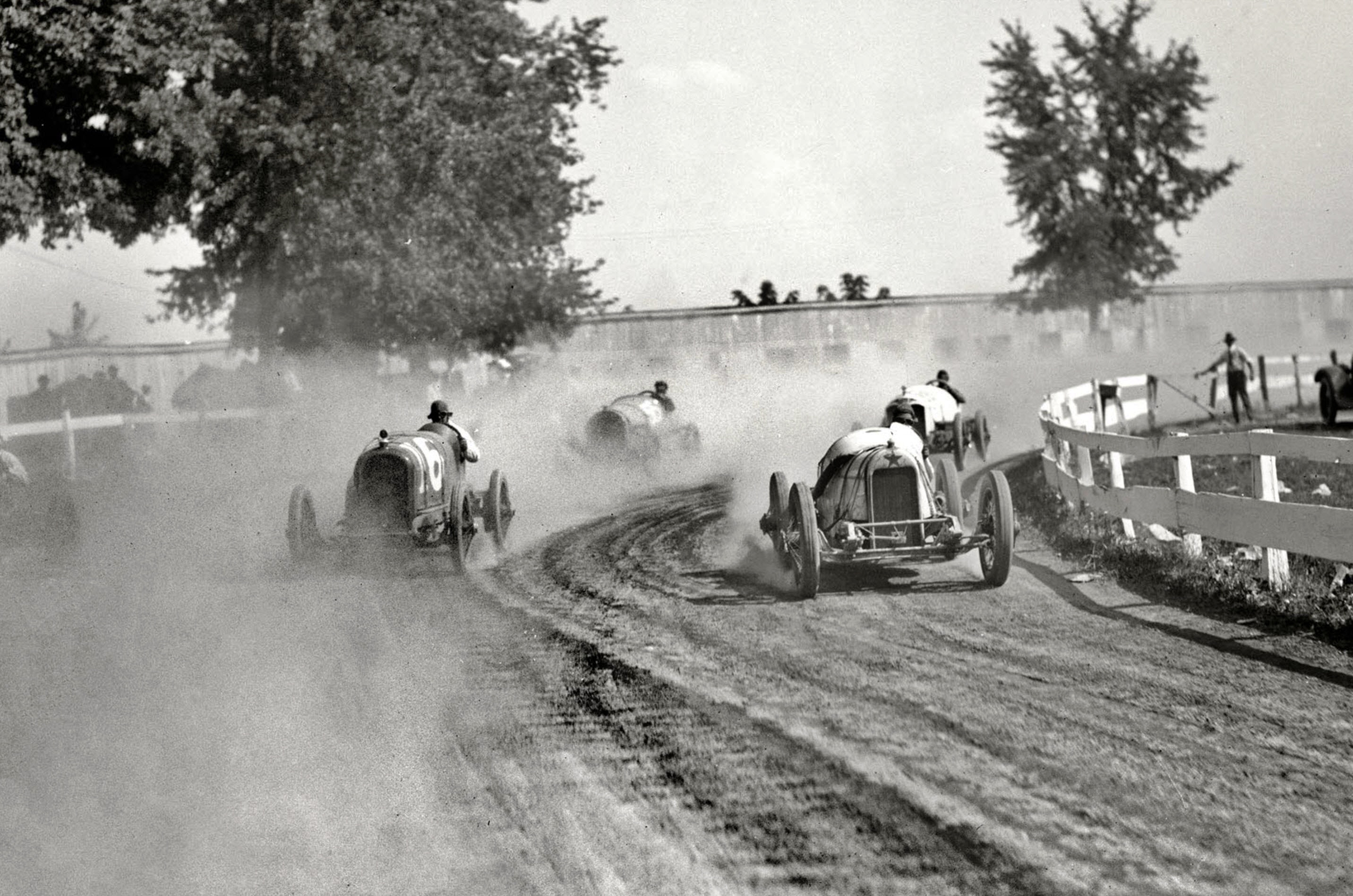
Five racers charge around the dirt track at the Rockville Fairgrounds, August 25, 1923. Photo by Lewis Reed.
Racing on the Dirt Track
Lewis Reed’s photographs show just how exciting early automobile racing could be. Cars raced closely together on the unpaved oval, their narrow tires throwing enormous clouds of dust into the air as drivers fought for position around the sweeping curves.
Spectators stood remarkably close to the action.
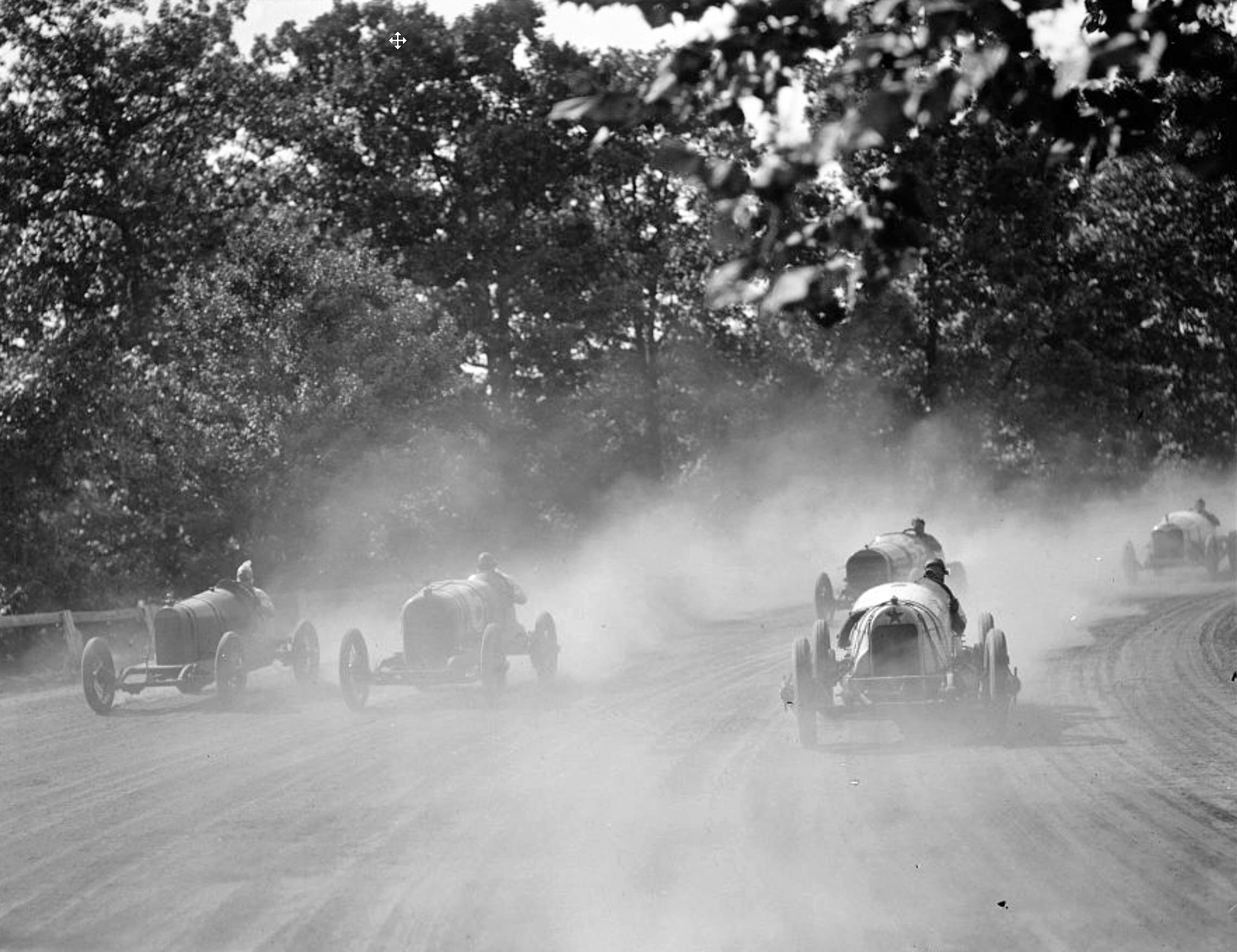
Race cars disappear into a cloud of dust while rounding the Rockville Fairgrounds track. Print made from a Lewis Reed glass negative.
One of Lewis Reed’s most interesting photographs from the races shows a car carrying two men. The passenger was a riding mechanic, once a familiar figure in early automobile racing. In addition to watching the mechanical condition of the car, he served as an extra set of eyes for the driver, keeping watch on competitors approaching from behind.
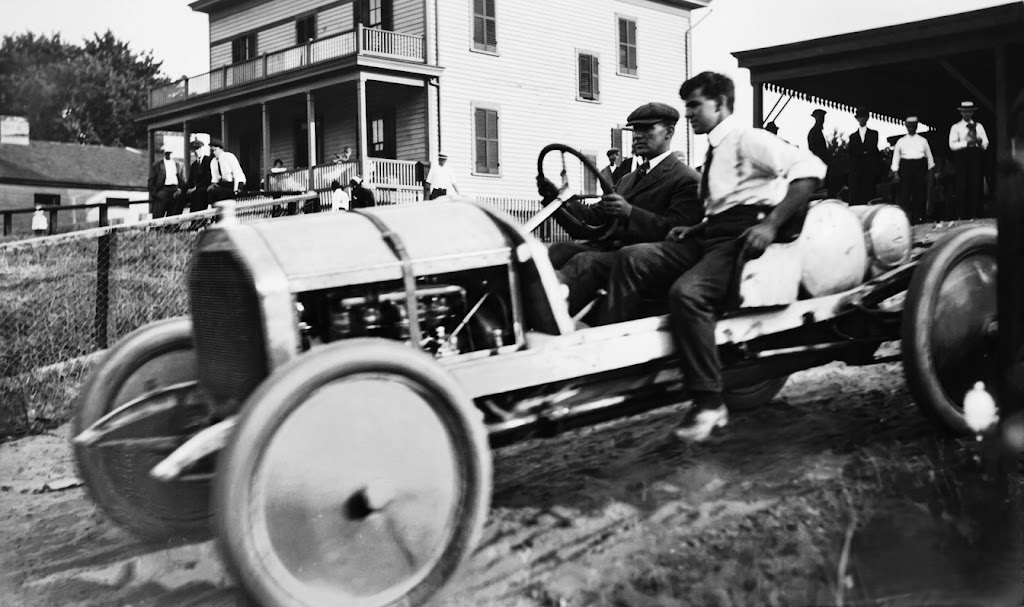
Driver and riding mechanic on the dirt track at the Rockville Fairgrounds, August 25, 1923. Photo by Lewis Reed.
A Future Indianapolis 500 Driver Raced at Rockville
Years after I first published these photographs, the story took an unexpected turn.
I received a message from John Snowberger, whose father, Russ Snowberger, raced at the Rockville Fairgrounds during the early 1920s. John told me that he had photographs of his father in his race car and believed that my grandfather, Lewis Reed, may have taken them.
Russ Snowberger, born in Denton, Maryland, raced throughout the region before going on to become a nationally known driver and a veteran of the Indianapolis 500.
Although I have not been able to establish that Snowberger competed specifically in the August 25, 1923 races, his son’s recollection provides a fascinating connection between Rockville’s early dirt-track racing and a driver who would later compete on one of the world’s most famous speedways.
It also raises an intriguing possibility: somewhere among Lewis Reed’s surviving photographs of early race cars and drivers may be an unidentified image of a young Russ Snowberger.
A Moment Preserved in Photographs
More than a century later, Lewis Reed’s photographs provide a rare visual record of the day automobile racing first came to the Rockville Fair.
They capture speeding cars, clouds of dust, spectators lining the track, and an era when automobile racing was still new enough to be a major local attraction.
And thanks to a message received nearly a century later from the son of an Indianapolis 500 driver, we now know that the old Rockville dirt track had connections extending well beyond Montgomery County.
For one dusty Saturday in August 1923, Rockville became a racing town.
Demolition of Original Rockville Garage Buildings (1971)
When the state widened the roads in 1970, Reed Brothers Dodge relocated its business to a brand new service complex at 15955 Rockville Pike, several miles north of its old location across from King Farm. The buildings on the Dodge Street site were all demolished to allow for re-routing of the Veirs Mill Road and Rockville Pike intersection.
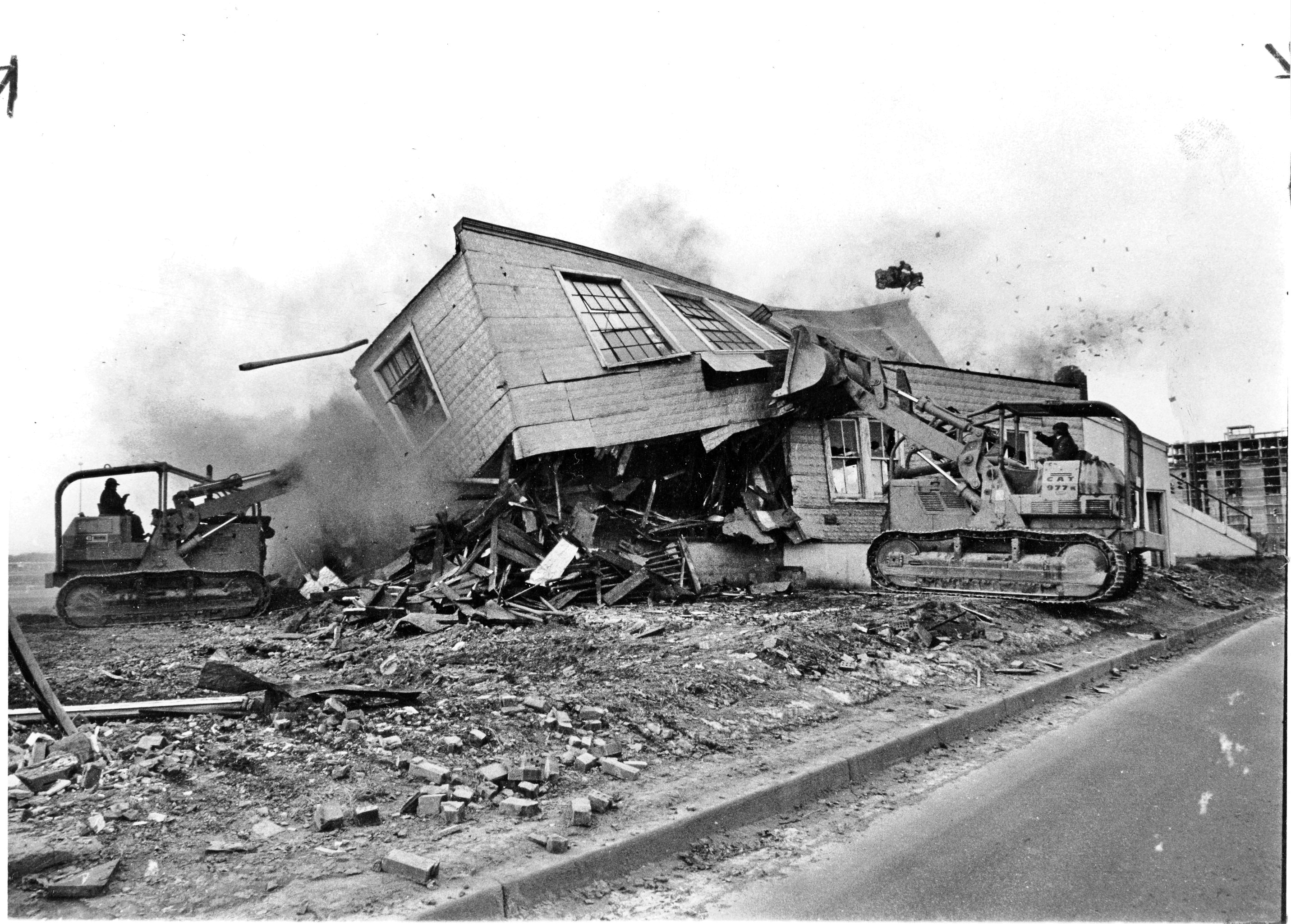
February, 1971: demolition of the original Rockville Garage buildings, which had stood on the Veirs Mill/Rockville Pike location for more than fifty years. (Montgomery History, Sentinel Photo Morgue)
Top photo from Montgomery History’s Sentinel Photo Morgue: Taken from Veirs Mill Road, the photo shows demolition of the original Rockville Garage buildings, which stood at the triangle site for more than 50 years.
Note: I think the picture captured the moment the bulldozer pushed the second story of the flat-roofed Body Shop OFF of the first, hence all the dust and debris flying in the air! Zoomed in, you can just see the edge of the old concrete ramp on the right side which led up to the Body Shop, as well as a partially completed building in the background, which I believe is the Americana Centre that opened in 1972.
Bottom photo: aerial view of the empty lot taken in 1971 after the business had been relocated and the buildings had been razed.
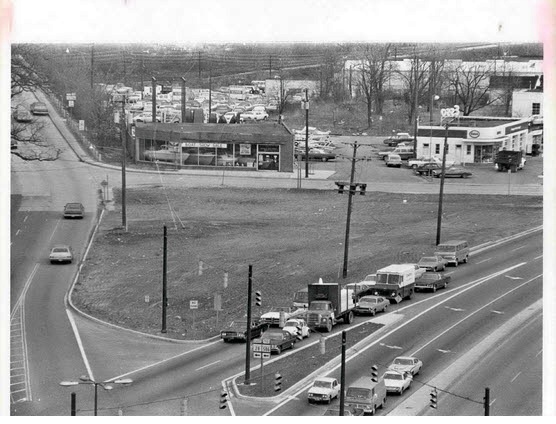
This photo of the Reed Brothers Dodge site was taken later in 1971, after the business had been relocated to 15955 Frederick Road and the buildings had been razed. (Montgomery History, photo by Bob Pusey)
Short History: Formation of Rockville Chamber of Commerce
Edgar Reed was one of the first members of the Rockville Chamber of Commerce when it was formed in August 1925. Sixty business and professional men of Rockville and vicinity gathered at the Montgomery County Country Club and elected officers for the Rockville Chamber of Commerce. Edgar was elected to the Executive Board and as Chairman of the Better Business Bureau committee.
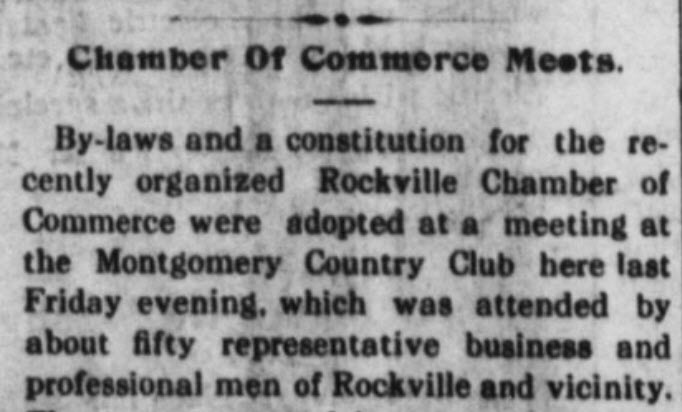
The Montgomery County Sentinel. Sept 25, 1925
From The Montgomery County Sentinel, September 25, 1925:
The purpose of the organization is set forth as “advancing the commercial, industrial and civic interests of Rockville and vicinity and to promote integrity and good faith in matters of business.”
The President was authorized to appoint committees on sanitation, public utilities, perks and playgrounds, schools, program and publicity, and the appointment of committees to cooperate with various organizations of the county for the celebration on October 2, 1926, of the 150th anniversary of the creation of Montgomery County; to investigate all stock selling schemes in the county, and to collect and invoice statistics concerning Rockville and possibilities for its future development.
The group attempted to resolve traffic and parking problems, advocate public improvements, and generally upgrade the town. Members served on the town council and generously supported the Rockville Volunteer Fore Department. Under the leadership of W. Valentine Wilson and others, the group espoused progressive ideas on behalf of improved education, economic development, and civic improvement. In 1926, Wilson commissioned a twelve-minute long movie featuring the best of Rockville—its business establishments, new firehouse, and dairy production, boasting “clean cows—clean udders—clean milk.” Organizing the Chamber marked a coming of age of Rockville’s business community. Common ground for the merchants further bonded the small town.
An integral part of the Rockville area’s past, present and future, the Rockville Chamber of Commerce is the voice of the thousands of businesses that proudly call Rockville their home.
Sources of Information:
Montgomery County Sentinel
Rockville Portrait of a City by Eileen S. McGuckian
Books

Related Resources


Copyright Notice

Reed Brothers Dodge History (1915-2012) by Jeanne Gartner is licensed under a Creative Commons Attribution-NonCommercial 3.0 Unported License.


Recent Comments