
Christmas Trees and Snow Villages from 100 Years Ago
With only a few days left until Christmas, I thought it might be fun to take a look at some photos from Lewis Reed’s collection that show us what Christmas trees used to look like 100 years ago. In those days, there was not wide-spread agreement on exactly what a tree should look like, which made for a lot of creativity. Not surprisingly, they were very different than the perfectly shaped tress we have on display today.
The trees were big back then and always fresh. They went right to the ceiling and were very wide. Early Christmas trees were generally fastened onto a flat board surrounded with fence-rails, snow villages and carpeted with cotton blankets of snow. The tree in the photo below has an abundance of tinsel, which grew in popularity to the point that, by the 1920s, it was common to nearly cover the tree in the decorative material.
So, what is tinsel (aka icicles) exactly? Originally made from strands of silver alloy, tinsel was in fact first used to decorate sculptures. It was only later that it became a Christmas tree decoration, employed to enhance the flickering of the candle flames. In the 1950s, tinsel became so popular that it was often used as a substitute for Christmas lights.
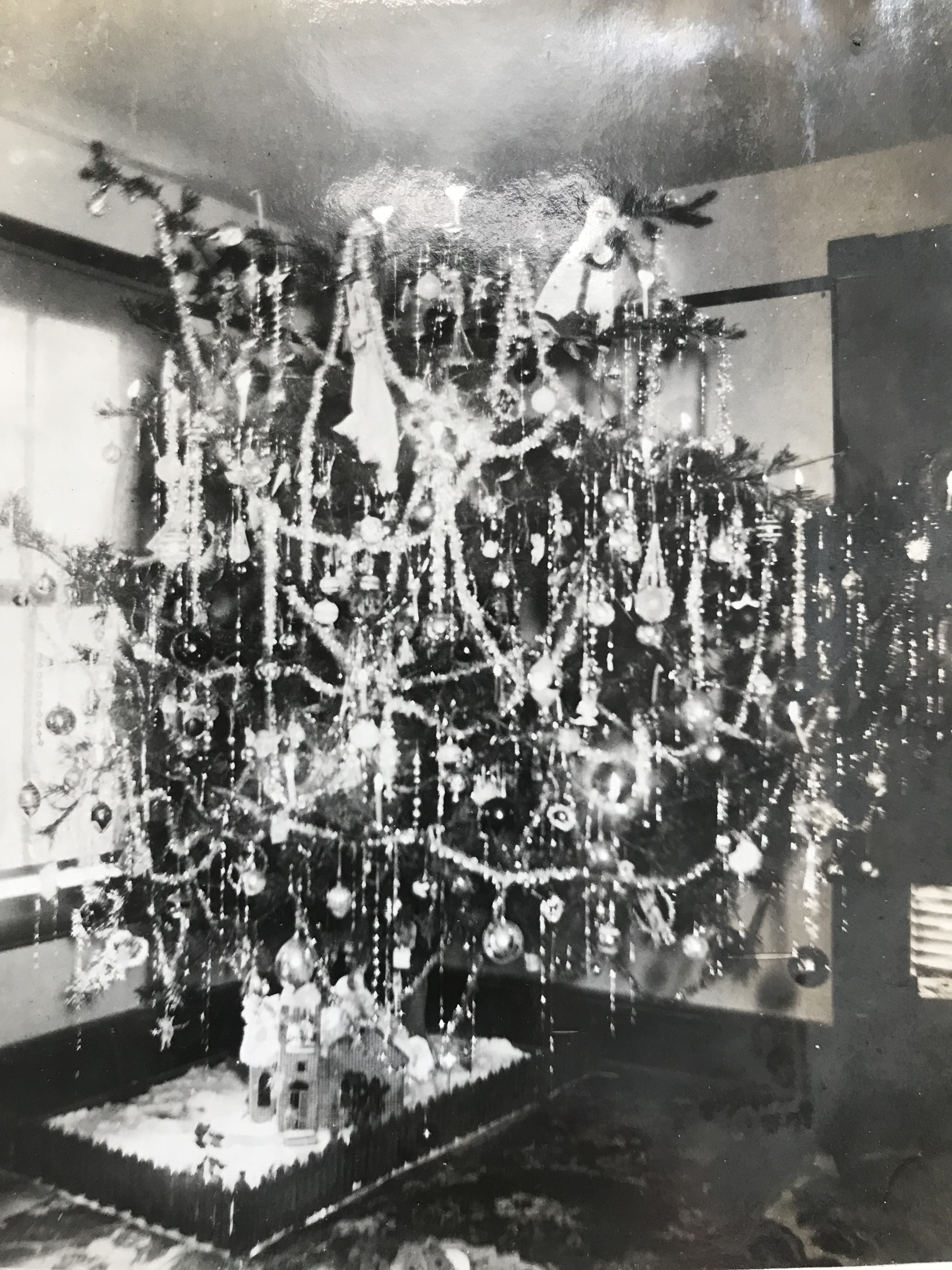
A small snow scene with what appears to be a miniature church is arranged at the foot of the Christmas tree. A popcorn garland adorns the tree. Photo by Lewis Reed
So, where did Washingtonians get their trees?
From The Evening Star, Washington, DC 23 December 1923:
Conduit Road on the long stretch between Glen Echo and Great Falls for many years has been a favorite hunting ground where hundreds and hundreds of families have customarily obtained scrub pine trees for Christmas week. Usually there is plenty of holly and some mistletoe to be found in the rugged and rolling hill lands which are the gateway to Great Falls.

No room for a star on the top of this tree! And just look at those big Santa and Angel dolls. Other fun little details are notable, including a miniature church with picket fence is arranged at the base of the tree. Photo by Lewis Reed
There’s a fine art to decorating Christmas trees that’s been developing since over 100 years ago. People consider lights, garland, ornaments, skirt, and more. But one thing that’s hard to resist sometimes is just filling every available space with decorations. Clearly, that was the case years ago too. What I like about these trees is that they are so randomly shaped and even misshapen. Folks back then didn’t trim them down to a more aesthetically pleasing symmetry like we do today.
The tradition of building miniature Christmas village landscapes, including houses, animals, and other hand-crafted wooden figures, began with the Pennsylvania Dutch in the late 1800s. Mass-produced cardboard houses, sold in dimestores, became popular in the mid-20th century. Today, these villages in good condition can be highly collectible.
Below are photos of Lewis Reed’s snow village set up under the Christmas tree decorated with vintage ornaments, tinsel, and lights. I don’t remember the odd-shaped Christmas trees, but I do remember having a lot of fun helping my grandfather set up the miniature landscapes with the varied figures, little houses, and trees at Christmastime each year. It seemed like a holiday village right out of a storybook.
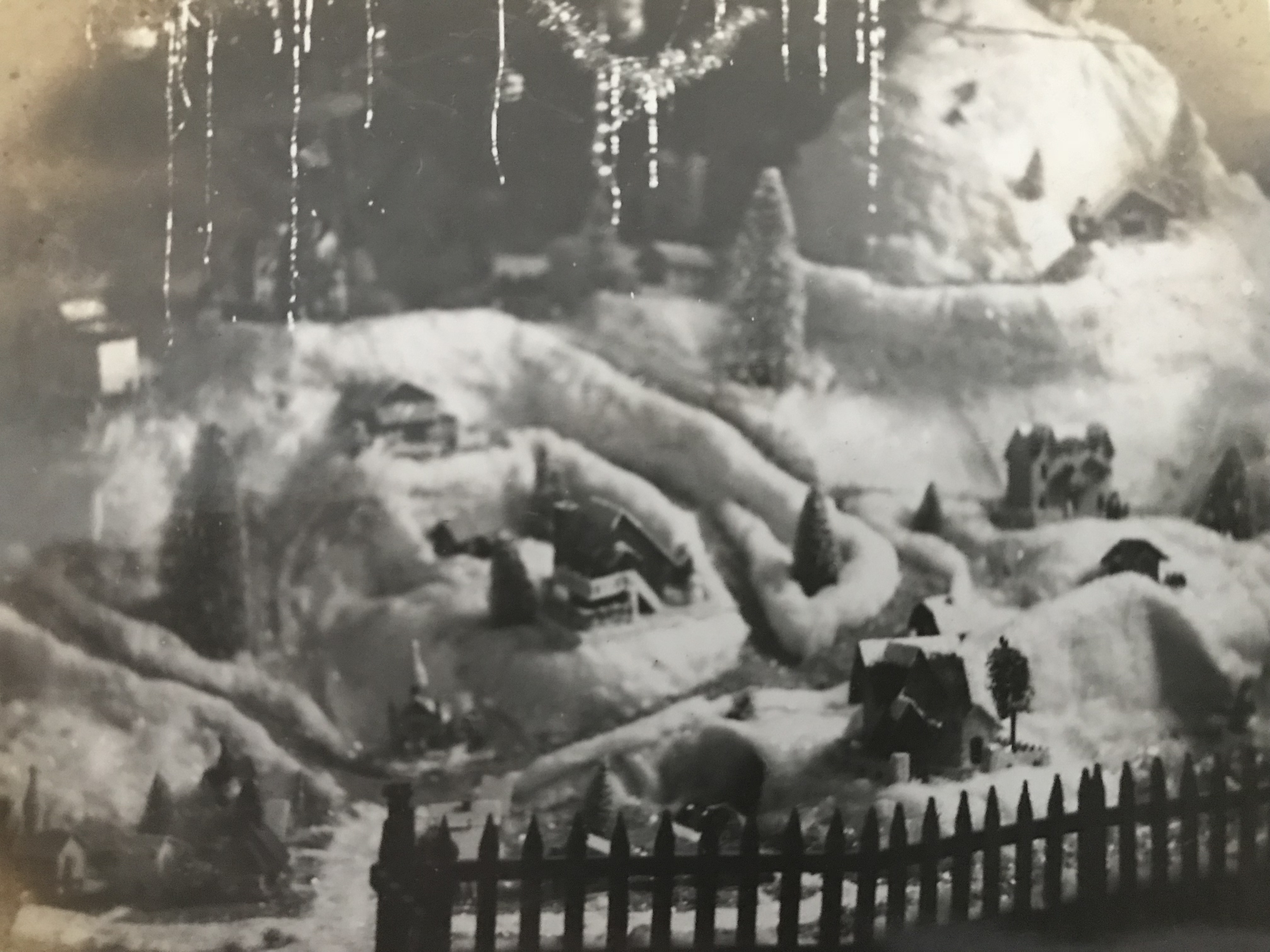
A rustic picket fence is used to set off the village display. Dangling strands of tinsel hang below the tree. Photo by Lewis Reed
The snow villages were set up in Lewis Reed’s basement on top of a big table beneath a small Christmas tree. He made the snow scenes entirely by hand using wire-covered cardboard and balled up paper to make hills and pathways. The little houses and figurines would fit into the landscape with cotton ‘snow’ all around; and lights would be wired underneath.

Little houses, churches, fences, trees, and pathways were added to the scene. Some of the houses have charming light effects in the windows. The roofs of the houses were decorated with fake snow. Photo by Lewis Reed
These Christmas villages were precursors of the Holiday Villages that were made popular by Department 56 that you see today.
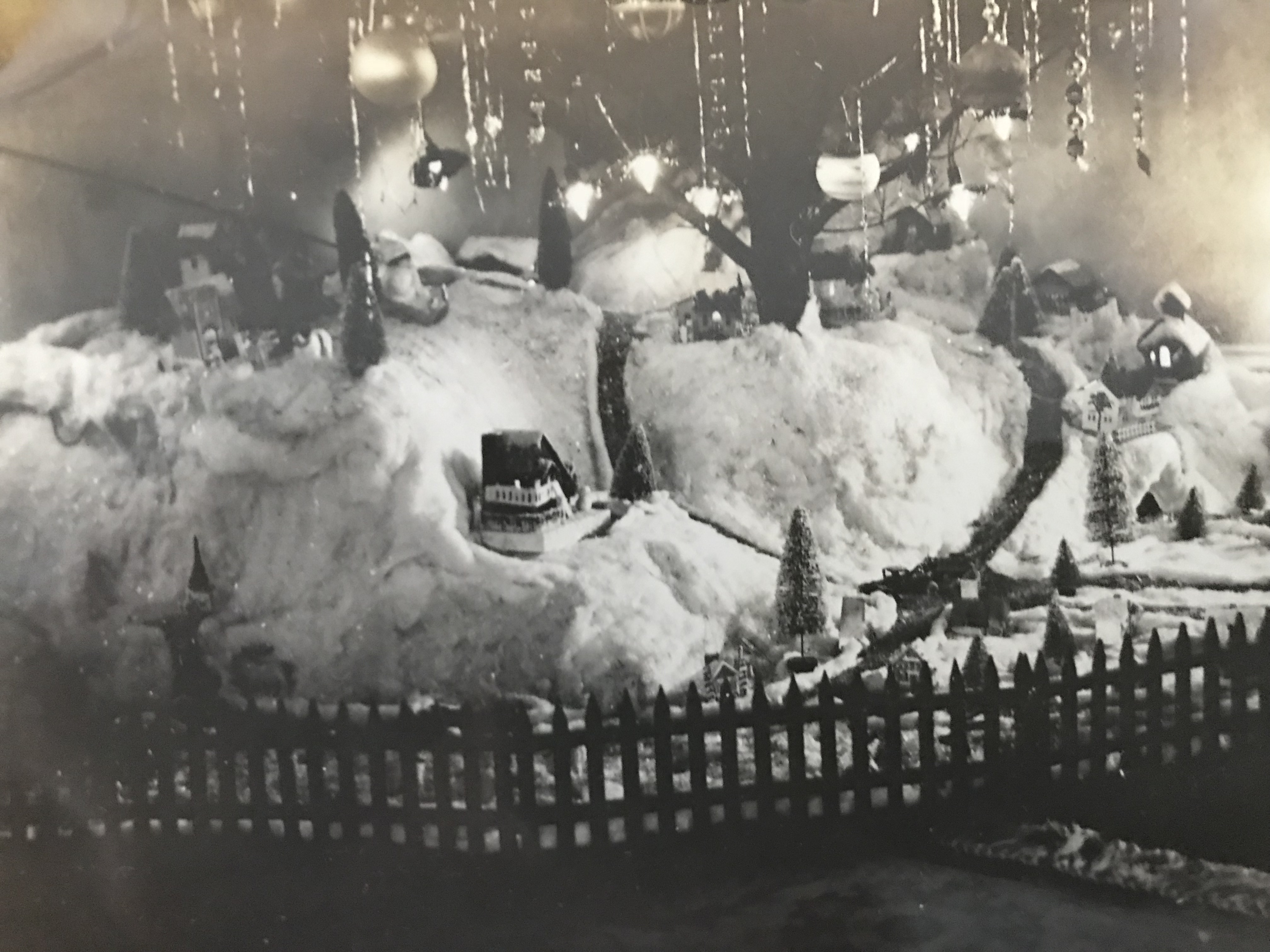
Old-fashioned lights can be seen on the tree, along with lit windows in the houses. The miniature houses usually had holes in the back or the bottom through which tiny lights were placed to provide illumination. Photo by Lewis Reed
Wishing all of you who have stopped in to visit a very Merry Christmas and Happy New Year! Stay safe and enjoy the holiday season with friends and family!

Montgomery History Online Exhibit: Montgomery County, Then and Now

Montgomery County, Then and Now: Photography of Lewis Reed and Barry Gartner
Opened December 6, 2023
Curated by Jeanne Gartner and Sarah Hedlund
Montgomery County: Then and Now, offers a captivating visual journey through more than a century of local history, told through rare photographs by Lewis Reed and his grandson Barry Gartner. This site presents side-by-side comparisons of historic scenes photographed by Reed between 1900 and 1930 and contemporary color images recreated from those same vantage points by Gartner in 2023, illustrating the dramatic changes, and sometimes surprising continuities, in the landscape, infrastructure, and community life of Montgomery County, Maryland.
Visitors are invited to explore stories behind each image, discovering the evolving character of familiar places as trees mature, buildings disappear, roads shift, and horse-drawn buggies give way to automobiles. The exhibit also delves into the personal histories of its featured photographers: Lewis Reed, remembered for his pioneering photography before founding Reed Brothers Dodge in 1915, and Barry Gartner, a third-generation owner who honors his grandfather’s legacy through both automotive restoration and modern photography.
A unique feature of the exhibit is the interactive map links accompanying each photo pair, allowing viewers to pinpoint the exact locations where history meets the present moment. Through this dynamic blend of archival and modern visuals, Montgomery County: Then and Now deepens our appreciation for local heritage and the passage of time, connecting generations through the lens of two accomplished photographers dedicated to capturing the changing face of their community.
This online exhibit opened December 6, 2023, and is thoughtfully curated by Jeanne Gartner and Sarah Hedlund, providing rich historical context and insight into the fascinating process of recreating these historical photographs. The full exhibition is available online at https://sites.google.com/view/mocothenandnow/home
What Halloween Looked Like 100 Years Ago
With Halloween just around the corner, I thought it would be fun to feature a special post how families celebrated Halloween 100 years ago. Thanks to the these photographs from Lewis Reed’s collection, we can travel all the way back to 1914.
At the turn of the century, women often wore their regular clothes topped with homemade masks. The first Halloween costumes were usually worn by women and reflected the idea of masquerades that was extremely popular in the early 1900s. People only began to buy manufactured costumes in the second and third decades of the 20th century.

Halloween, ca. 1914. These women are holding homemade Halloween masks for their upcoming celebration. Photo by Lewis Reed
Oh the good ol’ days, when wearing a mask was enough to be dressed up for celebrations! Do you know how your ancestors’ celebrated Halloween? Newspapers are a great source to get a better understanding of life in the past. This special post is a look back through newspaper articles and Lewis Reed’s photographs at how Halloween was celebrated 100 years ago.
Stocked Stores: Stores were stocked with all the Halloween supplies needed for a fun celebration. Below is an ad for costumes and masquerade suits for those participating in Halloween parties and other seasonal affairs.

The Washington Post, 30 October 1916
Dancing and Parties: Halloween parties and dancing were enjoyed by many. Some announcements even included a list of guests in attendance!

The Baltimore Sun, Nov 3, 1912
Here is the description of a Halloween party from the Society Section of the November, 1916 issue of The Evening Star (Washington, District of Columbia):
A Halloween party was given last evening… and a merry evening spent by those present. The reception hall, living and dining rooms were artistically decorated with autumn leaves, lanterns, chrysanthemums and orange and black streamers. The evening was spent in old-fashioned games, concluding with the entire assemblage gathering about an open fireplace in the dark, while the guests were led by a ghost through various parts of the darkened home. The evening’s entertainment concluded with music, dancing and the serving of refreshments.
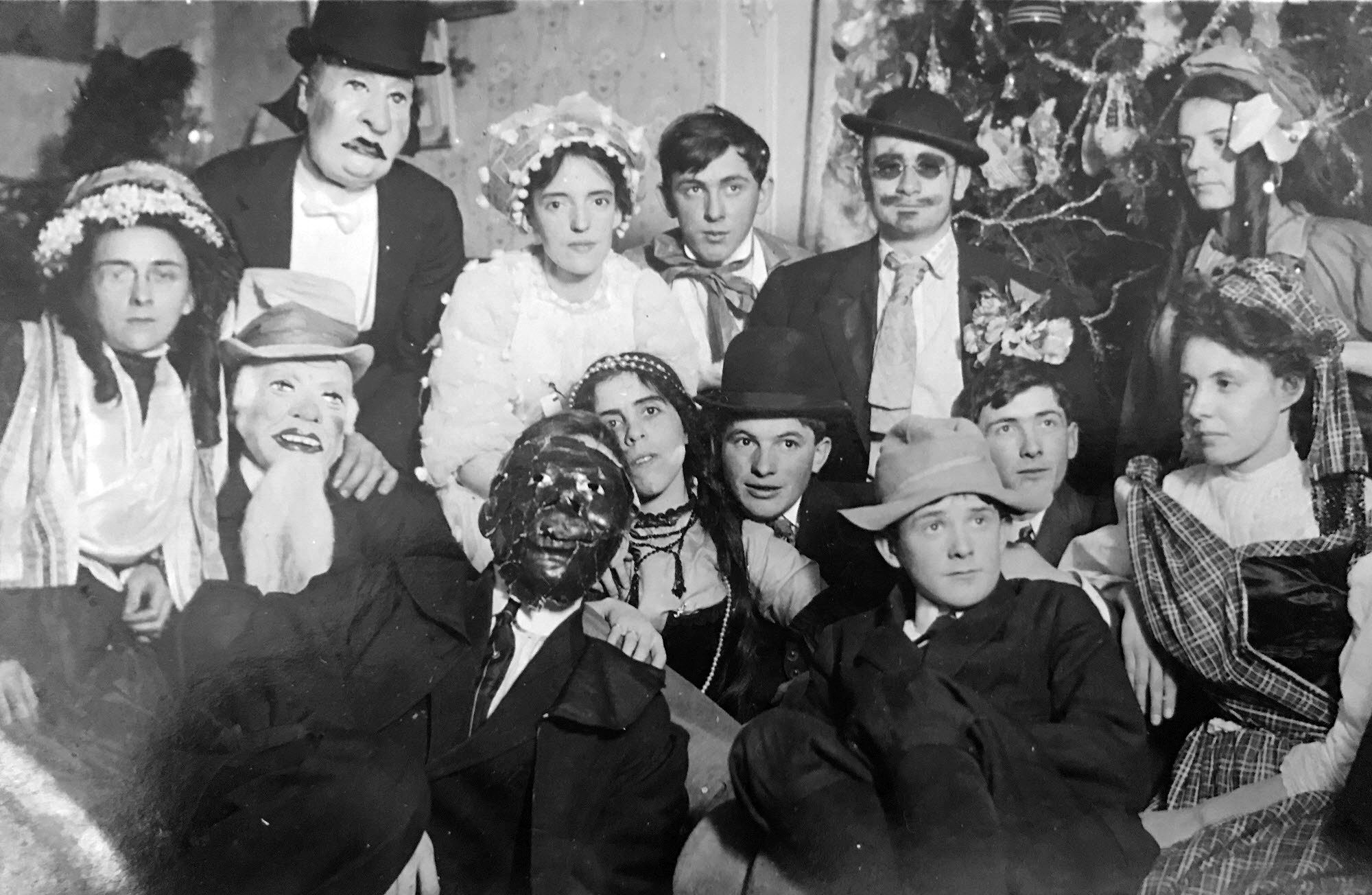
This photo captures a moment from a Halloween party over 100 years ago and is equal parts amusing and creepy. Photo by Lewis Reed
Any sort of Halloween festivities demanded some sort of refreshment. In addition to traditional pumpkin pies and molasses cookies, a suggested dish to serve at Halloween parties was a Halloween salad.

The Evening Star, October 24, 1915
Halloween Pranks: Witches and goblins, ghosts and mischief-making youngsters were permitted to enjoy all the Halloween revelry they liked … BUT DON’T THROW FLOUR. Yes, apparently in the early 1900s, there wasn’t much to do for entertainment, so kids would knock on doors on Halloween night and throw flour at whoever answered. To the modern observer, some of the traditions of Halloween 100 years ago are downright bizarre.
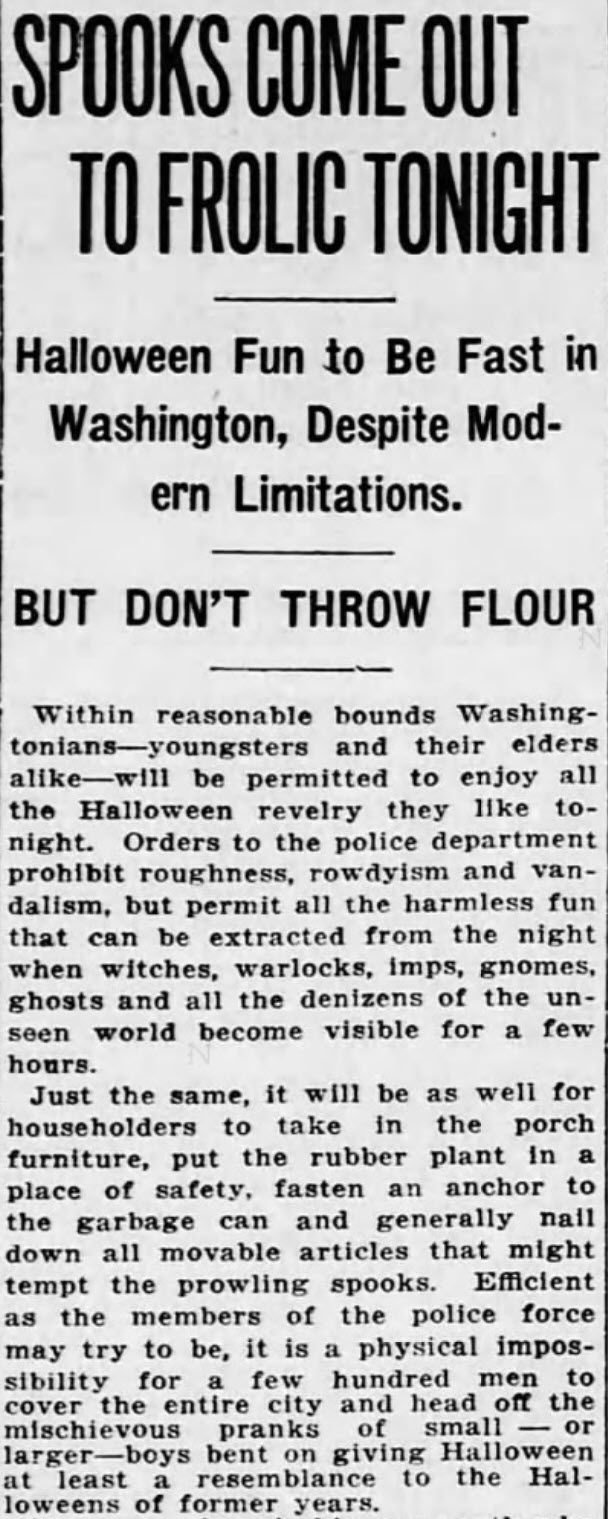
The Evening Star, October 31, 1916
Halloween Parades: Halloween parades actually began because pranks and mischief had gotten out of control. By 1920, there was a push to turn Halloween into a holiday centered around community gatherings and festive Halloween parades, rather than mischief.
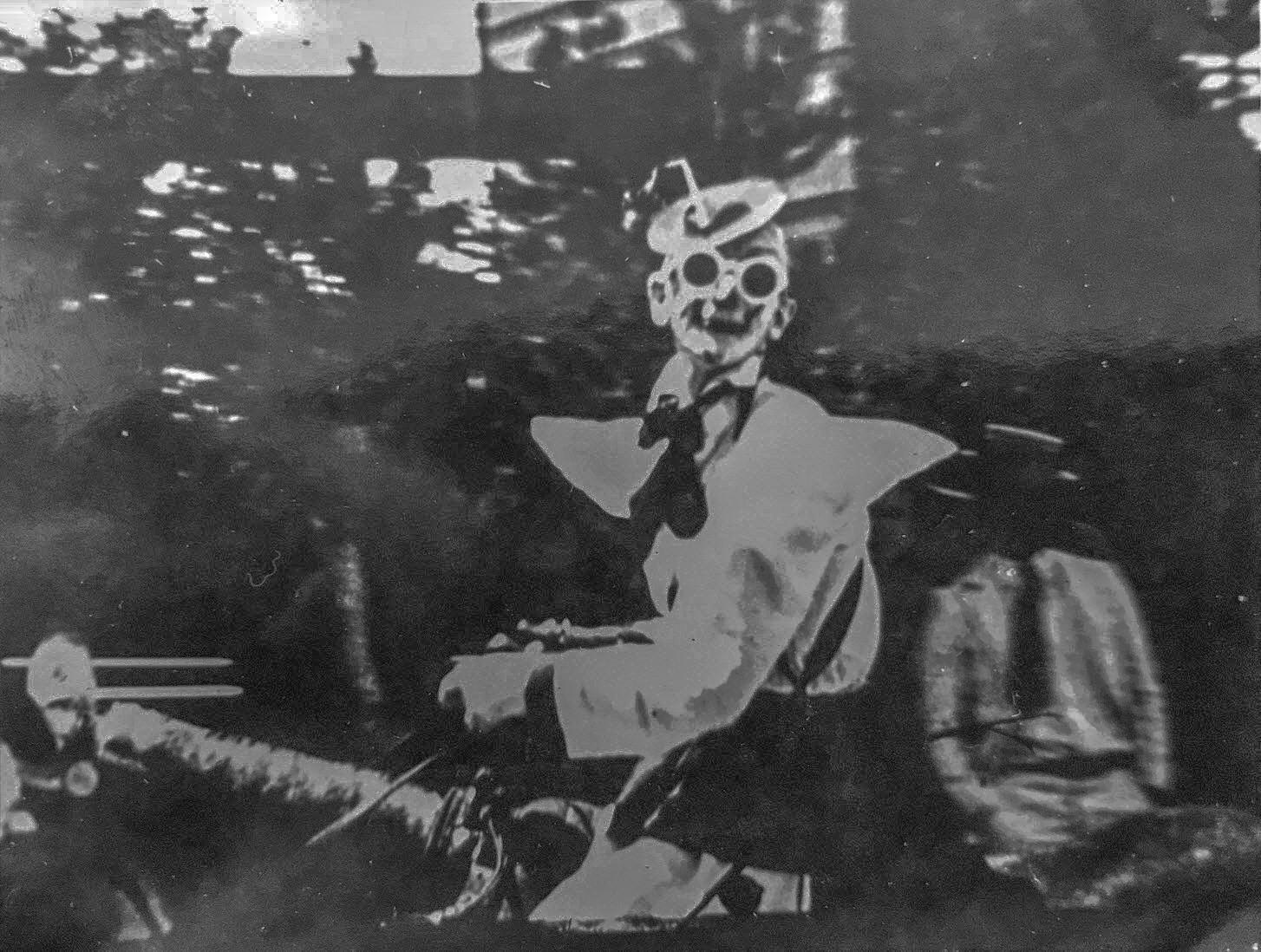
There is something undeniably creepy about this clown in sunglasses riding on a horse in a Halloween Parade. Location is unknown. Photo by Lewis Reed
Wishing all my friends, followers, and visitors of this blog a very safe and happy Halloween!
Front-of-the-House Photography of the Early 20th Century
Get the kids, the horses, the cats and dogs, buggies and tractors. Lewis Reed is here, and it’s time to gather in front of the house for a family picture!
Front-of-the-house family photographs were popular from the 1880s through the first decade of the 20th century. Until the early 1900s, people went to the photographer’s studio in town to get a picture, a “likeness” as they sometimes called it. But soon after, the reverse was possible: the photographer sometimes came to the family house to take a picture (and yes, a single picture!).
In the early 1900s, families rarely took their own photographs. Most people would never even consider owning a camera, which then was an expensive and complicated piece of equipment. If they wanted a picture of their family or their home, they called on a photographer like Lewis Reed to take it for them.
Below are some houses on which Lewis Reed trained his lens in the first decade of the 1900s–some identified, some not–but all a fascinating glimpse into the everyday world as it was back then. As always, click on the photos to get a better look.
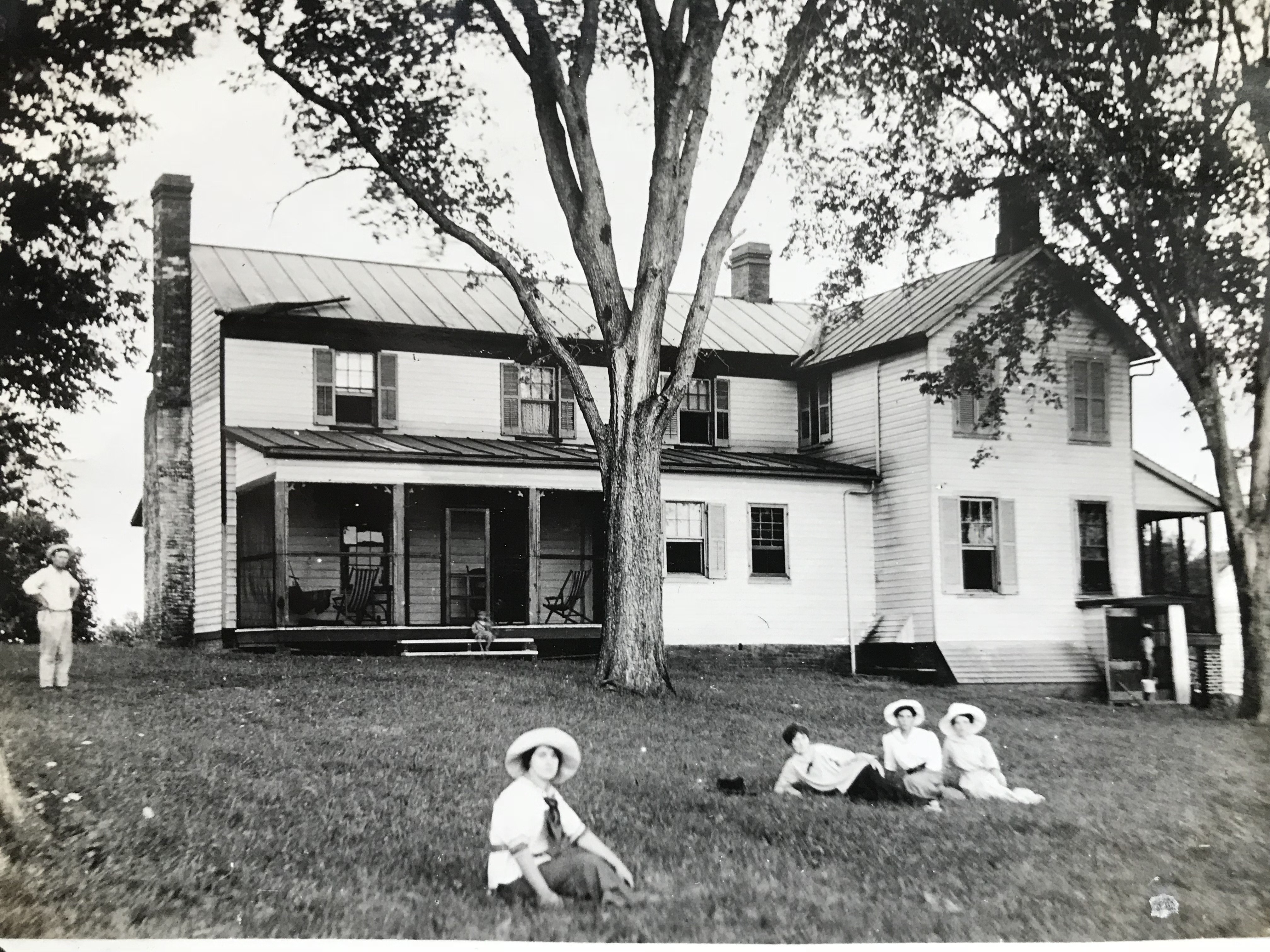
An unusual view of the backyard of a house, with its screened-in porch and children relaxing in big floppy hats.

This photo and the one below it, are very interesting in that they depict a small child posing with likely her nursemaid or a house servant who is African American, and still a child herself. Above, a view of the front porch…

…and the same house as above with the girls now playing in the side yard. The smaller child is in a buggy styled to look like a sleigh.

Here, the women of the family pose for the camera (while a young man photo-bombs from behind a bush).
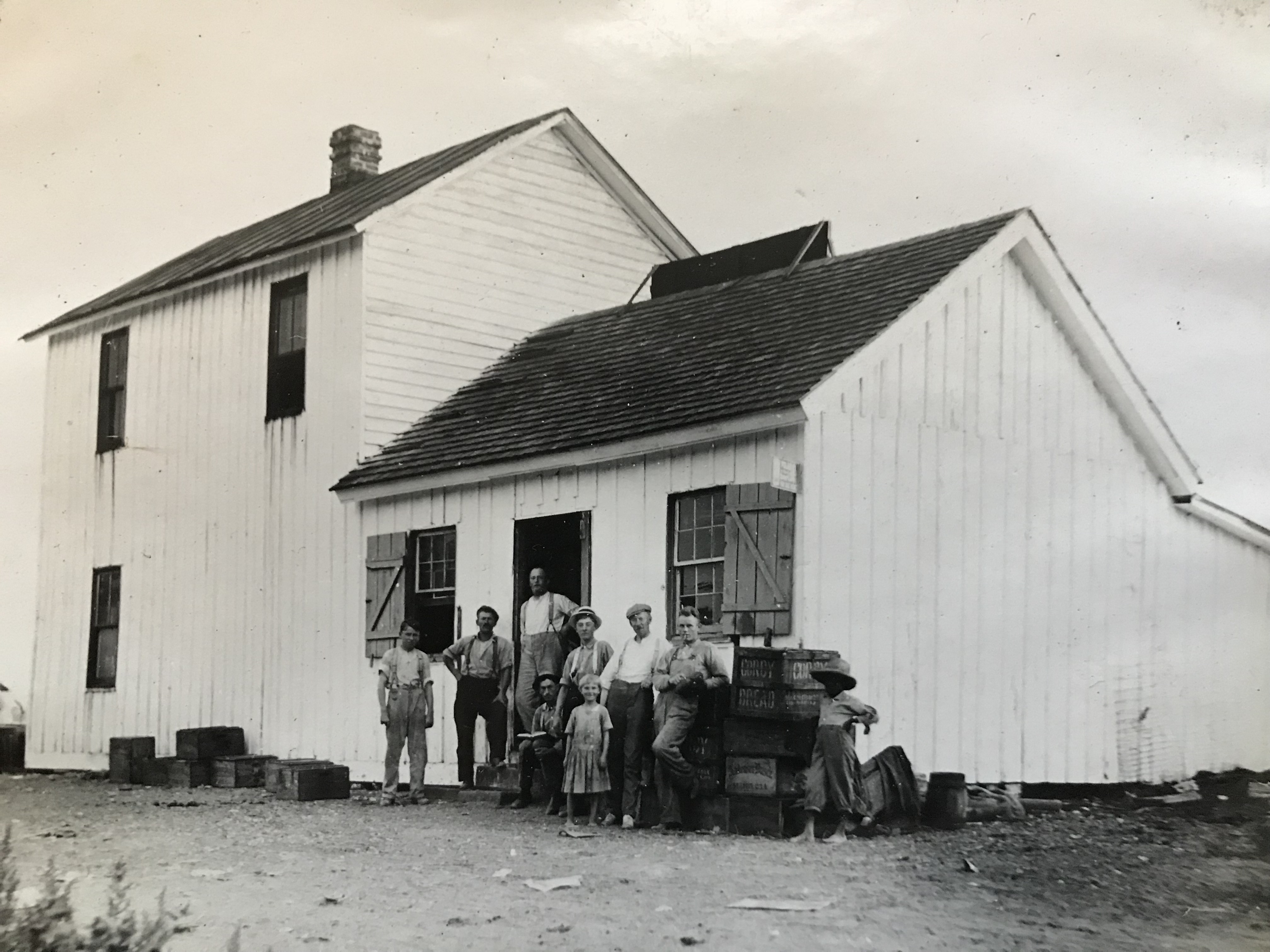
This unusual group of people posing at the back door of an unidentified building may be running a store. The crates and debris on the ground, and the back side of a possible sign on the roof indicate a mercantile rather than a home.

This family is clearly dressed in their Sunday best on a winter day. The sidewalk in front of their house is made of wooden planking.

Several women can be seen on this house’s front porch, with its flowering vines strung from trellis to rail.
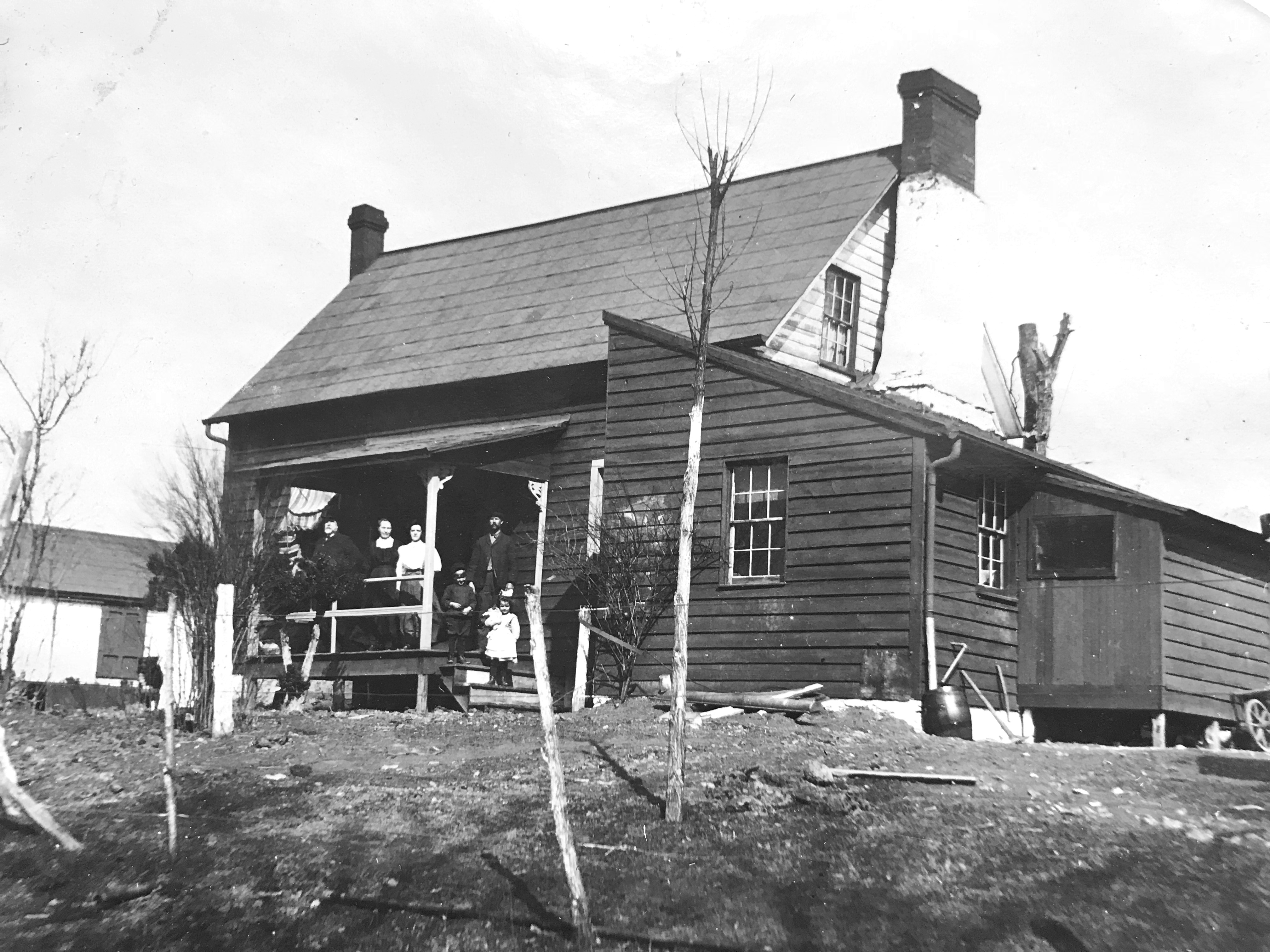
This modest house has had an addition put on–it looks rather new and perhaps Father wished to show it off. Here, a portion of the family poses on the front porch (possibly with a set of in-laws)…
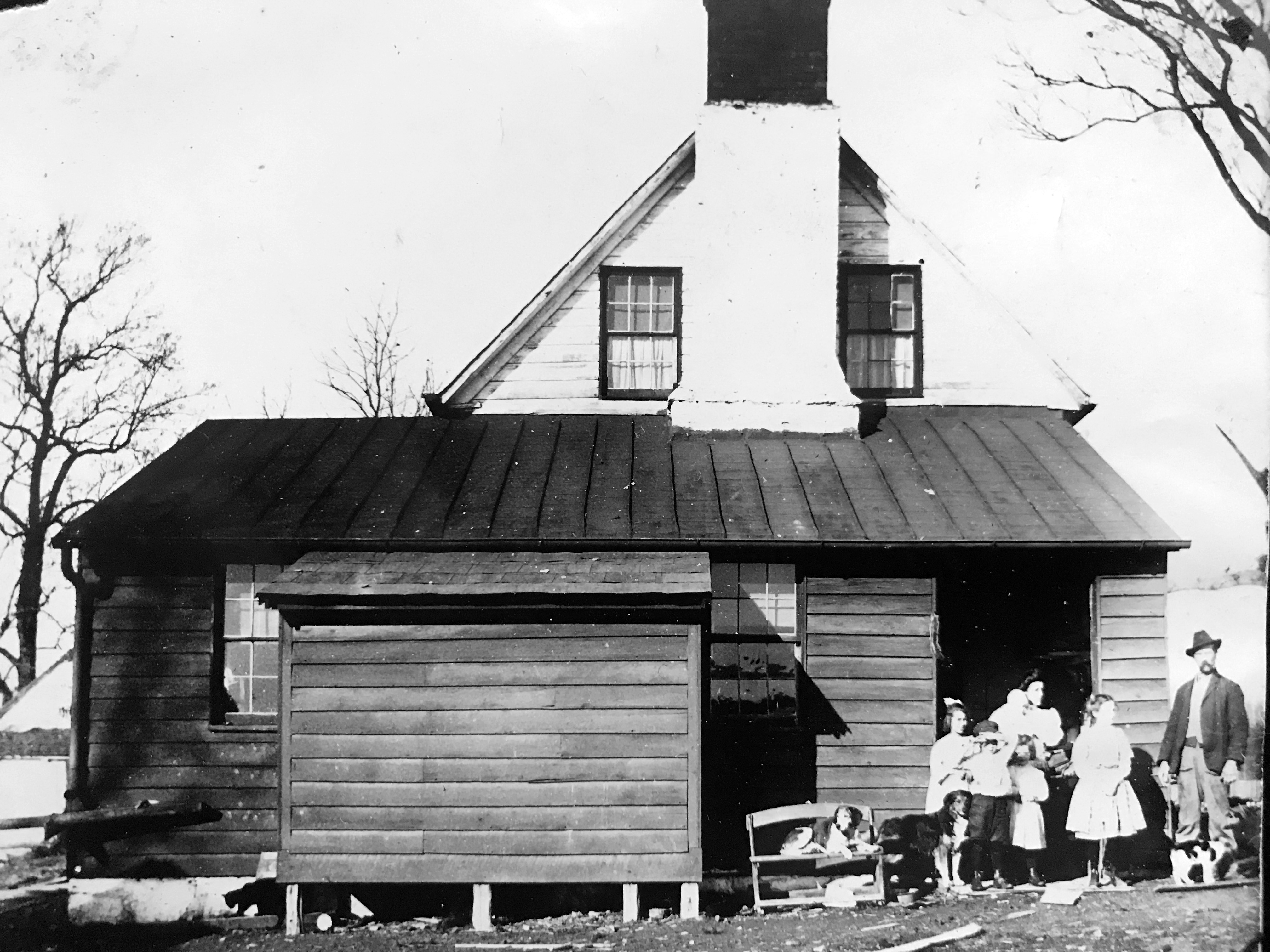
…and here a different grouping are at the side door. In this less formal shot, there are far more children, as well as two dogs and a cat in the picture.

One downside to photographing an entire house is you lose the detail of each family member. The families in this photo and the one below, clearly cared more about seeing their faces than their houses. Notice the youngest girl above couldn’t keep still long enough, so her face is blurred.
Modern observers of these photographs are often drawn to the poverty, or at least the relative poverty of the people in the images. In reality, however, the front-of-home family photograph was a sign of wealth. It’s function was to record a moment in which a family was prosperous enough to have their own homes, their own horses or tractor.

There is a chicken near the steps in the photo.
Around the turn of the century, middle class Americans could start to afford their own personal cameras.
100 Years Ago Today: First Ever Auto Races Held at Rockville Fair
Interestingly, horses made the first automobile speed races possible. Harness racing was one of the main attractions at the Rockville Fair race track before the introduction of the automobile and the subsequent popularity of racing cars. The race track was a half-mile dirt racing oval with wide, sweeping curves and a grandstand for spectators, and was easily adapted for bicycles, harness racing, and the sport of car racing.
The use of horse tracks for racing brought another change – the switch from amateur drivers to professionals. Cars were getting bigger and faster, and racing was becoming too dangerous for “gentlemen.” What had begun as entertainment for wealthy car owners had become a professional sport.
From The Evening Star (Washington, DC) 24 August 1923
ROCKVILLE AUTO RACES LISTED FOR TOMORROW
Speed records will be placed in jeopardy at Rockville Fair tomorrow afternoon when a half score of professional drivers will compete in a seven-event program.
Featuring the program is the record trials in which Frank Ripple, Canadian speed star and dirt track champion will drive his 140 horsepower aeroplane motor in an effort to hang up some new marks. Every driver on the track will be eligible to enter the time events, but speed fans look to Ripple.
Two foreign machine and six American-built cars are listed to start.
Early action shots like the ones below are rare, however, Lewis Reed was there to capture six epic moments of race history through the lens of his camera that day.
THE FIRST RACE
From The Baltimore Sun, August 27, 1923:
This is the first year that a Rockville Fair has continued through Saturday. The extra day was added this time as an experiment, the management believing that by substituting new features the additional day could be made a success. Automobile races, the first ever held at Rockville, were the day’s principal attraction and they attracted a good-sized crowd.
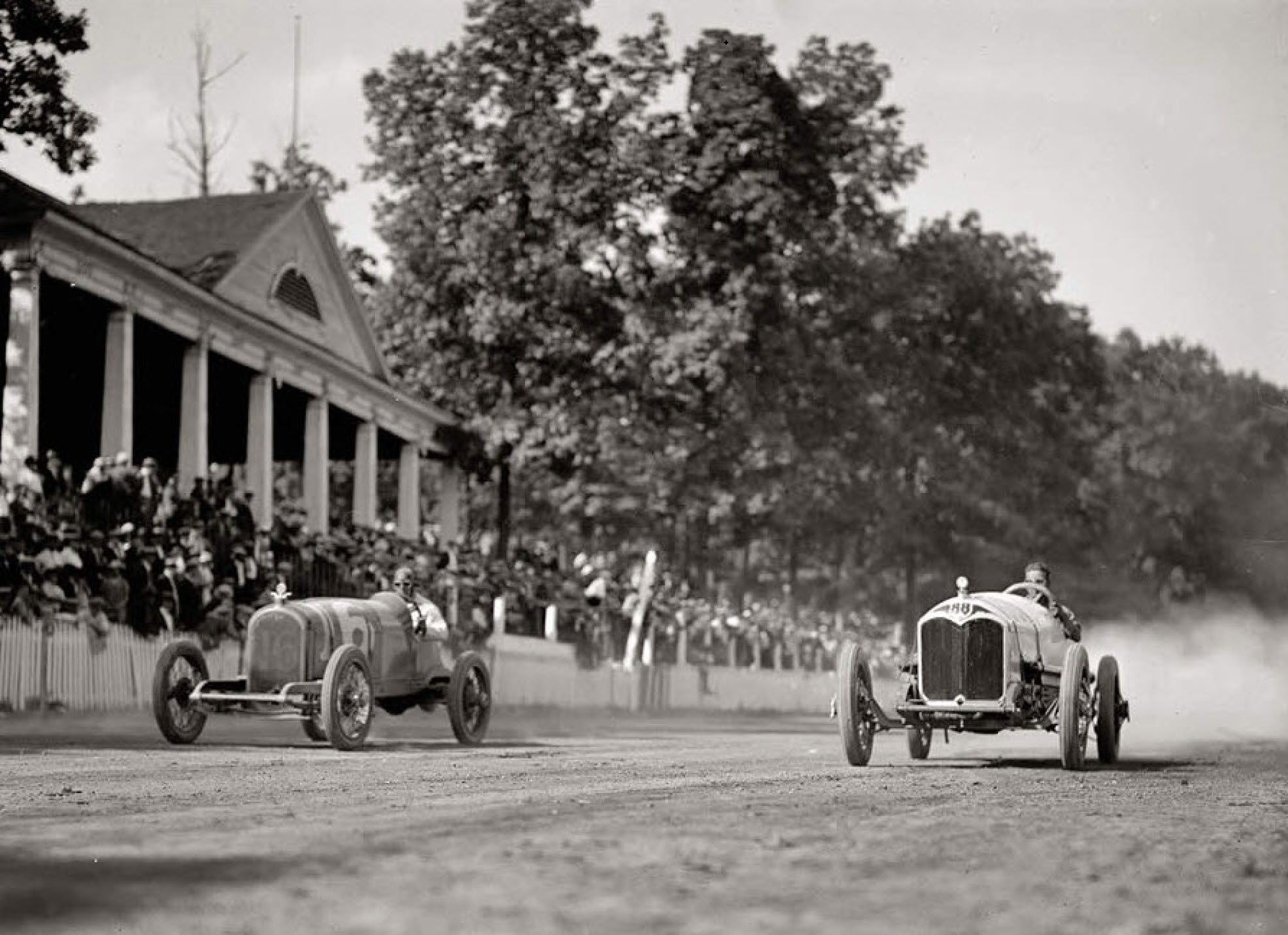
Rockville drew huge crowds for auto races. Rockville Fair, August 25, 1923. Photo by Lewis Reed

Dusty Action – 1923 photo of the exciting auto races at Rockville Fair. Five racers are just coming around the bend on this dirt track with their tires spinning up dust in their wake. Photo by Lewis Reed

Race car drivers deep in dust round a turn at the Rockville Fair auto races. Print made from a Lewis Reed glass negative.
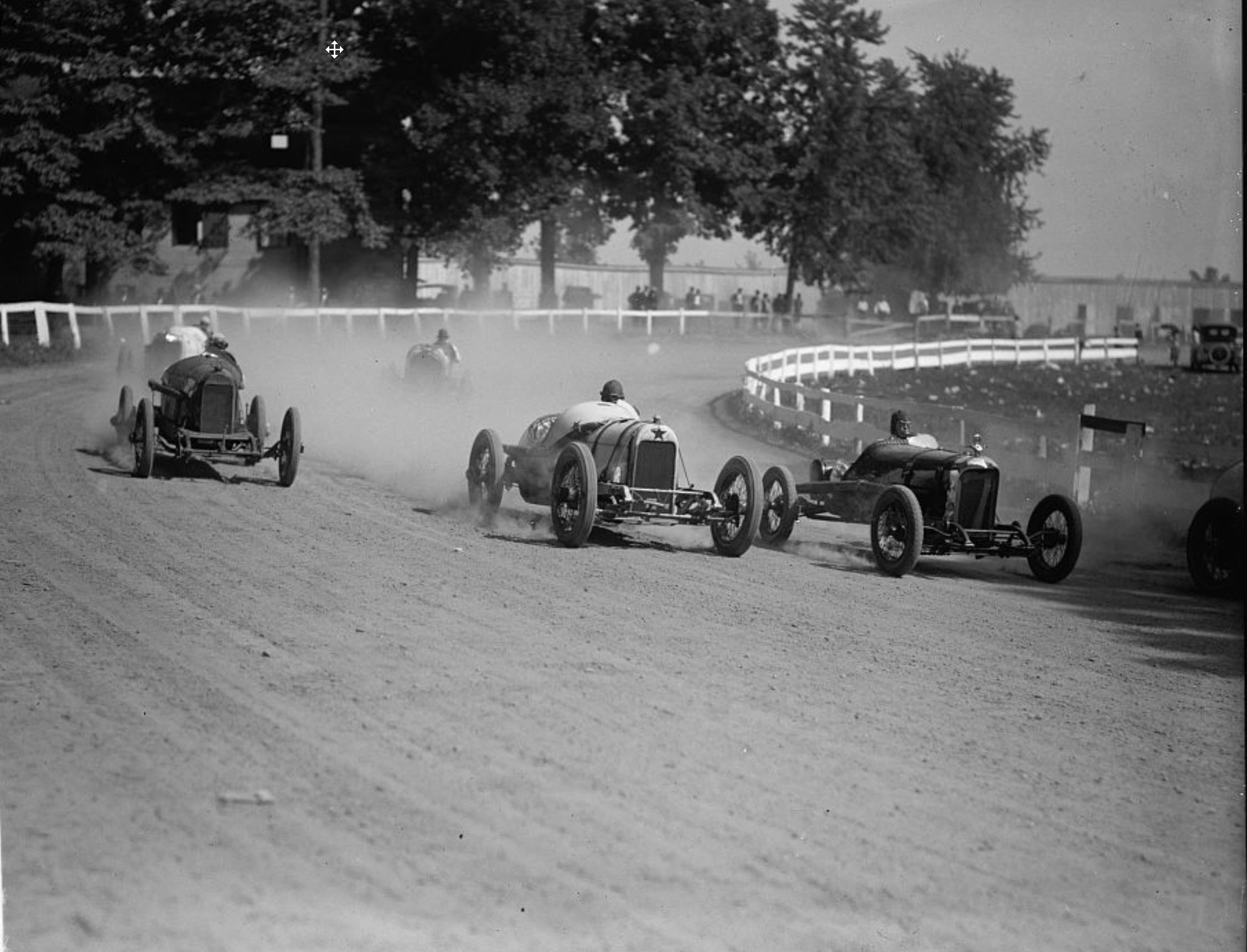
High-powered race cars rounding a wide, sweeping curve at the Rockville Fair auto races, August 25, 1923. Print made from a Lewis Reed glass negative

Two-man race car. Some early race cars included both a driver and a ‘riding mechanic’. One of the key jobs of the second man in a race car was to look backward and alert the driver to what was going on behind him. Photo by Lewis Reed
Early race car drivers were required to have a riding mechanic, otherwise it was voluntary. Riding mechanics, who in addition to being lookouts, kept an eye on tire wear and would even hop out of the car and run back through the infield to get fuel.
This photograph was featured as a part of the ‘London Array’ Series of Impossible Engineering that was broadcast on January 24, 2019 on Discovery’s Science Channel. The photograph was used on the program that featured a segment on the development of the race car.

More dirt track action. Skinny tires make for slippery turns. Photo by Lewis Reed.
ALONG WITH AUTO RACES, AUTO POLO DEBUTED AT THE ROCKVILLE FAIR

From The Washington Post, August 25, 1923
Note in the program above, that in addition to racing, there were two auto polo events.
WHAT ON EARTH IS AUTO POLO?

Given that early automobiles were marketed as replacement horses, it was inevitable that the game of auto-polo would be invented. The idea of playing polo with cars had been tossed around starting in about 1900. It took 10 years, and the Ford Model T, to make it practical.
In 1912, some people thought it would be a good idea to strip the bodies off Model Ts, and put together some two-car teams to whack a ball around with mallets. On July 12, they did just that, playing with oversized croquet mallets and a two-pound, basketball-sized ball. Two cars took the field, and two more tended their respective goals.
From The Daily News, Frederick, Maryland, August 24, 1923:
Thousands of people attended the Fair on Thursday, which was the biggest day of the week, at least from the attendance standpoint. By two-o’clock the grandstand was so crowded that even standing room was at a premium. The racing events of the afternoon were unusually good. As special grandstand features there were auto polo and stunt riding.
Any form of safety was completely absent, unless you count the occasional presence of a hat. The cars were protected with roll bars in back and around the radiator, but the drivers, not so much. The game consisted of five 10-minute periods. It was hard on drivers, cars, and the field. There was no limit on car substitutions, and as many as a half-a-dozen per team might be demolished during the game, along with the stands, goalposts, referees (on foot on the field) and anything else that got in their way.

1922 auto polo match in Los Angeles. The referees job is very dangerous as the cars careen about the field and smash into each other. Google stock image.
All we hope is that this lunatic game will not spread.Automobile Topics, Nov. 16, 1912
AUTO RACES MARK END OF 5-DAY ROCKVILLE FAIR
From The Sunday Star, Washington, DC, August 26, 1923:
Thrilling automobile races brought the annual Rockville Fair to a close this afternoon. The sport was as innovation so far as Rockville was concerned.
Seven high-powered cars, operated by some of the crack drivers of the country, participated. The events ranged from one to ten miles in distance, and some fast time was made. Excepting that of Thursday, the largest crowd of the five days was on hand.
Auto Polo Credit: May 2010 issue of Hemmings Motor News
Books

Related Resources


Copyright Notice

Reed Brothers Dodge History (1915-2012) by Jeanne Gartner is licensed under a Creative Commons Attribution-NonCommercial 3.0 Unported License.
 Reed Brothers Dodge History 1915 – 2012
Recent Comments