
Then & Now: Walker Avenue Gaithersburg
This post is a continuation of a series of “Then & Now” images that will show photographs of buildings, street scenes, and other historical locales from Lewis Reed’s Photo Collection alongside photographs of how they appear today. These photos show the same view of Walker Avenue in Gaithersburg about 98 years apart.
Walker Avenue (THEN): This photo of Walker Avenue in Gaithersburg was taken by Lewis Reed from the steeple of Grace United Methodist Church in the late 1920s. The street is named after John Walker, whose farm became Walker Avenue when he decided to subdivide the front end in 1904. Walker was mayor of Gaithersburg from 1906 to 1908 and again from 1918 to 1924. In June 1913, Walker Avenue was the first street in Gaithersburg to have electric streetlights installed along its full length. This period saw major advances in technology, communication, and transportation.
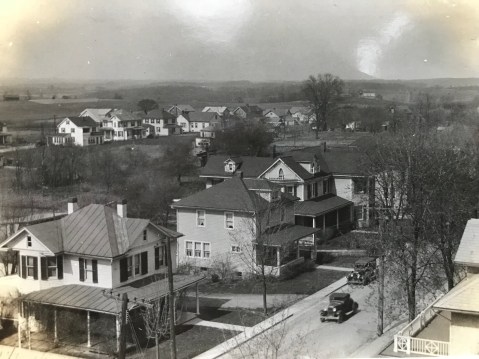
Walker Avenue in Gaithersburg taken from the steeple of Grace United Methodist Church, late 1920s. Photo by Lewis Reed
Walker Avenue (NOW): Walker Avenue is the most cohesive street in Gaithersburg’s historic district. Most of its houses were built between 1904 and 1930.
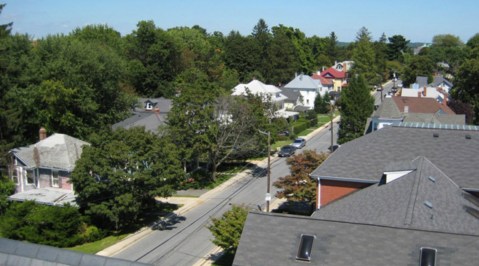
Walker Avenue in Gaithersburg today
Source: Maryland Historical Trust
Lewis Reed Photo: Old Country Store

Circa 1900s country store on a dirt road. Note the sign advertising Battle Axe Shoes. Two ladies standing on the porch. Location Unknown. Photo by Lewis Reed
This early 1900s photo taken by Lewis Reed is a flashback to a time when the clip-clop of horses could be heard going down the street, kids would walk to school, and people took the time to care about and create things that would last. This old store would have been considered not very clean from modern standards and the roads outside were unpaved.
While every store was different, there were similarities among many, including a front that was decorated by tin sign advertising, tobacco, cigars, shoes, hardware, and more. The sign in front advertises Battle Axe Shoes, Stephen Putney Shoe Company. I did a little research and found out Samuel and Stephen Putney were father and son shoe manufacturers of Battle Axe Shoes in Richmond, Virginia.
Usually, country stores featured double doors that opened inward and lots of barrels that might contain any number of items — from pickles, to crackers, potatoes, flour and candies. The store was usually an unpainted, two-story frame building fronted by a raised porch for convenient loading and unloading.
One thing in this photo I can’t explain are the steps seemingly leading to nowhere on side of the building. And I wonder what the tall pole is for? It seems to be bracketed on the side of the building. Ideas, folks?
The Putney’s owned and ran Battle Axe Shoes, and had this factory on 2200 West Broad Street as touted by the 1909 Postcard below.
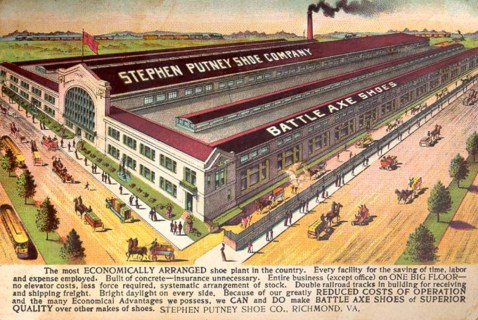
By the way, it appears as if the writer of this postcard was a big fan of CAPS-lock to get his point across.
Impressive….
And environmentally friendly to boot! (Pun intended)
The postcard reads:
“The most ECONOMICALLY ARRANGED shoe plant in the country. Every facility for the saving of time, labor and expense employed. Built of concrete – insurance unnecessary. Entire business (except office) on ONE BIG FLOOR – no elevator costs, less force required, systematic arrangement of stock. Double railroad tracks in building for receiving and shipping freight. Bridge daylight on every side. Because of our greatly REDUCED COSTS OF OPERATION and the many Economical Advantages we posses, we CAN and DO make BATTLE AXE SHOES of SUPERIOR QUALITY over other makes of shoes. STEPHEN PUTNEY SHOE CO., RICHMOND, VA.”
Lewis Reed: Enters 1936 Amateur Photo Contest
The Star published a series of pictures reproduced from photographs taken by local amateurs. The pictures were selected and judged each week and the best one chosen on its merits and published the following Sunday. Lewis Reed submitted his photo, “Sunset Over the River”, in the Washington Star Best Snapshots of the Week in The Star’s Amateur Contest. There was no indication where the photo was taken, but I’m guessing it was probably on the Potomac River, Maryland. At the time, Lewis Reed would have been 49 years old. There was no mention of whether or not he won a prize for his photograph, but I’m not surprised he entered this contest. He was a passionate photographer and always had his camera with him.
The full page image below is from the Sunday Gravure Section of The Washington Star newspaper. When looking at the top of the page, I wondered what the term “Gravure” meant, so I “googled” it. Turns out gravure refers to the special newspaper sections of photographs which were printed with this process starting around the late 1800s. In the 1930s, newspapers published relatively few photographs and instead published separate gravure sections in their Sunday editions. These sections were devoted to photographs and identifying captions, not news stories.

Full page image from The Sunday Star, Washington, D.C. – Gravure Section – June 28, 1936.

“Sunset Over the River” taken by Lewis Reed in 1936
Lewis Reed was a well-known photographer in Montgomery County and many of his photographs are now part of the Montgomery County (Maryland) Historical Society photo archives. His photography has appeared in highly regarded history books such as, “Montgomery County: Two Centuries of Change” by Jane C. Sween, “Montgomery County (Then & Now)” by Mark Walston, “Montgomery County (MD) Images of America”, by Michael Dwyer, “Rockville: Portrait of a City” by Eileen S. McGuckian, and “Gaithersburg: History of a City”. His photographs have been featured in the Norris-Banonis Automotive Wall Calendar, on the national television show, American Pickers, and on television’s most watched history series, American Experience on PBS.
Then & Now: Hagerstown Public Square
This post is a continuation of a series of “Then & Now” images that will show photographs of buildings, street scenes, and other historical locales from Lewis Reed’s Photo Collection alongside photographs of how they appear today.
Hagerstown Public Square (THEN): Hagerstown Public Square looking north on Potomac Street, circa 1913. D. Ramacciotti’s fruit and candy store dominated the left side of the square. Trolleys roll down the middle of the street and a piano store is on the right. Winding the giant clock in the background (still there today) was done by a line from the tower attached to a horse on the ground that pulled the clock’s weights up through the tower.

Hagerstown Public Square, 1913. Photo by Lewis Reed
Hagerstown Public Square (NOW): Traffic heads south on Potomac Street on the square in downtown Hagerstown 105 years later.

Hagerstown’s Public Square, looking north on Potomac Street, as it is today.
Then & Now: Rockville Fair Dirt Track Oval
The black and white photograph of the Rockville Fair auto races below was taken by Lewis Reed in 1923. The photograph was from the first incarnation of the Fair, held by the Montgomery County Agricultural Society (1846-1932) in Rockville and often known simply as the “Rockville Fair.” For this “Then & Now” feature, I have combined Lewis Reed’s original photograph for “then” and matched it with a corresponding contemporary shot for “now” to see how the location has changed throughout almost 95 years.
Rockville Fair Dirt Track Oval (THEN): Like many fairgrounds, the Rockville Fairgrounds included an oval track. Fairground race tracks, typically one-mile or half-mile dirt racing ovals with wide, sweeping curves and grandstands for spectators, were easily adapted for bicycles, harness racing, and the sport of car racing. Harness racing was one of the main attractions, but after the introduction of the automobile in the early 20th century, car races took over. The fairgrounds were just outside Rockville, where Richard Montgomery High School is today.

Crowds at the auto racetrack, Rockville Fair, August 1923. Photo by Lewis Reed
Rockville Fair Dirt Track Oval (NOW): In 1946, after the construction of Richard Montgomery High School, the old oval race track became a football field and stadium.
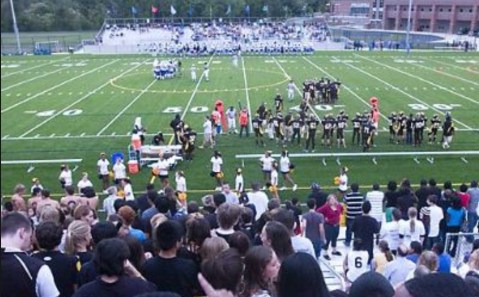
Richard Montgomery High School football field and stadium today
Books

Related Resources


Copyright Notice

Reed Brothers Dodge History (1915-2012) by Jeanne Gartner is licensed under a Creative Commons Attribution-NonCommercial 3.0 Unported License.
 Reed Brothers Dodge History 1915 – 2012
Recent Comments