
Then & Now: Clarksburg Main Street, 1913
This post is a continuation of a series of “Then & Now” images from Lewis Reed’s Photo Collection alongside photographs of how they appear today. Lewis Reed worked hard to preserve a visual history of Montgomery County, Maryland and surrounding area long before automobiles were even around. As early as 1910, he toured on his motorcycle across the state of Maryland and took photographs of many historic locations. Taken approximately 109 years apart, these photos takes us back in time to Clarksburg, Maryland at the intersection of the main road between Georgetown and Frederick and an old Seneca trail. The corresponding color photo is a google maps screenshot from the same location more than a century later.
CLARKSBURG MAIN STREET (THEN): In the early 20th century, Clarksburg was the third largest town in Montgomery County, after Rockville and Poolesville. Clarksburg had four general stores, two hotels, and an academy of learning. It also had a blacksmith, a doctor’s office, tanneries, shoemakers, winemakers, tailors, wheelwrights, fertilizer businesses, skilled farmers, master carpenters, and two town bands.
The black and white image was taken by Lewis Reed in 1913, where Clarksburg Road (to Boyds) met Frederick Road (Rt 355). Frederick Road has also been known as The Georgetown Road and the Great Road. The town of Clarksburg was laid out along Frederick Road. The road was used as the stagecoach line from Frederick to Georgetown and it remains as the present main street through Clarksburg. Turning wagon ruts/tire tracks are visible in the lower left corner. The first house on the right was the Horace Willson House (still standing). Left of the Willson house was Willson’s Store, built on the site of the town’s first trading post, established by town founder John Clark (still standing). Established April 1, 1800, this was the location of the first post office in Clarksburg, the second oldest in Montgomery County. In 1842, the old trading post building was replaced with a two-story general store. The dwelling beyond the pole served as a church parsonage (still standing) and just beyond stands the Clarksburg United Methodist Church. The church was used for church dinners, 4-H meetings, and community gatherings. The vehicle appears to be a very early Ford Model T.

Clarksburg Main Street (Frederick Road Rt 355). Photo by Lewis Reed, 1913.
CLARKSBURG MAIN STREET (NOW): Over 109 years have passed and three buildings in Lewis Reed’s photo still remain. The structure on the right in the current day photo below was the Lewis General Store and the yellow vacant house a little further down the road was the church parsonage. The recently renovated Lewis General Store received an award for best restoration of a historic commercial property from the county. The charming building boasts a tin ceiling, original counters; original beams from 1750 are exposed in some areas, wood floors, and many historic details throughout. The steps to the ME Church South are still visible today on Rt 335 near where it intersects with Spire Street (about where the car is in the image). The congregation claims to be the “oldest continuous Methodist congregation in Montgomery County”. Today, Clarksburg remains a small rural town, retaining many of its 19th century structures. It is among Montgomery County’s earliest, most intact historic towns.
Due to the Clarksburg Square Road extension that now connects to Frederick Road, the Horace Willson House was relocated approximately 70 feet to the south to preserve it. The building is currently a wine and beer shop.
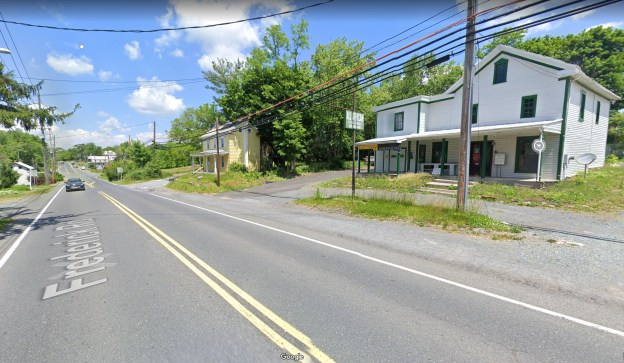
This current day image is a google maps screenshot from the corner of Redgrave Place and Rt 355.
Sources of Information:
Joan Edwards Ruff, Resident of Clarksburg for 45 years and granddaughter of Lillian and Elwood Barr
“The History of Clarksburg, King’s Valley, Purdum, Browningsville and Lewisdale Maryland” by Dona L. Cuttler
MHT Inventory Form13-10 Clarksburg Historic District
Then & Now: Washington’s Cherry Blossoms
Time passes, but the cherry blossoms always come back. Seeing the cherry blossoms is a time-honored D.C. tradition that dates back to 1912, when Tokyo gifted 3,020 cherry trees to the U.S. in an act of friendship. While many of the original trees have been replaced, the Tidal Basin’s beauty has persisted for more than a century. Each spring, more than 1.5 million visitors descend upon Washington, D.C. each year to admire the 3,000-plus trees.
Here are “then and now” comparison shots of the Cherry Blossoms on the Tidal Basin in Washington, D.C. from 1930 and 2022.
Cherry Blossoms on the Tidal Basin (THEN): From Lewis Reed’s collection of photographs. Cherry blossoms in bloom along the Tidal Basin, circa 1930s with my mother, Mary Jane (Reed) Gartner.

Cherry blossoms in bloom along the Tidal Basin with my mother, Mary Jane (Reed) Gartner. Photo by Lewis Reed, ca. 1930
Cherry Blossoms on the Tidal Basin (NOW): The “now” photo is a google image of approximately the same location… some 90 years later. According to the National Park Service, DC’s 2022 cherry blossoms will reach peak bloom sometime between March 22-25. The best viewing of the cherry blossom trees typically lasts four to seven days after peak bloom begins, but the blossoms can last for up to two weeks under ideal conditions.

Cherry blossoms in bloom along the Tidal Basin today.
Fun facts about Washington, DC’s cherry blossoms
- The first donation of 2,000 trees, received in 1910, was burned on orders from President William Howard Taft. Insects and disease had infested the gift, but after hearing about the plight of the first batch, the Japanese mayor sent another 3,020 trees to DC two years later.
- The first two trees were planted on the north bank of Tidal Basin in March 1912, and they still stand today. You can see them at the end of 17th Street Southwest, marked by a large plaque.
- It’s against the law to pick the cherry blossoms in Washington DC. While there aren’t any subtle wire fences or stern security guards like in a museum, any attempts to create your own corsage may very well land you a fine.
- The majority of the cherry blossom trees around the Tidal Basin are of the Yoshino variety. But another species, the Kwanzan, usually blooms two weeks after the Yoshino trees, giving visitors a second chance to catch the blossoms.
- The average lifespan of a cherry blossom tree is only 20 to 30 years, but nearly 100 of the original trees from 1912 still thrive at the Tidal Basin due to the maintenance of the National Park Service.
- No, they’re not all from 1912, reinforcements are sometimes necessary. New trees have been regularly planted, including in 1965, the late 1980s, 1999 and from 2002 to 2006, according to the NPS.
Happy National Ferris Wheel Day!
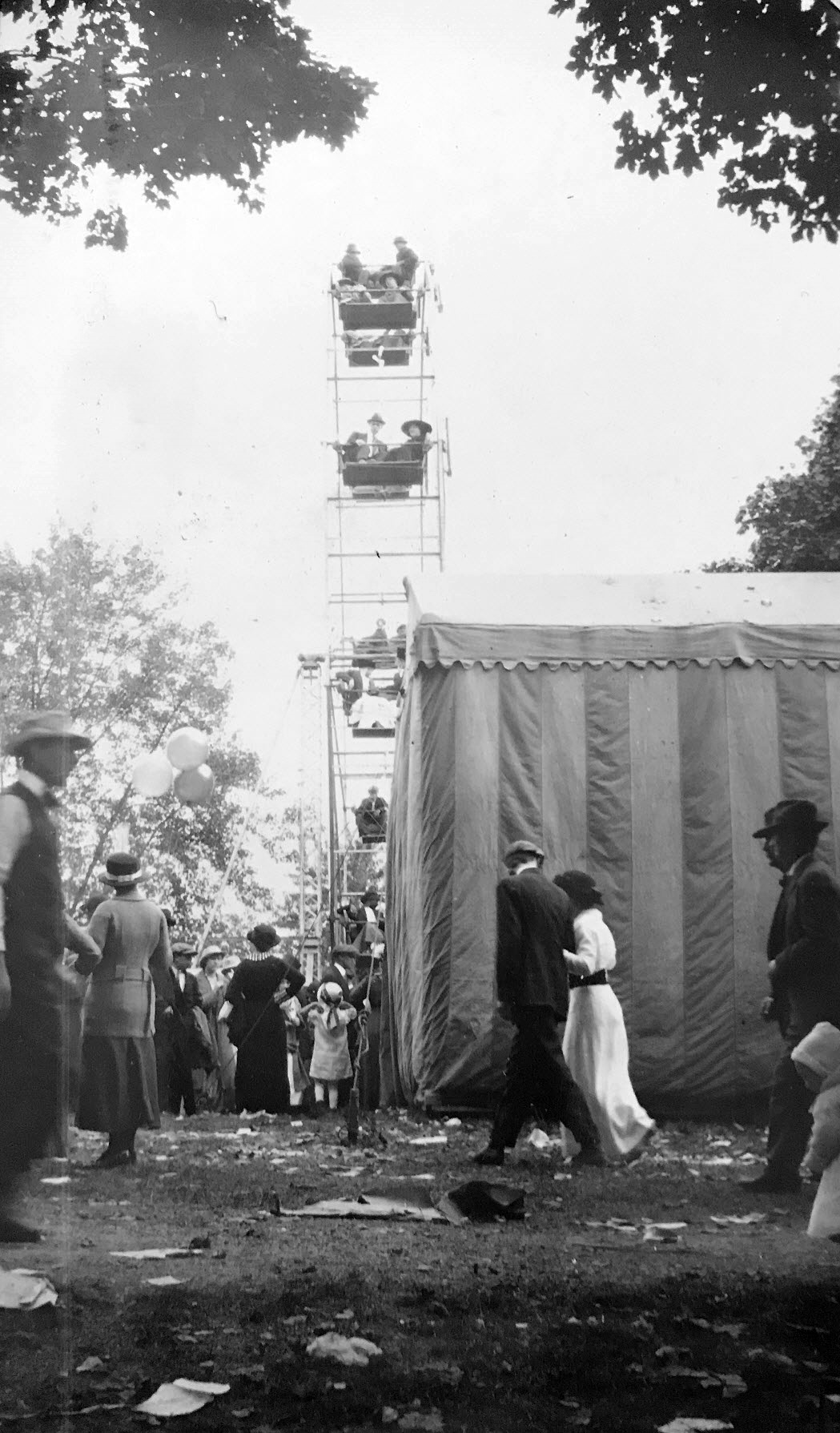
Ferris Wheel at Rockville Fair, circa 1920s. Photo by Lewis Reed
Did you know that February 14th is not only Valentine’s Day, but also National Ferris Wheel Day? This unofficial national holiday is held on this day to honor the birth of the inventor of the Ferris Wheel, George Washington Gale Ferris, Jr. What better way to celebrate Ferris Wheel Day than enjoying this old photograph of the Ferris Wheel taken at the Rockville Fairgrounds, courtesy of Lewis Reed. The fairgrounds were just outside Rockville, about where Richard Montgomery High School is today. The Fair lasted four days, from August 21st to the 24th, and drew visitors from local counties, Washington, and Baltimore.
For the singles and the “enough already with the Valentines”, here is your perfect alternative excuse. Go wish all your friends and family a Happy Ferris Wheel Day!
Then & Now: River House Lodge, Rowelsburg, WV
This post is a continuation of a series of “Then & Now” images that will show photographs of buildings, street scenes, and other historical locales from Lewis Reed’s Photo Collection alongside photographs of how they appear today. Taken approximately 100 years apart, these photos show the River House Lodge in Rowelsburg, West Virginia, then and now.
River House Lodge (THEN): This little railroad town of Rowesburg has always had hotels, beginning with the original River House, an early tavern and hotel serving the needs of a growing town in the 1850s. The railroad brought prosperity to Rowlesburg, designed the town and named it. Mr. Rowles was a surveyor with the railroad and laid out the plots and streets for the town.
The house was designed at the turn of the century or just before but the features were unusual. The top part of the house was Edwardian with panels and battens, creating a kind of checkerboard appearance. The lower half of the house was finished with narrow wood siding. The gables were of wood shingles.

River House Lodge located on Main Street in Rowlesburg, West Virginia. Lewis Reed’s circa 1926 Dodge Brothers Sedan is parked in front. Photo by Lewis Reed.
River House Lodge (NOW): Today, the River House has been transformed into a small, boutique lodge tucked away in the mountains of West Virginia. Though razed long ago, the “New” River House now takes its place to welcome guests into a motif of railroading that once dominated the small town of Rowlesburg. B&O artifacts adorn the rooms and hallways. Pictures of the past history of the town take visitors back to a different time, one of railroading in its golden era.
One source says that the original River House was a tavern and railroad lodge operated by A.A. Perry. The lodge was the center of this small settlement, with homes scattered nearby. The building sat next to the railroad, as did most of the early structures in Rowlesburg. Downtown Rowlesburg Historic District was listed on the National Register of Historic Places in 2005.

The River House Lodge today is still very recognizable.
Source: www.riverhouselodge.org
Fill’er up! Texaco Tanker Truck
The 1917 photo below is the Reed Brothers original Rockville Garage located at the intersection of Veirs Mill Road and Rockville Pike. To the right is a Texaco Gasoline Filling Station sign. One very tall Texaco branded fuel pump can be seen in this photo along with two Texaco Petroleum refueling trucks. The gas pump globe on the top advertises the gas company name and logo. Parked in front is a line-up of some very early Dodge Brothers Motor Vehicles.
Note the unpaved dirt road on Rockville Pike and trolley tracks running past the dealership. From 1900-1935, the trolley cars went past Reed Brothers Dodge as they traveled up Rockville Pike. Major stops along the line included Georgetown, Alta Vista, Bethesda, Montrose, Halpine, the Fairgrounds, Courthouse Square, and Chestnut Lodge.

1917 Original Rockville Garage with 2 story addition. Note the Texaco Filling Station signage and the Texaco Petroleum fuel truck refilling the single pump in front. Photo by Lewis Reed
At some point between prior to 1920, Reed Brothers Dodge changed over from selling Texaco and became a Gulf Gasoline dealer. Reed Brothers had the first Gulf gas station in the still-rural Washington D.C. area. (click on images to enlarge)
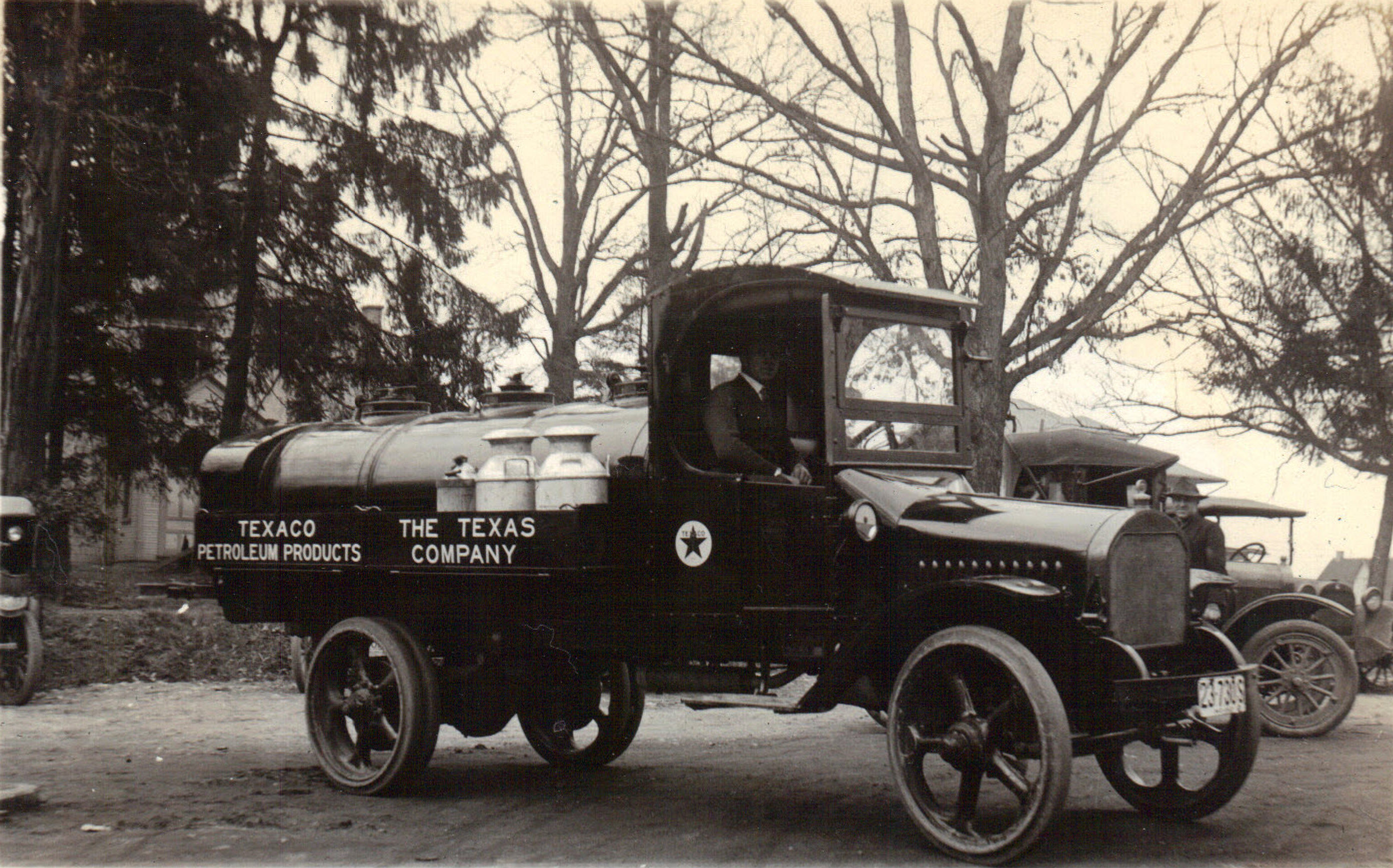
1917 Texaco tanker truck. Photo by Lewis Reed
A Texaco Petroleum Truck sits in front of Rockville Garage after delivering its load of fuel. On the side of the tanker is a hinged wooden box carrying 2-drums of a Texaco product. The delivery driver seems to be wearing his best suit on this job, something that you don’t see these days at all.
In addition to Texaco gasoline, Rockville Garage also carried a full line of Texaco lubricants, Fisk tires, Willard batteries and many other well known brands of merchandise.
The most essential vehicle of the early 20th century had to have been the tanker truck. In the pioneering period of tanker trucks, 1910 to 1920, the Texas Company was among many that were fitted with tanks to carry refined products such as gasoline, kerosene and fuel oil.
Books

Related Resources


Copyright Notice

Reed Brothers Dodge History (1915-2012) by Jeanne Gartner is licensed under a Creative Commons Attribution-NonCommercial 3.0 Unported License.
 Reed Brothers Dodge History 1915 – 2012
Recent Comments