
Ice Harvesting in Darnestown, ca.1910

Men harvesting ice with pitchforks and hand saws in Darnestown, Maryland. Photo taken by Lewis Reed, ca.1910. Note the blocks of ice stacked up along the shoreline.
Got ice? Usually, we don’t think about ice very often, unless there’s none in the freezer. At the start of the 19th century, keeping food fresh and edible was one of the biggest challenges of everyday life. So what was life like before we had that incredible device that we now take for granted, the refrigerator?
Before the first successful ice-making machines were built, ice for refrigeration was obtained through a process called “ice harvesting.” Men would venture out onto frozen ponds with saws, tongs, and pitchforks and methodically cut and dragged blocks of ice.
Refrigeration is a modern convenience that we just can’t live without and certainly one that I take for granted … or took for granted until I wrote this!
Then & Now: Halpine Store/Radio Shack 111 Years Apart
Looking at old photographs is like peering through an open window back into history. Not only do they give you a sense of wonder from traveling back in time, but also a staggering feeling of awe from seeing just how much things have changed. For this post, I have used one of Lewis Reed’s original photographs for “then” and a Google Maps street view image from today for “now”.
The Halpine Store (THEN): The Halpine Store, also known as the Lenovitz General Store, was built on Rockville Pike in 1898, taking advantage of the prime location on the trolley and railroad lines and the Pike. The store sold food, gasoline and other items to locals and Pike travelers. The man standing just in front of the trolley tracks is James H. Handy (b. 1890) who lived at Halpine and worked for Mr. Copeland on the Wilkins farm. Handy served in the U.S. Army during WWI, as a gunner for the 371st infantry, doing two tours of duty in France. In this photo, he is about 16 years old. Note the telephone or telegraph poles, and the trolley tracks paralleling the road. The nearby Halpine railroad station also brought customers to the area, and the store became the social/community gathering place for the Halpine area. Tradition has it that during the days of “Local Option” when the sale of alcoholic beverages was forbidden in the County, the men of Rockville traveled to the Halpine Store to gather on the broad front porch and sip its special brand of “coffee” served in tin cups.
The proprietors, Benjamin and Anna Lenovitz, lived on the second floor. The building burned in 1923 and a new fire-resistant brick building was rebuilt in its place. This building, at 1600 Rockville Pike, became a Radio Shack, selling computers and electronics.
Seen in the black & white photograph taken by Lewis Reed in 1906, is The Halpine-Lenovitz General Store at Rockville Pike and Halpine Road.

Halpine-Lenovitz General Store at Rockville Pike and Halpine Road, 1906. Photo taken by Lewis Reed.
The Halpine Store/Radio Shack (NOW): The same view one hundred and eleven years later. Rockville Pike is now six lanes, linking the once outlying Halpine and Montrose with Rockville’s town center in one long strip of commercial enterprises and office buildings.

Halpine Store/Radio Shack, Google Image Capture, Nov 2016
Source: Maryland Historical Trust
Old Rockville High School First Baseball Team, 1910

Old Rockville High School First Baseball Team, 1910. Photo by Lewis Reed
Front: Billy Beck, Tom Young, Ed Storey, Harry Beall, Roy Warfield.
Back: (first name unknown) Hicks, Lucius Lamar, name unknown, name unknown, Jesse Higgins, name unknown, name unknown, Fred Hays, Roger Whiteford.
Holding pennant: Griffith Warfield
The Montgomery County Historical Society was able to identify several people in the photograph. If anyone can help put a name to a face, please leave a comment.
First Shenandoah Apple Blossom Festival, May 3, 1924
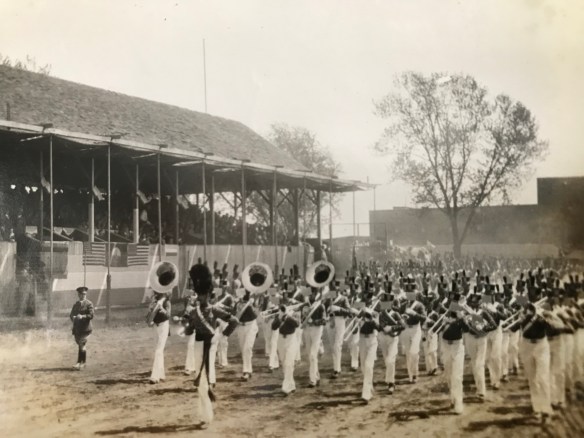
Here the parade participants circle the racetrack as spectators view the parade from a grandstand. There was no caption on this photo, but I’m guessing it might possibly be the VMI Regimental Band. Photo by Lewis Reed
Winchester, with its long history in the apple-growing industry, chose to honor the beauty and bounty of the apple blossom, beginning in the year 1924. On Saturday, May 3, 1924, the first Festival was a one-day event. To kick off the celebration, the parade assembled at the old fairgrounds just off Fairmont Avenue and marched through the streets of Winchester to the Royal Pavilion on the grounds of Handley High School.
Beginning in 1925, the first of three pageants was professionally produced by the John B. Rogers Production Company and staged on a dais at the fairgrounds. In 1928 the outdoor pageants were moved to the steps and esplanade of Handley High School. The pageant earned a reputation as being one of the most beautiful outdoor extravaganzas in the nation. The festival was suspended during World War II, and resumed in 1946 with its first celebrity grand marshals, Bing Crosby in 1948 and Bob Hope in 1949.
The below previously unpublished photos (dated 1925) from Lewis Reed’s album are what appears to be some of the very first photos of the Shenandoah Apple Blossom Festival held at the old fairgrounds in Winchester, Virginia. As always, click on an image to enlarge and scroll through gallery.


Source: thebloom.com
6 Years, 214 Posts & Thank You
 Today marks the 6-year anniversary of this blog. It’s been an honor to share the history of Reed Brothers Dodge – whether you’ve read our blog, followed us on Twitter, or “liked” us on Facebook. I would like to thank those mentioned below, and many others, for their kind words and the visibility they have provided.
To help review the past year I thought I’d search around on the Internet and see what others have been saying about us.
Included among the posts on our Facebook page:
“So neat to be part of Reed Brothers History!“
“ What great memories. Thanks so much for sharing.“
“What a great piece of history.”
“The photos are amazing!”
“What a wonderful thing you are doing with these photos.”
“Thank you ever so much for all these RBD History posts. I certainly am enjoying them.”
” Thank you for your many fine and historic posts to this site.”
Online and in print:
- Curator of the Dodge Brothers exhibit at Meadow Brook Hall:
Thank you so much for your support of Meadow Brook and out Dodge initiatives this year. I’ve admired your wonderful blog and the history you share. As we continue to build a Dodge museum, I truly hope to be able to collaborate with you to have an exhibit about your family.
- Meadow Brook Magazine, Fall 2017: To show support to preserving the Dodge legacy, the author of this blog has “adopted” a Dodge car — a 1925 Dodge Brothers Depot Hackney — one of the historic vehicles in the Meadow Brook Hall Dodge Brothers automobile collection.

Meadow Brook Magazine, Fall 2017
Reed Brothers Dodge Featured in Montgomery Magazine: Reed Brothers was very proud and honored to be featured in the month of April/May 2017 Montgomery Magazine, historic landmarks “Then & Now” section. The black and white photograph is Reed Brothers Dodge located at its original location in Old Rockville at the triangle at Veirs Mill Road and Rockville Pike – close to 100 years ago – with “That Good Gulf” gasoline drive-through filling station and Dodge Brothers Motor Car and Graham Brothers Truck signage.

Reed Brothers Dodge located at its original location in Old Rockville at the triangle at Veirs Mill Road and Rockville Pike. The photo was taken by Lewis Reed in the late 1920s.
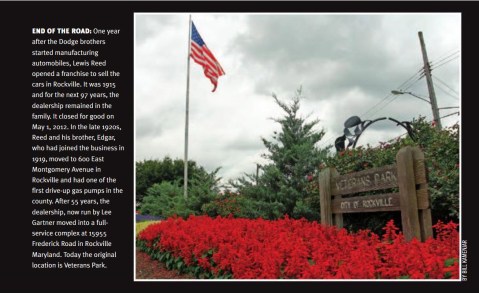
This is the dealership’s location today, now known as Veterans Park.
On National Television!
- Lewis Reed Photo in PBS Documentary: The Archival Producer for television’s most-watched history series, AMERICAN EXPERIENCE on PBS, found a photograph of the interior of a 1920’s trolley car taken by Lewis Reed and asked permission to use it in the documentary, “The Great War,” a six-hour, three-night event, that premiered Monday, April 10, through Wednesday, April 12, 9:00-11:00 p.m. ET in conjunction with the 100th anniversary of America’s entry into WWI.

Rare peak of the inside of a 1920’s trolley car and passengers featured in PBS documentary “The Great War”. Photo taken by Lewis Reed

Screen shot of credits from The American Experience series, “The Great War” on PBS
Last, but certainly not least, I would like to thank YOU for stopping by. I appreciate your patronage, whether it be via our blog, Facebook, Twitter, Pinterest or other social media.

Books

Related Resources


Copyright Notice

Reed Brothers Dodge History (1915-2012) by Jeanne Gartner is licensed under a Creative Commons Attribution-NonCommercial 3.0 Unported License.
 Reed Brothers Dodge History 1915 – 2012
Recent Comments