
A Short History of the Great Rockville Fair (1846-1932)

The Washington Times., August 20, 1922
In 1846, James K. Polk was President of the United States, the U.S. flag had only 28 stars on it, and less than 1,500 people lived in Rockville. It also was the year that the Montgomery County Agricultural Society was organized, that began the tradition of the Montgomery County Fair in Rockville. A 12-member board of directors was chosen, headed by John P. C. Peter, President. The Montgomery County Fair opened two years later on the Pike in 1848, about where Richard Montgomery High School is today.
Discussions about farm improvements led to organized agricultural efforts. In 1846, Rockville farmers helped to establish the Montgomery County Agricultural Society. Two years later, Court House Square overflowed with displays of agricultural implements at the first county fair. The register of will opened his office for exhibits of household manufacturers. and the county clerk’s place teemed with fruits and vegetables. Women competed for cash prizes in the categories of homespun fabrics, fancy handwork, pickles, preserves, butter, cheese, and honey. Men exhibited livestock on the grounds of the Beall-Dawson House.
In a few years, the fair moved to Samuel T. Stonestreet’s woodlot adjacent to Saint Mary’s Church. The annual fair became a week-long gathering to showcase innovation, compete, and socialize. The property on the Rockville Pike was used until 1932, after which much of the land became Richard Montgomery High School.
From The Baltimore Sun Newspaper on September 20, 1848:
The Montgomery County Agricultural Fair held at Rockville, Maryland on Thursday and Friday last, the Journal of that place says, fully met the most sanguine expectation of its friends. The concourse of people was very large, and the stock, implements, and other articles exhibited, were the most perfect and beautiful. The Journal designs to publish the various reports of the committee—and the very able and interesting address of R. J. Bowie, Esq., and the other appropriate remarks submitted on the occasion, and says:
The exhibition was highly credible to the officers and members of the club, and to our country. We must reserve, for a more lengthy notice, the beautiful stock and implements of agriculture sent by gentlemen residing out of our county. We are gratified, indeed, that every thing went off gloriously, and the occasion will be long remembered by all who were present.
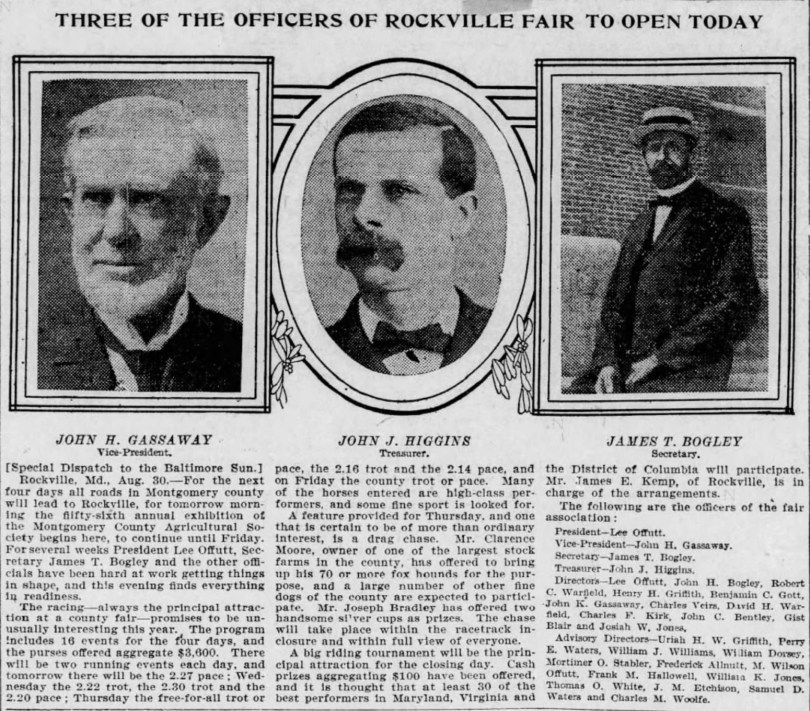
The Baltimore Sun, Sunday 31 August 1909
All the latest improved machinery in farm and garden implements were there, together with wagons, carriages, automobiles, trucks, and tractors. The display of cattle, sheep and hogs had long been one of the leading features at the Rockville Fair. Many fine herds of cattle, including Jerseys, Guernseys and other varieties were on exhibition. Two hundred of the finest horses in Montgomery County, along with many from the District of Columbia, nearby Virginia, and elsewhere were on exhibition.

Fair-goers in their finest stroll along the midway. Hats were a fashion requirement at the time, as were long flowing dresses and suits. Photo by Lewis Reed, ca. 1910
Many other attractions were provided, including the midway, merry-go-round, Ferris wheel, side shows, free exhibitions in front of the grandstand, horse racing, pony races, mule races, automobile contests, a parade of stock, horse show, dog show, poultry show, an automobile show, and clay pigeon shoots. The clay-pigeon shoot was one of the biggest events of its kind ever held in Maryland.

Ferris Wheel at the Rockville Fair. Photo by Lewis Reed, ca. 1910

Agricultural and various farm equipment exhibits. Photo by Lewis Reed, ca. 1910
The various departments were filled to overflowing with high-class exhibits. The main exhibition hall was devoted to farm products and garden products, household displays, flowers, fruits, etc. The household department had an endless array of preserves, jellies, canned fruits, bread, cakes, candles, pies, fancy articles, and works of art. Sanders & Stayman and E. F. Droop & Co. of Washington, had excellent displays of musical instruments in this hall. Examples of locally grown produce were abundant in the main hall. Peaches, apples, plums, damsons, cantaloupes and watermelons were piled up in tempting array. The poultry show was also a place of interest. Many fine chickens, turkeys, geese, ducks and pigeons were being shown.

Fair-goers meander through exhibits. Photo by Lewis Reed, ca. 1910

Can you hear me now? Photo by Lewis Reed, ca. 1910

Hundreds of cars parked in the fair parking lot. Photo by Lewis Reed, ca. 1910.
The Fair was always attended by large numbers of out-of-town visitors from other Maryland counties like Frederick, Howard, and Carroll counties, as well as attracting out-of-state fair-goers from the District of Columbia and neighboring counties in Virginia. Vehicles were assigned places all around the fairgrounds, and the park was completely surrounded. What is fascinating to me is, with all of these early cars painted in black, how on earth would you find your car?

Montgomery County Fairgrounds in the snow. Photo by Lewis Reed, ca. 1910
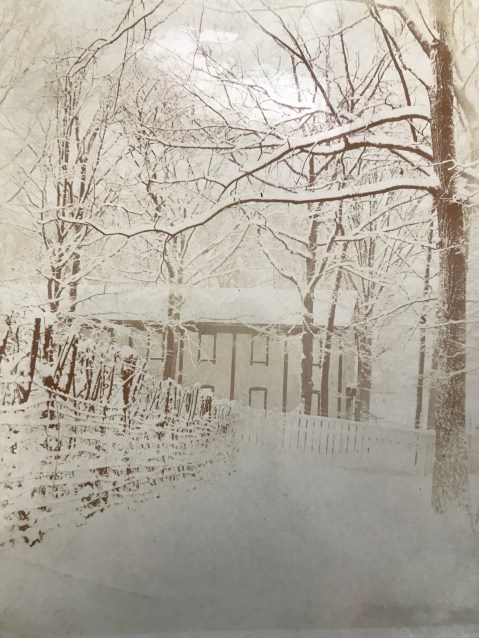
Montgomery County Fairgrounds Poultry House boarded up for the winter. Photo by Lewis Reed, ca. 1910

Sign on the left side of the building reads, “The Beautiful Caverns of Luray Souvenirs”. Photo by Lewis Reed, ca. 1910
The Race Track
If only the grandstands at the Rockville Fairgrounds could talk. The stories it could tell – it would tell stories of great racing – first on horses, bicycles and motorcycles, and then in cars. This grandstand could talk about the rich history of racing that took place on the one-third of a mile long dirt track which attracted high-power cars operated by some of the most noted speed kings of the country.
When Lewis Reed took these photographs in the early 1900s, the Rockville fairgrounds had undergone a significant upgrade. The grounds were enlarged by the addition of about five acres, allowing for the construction of a one-third of a mile race course along with a new grandstand, and improvements were made to the buildings and grounds, bringing them up-to-date in every respect. Montgomery County could well boast one of the nicest fairgrounds in the state.
Below is a previously unpublished Program of Speed Contests held in Rockville, Maryland, dated September 4 and 5, 1890. The program is from Lewis Reed’s collection. (click on photos for larger images)

Front cover of a racing program from the 1890 Montgomery County Agricultural Society Fair. From Lewis Reed’s Collection.

Racing program from the 1890 Montgomery County Agricultural Society Fair. From Lewis Reed’s Collection.
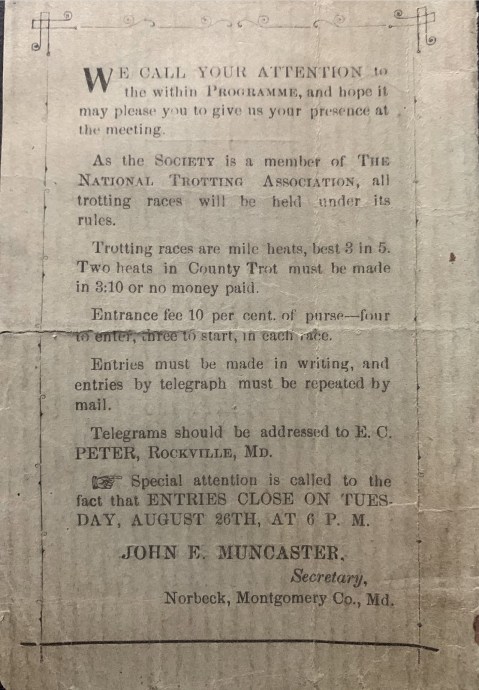
Back cover of racing program from the 1890 Montgomery County Agricultural Society Fair. From Lewis Reed’s Collection.
Bicycle Races
Bicycle races became very popular throughout the country and were a novel event at the Rockville Fairgrounds as early as 1915. The track was a one-third of a mile dirt racing oval with wide, sweeping curves and a grandstand for spectators, which made for clear views. Notice the riders are in shirts and ties. In the background: according to the 1903 Sanborn Fire Insurance Atlas of the fairgrounds, these structures near the track were used as cattle pens.

This circa 1915 photo of an early bicycle race at the Rockville Fairgrounds gives a sense of just how popular the sport was at the time. Photo by Lewis Reed
Harness Races
Harness racing was one of the main attractions at the new race track before the introduction of the automobile and the subsequent popularity of racing cars. Horses were harnessed to lightweight one-seater buggies called sulkies, and would race around the track at a trot, as opposed to the galloping gait of horses ridden by jockeys.

Rockville drew huge crowds for harness races. Photo by Lewis Reed, circa 1910
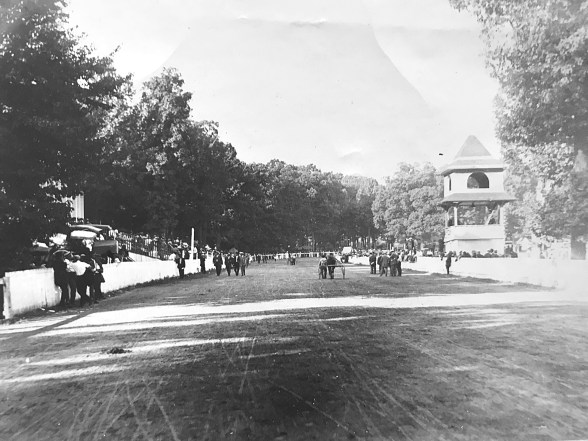
Harness race at the Rockville Fair, circa 1910. All those throngs of people had plenty to see. Photo by Lewis Reed

Harness racers rounding the bend on the racetrack, Rockville Fairground circa 1910. Photo by Lewis Reed

Bend on the harness racetrack, Rockville Fairground circa 1910. Photo by Lewis Reed
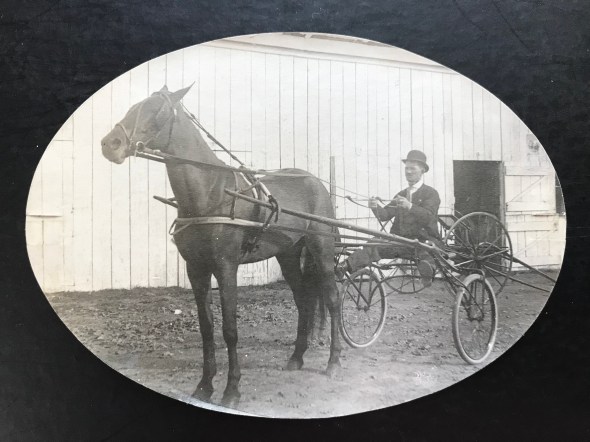
Race horses and two-wheeled sulkies (for trotting races) at the Rockville Fairground stables, Photo by Lewis Reed, ca. 1910.

Race horse and two-wheeled sulkies (for trotting races) at the Rockville Fairground stables. Photo by Lewis Reed ca. 1910
First Auto Races at Rockville Fair Speedway
From The Baltimore Sun, August 27, 1923:
This is the first year that a Rockville Fair has continued through Saturday. The extra day was added this time as an experiment, the management believing that by substituting new features the additional day could be made a success. Automobile races, the first ever held at Rockville, were the day’s principal attraction and they attracted a good-sized crowd.
Early action shots like the ones below are rare, however, Lewis Reed was there to capture six epic moments of race history through the lens of his camera that day.

Rockville drew huge crowds for auto races. Rockville Fair, August 25, 1923. Photo by Lewis Reed

Dusty Action – 1923 photo of the exciting auto races at Rockville Fair. Five racers are just coming around the bend on this dirt track with their tires spinning up dust in their wake. Photo by Lewis Reed

Race car drivers deep in dust round a turn at the Rockville Fair auto races. Print made from a Lewis Reed glass negative.
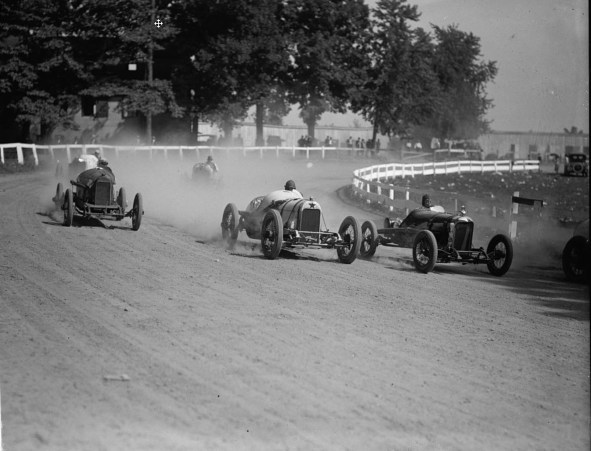
High-powered race cars rounding a wide, sweeping curve at the Rockville Fair auto races, August 25, 1923. Print made from a Lewis Reed glass negative
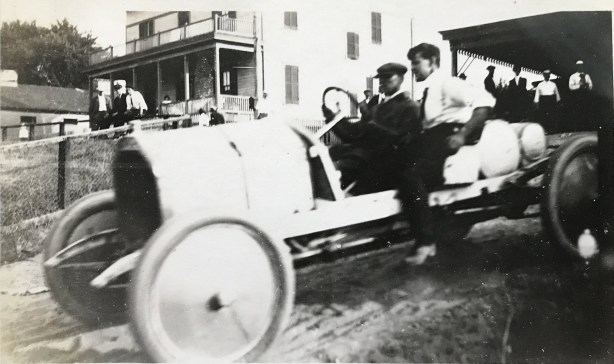
Two-man race car. Some early race cars included both a driver and a ‘riding mechanic’. One of the key jobs of the second man in a race car was to look backward and alert the driver to what was going on behind him. Photo by Lewis Reed
Early race car drivers were required to have a riding mechanic, otherwise it was voluntary. Riding mechanics, who in addition to being lookouts, kept an eye on tire wear and would even hop out of the car and run back through the infield to get fuel. Special note: The above photograph was featured as a part of the London Array Series of “Impossible Engineering,” broadcast on January 24, 2019 on Discovery’s Science Channel. The photograph was used on the program that featured a segment on the development of the race car.

More dirt track action. Skinny tires make for slippery turns. Photo by Lewis Reed
Rockville Garage Displaying New Model Cars at the Rockville Fair Grounds, 1918
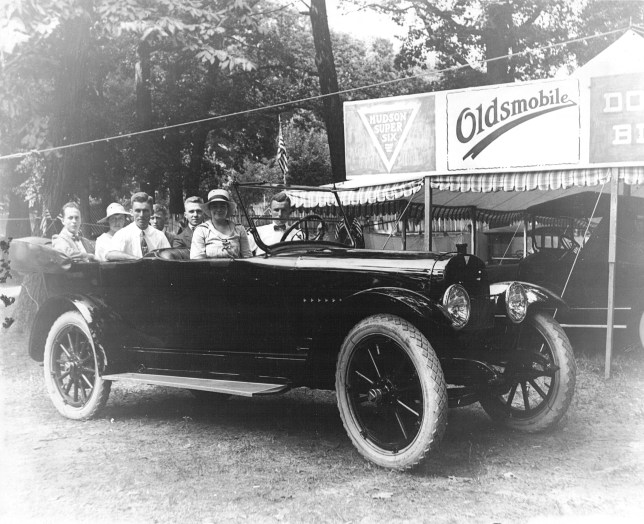
Anybody for a demonstration drive? Identified by the triangle logo on the grill and the number of passengers seated in it, the car appears to be a 1918 Hudson Super Six Seven Passenger Touring. Photo by Lewis Reed

Hudson Super Six, Oldsmobile, and Dodge Brothers Motor Cars on display. Lewis Reed in drivers seat.

Rockville Garage displaying their new models at the Rockville Fair Grounds. Photo by Lewis Reed

At Your Service Rockville Garage. Lewis Reed on the left
Reed Brothers Company Softball Team at the Rockville Fairgrounds, late 1920s
From a distance, it looks and sounds like a regular baseball game: the crack of the bat, the cheering from the bench, the sliding into home plate. But a closer look at the field shows something is very different. They’re playing on a rough grass field, no one is using a batting helmet, fielding glove, or catcher’s mask. From the 1920s through the 1940s, Reed Brothers Dodge had their own company softball team that played on the fields at the Rockville Fairgrounds where Richard Montgomery High School now stands.
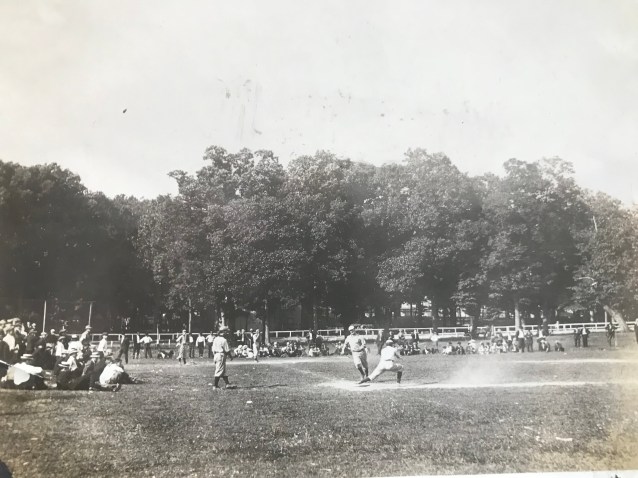
Reed Brothers Softball Team playing on a field set up inside the Rockville Fair racetrack oval, circa late 1920s. Photo by Lewis Reed
Fair Now History
From The Daily Mail (Hagerstown, Maryland) 23 Aug 1933:
The historic Rockville Fairgrounds, scene of many harness race programs, will be sold at a sheriff’s sale Friday afternoon at Rockville. The property consists of 26 acres, a dwelling and numerous stables, exhibition buildings and other structures. The sale is being made to satisfy a claim of a bank. It is rumored that the Montgomery County Board of Education will try to buy the grounds as a site for an elementary school and a future location for the entire Rockville educational plant.
Fair Ground Auctioned
From The Evening Sun (Baltimore, Maryland) 26 Aug 1933:
The Montgomery County National Bank submitted the only bid for the historic Rockville Fair Grounds at a public auction on August 25, 1933 to satisfy a bank’s claim. Its bid was $19,500.00 subject to a mortgage held by the Sandy Spring Savings Institution, and unpaid interest and taxes.
The Montgomery County Fair was reborn in 1949 and again started holding its annual Fair in Gaithersburg. On June 4th, 1949, hundreds of volunteers participated in an old-fashioned barn raising and 12 outbuildings were constructed in one day. The site of the new Montgomery County Agricultural Center was created.

June 4, 1949 – Construction of the cattle barns along the railroad tracks. Photo courtesy of Montgomery County Agricultural Fair photo archives.
End of An Era
While many things about the fair have changed over the years, its mission has remained the same.
This event provides the opportunity for 4-H and FFA members to exhibit their livestock, homemaking and craft projects. We also focus on promoting the science and preservation of agriculture in Montgomery County and educating Fair patrons and the community regarding agricultural related topics.
To that end they have been successful since 1846. The Montgomery County Agricultural Fair is now today, one of the largest county Fairs in the State of Maryland.
Find photos like these and much more on Montgomery History’s online exhibit, “Montgomery County 1900-1930: Through the Lens of Lewis Reed“.
References:
Chronicling America: Historic American Newspapers. Library of Congress
Newspapers.com: the largest online newspaper archive
Rockville, Portrait Of A City, Eileen S. McGuckian
Ag Center History
Fill’er up! Texaco Tanker Truck
The 1917 photo below is the Reed Brothers original Rockville Garage located at the intersection of Veirs Mill Road and Rockville Pike. To the right is a Texaco Gasoline Filling Station sign. One very tall Texaco branded fuel pump can be seen in this photo along with two Texaco Petroleum refueling trucks. The gas pump globe on the top advertises the gas company name and logo. Parked in front is a line-up of some very early Dodge Brothers Motor Vehicles.
Note the unpaved dirt road on Rockville Pike and trolley tracks running past the dealership. From 1900-1935, the trolley cars went past Reed Brothers Dodge as they traveled up Rockville Pike. Major stops along the line included Georgetown, Alta Vista, Bethesda, Montrose, Halpine, the Fairgrounds, Courthouse Square, and Chestnut Lodge.

1917 Original Rockville Garage with 2 story addition. Note the Texaco Filling Station signage and the Texaco Petroleum fuel truck refilling the single pump in front. Photo by Lewis Reed
At some point between prior to 1920, Reed Brothers Dodge changed over from selling Texaco and became a Gulf Gasoline dealer. Reed Brothers had the first Gulf gas station in the still-rural Washington D.C. area. (click on images to enlarge)

1917 Texaco tanker truck. Photo by Lewis Reed
A Texaco Petroleum Truck sits in front of Rockville Garage after delivering its load of fuel. On the side of the tanker is a hinged wooden box carrying 2-drums of a Texaco product. The delivery driver seems to be wearing his best suit on this job, something that you don’t see these days at all.
In addition to Texaco gasoline, Rockville Garage also carried a full line of Texaco lubricants, Fisk tires, Willard batteries and many other well known brands of merchandise.
The most essential vehicle of the early 20th century had to have been the tanker truck. In the pioneering period of tanker trucks, 1910 to 1920, the Texas Company was among many that were fitted with tanks to carry refined products such as gasoline, kerosene and fuel oil.
Montgomery County Police Department 99th Anniversary
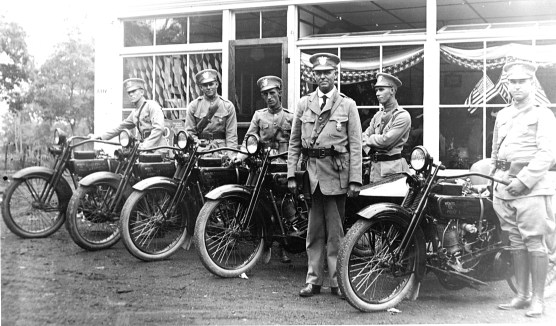
This is the first known photograph of the entire MCPD. Pictured left to right: Earl Burdine, Lawrence Clagett, Guy Jones, Chief Charles Cooley, Leroy Rodgers, and Oscar Gaither. Photo taken by Lewis Reed on July 4, 1922.
July 4th marks the 245th anniversary of the birth of our nation and the 99th anniversary of the beginning of the Montgomery County Police Department. Cattle rustling, bootlegging and stealing poultry were among the most common crimes when Montgomery County hired its first police chief and five officers in July 1922. So widespread was the theft of chickens and turkeys that some residents employed a homespun form of crime prevention by cutting off a specific claw on their birds to identify them. “Officers knew who all the chicken thieves were,” said one historical account of the era put together by the police department, “and upon getting a report of missing Rhode Island Reds, or some other breed, would head straight for the thieves’ hideaway to try to catch them ‘red handed’ before the birds got to the frying pan.”
Posing in front of Reed Brothers Dodge on July 4, 1922 Chief Charles Cooley, center, and his men of the first mounted unit of the Montgomery County Police Force, were on their first day of duty. For several years, since there was no police station, the officers would meet for “roll call” on the steps of the Red Brick Courthouse in Rockville at 2:00 p.m. every day to let each other know they were alive and well. Chief Cooley was given the privilege of a Model T Ford. The chief was paid $1,800 a year (the chief now gets $112,564) while the officers got $1,500. Each of the officers was issued a Harley-Davidson motorcycle, a .38 Smith & Wesson handgun, a black jack, law book and was allotted $300.00 a year for the upkeep of their motorcycle. Jones patrolled Silver Spring, Rodgers the Bethesda-Chevy Chase area and Burdine, Clagett and Gaither the Upper County areas.
The county’s population in the early 1920s was just 35,000 (it’s now more than 800,000). Much of the county was farmland, which accounted for the thefts of livestock. It also was the Prohibition era, when bootlegging and moonshine still factored routinely on an officer’s shift.
The officers worked 14 hours at night, 10 hours in the day, with two days off every two weeks. But they were on call at all times. Since there was no mobile radio contact (the first one-way radio system was installed in cars in the early 1930s), the officers tended to hang around the courthouse or a local firehouse that had a phone.
One of the officers came up with the idea of placing a flashing red beacon light on a pole atop the Rockville courthouse. When flashing, it would alert police that they had a call or were wanted at the office. In 1927, similar lights were used at district stations in Silver Spring and Bethesda.
Congratulations MCPD and thank you for your many years of service!
Introduction of School Buses in Montgomery County
Your parents and grandparents have probably told you stories of walking miles to get to school – uphill both ways of course. Today, most kids take the school bus. In fact, if you were a grade school student the late 1950’s, a Dodge school bus might have been your ride. The first school buses used around Rockville (and in Montgomery County) were furnished by Reed Brothers Dodge.
From The Montgomery County Sentinel, May 21, 1959:
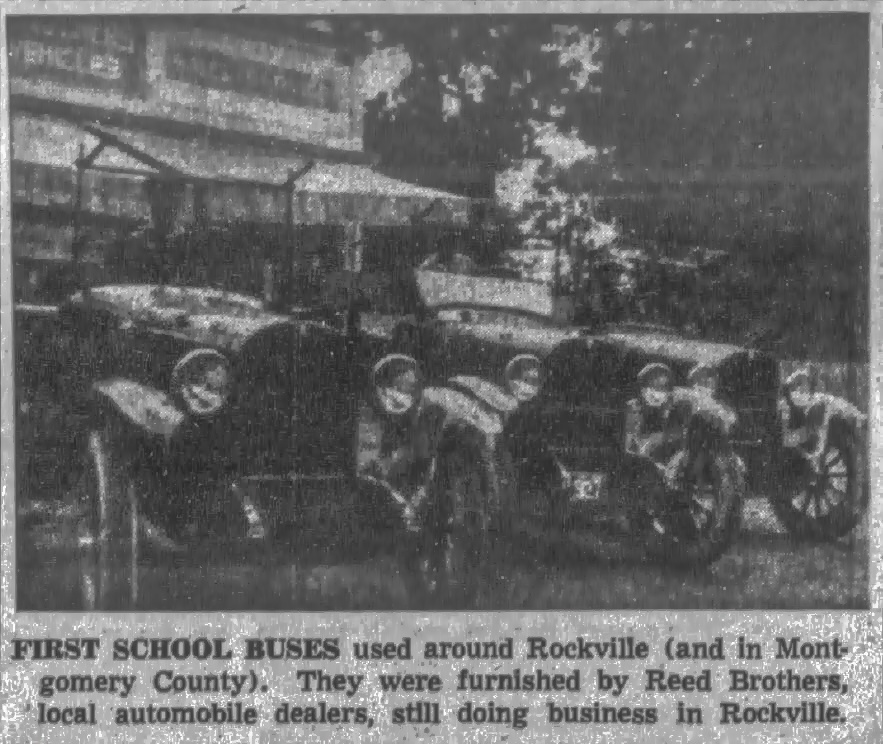
In the 1940s, the school bus started to become a profitable trend, so other companies began to jump on the bandwagon to create their own versions. Fifty years prior, Wayne Works and Blue Bird were the main producers, but around this time mainstream companies like Ford and Dodge used their vast resources to further innovation.

Following the end of WWII, the number of children exploded in America, and that necessitated another redesign for buses. This time they didn’t get wider or safer; this time they got a lot longer. Adding all that length increased overall capacity to around 100 students. It was around this time that the infamous yellow paint job became a national standard as well, so this is the beginning of the school buses we know today.
Then & Now: Historic Mathias Point Lighthouse
“Then and Now” photos are an excellent way to explore the passage of time. In this special post, I have combined one of Lewis Reed’s original photograph’s for “then” and matched it with a corresponding contemporary shot for “now”. Taken approximately 50 years apart, these photos show Mathias Point Lighthouse, then and now.
Mathias Point Lighthouse (THEN):
Mathias Point Lighthouse was placed at the edge of a shoal jutting out from a major bend in the Potomac River. This point was considered one of the most dangerous navigation problems on the river. In the summer of 1873, the United States naval steamer Frolic went ashore and remained grounded for over two weeks. It was eventually floated out at a cost of nearly $6,000. After much debate in Congress, $40,000 was finally appropriated in 1874. Originally, a day beacon was approved for Mathias Point and light for Port Tobacco Flats. After a delay of almost two years, the two sites were switched.
Plans were drawn up for Mathias Point and the design was like no other screwpile on the Bay. The design included 3 levels, unlike the other 2-level cottages on the Bay. It had a large second floor and smaller third floor which resulted in a “wedding cake” profile. It also had an unusual amount of ornate detailed woodwork. The pilings were angled inward to the base of the lighthouse, which was also different from other screwpile designs. The house was white with a brown roof and green shutters. Construction started in September 1876 and commissioned December 20, 1876.
The light was automated in 1951 and was monitored by the keeper of Maryland Point Light. In 1961 the light was decommissioned the beautiful lighthouse at Mathias Point was dismantled.

Mathias Point Light, Potomac River, near the Port Tobacco River, Maryland. Photo by Lewis Reed, 1915.
Mathias Point Lighthouse (NOW): The current light is a steel tower on the original screwpile supports and displays a 44-foot high, 6 second flashing green light. The current light can be viewed from the Mt. Bethel Recreation Center at Mathias Point in Virginia. As of 2020, it is still an active aid to navigation.
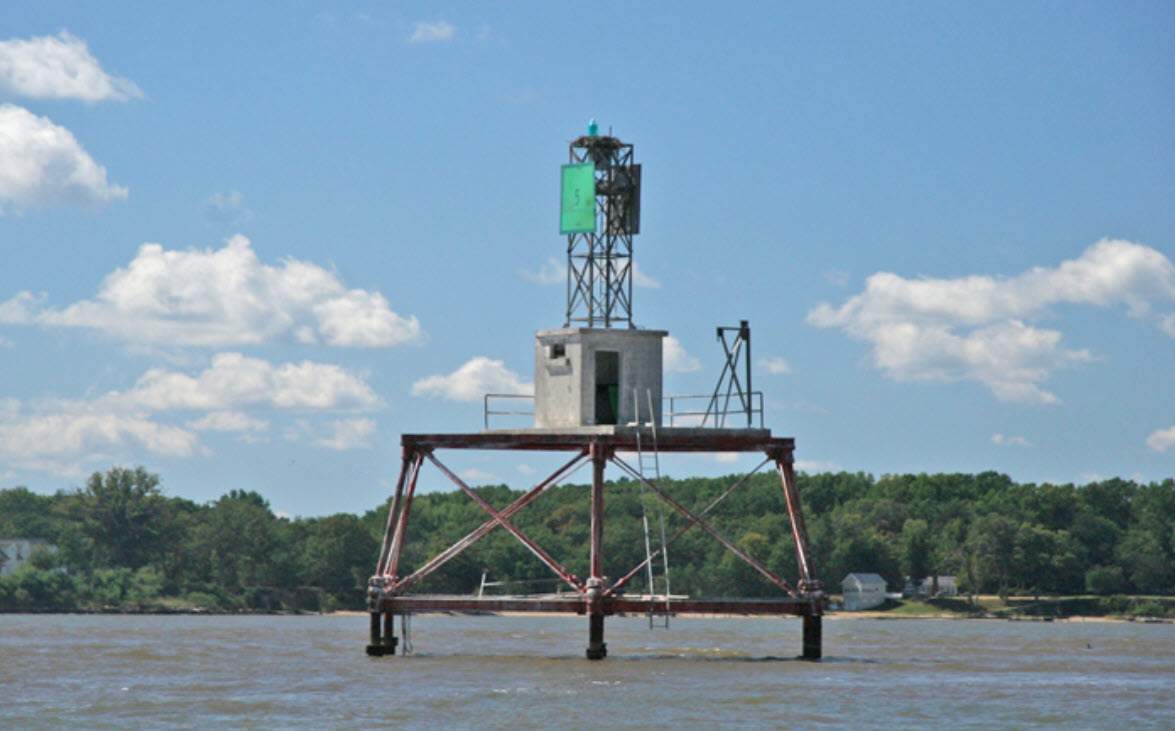
Mathias Point Light in the Potomac River in Maryland is no longer standing, now a beacon.
Books

Related Resources


Copyright Notice

Reed Brothers Dodge History (1915-2012) by Jeanne Gartner is licensed under a Creative Commons Attribution-NonCommercial 3.0 Unported License.


Recent Comments