
Then & Now: Washington Union Station 106 Years Apart
In this special post, I have combined one of Lewis Reed’s original photograph’s for “then” and matched it with a corresponding contemporary shot for “now” to see how the location has changed or remained nearly the same through the years. I started doing this as a research tool, now I mostly do it because of my passion for history and fascination with the subject. In the following photographs, you can see the difference 106 years can make.
Washington Union Station (THEN): Seen in the black & white photograph taken by Lewis Reed in 1912, is Union Station in Washington, DC. Union Station is one of the country’s first great union railroad terminals. Designed by renowned architect, Daniel Burnham, the station opened on October 27, 1907 and was completed in April 1908. At the height of its traffic, during World War II, as many as 200,000 passengers passed through the station in a single day. Today, Union Station is one of the busiest rail facilities and shopping destinations in the United States, and is visited by over 40 million people a year.
Visible in both photos is the Columbus Fountain also known as the Columbus Memorial which serves as a tribute to the explorer Christopher Columbus. The fountain sits in the center of the Columbus traffic circle in front of Union Station.
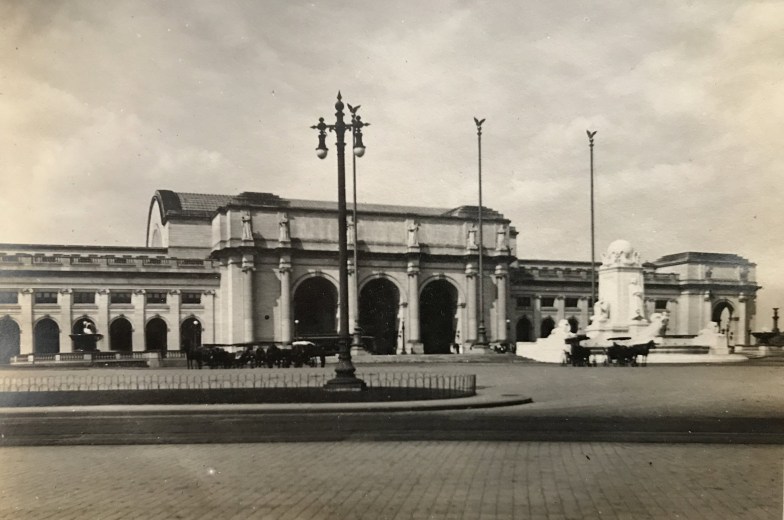
Washington Union Station, 1912. Photo by Lewis Reed
Washington Union Station (NOW): The same view over a century later. The difference? Color.
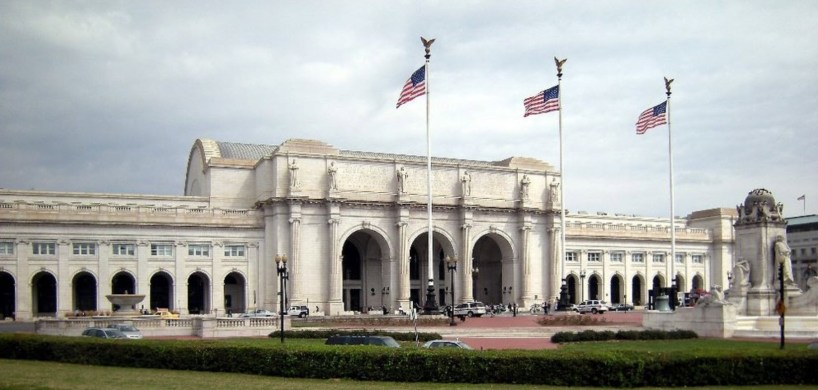
Washington Union Station today
Then & Now: Halpine Store/Radio Shack 111 Years Apart
Looking at old photographs is like peering through an open window back into history. Not only do they give you a sense of wonder from traveling back in time, but also a staggering feeling of awe from seeing just how much things have changed. For this post, I have used one of Lewis Reed’s original photographs for “then” and a Google Maps street view image from today for “now”.
The Halpine Store (THEN): The Halpine Store, also known as the Lenovitz General Store, was built on Rockville Pike in 1898, taking advantage of the prime location on the trolley and railroad lines and the Pike. The store sold food, gasoline and other items to locals and Pike travelers. The man standing just in front of the trolley tracks is James H. Handy (b. 1890) who lived at Halpine and worked for Mr. Copeland on the Wilkins farm. Handy served in the U.S. Army during WWI, as a gunner for the 371st infantry, doing two tours of duty in France. In this photo, he is about 16 years old. Note the telephone or telegraph poles, and the trolley tracks paralleling the road. The nearby Halpine railroad station also brought customers to the area, and the store became the social/community gathering place for the Halpine area. Tradition has it that during the days of “Local Option” when the sale of alcoholic beverages was forbidden in the County, the men of Rockville traveled to the Halpine Store to gather on the broad front porch and sip its special brand of “coffee” served in tin cups.
The proprietors, Benjamin and Anna Lenovitz, lived on the second floor. The building burned in 1923 and a new fire-resistant brick building was rebuilt in its place. This building, at 1600 Rockville Pike, became a Radio Shack, selling computers and electronics.
Seen in the black & white photograph taken by Lewis Reed in 1906, is The Halpine-Lenovitz General Store at Rockville Pike and Halpine Road.

Halpine-Lenovitz General Store at Rockville Pike and Halpine Road, 1906. Photo taken by Lewis Reed.
The Halpine Store/Radio Shack (NOW): The same view one hundred and eleven years later. Rockville Pike is now six lanes, linking the once outlying Halpine and Montrose with Rockville’s town center in one long strip of commercial enterprises and office buildings.

Halpine Store/Radio Shack, Google Image Capture, Nov 2016
Source: Maryland Historical Trust
U.S. Capitol Then & Now… 108 Years of Change
You might not realize how much Washington DC has changed until you look back and see what it looked like in the past. I thought it would be fun to revisit an historic location using one of Lewis Reed’s original photographs for “then” and a stock image from today for “now” to see what differences are visible. In the following photographs, you can see how the United States Capitol looks both the same and completely different from a century ago.
U.S. Capitol (THEN): Seen in the black & white photograph taken by Lewis Reed in 1910, is the United States Capitol in Washington, DC. Visible in both photos is the white marble Peace Monument that stands in the circle to the west of the U.S. Capitol at Pennsylvania Avenue and First Street, NW. A streetcar can also be seen in the black & white photo. The Pennsylvania Ave streetcar line ran from Georgetown, across Pennsylvania Avenue, past the White House, up to Capitol Hill, and then down to the Navy Yard. With no stop signs, speed limits, or lane lines, the streets of the early 1900s were completely different.
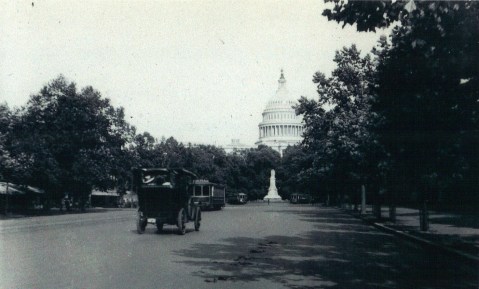
U.S. Capitol as seen from Pennsylvania Ave in 1910. Photo by Lewis Reed
U.S. Capitol (NOW): The same view over a century later hasn’t changed much… except for the traffic and Segway riders with fanny packs.
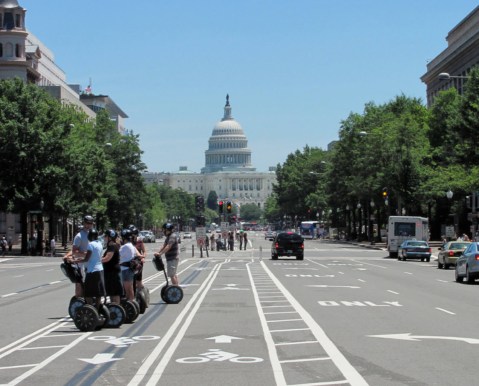
On Pennsylvania Ave and U.S. Capitol building today. A Segway tour is stopped along the bike lanes.
Then & Now: Georgetown University and Potomac Aqueduct Bridge 100 Years Apart
Washington DC has a lot of history. The Smithsonian museums, the monuments, etc., but it is interesting to see just how much the city has changed over the years. I thought it would be fun to revisit an historic location using one of Lewis Reed’s original photographs for “then” and a stock image from today for “now” to see what differences are visible. In the following photographs, you can see how Washington, DC looks both the same and completely different from a century ago.
Georgetown University and Aqueduct Bridge (THEN): The Key Bridge was not the original connector between Georgetown and Virginia. Prior to that construction in the 1920s, there were two iterations of the Aqueduct Bridge. The second iteration of the bridge looked visibly different, but even that one suffered from deterioration and was only used between 1889 and 1918. The Aqueduct Bridge continued as a bridge for traffic until the Key Bridge opened in 1923.
Seen in the black & white photograph taken by Lewis Reed in 1913, is the Aqueduct Bridge over the Potomac River in Washington, DC. The spires of buildings at Georgetown University can be seen in the background.
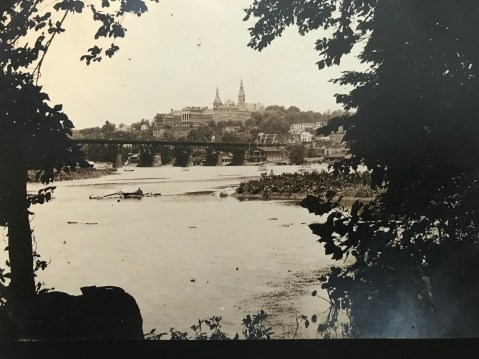
Potomac Aqueduct Bridge Washington DC 1913. Photo by Lewis Reed
Georgetown University and Key Bridge (NOW): The same view over a century later hasn’t changed much.

Georgetown University and Key Bridge Washington DC today
Tent Sales: What 90 Years of Change Looks Like
Pictured below are Reed Brothers tent sales 90 years apart, in 1918 and 2008. The black and white photograph below was taken by Lewis Reed in 1918 showing Rockville Garage displaying their new models at the Rockville Fair Grounds. The annual County Fair used to be held for four days in the month of August at the old Fairgrounds of Rockville, Maryland. Families came from every section of the Montgomery County in wagons and carriages, and stayed for the duration of the Fair. The Fair gave automobile dealers the opportunity to display their new models.

1918 Rockville Garage tent displaying Hudson Super Six, Oldsmobile, and Dodge Brothers Motor Cars at the Rockville Fair Grounds
The color photo below was taken some 90 years later in 2008, “Let’s Refuel America!” Tent Promo at Reed Brothers Dodge that let consumers lock in gas prices at $2.99 for three years. The novel Chrysler incentive offer was introduced at a time when high gas prices hammered sales of SUVs and trucks that dominated Chrysler’s line-up and was a way to help move the 2008 model gas guzzlers off the lot.

2008 Tent Promo at Reed Brothers Dodge
Books

Related Resources


Copyright Notice

Reed Brothers Dodge History (1915-2012) by Jeanne Gartner is licensed under a Creative Commons Attribution-NonCommercial 3.0 Unported License.
 Reed Brothers Dodge History 1915 – 2012
Recent Comments