
The Great Frederick Fair Parking Lot Shot, 1914

This fascinating scene of hundreds of cars parked in the Frederick Fair parking lot was taken by Lewis Reed in 1914. What is fascinating to me is, with all of these early cars painted in black, how on earth would you find your car in the parking lot?
This week (September 14-22) marks the 156th edition of the Great Frederick Fair, the largest and greatest county fair in the State of Maryland. There have been many changes since the first fair was held in 1822 when it was known as the Cattle Show and Fair: that was a two-day event, now it’s nine days. The location has changed and so has the name. Today, the Frederick County Fair is officially named the Great Frederick Fair. It’s been held in May, October and November, but now (and for many years) takes place in September — rain or shine.
Fair entertainment has certainly evolved over the years. In 1888, May Lillie, an “expert girl shot with a rifle” from the back of a running mustang, performed. In the early 1900s, acrobatic bears and monkeys, high-wire acts and vaudeville performers took the stage. In 1950, the highlight of the “Irish Horan and the lucky Hell Drivers” show was a “stock convertible catapulted from a giant cannon.” In 1965, it was Jack Kochman’s Hell Drivers performing stunts with cars.
The Thursday of the 1911 fair was noted as a record day with 15,000 people in attendance, 100 autos and 1,000 carriages, according to “The Great Frederick Fair” book. Today, fair attendance can range from 210,000 to 250,000 people during the nine-day fair.
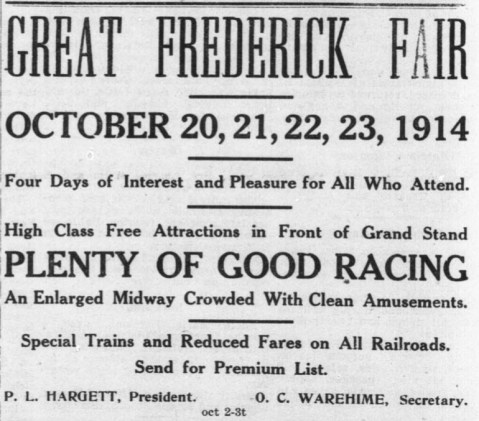
Newspaper ad advertising The Great Frederick Fair. THE DEMOCRATIC ADVOCATE OCTOBER, 1914
Source: Frederick News-Post
Montgomery County Saw & Grist Mills (1905-1910)
A key part of Montgomery County’s agricultural economy in the 18th and 19th centuries, grist mills ground wheat and corn into flour and meal for local farmers. Today, besides the more than 30 streets that are named for mills, all that is left are the remains that have been uncovered in our parks. All of the mill structures are in various stages of ruin and are barely visible today. The following photographs are a collection of fascinating historical images of Montgomery County Saw & Grist Mills taken by Lewis Reed from 1905-1910.

An unidentified lady poses in front of Black Rock Mill, circa 1905. Photo by Lewis Reed
Black Rock Grist & Saw Mill
Black Rock Mill was built by Thomas Hillary and has stood along the banks of Great Seneca Creek as a landmark since its construction in 1815-1816. The mill was in working operation for over a hundred years until a flood in 1920 destroyed a dam on Seneca Creek and damaged the mill. Today, it is a unique survivor of the many mills in Montgomery County harnessing the water-power of the creeks to grind wheat and corn into flour. It is one of only two mills standing in Montgomery County Maryland. As far as can be determined, Lewis Reed’s collection of about 20 Black Rock Mill photographs are some of the earliest known in existence.

Muncaster Mill. Photo by Lewis Reed
Muncaster Saw & Grist Mill 1760s
Joseph Elgar built saw and grist mill on Rock Creek, later known as Muncaster Mill. Muncaster Mill was built in the early 1800s and closed in 1925 due to competition from modern milling practices. It was burned to its foundation in 1935. At one time, as many as 12 other mills operated along Rock Creek but most disappeared before the Civil War. Muncaster Mill was the last mill to operate in what is now Rock Creek Park. During its lifetime, the mill served 30–50 farmers in the area. There were three millstones, each designed for a specific grinding job. One ground unshelled corn for animal feed; one coarsely ground wheat, barley, and oats; and one ground fine flour. For many years, there was also a sawmill, operated by a water turbine. The sawmill foundation was about 75 feet west of the grist mill site. The old miller’s house stood on Emory Lane near Muncaster Mill Road.
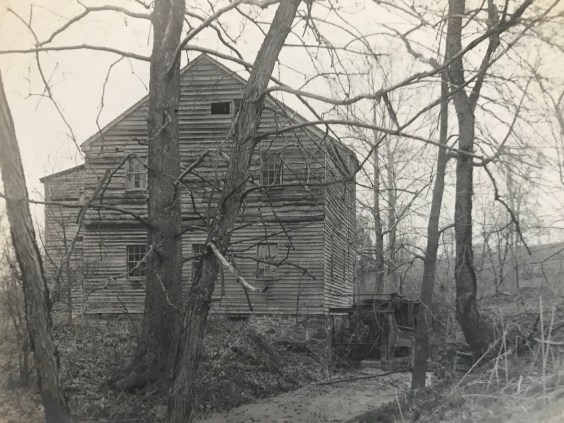
1910 Veirs Mill on Rock creek south of Veirs Mill Road operated from 1838-1880. Photo by Lewis Reed
Veirs Mill
The original Veirs Mill was built by Samuel Clark Veirs sometime after 1838 on the 400 acre farm which Veirs acquired in that year about two miles south of Rockville, on Rock Creek; the farm was part of an original land grant called “Prevention”. The sixth mill to be built on Rock Creek, Veirs Mill operated for approximately 80 years. The mill is identified as “Rock Creek Mills” and was located to what is now the intersection of Aspen Hill and Veirs Mill Roads. There are no above-ground remains of the Veirs Mill.

Hickerson Brothers Flour & Grist Mill 1910. Photo by Lewis Reed
Hickerson Brothers Grist Mill
Hickerson Brothers Grist Mill on Rock Creek south of Veirs Mill Road operated from 1838-1880. In 1925, Hickerson Brothers Lindsay and Clarence, operated a steam-powered grist mill near the B&O tracks until 1928-1929.

Clopper’s Mill. Photo by Lewis Reed
Clopper’s Mill
Clopper’s Mill was most active between 1850 and 1880, the arrival of the railroad and steam-powered mills had put an end to the water powered mills by the early 20th century. On April 15, 1865 Clopper’s Mill became part of national history when would-be assassin of the vice-president of the United States, George Atzerodt, spent the night there while fleeing from Washington D.C. after the assassination of President Lincoln. George was part of the gang assembled by John Wilkes Booth to eliminate the heads of the U.S. government. He was supposed to kill Vice-president Johnson at the Willard Hotel at the same time as Booth assassinated the President. But Atzerodt ran out of courage and instead made his way to Germantown. The mill was purchased by the state in 1955. The Clopper’s Mill ruins are significant as one of the few remaining distinguishable mills in the county. The ruins consist of stone and brick walls with no roof.

Liberty Mill. Photo by Lewis Reed
Liberty Mill. The Bowman Brothers built a steam-powered mill in 1888. When this mill burned down in 1914, an electric-powered mill was built and bought by the Liberty Milling Company in 1917. “Feed the Liberty Way” was the slogan for the mill which became the second largest mill in Maryland and supplied flour for the army during World War II. Cornmeal and animal feed were also made at the mill, and a mill store sold specialty mixes like pancake and muffin mix. After the war the mill went into decline, and was burned by arson May 30, 1972.
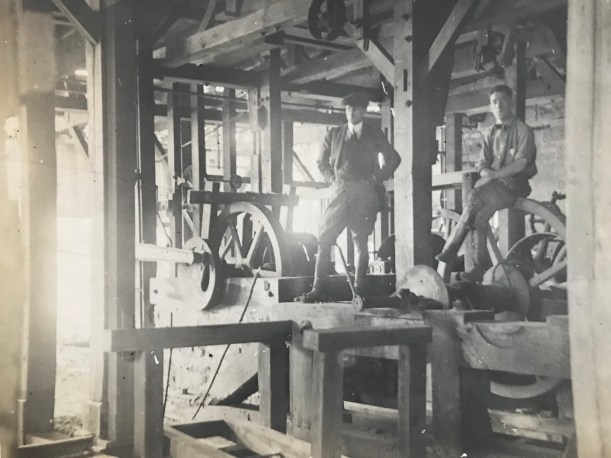
Rare peek at the inside of an old mill. Photo by Lewis Reed.
Source: Maryland Historical Trust
Darnestown One-Room Schoolhouse (1898)
Have you ever wondered what it would be like to attend a one-room school, to be in the same classroom as your older brother or younger sister, where all the kids, no matter how old, are in the same class? One-room schoolhouses are all but a memory now. But at the turn of the 20th century, they were where most rural students received their educations. One room schoolhouses were the pioneers of the early education period. At the period’s peak, just under 100 one- and two-room schools existed in Montgomery County.
One of the most amazing photographs in Lewis Reed’s collection is of the one-room schoolhouse where he and his brother, Edgar, went to school. This photograph is the only one known to exist of this school. The schoolhouse, now long gone, was located on Thomas Kelley’s Farm at Pleasant Hill (which today, would be located in the center of the Spring Meadows community). Lewis Reed grew up on a farm in rural Darnestown and for much of his young life had no running water or electricity. His father was an early settler and worked as a Cabinetmaker and Blacksmith. The Reed family farmhouse and blacksmith shop was located in off Route 118 in Darnestown.

Darnestown One-Room Schoolhouse. The chimney was probably to a wood-burning stove that was used to heat the building. Note the outhouse on the left. Photo from the Lewis Reed Collection
This small, one-room schoolhouse was within walking distance of my grandfather’s farmhouse. In those days, walking distance generally meant within a few miles. Lewis Reed attended this school with his brother, Edgar. First through sixth grades were taught by one teacher (Minnie McAtee) to about thirty or more students. Few students went beyond sixth or seventh grade; in fact, Lewis Reed’s education stopped after the sixth grade. He would later be home-schooled by his wife, Ethelene Thomas, who was a teacher in the Maryland public school system.
The age range for students was 6 to 16. The students were separated roughly by level of study in each particular subject, rather than by age as they are now: a child might have studied 3rd grade math while also doing 6th grade reading or history. Gender separation was maintained by seating girls and boys on opposite sides of the room. The larger boys were expected to help bring in the wood or coal and carry out the ashes. Misbehavior begot corporal punishment.
School usually took place between the hours of 8 a.m. and 4 p.m. The youngest children sat in the front, while the oldest students sat in the back. The teacher usually taught reading, writing, arithmetic, history, and geography. Students memorized and recited their lessons. The teacher’s desk may have been on a raised platform at the front of the room, however, and there would have been a wood-burning stove since there was no other source of heat. The bathroom would have been outside in an outhouse.

Circa 1898 class photo taken at Lewis and Edgar Reed’s one-room schoolhouse (Darnestown School). There were six grades in the school with one teacher. Minnie McAtee, teacher (right rear). Photo from the Lewis Reed Collection.
As for Minnie McAtee, according to The Baltimore Sun (Baltimore, Maryland) 05 June 1901, Miss McAtee resigned from the Montgomery County school system in 1901.
Born in Darnestown, Miss McAtee attended the Andrew Small Academy in Darnestown, after which she completed correspondence courses to further her education. For eight years, she taught in the one-room schoolhouse at Pleasant Hill, Darnestown.
The undated “Get Well Story” below was posted on the Find A Grave website in her memory. Anybody who took such good care of flowers as she did, most certainly must have been a great school teacher.
 At least 34 schoolhouses of this bygone era still stand today in Montgomery County, an astounding total considering how developed Montgomery County is today. The five schoolhouses in Montgomery County restored as museums — Boyds, Brookeville (one-room school), Kingsley, Seneca, and Smithville — are open to the public at various times during the year. Most are open during Heritage Days; check www.heritagemontgomery.org for the schedule.
Then & Now: Hagerstown Public Square
This post is a continuation of a series of “Then & Now” images that will show photographs of buildings, street scenes, and other historical locales from Lewis Reed’s Photo Collection alongside photographs of how they appear today.
Hagerstown Public Square (THEN): Hagerstown Public Square looking north on Potomac Street, circa 1913. D. Ramacciotti’s fruit and candy store dominated the left side of the square. Trolleys roll down the middle of the street and a piano store is on the right. Winding the giant clock in the background (still there today) was done by a line from the tower attached to a horse on the ground that pulled the clock’s weights up through the tower.

Hagerstown Public Square, 1913. Photo by Lewis Reed
Hagerstown Public Square (NOW): Traffic heads south on Potomac Street on the square in downtown Hagerstown 105 years later.

Hagerstown’s Public Square, looking north on Potomac Street, as it is today.
Then & Now: Quebec Bridge (8th Wonder of the World)
The Quebec Bridge (Pont de Québec in French) has been an icon of Canada for more than a century. But did you know that the Quebec Bridge collapsed twice (1907 & 1916) before it was completed, making it the world’s worst bridge construction disaster. Taken approximately 90 years apart, these photos show the Quebec Bridge (8th Wonder of the World) then and now.
Quebec Bridge (THEN): Hailed at the time as the 8th wonder of the world, the Quebec Bridge was the first bridge over the St. Lawrence River in Montreal. Accommodating three highway lanes, one rail line and a pedestrian walkway, it represented a colossal challenge to construct at the time. First conceived in 1887, the bridge collapsed failed twice, at the cost of 88 lives, and took over 30 years to complete. A riveted steel truss structure, the Quebec Bridge is the longest cantilever bridge span in the world. The Quebec Bridge was declared a historic monument in 1987 by the Canadian and American Society of Civil Engineers, and on January 24, 1996, the bridge was declared a National Historic Site of Canada.

Quebec Bridge (8th Wonder of the World). Photo by Lewis Reed, ca. 1930
Quebec Bridge (NOW): The same view almost 90 years later. The bridge remains in use to this day, carrying both road and rail traffic. rails in the middle and roadways on both sides.

Night view of the Quebec Bridge, today. Photo credit: Martin St-Amant – Wikipedia
Source: Wikipedia
Books

Related Resources


Copyright Notice

Reed Brothers Dodge History (1915-2012) by Jeanne Gartner is licensed under a Creative Commons Attribution-NonCommercial 3.0 Unported License.
 Reed Brothers Dodge History 1915 – 2012
Recent Comments