
Horsemobile?
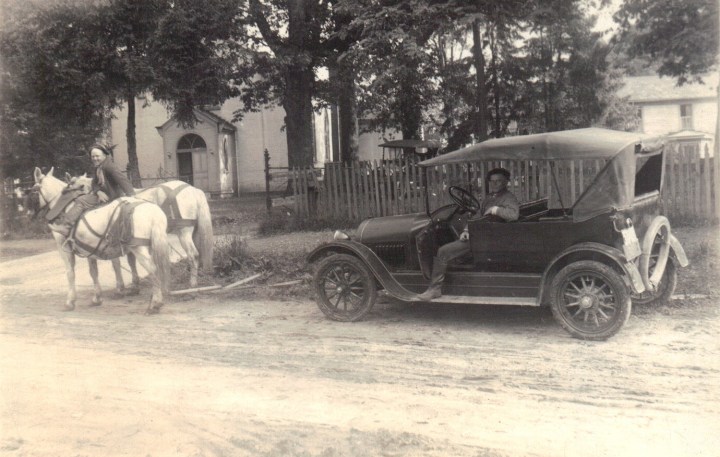
Early transportation powered by true “horsepower”. Photo taken by Lewis Reed, 1915
This fun and interesting photograph taken by Lewis Reed is one of my favorites. The photo shows William Beall in his 1915 Pullman in front of old St Mary’s Church and his younger brother Vernon on horseback “towing” him to Reed Brothers. The photo was taken from in front of Reed Brothers Dodge which was directly across the street from St Mary’s Church.
Several of the Beall family were original employees at Reed Brothers, including: Leonard Beall (paint/auto body shop), Otis Beall, Walter (Bud) Beall, and Mary Anna (Slater) Beall (Bookkeeper). Bud and Otis Beall were two of Reed Brothers’ original Gulf Gasoline Station attendants.

Then & Now: Wilson Bridge Hagerstown 105 Years Apart
Looking at old photographs is like peering through an open window back into history. Not only do they give you a sense of wonder from traveling back in time, but also a staggering feeling of awe from seeing just how much things have changed. For this post, I have used one of Lewis Reed’s original photographs for “then” and a Google stock image for “now”.
Wilson Bridge (THEN): Built in 1819, this five arch structure named for nearby village was the first stone bridge built by Washington County. Erected by Silas Harry at cost of $12,000, it was a major improvement to the road system between Baltimore and Cumberland, providing continuous smooth surface from eastern seaboard to western wilderness. Wilson Bridge carried traffic until seriously damaged by storm flood in 1972. It was placed in the National Register of Historic Places in 1982.
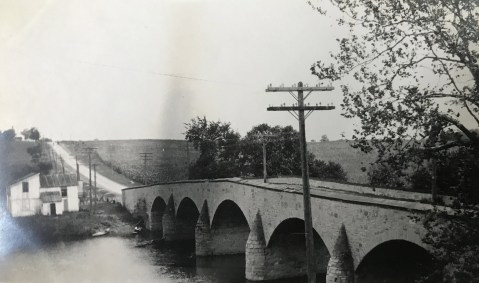
Wilson Bridge Hagerstown, Maryland. Photo by Lewis Reed, 1914
Wilson Bridge (NOW): The bridge was beautifully restored in 1984 by LeRoy E. Myers. The bridge is one of numerous still standing stone bridges in central and western Maryland.
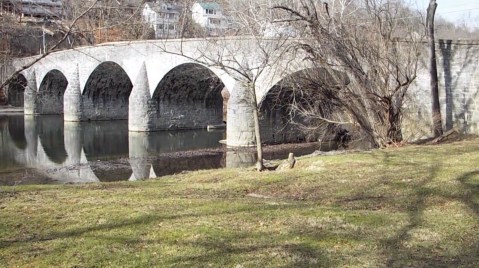
Restored Wilson Bridge today
UPDATE: Lewis Reed Photos to Appear on Science Channel ‘Impossible Engineering’

I just got word from the Production Assistant at Discovery that the new season of Impossible Engineering Series 4 is about to start airing in the US. Lewis Reed’s race car photographs will be a part of the “London Array Wind Farm” episode which is the second episode of the series. The show is scheduled to be broadcast on Thursday, January 10, 2019 on Discovery’s Science Channel.
The following 1923 dirt track race shots taken by Lewis Reed at the Rockville Fair will be used on the program that will feature a segment on the development of the race car.
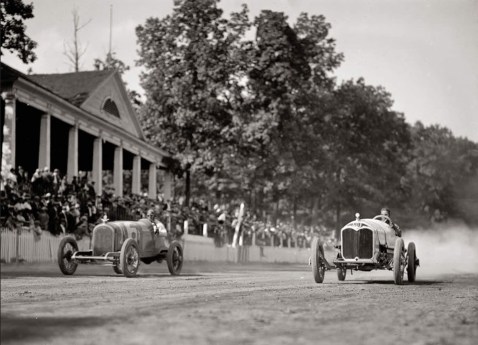
Photo by Lewis Reed
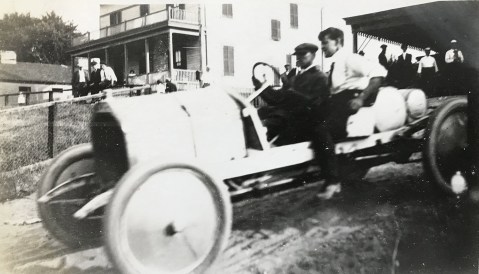
Photo by Lewis Reed
About Impossible Engineering
Behind every seemingly impossible marvel of modern engineering is a cast of historic trailblazers who designed new building techniques, took risks on untested materials and revolutionized their field. Brand new series, ‘Impossible Engineering’, is a tribute to their achievements. Each episode details how giant structures, record-beating buildings, war ships and space crafts are built and work. As the show revels in these modern day creations, it also leaps back in time to recount the stories of the exceptional engineers whose technological advances made it all possible. How would they have ever existed without the historical work of their ancestors? Interviews with their great advocates bring engineering history to life and retell how these incredible accomplishments shaped the modern world.
“Impossible Engineering” is produced for Science Channel by Twofour Broadcast.
A Glimpse of Christmas Past in the Reed Family Home

Lewis Reed’s craftsman-style home, looking rather solitary on a snowy day. Photo by Lewis Reed.
I am flooded today with memories of my grandparents’ house. As a kid, it was a magical place. It was not a huge house, a modest Sears and Roebuck craftsman-style home built in 1926. Some of my earliest memories are visits to this home as I spent a lot of time there during my childhood. While looking through my grandfathers Christmas photographs, I started making some notes about some of the arbitrary things I could remember about them. And eventually some of that turned into this blog post.

Snow on the ground means it’s time for building a (presidential) snowman. This photo is Lewis Reed and the snowman he built of George Washington.
The following photos from Lewis Reed’s collection are a fabulous glimpse into Christmas inside the Reed family home at 301 North Frederick Avenue in Gaithersburg, Maryland. A lot of people assume that the traditions we follow have looked pretty much the same since their inception but, in most cases, like everything else in life, Christmas has definitely changed over the years.
The trees were big back then and always fresh. They went right to the ceiling and were very wide. Early Christmas trees were generally fastened onto a flat board surrounded with fence-rails, snow villages and carpeted with cotton blankets of snow. Lots of tinsel and strings of popcorn garnish the trees.
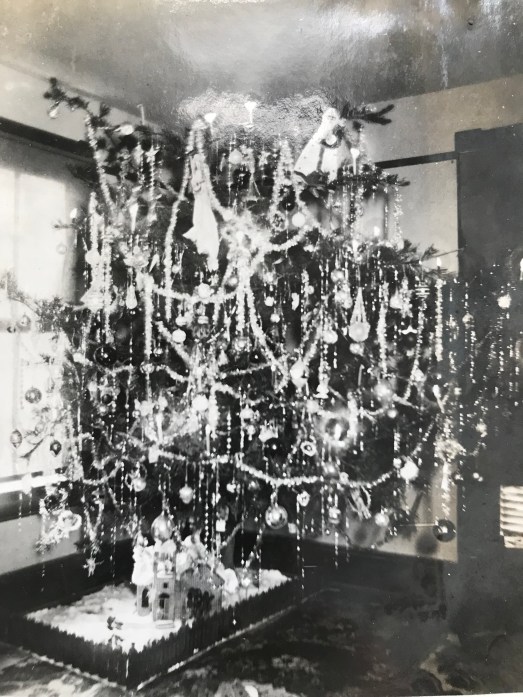
A small snow scene with what appears to be a miniature church is arranged at the foot of the Christmas tree. A popcorn garland adorns the tree. Photo by Lewis Reed
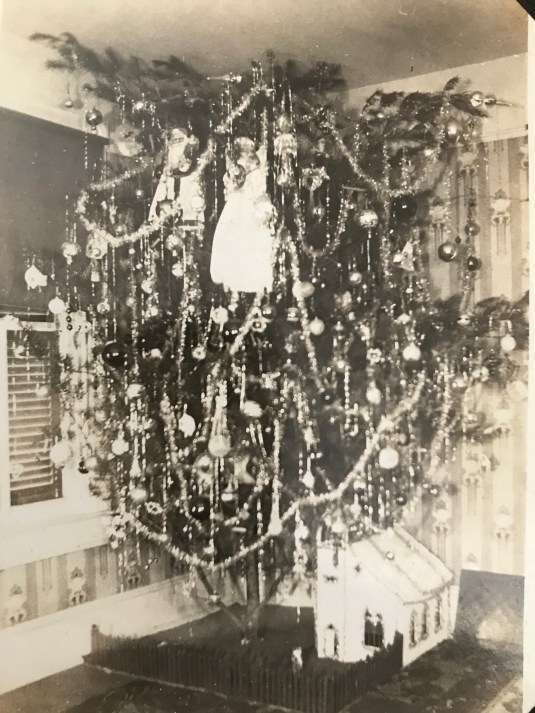
No room for a star on the top of this tree! And just look at those big Santa and Angel dolls. A miniature church with picket fence is arranged at the base of the tree. Photo by Lewis Reed
Below are photos of Lewis Reed’s snow village set up under the Christmas tree decorated with vintage ornaments, tinsel, and lights. I used to have a ton of fun helping my grandfather set up the miniature landscapes with the varied figures, little houses, and trees at Christmastime each year. It seemed like a holiday village right out of a storybook.

A rustic picket fence is used to set off the village display. Photo by Lewis Reed
The snow villages were set up in Lewis Reed’s basement on top of a big table beneath a small Christmas tree. He made the snow scenes entirely by hand using wire-covered cardboard and balled up paper to make hills and pathways. The little houses and figurines would fit into the landscape with cotton ‘snow’ all around; and lights would be wired underneath. It was just amazing to me.
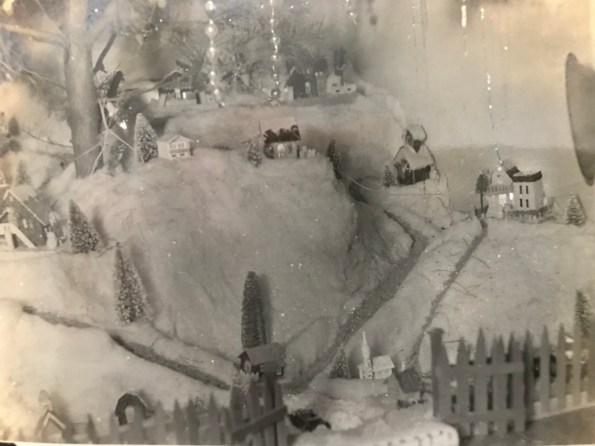
Little houses, churches, fences, trees, and pathways were added to the scene. Some of the houses have charming light effects in the windows. Photo by Lewis Reed
These Christmas villages were precursors of the Holiday Villages that were made popular by Dept. 56 that you see today.

Old-fashioned lights can be seen on the tree, along with lit windows in the houses. Photo by Lewis Reed
Looking back on these memories now in my adult mind is like watching my favorite Christmas movie. They are memories of my grandparents house at Christmastime, and are ones I will always treasure.
Then & Now: Walker Avenue Gaithersburg
This post is a continuation of a series of “Then & Now” images that will show photographs of buildings, street scenes, and other historical locales from Lewis Reed’s Photo Collection alongside photographs of how they appear today. These photos show the same view of Walker Avenue in Gaithersburg about 98 years apart.
Walker Avenue (THEN): This photo of Walker Avenue in Gaithersburg was taken by Lewis Reed from the steeple of Grace United Methodist Church in the late 1920s. The street is named after John Walker, whose farm became Walker Avenue when he decided to subdivide the front end in 1904. Walker was mayor of Gaithersburg from 1906 to 1908 and again from 1918 to 1924. In June 1913, Walker Avenue was the first street in Gaithersburg to have electric streetlights installed along its full length. This period saw major advances in technology, communication, and transportation.
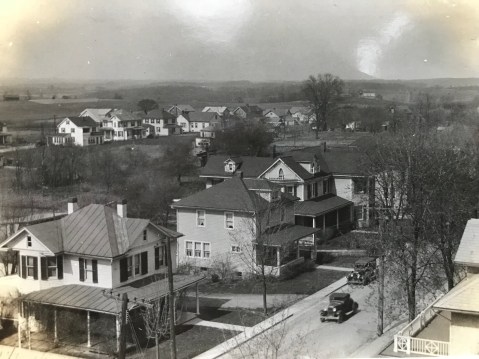
Walker Avenue in Gaithersburg taken from the steeple of Grace United Methodist Church, late 1920s. Photo by Lewis Reed
Walker Avenue (NOW): Walker Avenue is the most cohesive street in Gaithersburg’s historic district. Most of its houses were built between 1904 and 1930.
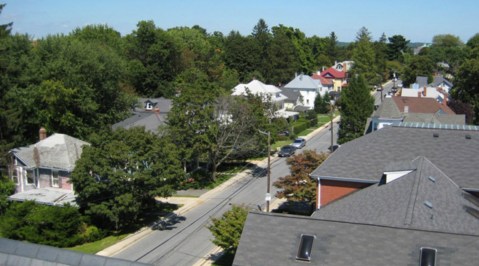
Walker Avenue in Gaithersburg today
Source: Maryland Historical Trust
Books

Related Resources


Copyright Notice

Reed Brothers Dodge History (1915-2012) by Jeanne Gartner is licensed under a Creative Commons Attribution-NonCommercial 3.0 Unported License.


Recent Comments