
Lewis Reed Captures the Thrill of Motorcycle Racing in 1915

A motorcycle racer rips down an unknown racetrack kicking up dust in his wake. Photo by Lewis Reed, ca. 1915
In the first years of the twentieth century, companies like Harley-Davidson and Indian began producing motorcycles for the general public. Although there is not an exact date of the first motorcycle race, you can be sure that as soon as there were two motorcycles on the road, there was racing. As more and more motorcycle manufactures started popping up across the U.S., motorcycle racing started making it’s way to more official venues. The earliest races were held on fairground dirt tracks used for horse racing.
This photograph taken by Lewis Reed shows an unknown racer at a fairground raceway in the early 1900s. In the teens, motorcycle racing on dirt tracks throughout the country, was one of the most popular spectator sports. Despite the danger to both racers and spectators, the motorcycle races became very popular and drew large crowds of spectators. Motorcycle racing continued until just after World War 1, when the focus shifted to automobile racing.
Featured Photo: Popes Creek Post Office, 1910

Popes Creek Post Office on the Potomac River. Photo by Lewis Reed, ca. 1910
It’s hard to imagine a world without cars, buses, and trucks. But put yourself back in the early 20th century. Before the invention of trains and automobiles, animal power was the main form of travel. Horses, donkeys, and oxen pulled wagons, coaches, and buggies. Early settlers often used oxen to pull their big wagons. Oxen were slower than horses, but they could pull four times as much weight.
In this circa 1910 photograph taken by Lewis Reed, two men pose with an ox-drawn wagon in front of the little Popes Creek Post Office on the Potomac River. Two elegantly dressed women with hats stand outside on the porch. Note the two-person horse buggy on the right. The Potomac River is visible in the background. The Popes Creek Post Office probably served as a social gathering place for the community.
A bit of history: Popes Creek is an unincorporated community in Charles County, Maryland. It is located on the shore of a north-south section of the Potomac River north of and in sight of the Harry Nice Memorial Bridge. To the north is Port Tobacco Village, Maryland, and to the southeast the Cobb Island peninsula. Pope’s Creek has a long and varied history. Near here, John Wilkes Booth was rowed across the river, a week after he assassinated President Abraham Lincoln. The creek itself was named for Nathaniel Pope, an early landowner in the area.
Reference: Wikipedia
Then & Now: Clopper Grist Mill
This post is a continuation of a series of “Then & Now” images that will show photographs of buildings, street scenes, and other historical locales from Lewis Reed’s Photo Collection alongside photographs of how they appear today. Taken approximately 109 years apart, these photos show the Clopper Grist Mill then and now.
Clopper Mill (THEN): Francis Cassatt Clopper bought this mill and 541 acres in 1810, but the earliest mention of a mill on this site dates back to 1777. Clopper’s mill was a square, three-story grist mill, with basement and first floor levels made of local field stone and a third story of brick. The mill was destroyed by a fire in 1947.
On April 15, 1865 Clopper Mill became part of national history when would-be assassin of the Vice President of the United States, George Atzerodt, spent the night there while fleeing from Washington D.C. after the assassination of President Lincoln. George was part of the gang assembled by John Wilkes Booth to eliminate the heads of the U.S. government. He was supposed to kill Vice President Johnson at the Willard Hotel at the same time as Booth assassinated the President. But Atzerodt ran out of courage and instead made his way to Germantown.

Clopper Grist Mill. Photo by Lewis Reed, ca. 1910
Clopper Mill (NOW): The ruins of this large brick and stone mill stand on the west bank of Great Seneca Creek, just south of Clopper Road near the intersection of Warring Station Road. The property was acquired by the State in 1955 as part of Seneca Creek State Park.

Clopper’s Mill Ruins today.
Montgomery County Police Department Celebrates 97th Anniversary (1922-2019)
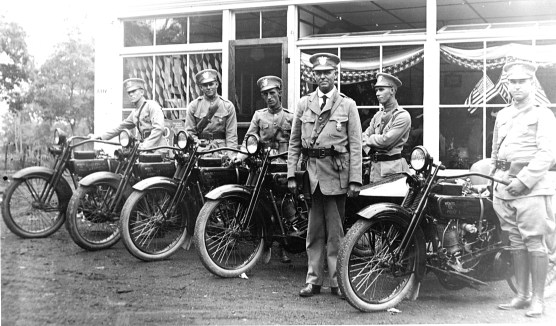
This is the first known photograph of the entire MCPD. Pictured left to right: Earl Burdine, Lawrence Clagett, Guy Jones, Chief Charles Cooley, Leroy Rodgers, and Oscar Gaither. Photo taken by Lewis Reed on July 4, 1922.
Today marks the 243rd anniversary of the birth of our nation and the 97th anniversary of the beginning of the Montgomery County Police Department. Cattle rustling, bootlegging and stealing poultry were among the most common crimes when Montgomery County hired its first police chief and five officers in July 1922. So widespread was the theft of chickens and turkeys that some residents employed a homespun form of crime prevention by cutting off a specific claw on their birds to identify them. “Officers knew who all the chicken thieves were,” said one historical account of the era put together by the police department, “and upon getting a report of missing Rhode Island Reds, or some other breed, would head straight for the thieves’ hideaway to try to catch them ‘red handed’ before the birds got to the frying pan.”
Posing in front of Reed Brothers Dodge on July 4, 1922 Chief Charles Cooley, center, and his men of the first mounted unit of the Montgomery County Police Force, were on their first day of duty. For several years, since there was no police station, the officers would meet for “roll call” on the steps of the Red Brick Courthouse in Rockville at 2:00 p.m. every day to let each other know they were alive and well. Chief Cooley was given the privilege of a Model T Ford. The chief was paid $1,800 a year (the chief now gets $112,564) while the officers got $1,500. Each of the officers was issued a Harley-Davidson motorcycle, a .38 Smith & Wesson handgun, a black jack, law book and was allotted $300.00 a year for the upkeep of their motorcycle. Jones patrolled Silver Spring, Rodgers the Bethesda-Chevy Chase area and Burdine, Clagett and Gaither the Upper County areas.
The county’s population in the early 1920s was just 35,000 (it’s now more than 800,000). Much of the county was farmland, which accounted for the thefts of livestock. It also was the Prohibition era, when bootlegging and moonshine still factored routinely on an officer’s shift.
The officers worked 14 hours at night, 10 hours in the day, with two days off every two weeks. But they were on call at all times. Since there was no mobile radio contact (the first one-way radio system was installed in cars in the early 1930s), the officers tended to hang around the courthouse or a local firehouse that had a phone.
One of the officers came up with the idea of placing a flashing red beacon light on a pole atop the Rockville courthouse. When flashing, it would alert police that they had a call or were wanted at the office. In 1927, similar lights were used at district stations in Silver Spring and Bethesda.
Congratulations MCPD and thank you for your many years of service!
75 Years Ago: Fire Destroys Barns on Rockville Farm
Seventy five years ago, from the pages of The Washington Evening Star newspaper for the first week of September 1944.
Members of the Rockville Volunteer Fire Department fought a fire on the farm of Mrs. Rose Veirs, a mile and a half west of Rockville, which destroyed three bars, a silo, livestock and grain. Barn and brush fires were very difficult to control and complete loss of the buildings or fields was usually inevitable. This was the case with Mrs. Rose Veirs who lost three barns, a silo, livestock and grain in a fire in 1944. The farm was associated for 70 years with the prominent Rockville family, the Veirs.
These previously unpublished photographs taken by Lewis Reed show scenes during the fire and extent of the damage.
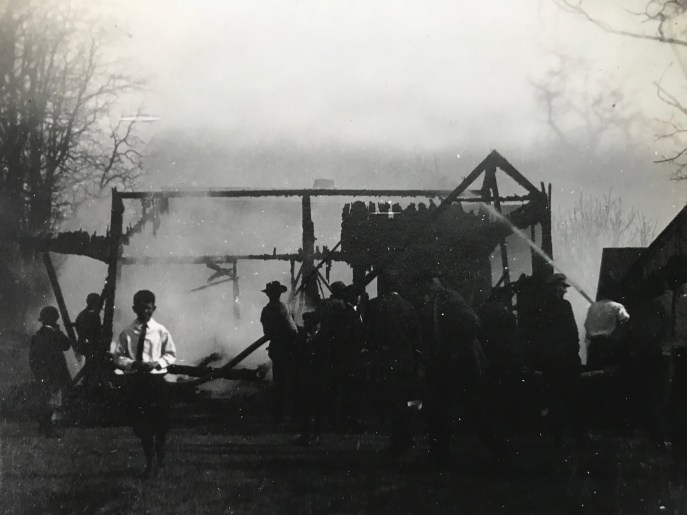
Fire destroys building on the farm of Mrs Rose Veirs. Photo by Lewis Reed.
From The Evening Star, September 07, 1944:
$25,000 Damage Done As Volunteer Firemen Fight Blaze for 5 Hours
Three barns and a silo were leveled, 2 horses and 7 calves were killed and 1,500 bushels of barley and 115 tons of hay were destroyed last night by fire on the 250-acre farm of Mrs Rose Veirs, a mile and a half west of Rockville, Md. Damage was estimated at $25,000 and was partially covered by insurance.
Four pumpers and a rescue wagon from the Rockville Volunteer Fire Department and two pumpers from the Kensington Volunteer Fire Department fought the blaze for five hours, although handicapped by a lack of water.
A small pond was drained, and the pumpers went back to Rockville several times for water. A pump on the property was put to work, but the fire had too far advanced to save the buildings.
L.M. Kennedy, foreman on the farm, discovered the fire about 8:10 p.m. J. Vinson Peter, son-in-law of Mrs, Veirs, manages the farm and gave the estimate of damage.
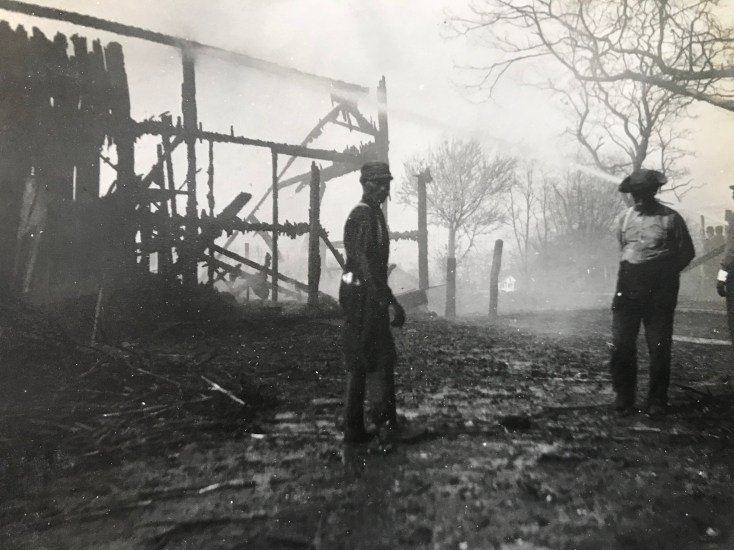
Fire destroys building on the farm of Mrs Rose Veirs. Photo by Lewis Reed.
Organized with 51 men in 1921, the Rockville Volunteer Fire Department now has a diverse complement of over 270 volunteers supported by almost 100 Montgomery County career firefighters. The call volume has increased tremendously over the years, from the 1920’s where the Department responded to about 200 incidents a year to the present, where they responded to over 25,000 incidents in 2017.
Books

Related Resources


Copyright Notice

Reed Brothers Dodge History (1915-2012) by Jeanne Gartner is licensed under a Creative Commons Attribution-NonCommercial 3.0 Unported License.


Recent Comments