
Then & Now: Washington’s Cherry Blossoms
Time passes, but the cherry blossoms always come back. Seeing the cherry blossoms is a time-honored D.C. tradition that dates back to 1912, when Tokyo gifted 3,020 cherry trees to the U.S. in an act of friendship. While many of the original trees have been replaced, the Tidal Basin’s beauty has persisted for more than a century. Each spring, more than 1.5 million visitors descend upon Washington, D.C. each year to admire the 3,000-plus trees.
Here are “then and now” comparison shots of the Cherry Blossoms on the Tidal Basin in Washington, D.C. from 1930 and 2022.
Cherry Blossoms on the Tidal Basin (THEN): From Lewis Reed’s collection of photographs. Cherry blossoms in bloom along the Tidal Basin, circa 1930s with my mother, Mary Jane (Reed) Gartner.

Cherry blossoms in bloom along the Tidal Basin with my mother, Mary Jane (Reed) Gartner. Photo by Lewis Reed, ca. 1930
Cherry Blossoms on the Tidal Basin (NOW): The “now” photo is a google image of approximately the same location… some 90 years later. According to the National Park Service, DC’s 2022 cherry blossoms will reach peak bloom sometime between March 22-25. The best viewing of the cherry blossom trees typically lasts four to seven days after peak bloom begins, but the blossoms can last for up to two weeks under ideal conditions.

Cherry blossoms in bloom along the Tidal Basin today.
Fun facts about Washington, DC’s cherry blossoms
- The first donation of 2,000 trees, received in 1910, was burned on orders from President William Howard Taft. Insects and disease had infested the gift, but after hearing about the plight of the first batch, the Japanese mayor sent another 3,020 trees to DC two years later.
- The first two trees were planted on the north bank of Tidal Basin in March 1912, and they still stand today. You can see them at the end of 17th Street Southwest, marked by a large plaque.
- It’s against the law to pick the cherry blossoms in Washington DC. While there aren’t any subtle wire fences or stern security guards like in a museum, any attempts to create your own corsage may very well land you a fine.
- The majority of the cherry blossom trees around the Tidal Basin are of the Yoshino variety. But another species, the Kwanzan, usually blooms two weeks after the Yoshino trees, giving visitors a second chance to catch the blossoms.
- The average lifespan of a cherry blossom tree is only 20 to 30 years, but nearly 100 of the original trees from 1912 still thrive at the Tidal Basin due to the maintenance of the National Park Service.
- No, they’re not all from 1912, reinforcements are sometimes necessary. New trees have been regularly planted, including in 1965, the late 1980s, 1999 and from 2002 to 2006, according to the NPS.
1921 Rockville Volunteer Fire Department Charter Members


On the evening of March 9th 1921, the Rockville Volunteer Fire Department was formed by fifty-one men who gathered at the office of the Potomac Electric Power Company on S. Stonestreet Ave after a major fire at a store on East Montgomery Ave in old downtown Rockville raged out of control and threatened to burn down the entire block just a month before. That night, officers were elected and a committee was appointed to raise funds for the department. The first officers were President Dr. O.M. Linthicum, Vice President C.H. Robertson, Secretary-Treasurer Bache Abert, Engineer W.F. Disney, and Chief Joseph Howes. William Prettyman was named chairman of the committee designated to canvas house-to-house for funds. The fifty-one men, listed on the monument above, formed the original members of the Rockville Volunteer Fire Department 101 years ago.
Two of those men were Rockville residents, Edgar Reed and Phillip Reed. Edgar was a partner with his brother, Lewis Reed, in the firm Reed Brothers Dodge. Phillip was a brother of Lewis Reed and a part of the first work force at Reed Brothers Dodge. Phillip came to work for the dealership in 1916 as a mechanic until 1944. Lewis Reed was an original incorporator and Charter Member of the Gaithersburg-Washington Grove Volunteer Fire Department.

Rockville VFD paid $3,424 for their first fire engine, a 1922 Ford Motor Company Model T Waterous Pumper. The top running speed was 18 MPH. The unit is pictured here are the original charter members.
Only six people were allowed to ride on the Model-T in times of emergency and to prevent an argument, a ring system was developed. The first man to arrive after the siren sounded, grabbed the red ring, earning the coveted driver’s seat. The second man would grab the blue ring for the next most popular position, the officer’s seat. The remaining four men would grab white rings, signifying riding the back step. The rest would follow in their own cars.

The Rockville VFD monument used to sit across the street from the Montgomery County Court house and in front of the old library on E. Jefferson Street. The monument currently sites in storage as it was removed for the building of the new courthouse.
Organized with 51 men in 1921, the RVFD now has a diverse complement of over 270 volunteers supported by almost 100 Montgomery County career firefighters.
Source: Rockville VFD Website
Lewis Reed as a Chauffeur-Mechanic
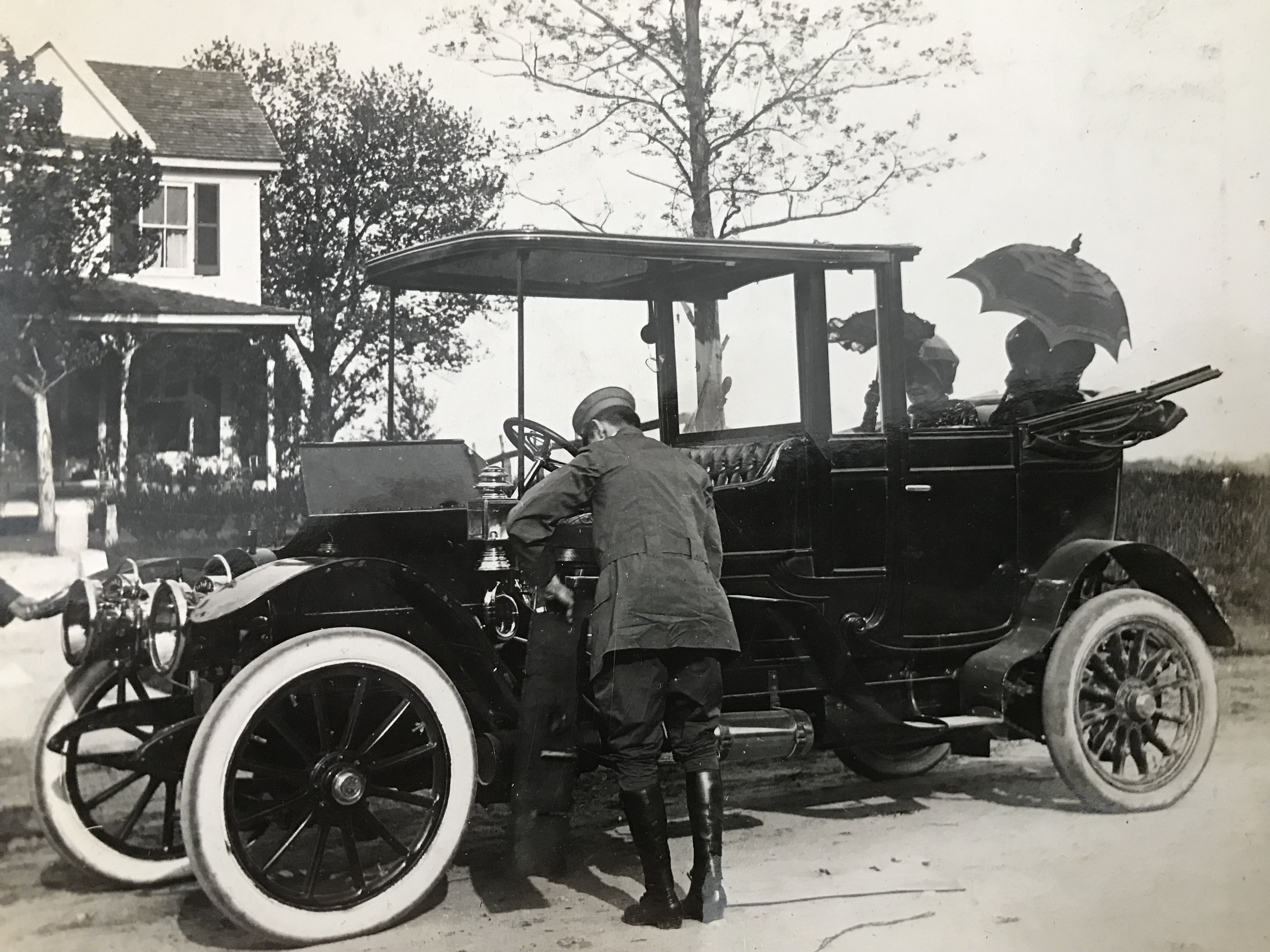
Two ladies with parasols are sitting in the landaulet section of an early Pierce-Arrow limousine, while chauffeur Lewis Reed tends to the motor. The rear portion of the limousine is partitioned from the driver with a glass shield, and covered by a convertible top, which you can see is currently in the lowered position behind the ladies. Photo taken circa 1910.
The year is 1910 and you’ve just purchased a brand new automobile. To show it off for the first time, you’ve hired a knowledgeable chauffeur. You sit on a padded seat while the chauffeur tends to the engine. Though it takes a while to start up, your new ride can reach around 37 mph. The ride is a bumpy one, and you could probably walk faster than the car travels. Ooops! One of the wheels has popped off as you go around a bend. Chauffeurs were not only trained to be proficient with their driving skills, but they also had to keep the luxury automobiles in tip top shape, which is where Lewis Reed’s mechanic training – a vital skill in the early days of motoring – would have come into play.
Lewis Reed understood automobiles. He knew how they worked and how to fix them. He loved cars and anything associated with them. Prior to World War I, Lewis Reed’s love of automobiles led him to becoming a chauffeur. At the dawn of the early 20th century, society was transitioning from horse-drawn carriages to automobiles. Having grown up in a blacksmith family, he was well positioned to move to the new technology. The 1910 census indicates that 23-year-old Lewis Reed was working as a machinist. Lewis worked as a chauffeur from roughly 1910-1914, before he became involved in the business of selling and repairing automobiles.
Chauffeur-mechanics of the early 1900s were the first group to earn a living working on automobiles. Wealthy people employed private chauffeur-mechanics to not only drive, but also maintain and repair their large, expensive automobiles — rather than learn to do it themselves. The vehicles of the time came with mobile toolboxes often resembling a small hardware store tucked away in the trunk. The early 1900s Pierce-Arrow toolkit included extra intake and exhaust valves, not exactly your typical roadside service. During the height of travel season, Spring through Fall, oil changes were required almost weekly. As you can easily surmise, there had to be someone to keep track of all of the maintenance and upkeep of the vehicle as well as the daily driving.
The novelty of the motor car led many manufacturers to create clothes that were specifically marketed for the automobile driver and his or her passengers. Lewis Reed wore a typical chauffeur’s uniform of the time. His motoring outfit was taken from the military uniform, combining a single or double breasted hip length coat and a pair of knicker pants with tall boots and a traditional driver’s cap. Gauntlet gloves were worn while driving and goggles were worn in open air cars. Goggles obviously protected ones’ eyes from flying pebbles and dirt, but heavy-weight boots ensured that the driver could, when necessary, get out to push a stalled car or fix a punctured tire.
Savvy marketers were especially quick to recognize that automobile owners had “more money to spend” than non-car owners. As these marketers gleefully noted, car owners “spend…more freely than non-[car] owners.” Convincing these customers of the need for special clothes was not too difficult. In fact, some car owners spent nearly as much on their motoring clothes as they did on their cars. The ladies in the photograph with parasols could have used them as an attractive way of shielding themselves from the sun’s rays, or to keep the dust from the dirt roads off their faces.
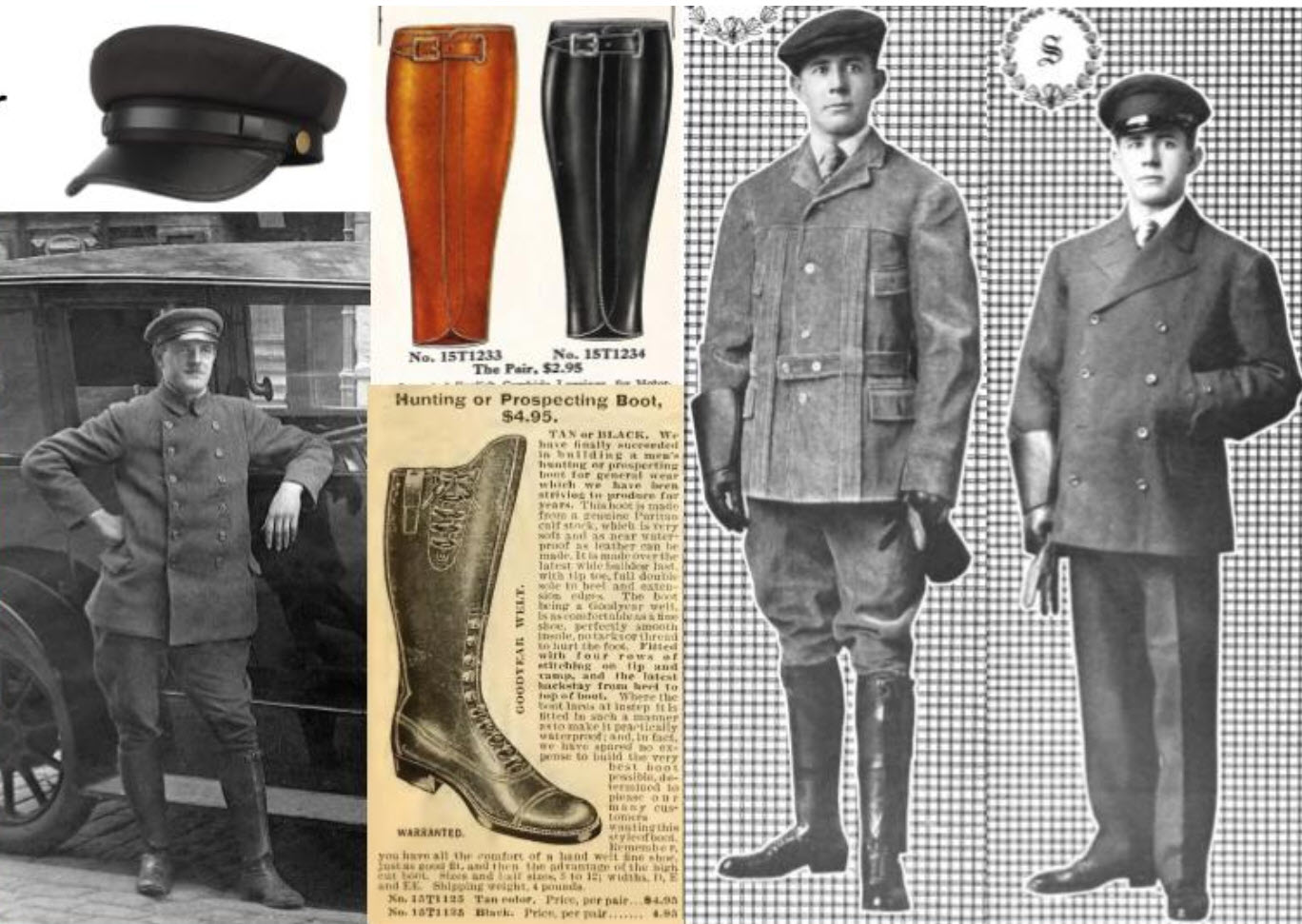
Early 1900s Chauffeur’s uniform
In October of 1915, Lewis Reed opened his Dodge dealership on Rockville Pike, less than one year after the first-ever Dodge automobile rolled off the assembly line. Reed Brothers Dodge provided “wheels” to many families for most of the 20th century during a period when the number of motorcars was rising rapidly throughout Maryland. Few businesses survived the Great Depression and two world wars, but Reed Brothers Dodge eventually emerged from the gauntlet of the 20th century as the oldest Dodge dealership in Maryland history and one of the oldest in the United States.
Happy National Ferris Wheel Day!
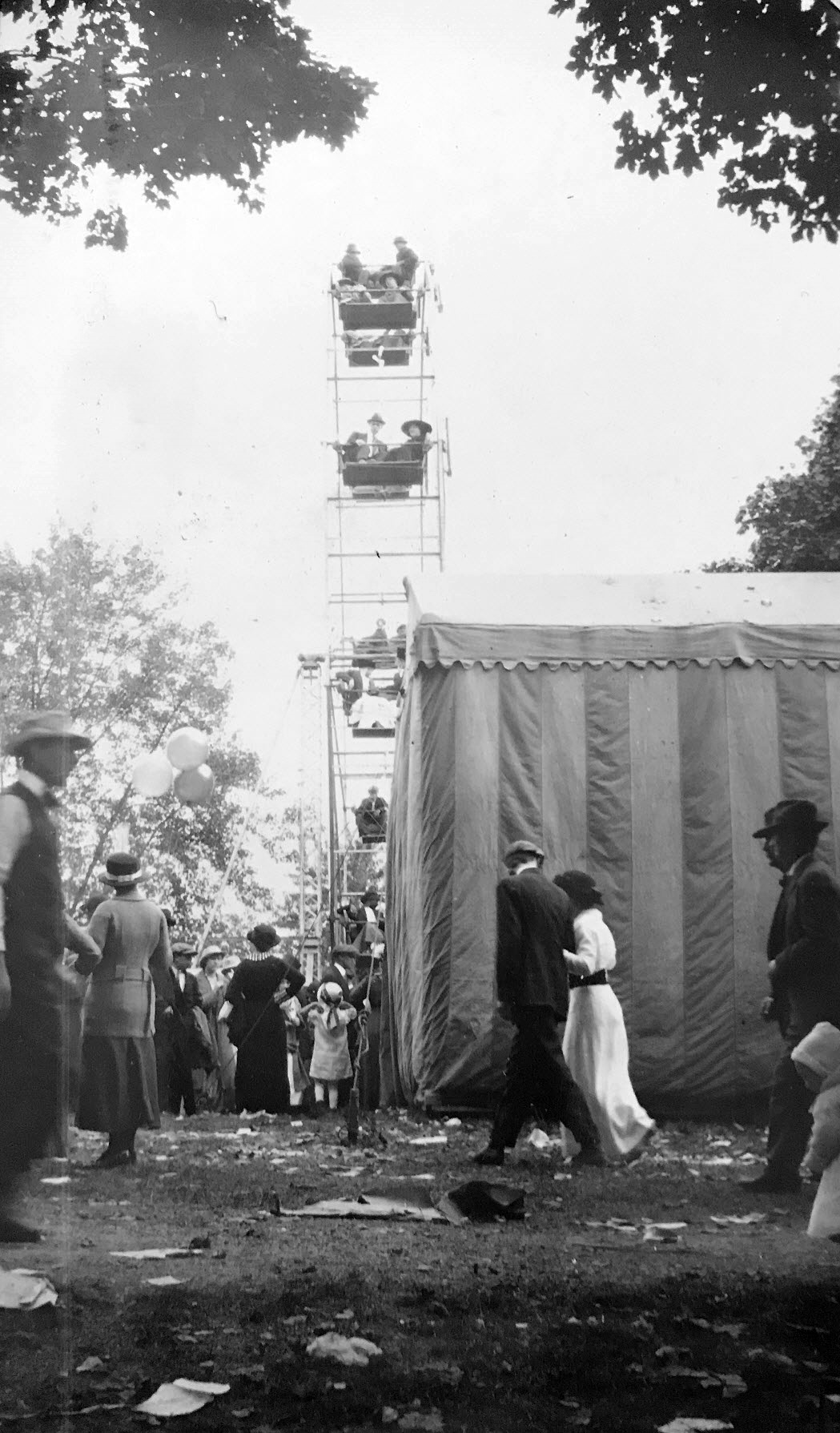
Ferris Wheel at Rockville Fair, circa 1920s. Photo by Lewis Reed
Did you know that February 14th is not only Valentine’s Day, but also National Ferris Wheel Day? This unofficial national holiday is held on this day to honor the birth of the inventor of the Ferris Wheel, George Washington Gale Ferris, Jr. What better way to celebrate Ferris Wheel Day than enjoying this old photograph of the Ferris Wheel taken at the Rockville Fairgrounds, courtesy of Lewis Reed. The fairgrounds were just outside Rockville, about where Richard Montgomery High School is today. The Fair lasted four days, from August 21st to the 24th, and drew visitors from local counties, Washington, and Baltimore.
For the singles and the “enough already with the Valentines”, here is your perfect alternative excuse. Go wish all your friends and family a Happy Ferris Wheel Day!
Then & Now: River House Lodge, Rowelsburg, WV
This post is a continuation of a series of “Then & Now” images that will show photographs of buildings, street scenes, and other historical locales from Lewis Reed’s Photo Collection alongside photographs of how they appear today. Taken approximately 100 years apart, these photos show the River House Lodge in Rowelsburg, West Virginia, then and now.
River House Lodge (THEN): This little railroad town of Rowesburg has always had hotels, beginning with the original River House, an early tavern and hotel serving the needs of a growing town in the 1850s. The railroad brought prosperity to Rowlesburg, designed the town and named it. Mr. Rowles was a surveyor with the railroad and laid out the plots and streets for the town.
The house was designed at the turn of the century or just before but the features were unusual. The top part of the house was Edwardian with panels and battens, creating a kind of checkerboard appearance. The lower half of the house was finished with narrow wood siding. The gables were of wood shingles.

River House Lodge located on Main Street in Rowlesburg, West Virginia. Lewis Reed’s circa 1926 Dodge Brothers Sedan is parked in front. Photo by Lewis Reed.
River House Lodge (NOW): Today, the River House has been transformed into a small, boutique lodge tucked away in the mountains of West Virginia. Though razed long ago, the “New” River House now takes its place to welcome guests into a motif of railroading that once dominated the small town of Rowlesburg. B&O artifacts adorn the rooms and hallways. Pictures of the past history of the town take visitors back to a different time, one of railroading in its golden era.
One source says that the original River House was a tavern and railroad lodge operated by A.A. Perry. The lodge was the center of this small settlement, with homes scattered nearby. The building sat next to the railroad, as did most of the early structures in Rowlesburg. Downtown Rowlesburg Historic District was listed on the National Register of Historic Places in 2005.

The River House Lodge today is still very recognizable.
Source: www.riverhouselodge.org
Books

Related Resources


Copyright Notice

Reed Brothers Dodge History (1915-2012) by Jeanne Gartner is licensed under a Creative Commons Attribution-NonCommercial 3.0 Unported License.
 Reed Brothers Dodge History 1915 – 2012
Recent Comments