
Then & Now: Saylorsburg Lake House & Hotel of Horror
With Halloween just around the corner, I thought it would be fun to feature a photograph that Lewis Reed took of the Saylorsburg Lake House Hotel, now the site of Hotel of Horror. The aging Lake House Hotel in Saylorsburg, Pennsylvania, once a vibrant Poconos retreat, was a popular hotel for the region’s tourists who were looking for fun on nearby Saylors Lake. During the hotel’s heyday, its staff was booking rooms a year in advance. Today, the former hotel’s fame is generated from its annual Halloween haunted-house attraction.
Lake House Hotel (THEN): The legend of the Lake House Hotel spans more than two-hundred years. According to local folklore, during World War II, many of the employees at the Lake House were called to assist in the Pennsylvania National Guard, leaving the local asylum with one lone security guard to watch over the entire building. The inmates escaped, made their way to the hotel and took it over. The insane patients performed experiments on the guests. What was once a renowned resort for the rich and famous, became a torture chamber.
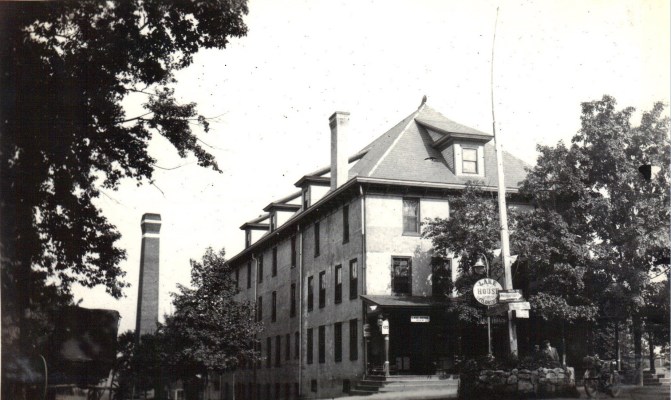
Saylorsburg Lake House Hotel. Photo taken by Lewis Reed, 1915.
Hotel of Horror (NOW): This 2019 season will celebrate the 27th year that the Hotel of Horror has been fascinating and horrifying legions of fans from the far reaches of the United States and even internationally. To all the readers of this blog: Have a spooky, enjoyable and very safe Halloween!
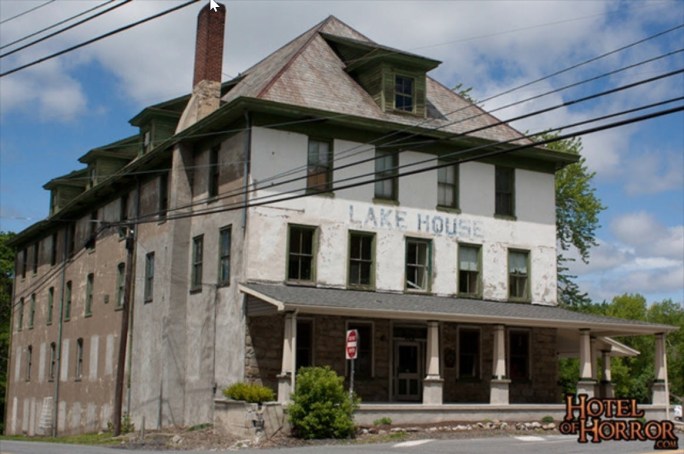
Welcome to The Hotel of Horror, The Pocono Mountains Premier Haunted House Attraction

Then & Now: Clopper Grist Mill
This post is a continuation of a series of “Then & Now” images that will show photographs of buildings, street scenes, and other historical locales from Lewis Reed’s Photo Collection alongside photographs of how they appear today. Taken approximately 109 years apart, these photos show the Clopper Grist Mill then and now.
Clopper Mill (THEN): Francis Cassatt Clopper bought this mill and 541 acres in 1810, but the earliest mention of a mill on this site dates back to 1777. Clopper’s mill was a square, three-story grist mill, with basement and first floor levels made of local field stone and a third story of brick. The mill was destroyed by a fire in 1947.
On April 15, 1865 Clopper Mill became part of national history when would-be assassin of the Vice President of the United States, George Atzerodt, spent the night there while fleeing from Washington D.C. after the assassination of President Lincoln. George was part of the gang assembled by John Wilkes Booth to eliminate the heads of the U.S. government. He was supposed to kill Vice President Johnson at the Willard Hotel at the same time as Booth assassinated the President. But Atzerodt ran out of courage and instead made his way to Germantown.

Clopper Grist Mill. Photo by Lewis Reed, ca. 1910
Clopper Mill (NOW): The ruins of this large brick and stone mill stand on the west bank of Great Seneca Creek, just south of Clopper Road near the intersection of Warring Station Road. The property was acquired by the State in 1955 as part of Seneca Creek State Park.

Clopper’s Mill Ruins today.
Then & Now: State of Pennsylvania Monument (Gettysburg)
In this “Then & Now” feature, I have combined one of Lewis Reed’s original photograph’s for “then” and matched it with a corresponding contemporary shot for “now”. The Pennsylvania State Memorial is a monument in Gettysburg National Military Park that commemorates the 34,530 Pennsylvania soldiers who fought in the July 1 to 3, 1863 Battle of Gettysburg during the American Civil War. These photos show the same view taken about 109 years apart.
State of Pennsylvania Monument (THEN): This rare photograph was taken by Lewis Reed of the State of Pennsylvania Monument while under construction. Completed in 1914, it is the largest of the state monuments on the Gettysburg Battlefield. Taken approximately 109 years apart, these photos show the State of Pennsylvania Monument then and now.

State of Pennsylvania Monument Under Construction, ca. 1910. Photo by Lewis Reed
State of Pennsylvania Monument (NOW): The State of Pennsylvania Monument (at 110 feet tall) incorporates individual sculptures commemorating the six Keystone State generals who fought at Gettysburg — plus President Abraham Lincoln and Governor Andrew Curtain — and 90 bronze plaques emblazoned with the names of each of the 34,530 Pennsylvanians who fought in the battle. It cost $240,000 to build in the early 1900s, or almost $6 million in 2018.
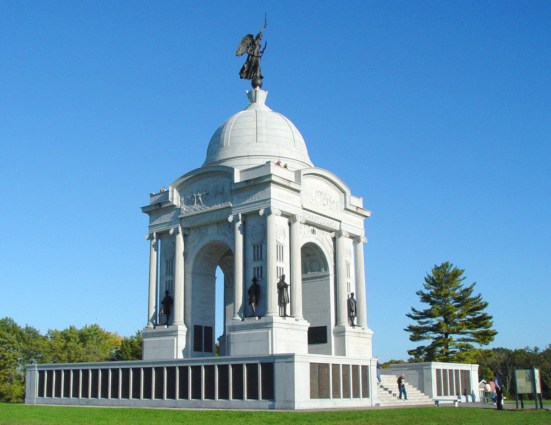
State of Pennsylvania Monument as it is today.
Source: Wikipedia
Then & Now: Rockville Fair Harness Racing
The black and white photographs of the Rockville Fair harness races below were taken by Lewis Reed in 1910. The photographs were from the first incarnation of the Fair, held by the Montgomery County Agricultural Society (1846-1932) in Rockville and often known simply as the “Rockville Fair.” For this “Then & Now” feature, I have combined Lewis Reed’s original photographs for “then” and matched it with a corresponding contemporary shot for “now” to see the difference 109 years can make.
Rockville Fair Dirt Track Oval (THEN): Like many fairgrounds, the Rockville Fairgrounds included an oval track. Fairground race tracks, typically one-mile or half-mile dirt racing ovals with wide, sweeping curves and grandstands for spectators, were easily adapted for bicycles, harness racing, and the sport of car racing. Harness racing was one of the main attractions, but after the introduction of the automobile in the early 20th century, car races took over. The fairgrounds were just outside Rockville, where Richard Montgomery High School is today.

Rockville drew huge crowds for harness races. Photo by Lewis Reed, circa 1910

Harness race at the Rockville Fair, circa 1910. All those throngs of people had plenty to see. Photo by Lewis Reed
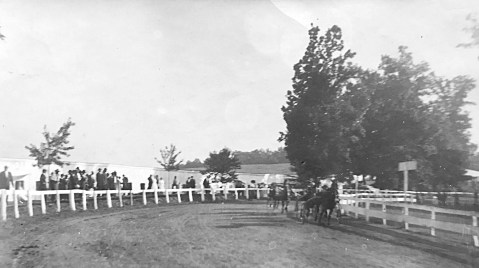
Harness racers rounding the bend on the racetrack, Rockville Fairground circa 1910. Photo by Lewis Reed

Bend on the harness racetrack, Rockville Fairground circa 1910. Photo by Lewis Reed
Rockville Fair Dirt Track Oval (NOW): In 1946, after the construction of Richard Montgomery High School, the old oval race track became a football field and stadium.

RMHS football field and stadium
Then & Now: Windsor Store in Darnestown
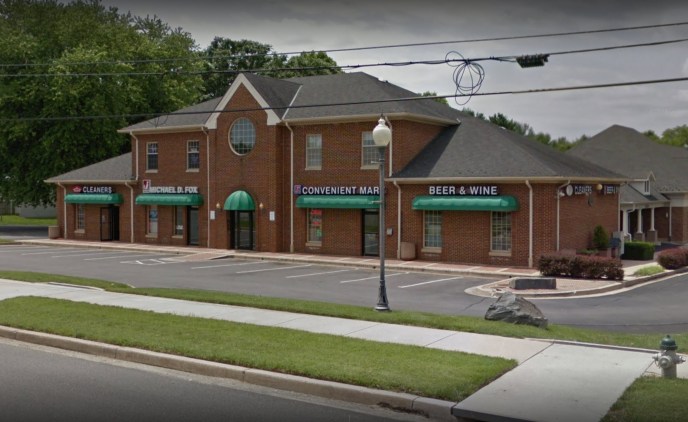
Photos are our window to the past. You might not realize how much Darnestown has changed until you look back and see what it looked like in the past. In this “Then & Now” feature, I have combined one of Lewis Reed’s original photograph’s for “then” and matched it with a google street view image for “now”. Travel back 110 years in time to see how Windsor Store in Darnestown used to be.
A bit of Darnestown history: The Darnestown area, which was located at the intersection of Darnestown and Seneca Roads, was settled in the 1750s. Darnestown Road (Route 28) was an old Indian trail and is recognized as one of the oldest roads in Montgomery County, Maryland. By the 1820’s, the town began to blossom and hosted a wheelwright, the Grist Mill, a blacksmith, a physician, a post office and a variety of other businesses. Darnestown became an important place for commerce in the area. Seneca Road led to a sandstone mill and the C&O canal at Seneca Village. From Darnestown one could travel either by stagecoach along Darnestown Road or board a packet boat on the canal at Seneca.
THEN: Mr James Windsor, grandfather of Curry England, opened the Windsor Store at the corner of Seneca and Darnestown Roads in approximately 1878. He operated the store for many years, and also served as Darnestown’s Postmaster for some 20 years. During the 1800s mail arrived three times a week by stagecoach from Rockville and local people gathered for the arrival, creating a regular social event. The Darnestown Post Office was discontinued in 1911. The Windsor building survived until 1969, when it caught fire and burned to the ground.
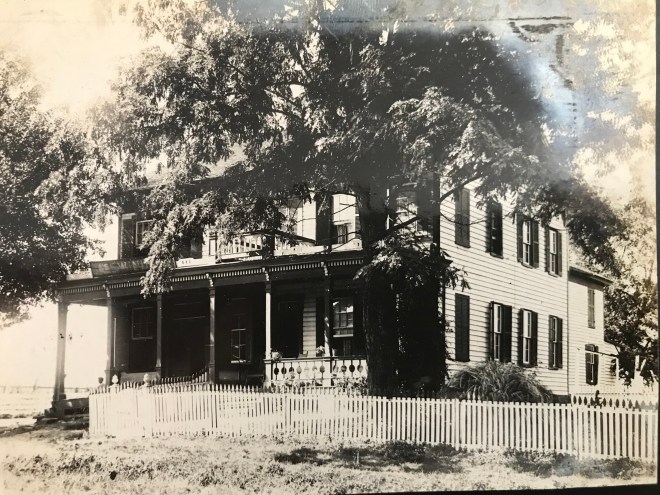
Windsor Store in Darnestown, early 1900s. Photo by Lewis Reed
NOW: Today, a 6-Twelve Convenient Mart sits on the site.
Books

Related Resources


Copyright Notice

Reed Brothers Dodge History (1915-2012) by Jeanne Gartner is licensed under a Creative Commons Attribution-NonCommercial 3.0 Unported License.
 Reed Brothers Dodge History 1915 – 2012
Recent Comments