
Rockville’s First Manual Training School, 1913

Manual Training work on display in Rockville High School classroom. Photo by Lewis Reed, 1913.
One of my favorite things to do is explore details in old photos and to try and figure out what things are and what the picture is. I was immediately intrigued by this photograph when I saw it in one of my grandfather’s albums. The caption on the photo was, “Manual Training Work at R.H.S. 1913”.
What first struck me about the photo is, it appears to be what used to be the inside of an old school classroom. My eye was first drawn to the chalkboard that runs across the front of the room and down the side. When I looked at the details by enlarging it, the writing on the chalkboard reveals a M-F weekday class schedule. I can just barely make out, Algebra and Latin. The rest of the subjects are illegible.
But I was also intrigued by the caption… what exactly is “manual training” in education, anyway? According to google, the Manual Training movement was the precursor to the vocational training programs in our schools today. First used in the United States in the 1870s in the training of engineers, the movement spread rapidly to general public education. The student would learn to skillfully use tools in drafting, mechanics, wood or metal working, and then would be able to transfer this knowledge to almost any kind of tool or setting.
The Rockville Manual Training School opened on January 21, 1901, with over 50 students admitted.

Montgomery County Sentinel, March 22, 1901
From “The Montgomery County Story” Vol. 24, No. 2, May 1981 by E. Guy Jewell
At a meeting held on January 8, 1901, the Rockville Manual Training School was established by order of the Board of County School Commissioners. On February 21, 1902, Wilson S. Ward became instructor in Manual Training and remained for several years to develop a course noted as outstanding in the State. In 1908, the School Commissioners opened the Business School in the Rockville High School Building. Prof. Neely Graham, a graduate of the Westchester Normal School and of the Wilmington Business College, was appointed principal of this school. One of the large basement rooms was equipped with business desks and typewriters for the business students.
The classes that were introduced in 1902 eventually grew into the Vocational Course in the High School; the other courses were Academic, General, and Commercial.
Rockville High School/Montgomery County High School, pictured around the time of completion in 1906. Photo by Lewis Reed
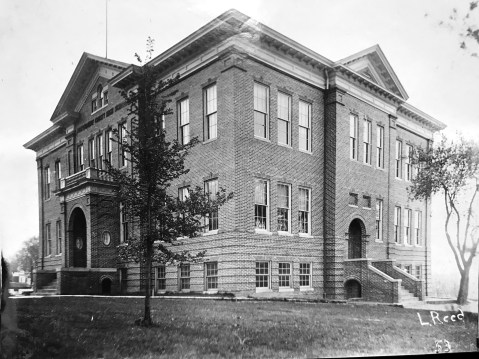
Located in Rockville, the school now named Richard Montgomery High School is the oldest public high school in Montgomery County. In 1892, the Board of School Commissioners approved an addition to the existing elementary school in Rockville to create a new “Rockville High School,” serving students from grades one to eleven. The first class of twelve seniors graduated in 1897.
The Montgomery County Sentinel
Snowy Day in 1910 at the Old Montgomery County Fairgrounds
As we’re currently experiencing cold, snowy, icy weather, what better time than now to post these snowy pictures of the old Montgomery County Fair. These snowy images of the Fairgrounds were taken by Lewis Reed in 1910.
From 1846-1932, the Montgomery County Fair took place in Rockville with competitions, entertainment, and food that attracted people from Montgomery County and Washington, DC.

Montgomery County Fairgrounds. Photo by Lewis Reed, ca. 1910
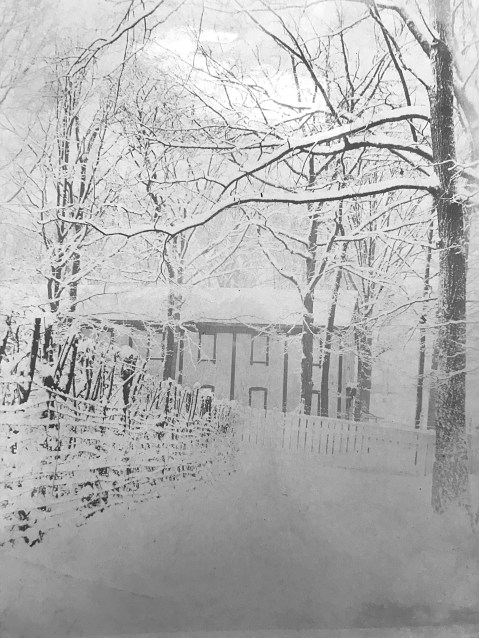
Montgomery County Fairgrounds Poultry House boarded up for the winter. Photo by Lewis Reed, ca. 1910
Montgomery History Online Exhibit: Montgomery County, Then and Now

Montgomery County, Then and Now: Photography of Lewis Reed and Barry Gartner
Opened December 6, 2023
Curated by Jeanne Gartner and Sarah Hedlund
Montgomery County: Then and Now, offers a captivating visual journey through more than a century of local history, told through rare photographs by Lewis Reed and his grandson Barry Gartner. This site presents side-by-side comparisons of historic scenes photographed by Reed between 1900 and 1930 and contemporary color images recreated from those same vantage points by Gartner in 2023, illustrating the dramatic changes, and sometimes surprising continuities, in the landscape, infrastructure, and community life of Montgomery County, Maryland.
Visitors are invited to explore stories behind each image, discovering the evolving character of familiar places as trees mature, buildings disappear, roads shift, and horse-drawn buggies give way to automobiles. The exhibit also delves into the personal histories of its featured photographers: Lewis Reed, remembered for his pioneering photography before founding Reed Brothers Dodge in 1915, and Barry Gartner, a third-generation owner who honors his grandfather’s legacy through both automotive restoration and modern photography.
A unique feature of the exhibit is the interactive map links accompanying each photo pair, allowing viewers to pinpoint the exact locations where history meets the present moment. Through this dynamic blend of archival and modern visuals, Montgomery County: Then and Now deepens our appreciation for local heritage and the passage of time, connecting generations through the lens of two accomplished photographers dedicated to capturing the changing face of their community.
This online exhibit opened December 6, 2023, and is thoughtfully curated by Jeanne Gartner and Sarah Hedlund, providing rich historical context and insight into the fascinating process of recreating these historical photographs. The full exhibition is available online at https://sites.google.com/view/mocothenandnow/home
Happy Birthday to Lewis Reed Founder of Reed Brothers Dodge

This ca. 1965 photo of Lewis Reed was taken in the new car showroom at Reed Brothers Dodge original location at the triangle at Veirs Mill Road and Rockville Pike.
Happy 136th birthday Lewis Reed! The founder of Reed Brothers Dodge was born on this day in 1887 in Darnestown, Maryland. In 1915, he founded what would become the oldest Dodge dealership under the same family ownership in the state of Maryland, and one of the oldest in the entire nation.
Lewis Reed was just 27 years old when he started selling cars built by brothers Horace and John Dodge in Detroit. Few people jumped onto the Dodge Brothers bandwagon earlier than Lewis Reed, and not many have lasted longer. Reed Brothers was franchised as a Dodge dealership and service facility less than one year after the first Dodge automobile rolled off the assembly line. Lewis Reed was the first to sell Dodge cars in Montgomery County, Maryland and his company was the first Gulf gas dealer in the Washington, D.C. area. During the early years, Reed Brothers represented several franchise nameplates along with Dodge, including Oldsmobile, Hudson and Essex. The Hudson and Oldsmobile were sold at Reed Brothers from roughly 1917 through 1923.
Lewis Reed was a member of the Gaithersburg Grace Methodist Church where he served as a member and Chairman of the Board of Stewards, a Lay Leader, and President of the Men’s Bible Class. He was one of nine original incorporators of the Gaithersburg-Washington Grove Volunteer Fire Department when it was created by charter in 1928. He was a Charter Member and Past President of the Gaithersburg-Washington Grove Fire Department and a member of the advisory board of the Rockville Branch of the First National Bank of Maryland. He belonged to the Masonic Lodge of Rockville, the Pentalpha Chapter of the Eastern Star and the Rockville Rotary Club. Before opening his Dodge dealership in 1915, Lewis Reed was one of the earliest and most prolific photographers in Montgomery County. Many of his photographs are now part of Montgomery History’s photo archives. Unsurprisingly, his love of both cars and cameras resulted in his taking numerous pictures of car culture all over the State of Maryland as it developed from infancy to supremacy.
Prior to World War I, Lewis Reed’s love of automobiles led him to becoming a chauffeur. Chauffeurs were not only trained to be proficient with their driving skills, but they also had to keep the luxury automobiles in tip top shape which is where his mechanic training would have come into play. He received his training as an automobile mechanic at the Pierce Arrow factory at Buffalo, New York, the Dodge and Hudson factories at Detroit and the Washington Auto College.
Active in the dealership daily until the day of his death, Lewis Reed passed on January 28, 1967 at the age of 79. Shortly after his death, the Senate of Maryland passed Senate Resolution No. 10, expressing “the deepest regret and sympathy of every member of this body,” describing Reed as “a kindly and loyal person completely devoted to his duties” which he carried out “with fairness and human understanding.” The resolution was sponsored by Senator Thomas M. Anderson, Jr. and Senator Louise Gore.
When you look back and consider what has taken place in the world in the past 100 years or so, you gain a perspective of what Lewis Reed faced. He overcame a lot of obstacles throughout his life. He steered his dealership through World War I, The Great Depression and World War II. When Reed Brothers had no new cars to sell for three and a half years and many dealers went bankrupt, he converted his car showroom into a display room and sold GE Washing Machines, Westinghouse Radios, and other large appliances. Reed Brothers Dodge occupied two locations, the original at the Veirs Mill Road and Rockville Pike intersection and the second at 15955 Frederick Road in front of the Shady Grove Metro.
Lewis Reed set an outstanding example through his success, but more importantly through his sacrifices and commitment to the community he served. Today, Bainbridge Shady Grove Metro Apartments pays tribute to the oldest Dodge dealership in Maryland with commemorative art on the former site of the iconic Reed Brothers dealership.

Bainbridge Shady Grove Metro Apartments now stands on the former site of the Reed Brothers Dodge dealership at 15955 Frederick Road. A sculpture now installed on the property pays tribute to the oldest Dodge dealership in Maryland history. More than 20 feet high, and over 6 feet wide, the public art is inspired by 1939 Dodge headlamps, and the fender of a 1957 Dodge pickup truck.
A Special Veterans Day Tribute to Edgar Reed
Veterans Day is a time to recognize the veterans in our lives — to honor their service for our country and show them that we appreciate their sacrifices made in our behalf. World War I began on July 28, 1914 and later ended on November 11, 1918. In commemoration of Veterans Day, this very special post is in honor of the contributions Sergeant Edgar Reed made for our country during World War I.

Edgar Reed, partner with brother Lewis, in Reed Brothers Dodge. Photo taken ca. 1918 by Lewis Reed.
Edgar was a partner with his brother Lewis Reed, in Reed Brothers Dodge. I never got to know my great uncle Edgar like the rest of the Reed family, because he passed away the year after I was born. My mother told me she took me to the hospital right after I was born to meet Edgar, but of course, I have no recollection of that. I do, however, feel like I know him through all of the family stories and photographs I have spent archiving over the last 10+ years.

Edgar, center. Photo taken ca. 1918 by Lewis Reed.

Edgar at Hotel Cape May, New Jersey. Photo by Lewis Reed, 1918
On September 28, 1917 a draft for World War I began and the first 40 men reported for duty at the Montgomery County Court House in Rockville, Maryland. In the photograph below, cars are parked around the court house during the speech-making in the court room to drafted men. Montgomery County’s first recruits left Rockville by train for Camp Meade, Maryland on this same day. They each received a package of smoking tobacco and a rousing send-off from two thousand people after speeches at the courthouse, dinner at the Montgomery House Hotel, and a parade to the depot. About 160 Rockville men served in the eighteen-month war. One of those men was Rockville resident, Edgar Reed.

Montgomery County Court House. Note two tags on the cars; it was necessary to have DC as well as Maryland tags if the car was to be driven in DC. Photo by Lewis Reed, 1917.
Edgar Reed (1890–1951) was born in Darnestown, Maryland on October 17, 1890. On February 26, 1918 at the age of 27 years old, Edgar was enlisted into the U.S. Army as a Private. At this time, he lived on Montgomery Avenue in Rockville. He had been employed by R.W. Vinson, Rockville druggist for eight years.
On April 27, 1918, Edgar was promoted to the rank of Private First Class, and on February 14, 1919, he was promoted to Sergeant. According to “Maryland Military Men, 1917-1918”, Edgar served as a Sergeant in the U.S. Army Medical Corps from February 1918 to August 1919. He had been posted to GENERAL HOSPITAL NO. 16, NEW HAVEN, CONNECTICUT and GENERAL HOSPITAL NO. 11, CAPE MAY, NEW JERSEY.
The spirit of patriotic service which swept the country prompted many persons to offer their properties to the War Department for hospital purposes. These offers included buildings of every conceivable kind, such as department stores, private establishments, hospitals, and properties in large cities. It was found that many of these could be obtained and converted into hospitals much more expeditiously than barrack hospitals could be constructed, and at less cost.
The Surgeon General recommended that the War Department authorize the leasing of the Hotel Cape May in New Jersey for use as a general hospital on December 18, 1917. The Hotel Cape May was located on the Ocean Drive, at the eastern end of the city, and within 100 feet of the beach of the Atlantic Ocean. Opened first as GENERAL HOSPITAL NO. 16, the designation was changed to GENERAL HOSPITAL NO. 11, March 14, 1918. The enlisted personnel were quartered in tents which were located to the rear of the building.
At eleven o’clock on the eleventh day of the eleventh month in 1918, World War I fighting came to an end when an armistice between Germany and the Allied nations went into effect. On August 4, 1919, Edgar was transferred to the Demobilization Center at Camp Lee, Virginia and was honorably discharged on August 6, 1919.
Pictured below is Edgar Reed’s World War I draft card, signed and dated June 5, 1917.


Below is Edgar Reed and friends returning home on the train after the war ended wearing the World War I “Victory Medal” on their lapels.

Edgar Reed, right. Photo by Lewis Reed.
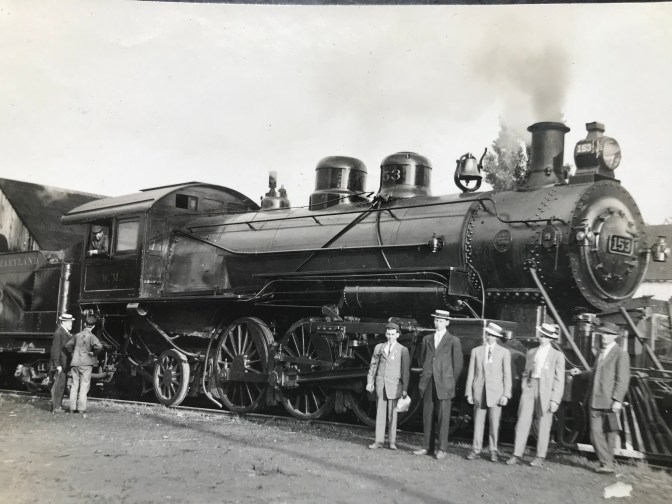
This photo captures the moment Edgar Reed (left) and friends arrived home from World War I. Photo by Lewis Reed.
Edgar was fortunate enough to survive World War I and to settle back in Rockville and enjoy a successful life and career in the automobile business. After returning from the war in 1919, Edgar joined his brother in the business and the name changed to Reed Brothers Dodge. Edgar was in the automobile business with his brother, Lewis, for 35 years until his death in 1951.
So while we honor all who served this Veterans Day, on this day, I salute you Edgar Reed, and thank you for your service to our country.
Sources:
U.S. Army Office of Medical History
Ancestry.com
Maryland Military Men, 1917-1918
Books

Related Resources


Copyright Notice

Reed Brothers Dodge History (1915-2012) by Jeanne Gartner is licensed under a Creative Commons Attribution-NonCommercial 3.0 Unported License.
 Reed Brothers Dodge History 1915 – 2012
Recent Comments