
Then & Now: River House Lodge, Rowelsburg, WV
This post is a continuation of a series of “Then & Now” images that will show photographs of buildings, street scenes, and other historical locales from Lewis Reed’s Photo Collection alongside photographs of how they appear today. Taken approximately 100 years apart, these photos show the River House Lodge in Rowelsburg, West Virginia, then and now.
River House Lodge (THEN): This little railroad town of Rowesburg has always had hotels, beginning with the original River House, an early tavern and hotel serving the needs of a growing town in the 1850s. The railroad brought prosperity to Rowlesburg, designed the town and named it. Mr. Rowles was a surveyor with the railroad and laid out the plots and streets for the town.
The house was designed at the turn of the century or just before but the features were unusual. The top part of the house was Edwardian with panels and battens, creating a kind of checkerboard appearance. The lower half of the house was finished with narrow wood siding. The gables were of wood shingles.

River House Lodge located on Main Street in Rowlesburg, West Virginia. Lewis Reed’s circa 1926 Dodge Brothers Sedan is parked in front. Photo by Lewis Reed.
River House Lodge (NOW): Today, the River House has been transformed into a small, boutique lodge tucked away in the mountains of West Virginia. Though razed long ago, the “New” River House now takes its place to welcome guests into a motif of railroading that once dominated the small town of Rowlesburg. B&O artifacts adorn the rooms and hallways. Pictures of the past history of the town take visitors back to a different time, one of railroading in its golden era.
One source says that the original River House was a tavern and railroad lodge operated by A.A. Perry. The lodge was the center of this small settlement, with homes scattered nearby. The building sat next to the railroad, as did most of the early structures in Rowlesburg. Downtown Rowlesburg Historic District was listed on the National Register of Historic Places in 2005.

The River House Lodge today is still very recognizable.
Source: www.riverhouselodge.org
Merry Christmas and Best Wishes for 2022!
Christmas 1944, exactly 77 years ago this holiday season, marked the last Christmas of World War II. The 1940s was a decade shaped by war, but the Christmas spirit and the act of good fellowship and kindness was still important to people even in times of hardship. The vintage holiday print ad below from Reed Brothers Dodge offers a window into how businesses of the 1940s pictured an idealized holiday season.

The Montgomery County Sentinel, December 21, 1944
I would like to wish everyone who finds time during the course of your day to visit this blog a very Merry Christmas and a safe and healthy Happy New Year in 2022.
Jeanne Gartner
Blog Author
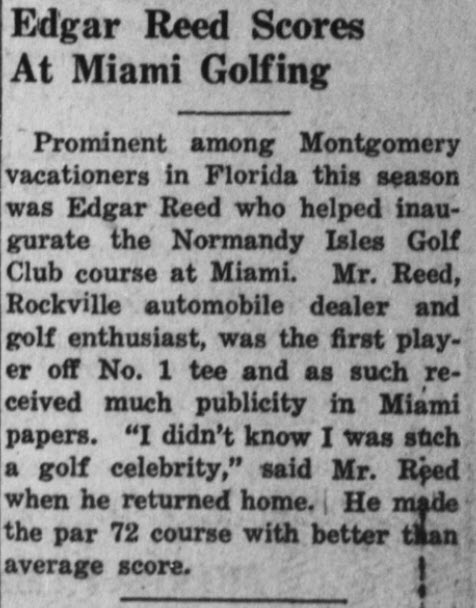
Edgar Reed Helps Inaugurate The Legendary Normandy Shores Golf Club

From the Miami Herald, January 24, 1941
Edgar Reed helps inaugurate the Normandy Isles Golf Course in Miami, Florida. The golf course opened for play on January 23, when Maryland visitor Edgar Reed had the honor of being the first player to tee off that morning and ended up shooting a 97. The golf course was officially dedicated on December 18, 1941.
Montgomery County Sentinel, Feb 20, 1941
History
Normandy Shores Golf Club is located on the northern end of Miami Beach in Miami-Dade County. In 1923, two mangrove-covered islands in Biscayne Bay were being developed by Henri Levy and his associates. In honor of Levy’s French heritage, it was renamed the Isle of Normandy and the streets were named after French towns and provinces.
The developers originally planned to create one large island with a golf course in the center, however, they ended up building two separate islands. Workers starting dredging and filling to create the South Island, now called Normandy Isles. Unsuccessful in building a golf course, the developers eventually sold the North Island, which would be later be named Normandy Shores, to the City of Miami Beach.
The City soon made plans to build a municipal golf course and began to dredge and fill to create the man-made Normandy Isles. In 1936, the City began working with William S. Flynn of the golf course architectural firm Toomey and Flynn. He planned to make this new course one of the sportiest municipal layouts in the country. Flynn made several visits to the site and after his inspection in December 1940 he stated “The laying out of the Normandy Isle course offered a different problem from any that I had undertaken before.” Flynn added, “On most of the jobs you are given a topographic map of the section and then it is up to the architect to make the holes as sporty as possible.” Normandy was just the opposite as it was drawn out first on paper and then the land was pumped in to fill the requirements.
Construction of the golf course took longer than expected due to the difficulties encountered growing grass on the spoil that had been pumped off the bottom of Biscayne Bay because of its heavy salt content.
The golf course opened for play on January 23, when Maryland visitor Edgar Reed had the honor of being the first player to tee off that morning and ended up shooting a 97. The golf course was officially dedicated on December 18, 1941.
The golf course underwent major changes in 1966, when the grade was raised several feet and 14 artificial lakes were added to address the flooding issues. The site of the old driving range became the new 18th hole and the former 18th became the new and enlarged driving range. Miami Beach Mayor Elliot Roosevelt (son of President Franklin D. Roosevelt and First Lady Eleanor Roosevelt) hit the first ball on the reopening of the golf course.
In 2008, the City of Miami Beach spent over $9 million to renovate the golf course. Golf course architect Arthur Hills was hired to redesign the aging course and bring it back to its former state of glory.
To learn more about the history of the course and its hometown, see a selection of historic and current images of the course, and learn about what the course is like today, visit the Florida Historic Golf Trail: https://floridahistoricgolftrail.com/courses/normandy-shores-golf-club/
Happy Birthday to Our Founder, Lewis Reed
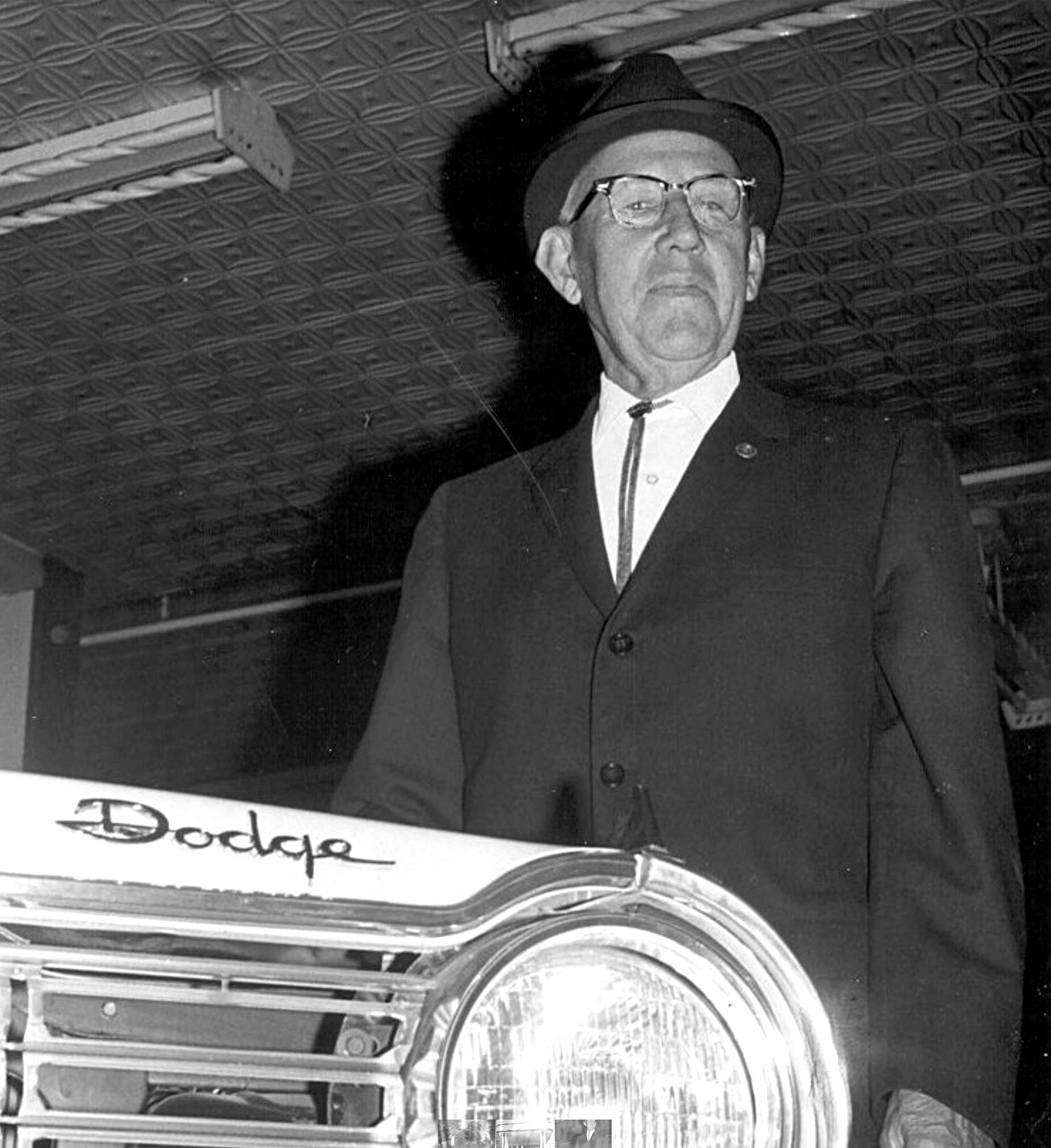
This ca. 1965 photo of Lewis Reed was taken in the new car showroom at Reed Brothers Dodge original location at the triangle at Veirs Mill Road and Rockville Pike.
Lewis Reed was born in Darnestown, Maryland on November 25, 1887 and was the founder of Reed Brothers Dodge. When Lewis Reed opened his car dealership in October 1915, he never knew he was starting a family tradition that would be carried out for 97 years and three generations. He founded what would become the oldest Dodge dealership under the same family ownership in the state of Maryland, and one of the oldest in the entire United States.
Lewis Reed was just 27 years old when he started selling cars built by brothers Horace and John Dodge in Detroit. Few people jumped onto the Dodge Brothers bandwagon earlier than Lewis Reed, and not many have lasted longer. Reed Brothers was franchised as a Dodge dealership and service facility less than one year after the first Dodge automobile rolled off the assembly line. Lewis Reed was the first to sell Dodge cars in Montgomery County, Maryland and his company was the first Gulf gas dealer in the Washington, D.C. area. During the early years, Reed Brothers represented several franchise nameplates along with Dodge, including Oldsmobile, Hudson and Essex. The Hudson and Oldsmobile were sold at Reed Brothers from roughly 1917 through 1923.
Lewis Reed was a member of the Gaithersburg Grace Methodist Church where he served as a member and Chairman of the Board of Stewards, a Lay Leader, and President of the Men’s Bible Class. He was one of nine original incorporators of the Gaithersburg-Washington Grove Volunteer Fire Department when it was created by charter in 1928. He was a Charter Member and Past President of the Gaithersburg-Washington Grove Fire Department and a member of the advisory board of the Rockville Branch of the First National Bank of Maryland. He belonged to the Masonic Lodge of Rockville, the Pentalpha Chapter of the Eastern Star and the Rockville Rotary Club. Before opening his Dodge dealership in 1915, Lewis Reed was one of the earliest and most prolific photographers in Montgomery County. Many of his photographs are now part of Montgomery History’s photo archives. Unsurprisingly, his love of both cars and cameras resulted in his taking numerous pictures of car culture all over the State of Maryland as it developed from infancy to supremacy.
Prior to World War I, Lewis Reed’s love of automobiles led him to becoming a chauffeur. Chauffeurs were not only trained to be proficient with their driving skills, but they also had to keep the luxury automobiles in tip top shape which is where his mechanic training would have come into play. He received his training as an automobile mechanic at the Pierce Arrow factory at Buffalo, New York, the Dodge and Hudson factories at Detroit and the Washington Auto College.
Active in the dealership daily until the day of his death, Lewis Reed passed on January 28, 1967 at the age of 79. Shortly after his death, the Senate of Maryland passed Senate Resolution No. 10, expressing “the deepest regret and sympathy of every member of this body,” describing Reed as “a kindly and loyal person completely devoted to his duties” which he carried out “with fairness and human understanding.” The resolution was sponsored by Senator Thomas M. Anderson, Jr. and Senator Louise Gore.
When you look back and consider what has taken place in the world in the past 100 years or so, you gain a perspective of what Lewis Reed faced. He overcame a lot of obstacles throughout his life. He steered his dealership through World War I, The Great Depression and World War II. When Reed Brothers had no new cars to sell for three and a half years and many dealers went bankrupt, he converted his car showroom into a display room and sold GE Washing Machines, Westinghouse Radios, and other large appliances. Reed Brothers Dodge occupied two locations, the original at the Veirs Mill Road and Rockville Pike intersection and the second at 15955 Frederick Road in front of the Shady Grove Metro.
Lewis Reed set an outstanding example through his success, but more importantly through his sacrifices and commitment to the community he served. Today, Bainbridge Shady Grove Metro Apartments pays tribute to the oldest Dodge dealership in Maryland with commemorative art on the former site of the iconic Reed Brothers dealership.
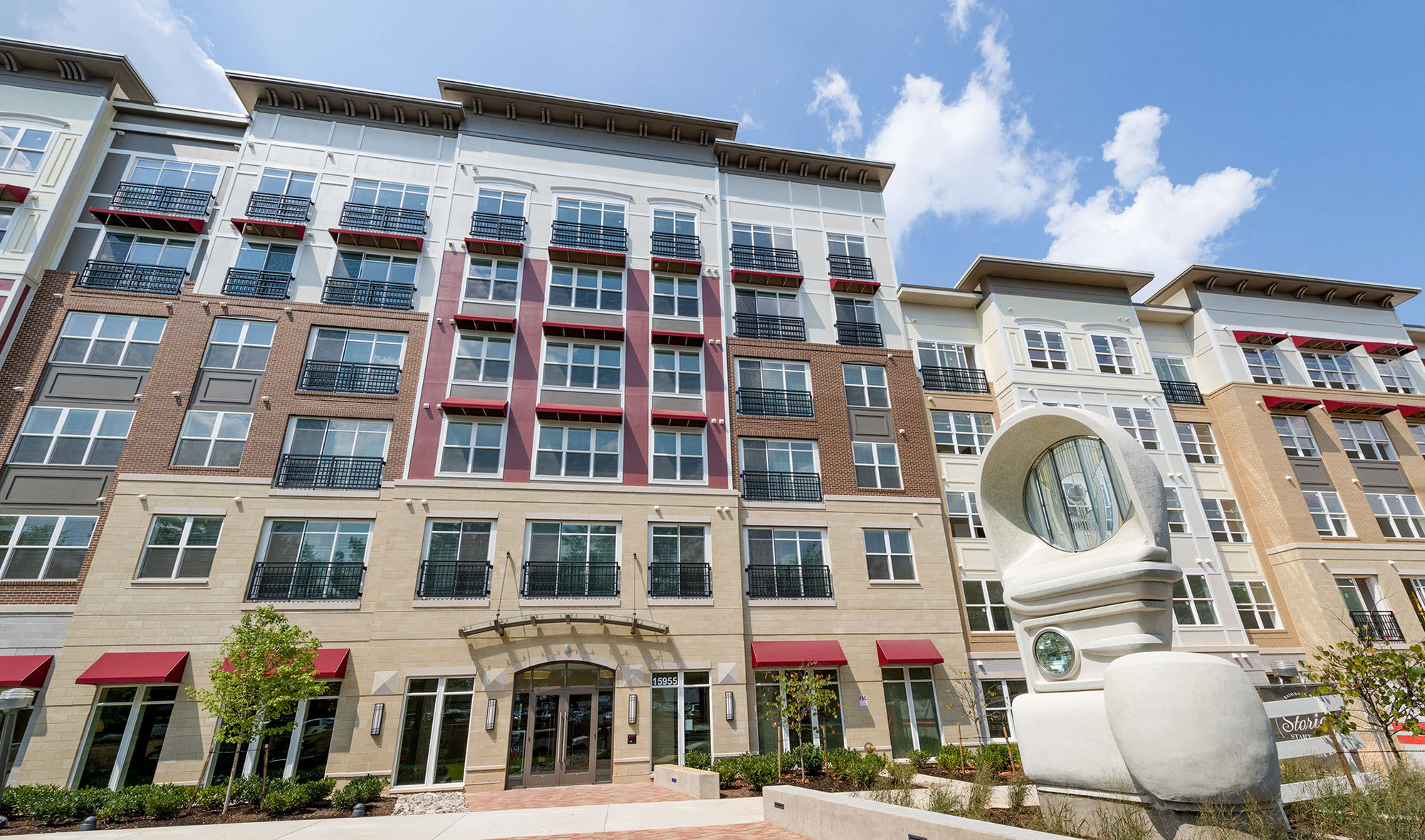
Bainbridge Shady Grove Metro Apartments now stands on the former site of the Reed Brothers Dodge dealership at 15955 Frederick Road. A sculpture now installed on the property pays tribute to the oldest Dodge dealership in Maryland history. More than 20 feet high, and over 6 feet wide, the public art is inspired by 1939 Dodge headlamps, and the fender of a 1957 Dodge pickup truck.
The First Dodge Automobile Debuted in 1914
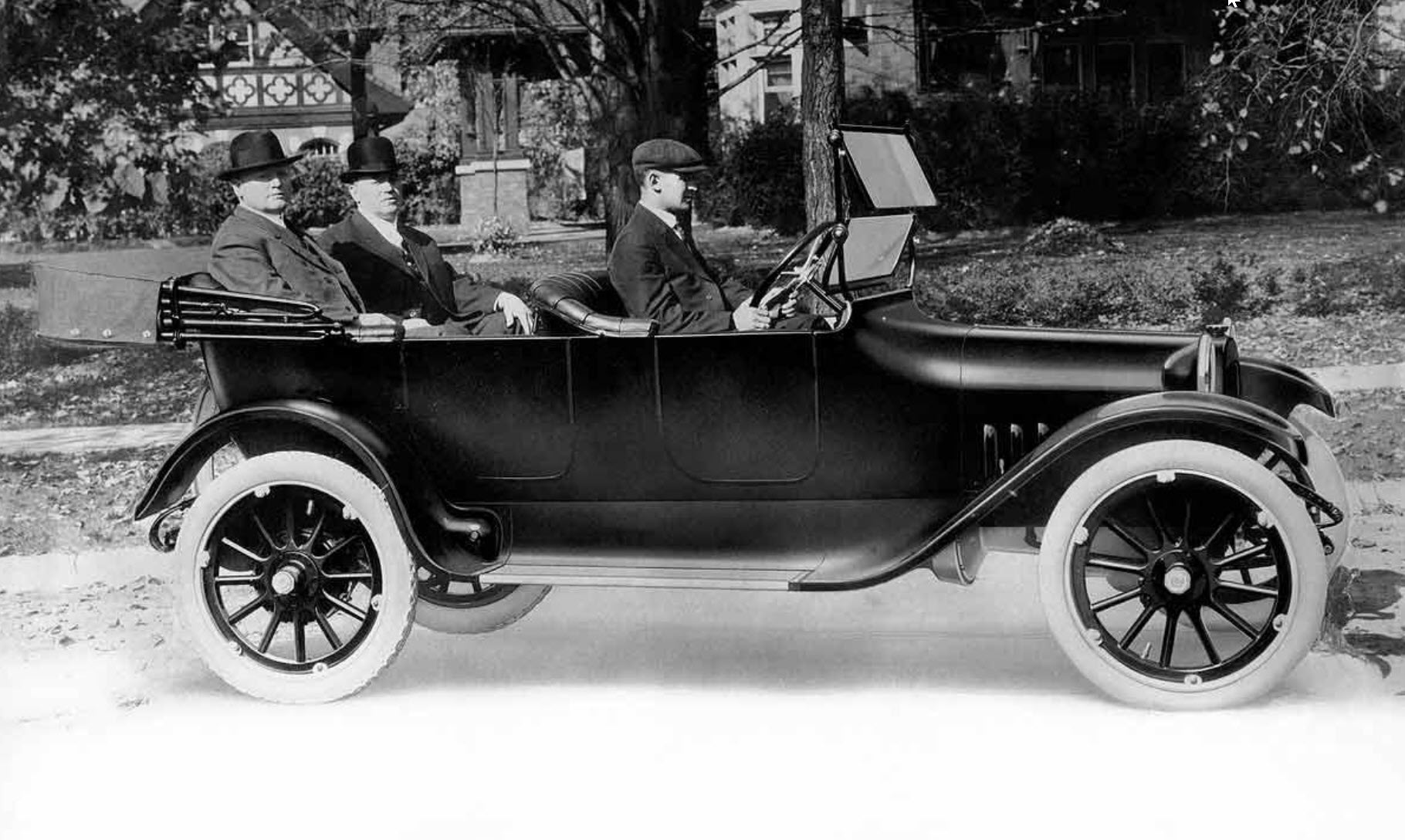
Horace Dodge (left, rear) and John Dodge (right, rear) take delivery of the first Dodge automobile on Nov. 14, 1914.
One hundred and seven years ago on this date –November 14, 1914 — the very first Dodge car, “Old Betsy”, rolled off the assembly line. On that day, the Dodge Brothers (Horace and John) were photographed riding in the rear seat of the first car to bear their last name. It cost $785, had a 110-inch wheelbase, and was powered by an L-head 4-cylinder engine that proved so reliable it was continued until 1920 with very little modification. Total production for 1914 was a mere 249 touring cars. The following year Dodge offered a two-passenger roadster which also sold for $785 and the plant went into full production.
According to “The Dodge Brothers: The Men, the Motor Cars, and the Legacy” by Charles K. Hyde, here’s the full story:
The widely accepted history of the initial production of early Dodge Brothers automobiles in November 1914 is at odds with much of the evidence about the earliest Dodge Brothers cars. Automotive historians have thought that the first production car, later named “Old Betsy,” came off the assembly line at the Hamtramck factory on 14 November 1914. Guy Ameel, superintendent of final assembly for Dodge Brothers since the start of automobile production, served as John and Horace’s chauffeur that day. With the brothers in the back seat, Ameel stopped the first Dodge Brothers car in front of John Dodge’s mansion on Boston Boulevard in Detroit and a photographer recorded this important moment.
“Old Betsy” was more likely an experimental prototype car assembled several months before 14 November 1914 and not a production car at all…
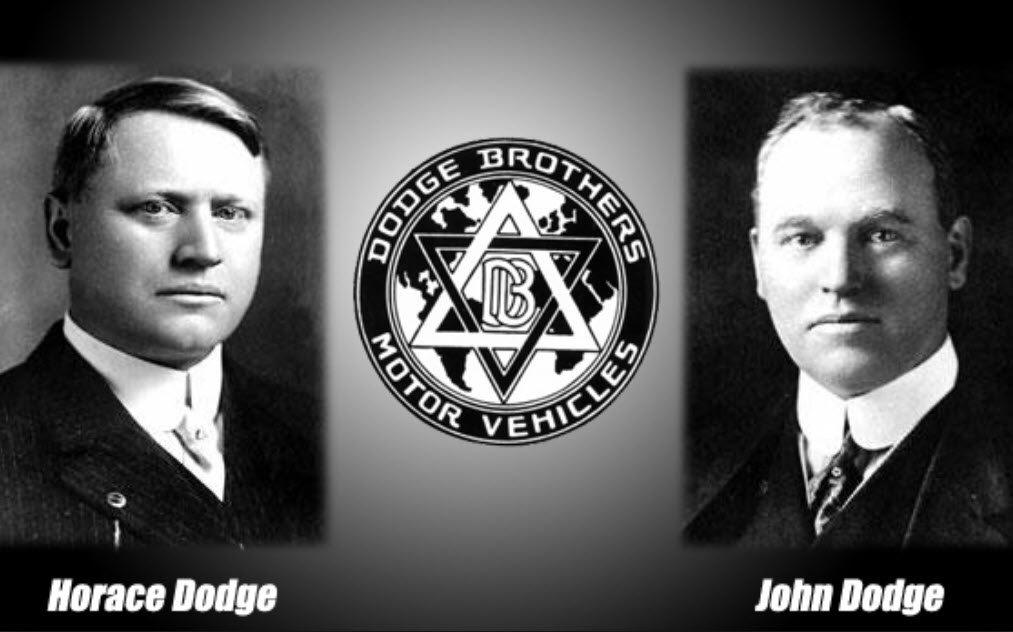
The Dodge Brothers
The Dodge Brothers began an aggressive advertising campaign to promote their new automobiles and to attract potential dealers to sell their cars. Few people jumped onto the Dodge Brothers bandwagon earlier than Lewis Reed, and not many have lasted longer.
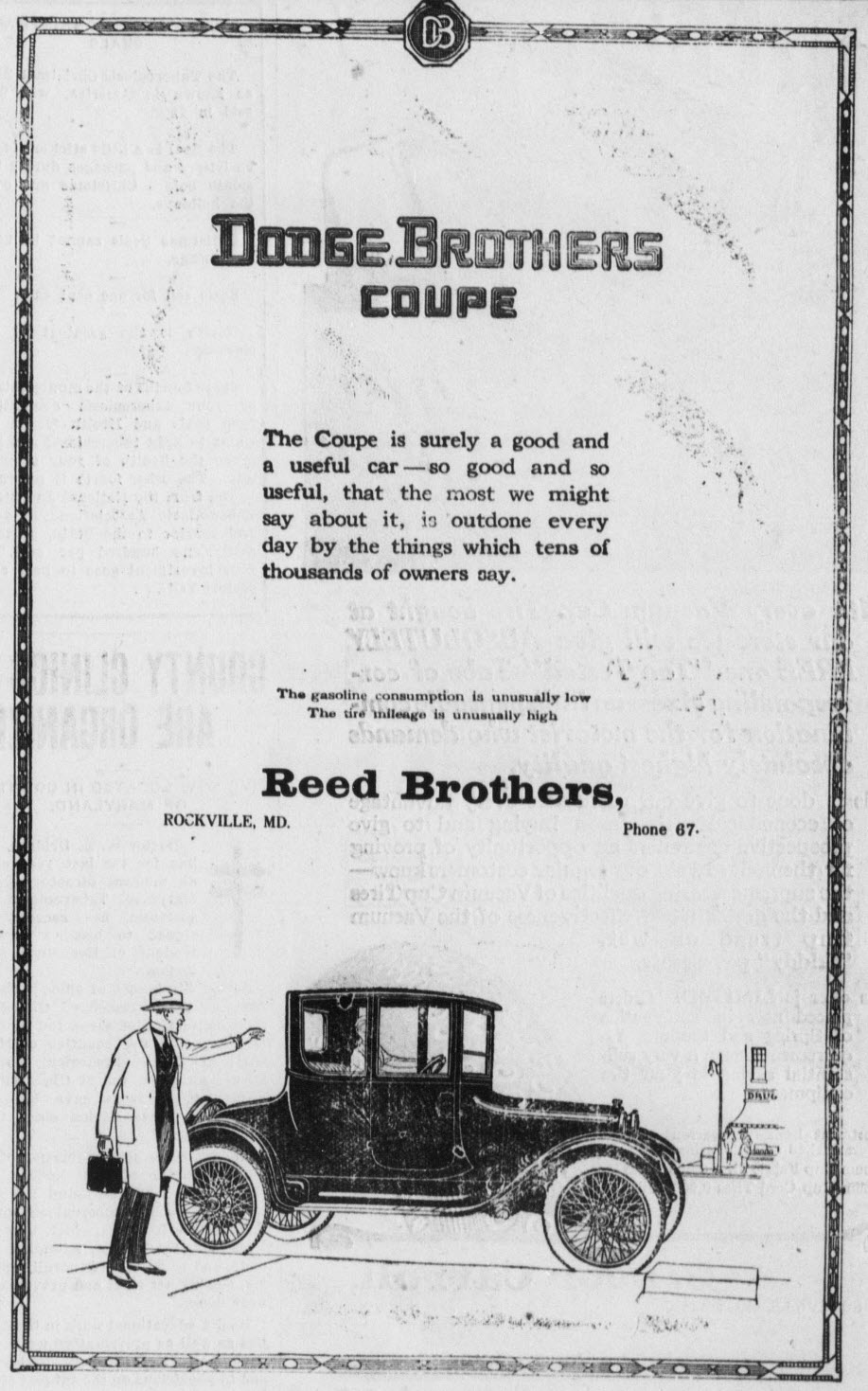
A Dodge Brothers Coupe ad from by Reed Brothers. Montgomery County Sentinel. December 24, 1920
Lewis Reed received his franchise to sell Dodge Brothers Motor Cars from John and Horace Dodge in October 1915; less than one year after the first Dodge Model-30 rolled off the assembly line for $785. He was just 27 years old. Since then, the business grew and transformed into the oldest Dodge dealership in Maryland history and one of the oldest in the entire United States.
Books

Related Resources


Copyright Notice

Reed Brothers Dodge History (1915-2012) by Jeanne Gartner is licensed under a Creative Commons Attribution-NonCommercial 3.0 Unported License.
 Reed Brothers Dodge History 1915 – 2012
Recent Comments