
Featured Photo: 1914 Indian Motorcycle With Sidecar

Photo by Lewis Reed
This is a photograph taken by Lewis Reed of an Indian motorcycle with his brother, Edgar, seated in the sidecar next to Uncle Bernie Hanshew. From what I’ve been able to research, I believe it’s a 1914 Indian. The handle bars on a 1913 had no cross bar, the 1914 model had a cross bar that can be seen on this one. The tool box was mounted on the rear of the carrier in 1913 and moved to the top of the fuel tank in 1914. If anyone can help to date or confirm the identity of this machine please leave a comment.
In the early days, motorcycles were a staple of transportation, and both Lewis and Edgar Reed rode them.
Motorcyclists in the 1920s were more likely to wear a tie, goggles, and a sporty little cap than the leather of today.

A 1915 advertisement for the Indian Motocycle (spelling motocycle without the “r”)
Plymouth Automobile First Introduced July 7, 1928
The logo featured a rear view of the ship Mayflower which landed at Plymouth Rock. However, the Plymouth brand name came from Plymouth Binder Twine, chosen by Joe Frazer (a 20th-century American automobile company executive employed in succession by Chrysler, Willys-Overland, Graham-Paige and Kaiser-Frazer Corporation).
The first Plymouth automobile debuted on July 7, 1928, to help Chrysler Corporation compete with Chevrolet and Ford in the entry-level market. The name was inspired by Plymouth Rock and the first Pilgrim colony in the United States, and the Mayflower ship was stamped on the radiator.
In 1928, Walter P. Chrysler took over after Horace and John Dodge died and Lewis Reed became an original member of the Chrysler family.
Plymouth went on to become Chrysler’s top-selling brand from 1930 to 1978.
Some notable Plymouths:
• Barracuda: The muscle car had a decadelong run from 1964 to 1974, though the last generation, 1970-74, is considered the true Mustang and Camaro competitor and remains a popular collector car today.
• Road Runner: Dubbed Plymouth’s “muscle car icon” by FCA, the Road Runner was introduced in 1968. It was based on the Plymouth Belvedere. Plymouth paid Warner Brothers $50,000 for the rights to use the Road Runner and Coyote characters throughout the car’s run, according to Ateupwithmotor.com. Chrysler’s engineering department modified the car’s horn to sound like the cartoon bird’s “beep-beep” as well.
• Superbird: Created to entice stock car racing’s Richard Petty back to Plymouth for NASCAR, the Superbird was a modified Road Runner hardtop with an iconic large wing and nose for aerodynamics.
• Voyager: Plymouth was also at center stage when Chrysler CEO Lee Iacocca introduced a new product in November 1983: front-wheel-drive minivans in the form of the Plymouth Voyager and Dodge Caravan.
Plymouth went defunct at the end of the 1999 model year in Canada and consequently, DaimlerChrysler decided to drop the make after a limited run of 2001 models. This was announced on November 3, 1999. Plymouths were sold at Reed Brothers until 1969, when the Plymouth brand was given to the Chrysler dealers.
Plymouth production ended on June 28, 2001, when the last car, a silver Neon, rolled off the line at a plant in Belvidere, Illinois.
Anyone grow up with a Plymouth in their driveway?
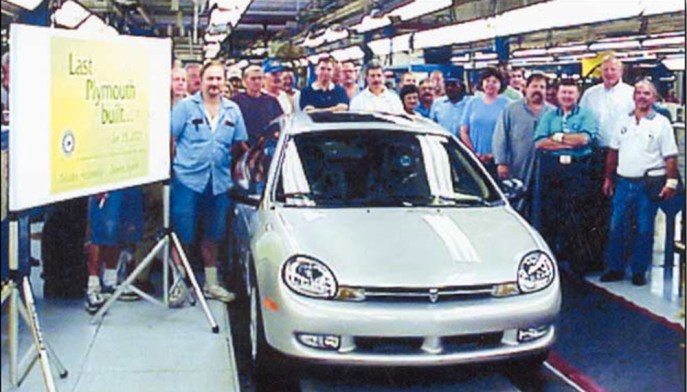
The last Plymouth Neon — and the last Plymouth — was built on June 28, 2001.
Dodge Hamtramck Plant 106 Years Ago

Dodge Hamtramck Plant (Dodge Main) circa 1920
Lewis Reed received his mechanical training at the Dodge Main Hamtramck Plant, in addition to the Hudson Motor Car factory in Detroit, Michigan, the Pierce-Arrow factory in Buffalo, New York, and the Washington Auto College. In 1910, Horace and John Dodge contracted with Albert Kahn to build the 5.1-million-square-foot Dodge Main complex with the idea of building their own automobile. This dream came true in 1915 with the introduction of the Dodge Brothers motorcar.
Lewis Reed was just 27 years old when he started selling cars built by brothers Horace and John Dodge in Detroit. Few people jumped onto the Dodge Brothers bandwagon earlier than Lewis Reed, and not many have lasted longer. Reed Brothers was franchised as a Dodge dealership and service facility in 1915 – less than one year after the first Dodge automobile rolled off the assembly line. He founded what would become the oldest Dodge dealership under the same family ownership in the state of Maryland, and one of the oldest in the entire nation.
Lewis Reed was the first to sell Dodge cars in Montgomery County, Maryland and his company was the first Gulf gas dealer in the Washington, D.C. area. During the early years, Reed Brothers represented several franchise nameplates along with Dodge, including Oldsmobile, Hudson and Essex. The Hudson and Oldsmobile were sold at Reed Brothers from roughly 1917 through 1921.
A mechanical aptitude was necessary to be a car dealer in the early 1900′s. When the cars were shipped to the dealer from the manufacturer they were only partially complete and they needed final assembly, so the new dealer quickly became skilled at repair. It was the dealer’s responsibility to assemble the cars at the rail yard and drive them back to the showroom. Mechanics were often needed to repair the new cars if they broke down along the way.

1916 – The first shop force of Rockville Garage (from left: Lewis Reed, (first name unknown) Long and Philip Reed.
The photos below are a caravan of circa 1920s cars all with Maryland Dealer license plates slowly making their way along a snowbound Goshen Road in rural Gaithersburg. The radiator badge on the front of the car in the below image identifies it as a Hudson. The only indication of where these photos were taken was a small piece of paper tucked behind one of the photos that was labeled “Goshen Road – outside Gaithersburg”.

Line of MD dealer cars making their way along Goshen Road. The car at the rear appears to be getting a helping hand to change a flat tire. Photo by Lewis Reed

Dealer car stopped (stuck?) on snowbound Goshen Road. Note the trailing cars slowly making their way up the hill. Although no tire chains are in evidence, they might have been useful coming up that hill. Photo by Lewis Reed

Maryland dealer car in a circa 1920 Oldsmobile stopped along Goshen Road outside Gaithersburg. Photo by Lewis Reed
Reed Brothers Becomes an Original Member of Chrysler
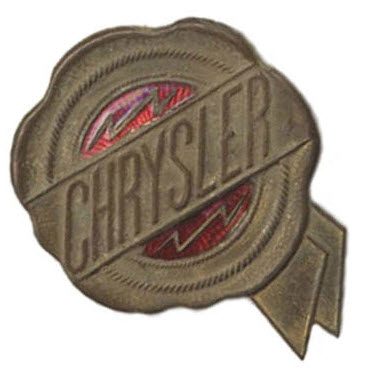
1930s Chrysler radiator “ribbon” emblem
May 28, 1928 marks an important milestone in the history of Chrysler. It was on this day in 1928 that Dodge Brothers, Horace and John Dodge, became a part of Chrysler. It was on this same date that Lewis Reed, founder of Reed Brothers Dodge in Rockville, Maryland also became an original member of the Chrysler family.
During 1920, the Dodge Brothers company lost its founding fathers. John Dodge died in January, and his younger brother Horace succumbed the following December. A New York investment banking firm paid the brothers’ widows, in a single cash payment, $146 million for the Dodge Brothers firm. Within three years, the bankers initiated negotiations, and on May 28, 1928, Walter P. Chrysler purchased Dodge Brothers, Inc. for $170 million, making it, at the time, the largest business transaction in history. When the transaction was complete, the Chrysler Corporation had grown five-fold overnight to become the third of Detroit’s “Big Three” automakers.
The first Plymouth was built in 1928 and Plymouths were sold at Reed Brothers until 1969, when the Plymouth brand was given to the Chrysler dealers.
22 Then & Now Photos to Show Just How Much Has Changed
Reed Brothers Dodge and the surrounding area sure has changed a lot in its almost century-long history. I thought it would be fun to revisit some locations using some of Lewis Reed’s original photographs for “then” and Google Maps street view images from today for “now” to see what differences are visible. Google Maps time-lapse tool lets you explore an area’s evolution as far back as 2007. Some views look remarkably similar, while others are completely unrecognizable. So, in no particular order, here is a collection of Reed Brothers “then and now” photographs taken between 1915 and today. (click images to enlarge)


The black and white photograph on the left is Lewis Reed’s original 1914 Rockville Garage located at the intersection of Veirs Mill Road and Rockville Pike. In those days, many early car dealers grew out of existing garages. In 1914, Lewis Reed became a partner in the Rockville Garage with Robert L. and Griffith Warfield. The Warfield brothers had purchased this building in July 1915, from Lee Ricketts and Sons who had the Overland Agency. The business continued to operate under the old name until it was changed at the suggestion of the late Judge Edward Peter shortly after Edgar Reed joined his brother.
On the right, is a 1970 artist rendition of the new dealership. After 55 years at the original location at the triangle at Veirs Mill Road and Rockville Pike, Lee Gartner purchased 4.37 acres of land from Eugene Casey and relocated Reed Brothers Dodge to a new state-of-the-art showroom and Dodge/Chrysler/Jeep service complex on Route 355 at 15955 Frederick Road in Rockville Maryland.


The black and white photograph above taken by Lewis Reed, is the dealership close to 80 years ago … and on the right is the same location today, now known as Veterans Park. In the 1970s the site was known as the Francis Scott Key Memorial Park, and later in 1988, it was permanently rededicated as Veterans Park. In the late 1960s, the state of Maryland acquired the land to widen 355 and donated the remaining sliver to the City. The state named the connector street behind the dealership’s location “Dodge Street” because Reed Brothers Dodge dealership was located there for more than 50 years.


These photographs were taken on the corner of Route 355 at the intersection of King Farm Boulevard and Frederick Road. Reed Brothers Dodge stood at this location for more than 40 years. The photo on the left is a Google street view taken in April 2012 of Reed Brothers just before closing.
The dealership’s legacy continues to this day on the site of its former location on the right, which is now the Bainbridge Shady Grove Metro Apartments. A 20-ft sculpture that commemorates the dealership’s history sits prominently at the main entrance to the development and can be seen by thousands of daily commuters taking the Red Line from the Shady Grove Metro Station to Bethesda, Maryland and Washington, D.C. The sculpture can be seen from some distance, especially at night, and now acts as a key landmark at the entrance to the Shady Grove Metro Station.


The black and white photograph above was taken by Lewis Reed in 1915 from the location of his Rockville Garage. Their first “gas station” consisted of a single pump which can be seen in the photo. The view is looking West on Main Street of Rockville showing an early Trolley car. From 1900 – 1935, the trolley cars went past Reed Brothers Dodge as they traveled up Rockville Pike. Also in the background is the old St Mary’s Cemetery. And on the right is the same view today, fondly known as “the mixing bowl.”


The “then” photo above was taken by Lewis Reed in 1953 at the corner of East Montgomery Ave and Dodge Street. It shows the new building for Reed Brothers Showroom, Parts and Service Departments. When the state of Maryland widened the roads in 1970, they named the connector street behind the dealership’s original location, “Dodge Street” because Reed Brothers Dodge was located there for so may years (1914-1970). The “now” photo on the right is a google maps image of the same location captured in 2016 … 64 years later.


Both of the “then & now” images above are Google Maps Street views taken 10 years apart. Reed Brothers Dodge in 2007 on the left and on the site of its former location, now the Bainbridge Shady Grove Metro Apartments.


The 1917 photo on the left is the original Rockville Garage located at the intersection of Veirs Mill Road and Rockville Pike, 100 years ago. Note the unpaved dirt road on Rockville Pike and trolley tracks running past the Rockville Garage. Both photographs were taken by Lewis Reed on the Rockville Pike side of the dealership.
On the right, is the same location 50 years later of the Reed Brothers Dodge Gulf Gasoline station. Due to changes in the highway, Reed Brothers began an extensive remodeling and rebuilding program. Two-thirds of the original location at the junction of then Route 240 and Veirs Mill Road was razed and a modern Gulf Service Station was erected.


On the left is a mid-1960s view from the corner of Veirs Mill Road and Dodge Street showing the new building for Reed Brothers Service Department. On the right is a Google street view image of the same location today, 50 years later.


The photo on the left is a side view of the Rockville Garage two story addition to the original shop taken .. close to 100 years ago. The first floor housed the Service Department and upper floor was used for parts storage. The chimney was probably to a coal furnace that was used to heat the building. The many windows allowed natural light for working on cars. Signage for Firestone Tires replaced the Fisk brand that was sold at Rockville Garage earlier in 1915.
The photo on the right is a 1968 photo taken at the same location, some 50 years later. Due to changes in the highway, two-thirds of the original location at the junction of then Route 240 and Veirs Mill Road was razed and a modern Gulf Service Station was erected.


The “beginning and the end” at 15955 Frederick Road: 1970 and 2013. The photo on the left is the new building in 1970 after the move from its original location at the triangle at Veirs Mill Road and Rockville Pike. The new building marked the dealership’s 55th year of selling Dodge’s.
On the right, is a photo that I took on May 16, 2013 of the vacant building on the day that demolition began.


The photograph on the left is a line of beige and baby blue cars all lined up in rows on the side lot. Across the road is King Farm with the big barn that said, “MILK FOR THOMPSON’S DAIRY” before it was transformed into a large-scale mixed use community. Lawson King’s dairy cows used to graze in the fields just a few feet from the roadway right across the road. At its peak, King Farm was the largest milk producer in the area and had been in agricultural use for nearly 75 years before it was approved for development in 1996.
On the right is a view from the same perspective taken in 2009… 30 some years later. In the background is the same big barn on the field that is now the new urban development known as King Farm.
Books

Related Resources


Copyright Notice

Reed Brothers Dodge History (1915-2012) by Jeanne Gartner is licensed under a Creative Commons Attribution-NonCommercial 3.0 Unported License.
 Reed Brothers Dodge History 1915 – 2012
Recent Comments