
Heartiest New Year Greetings!
A simple, but straightforward, Happy New Year greeting from Edgar and Lewis Reed from 73 years ago.
May the year ahead be all you want it to be.
This blog author would like to wish all the visitors and subscribers to this blog a very Happy New Year and all the best for a happy, healthy, and successful 2023. Thank you all for your support and for being loyal readers throughout the past year.
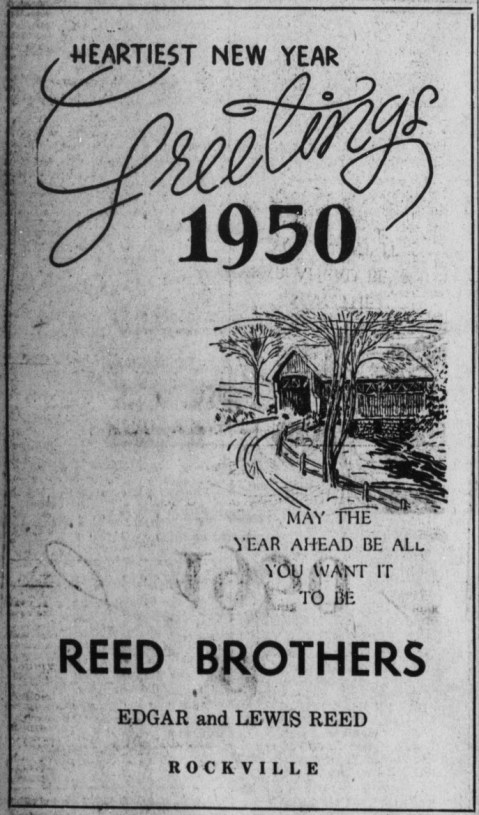
The Montgomery County Sentinel. December 29, 1949
Christmas Trees and Snow Villages from a Hundred Years Ago
With only a few days left until Christmas, I thought it might be fun to take a look at some photos from Lewis Reed’s collection that show us what Christmas trees used to look like 100 years ago. In those days, there was not wide-spread agreement on exactly what a tree should look like, which made for a lot of creativity. Not surprisingly, they were very different than the perfectly shaped tress we have on display today.
The trees were big back then and always fresh. They went right to the ceiling and were very wide. Early Christmas trees were generally fastened onto a flat board surrounded with fence-rails, snow villages and carpeted with cotton blankets of snow. The tree in the photo below has an abundance of tinsel, which grew in popularity to the point that, by the 1920s, it was common to nearly cover the tree in the decorative material.
So, what is tinsel (aka icicles) exactly? Originally made from strands of silver alloy, tinsel was in fact first used to decorate sculptures. It was only later that it became a Christmas tree decoration, employed to enhance the flickering of the candle flames. In the 1950s, tinsel became so popular that it was often used as a substitute for Christmas lights.
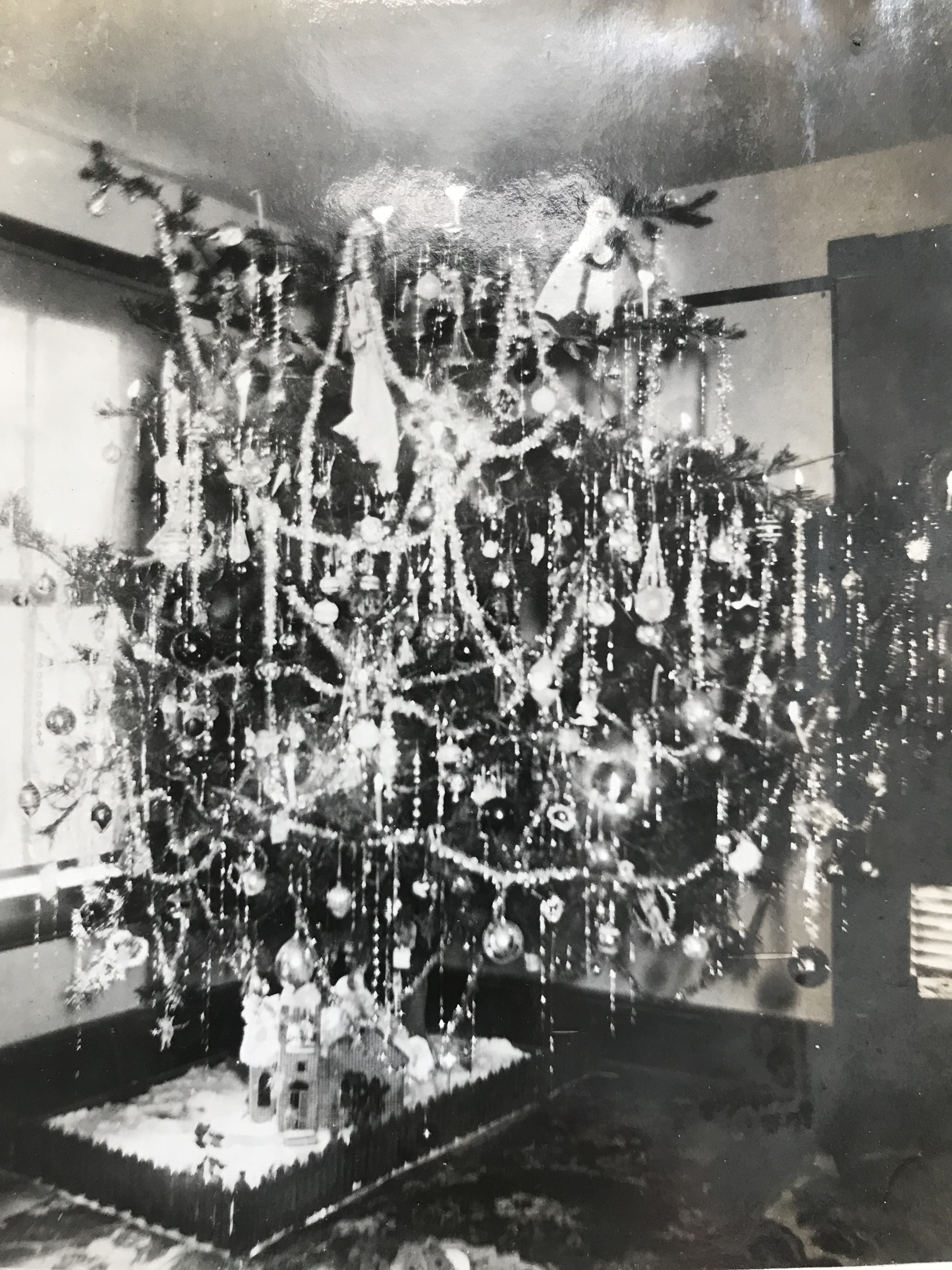
A small snow scene with what appears to be a miniature church is arranged at the foot of the Christmas tree. A popcorn garland adorns the tree. Photo by Lewis Reed
So, where did Washingtonians get their trees?
From The Evening Star, Washington, DC 23 December 1923:
Conduit Road on the long stretch between Glen Echo and Great Falls for many years has been a favorite hunting ground where hundreds and hundreds of families have customarily obtained scrub pine trees for Christmas week. Usually there is plenty of holly and some mistletoe to be found in the rugged and rolling hill lands which are the gateway to Great Falls.

No room for a star on the top of this tree! And just look at those big Santa and Angel dolls. Other fun little details are notable, including a miniature church with picket fence is arranged at the base of the tree. Photo by Lewis Reed
There’s a fine art to decorating Christmas trees that’s been developing since over 100 years ago. People consider lights, garland, ornaments, skirt, and more. But one thing that’s hard to resist sometimes is just filling every available space with decorations. Clearly, that was the case years ago too. What I like about these trees is that they are so randomly shaped and even misshapen. Folks back then didn’t trim them down to a more aesthetically pleasing symmetry like we do today.
The tradition of building miniature Christmas village landscapes, including houses, animals, and other hand-crafted wooden figures, began with the Pennsylvania Dutch in the late 1800s. Mass-produced cardboard houses, sold in dimestores, became popular in the mid-20th century. Today, these villages in good condition can be highly collectible.
Below are photos of Lewis Reed’s snow village set up under the Christmas tree decorated with vintage ornaments, tinsel, and lights. I don’t remember the odd-shaped Christmas trees, but I do remember having a lot of fun helping my grandfather set up the miniature landscapes with the varied figures, little houses, and trees at Christmastime each year. It seemed like a holiday village right out of a storybook.
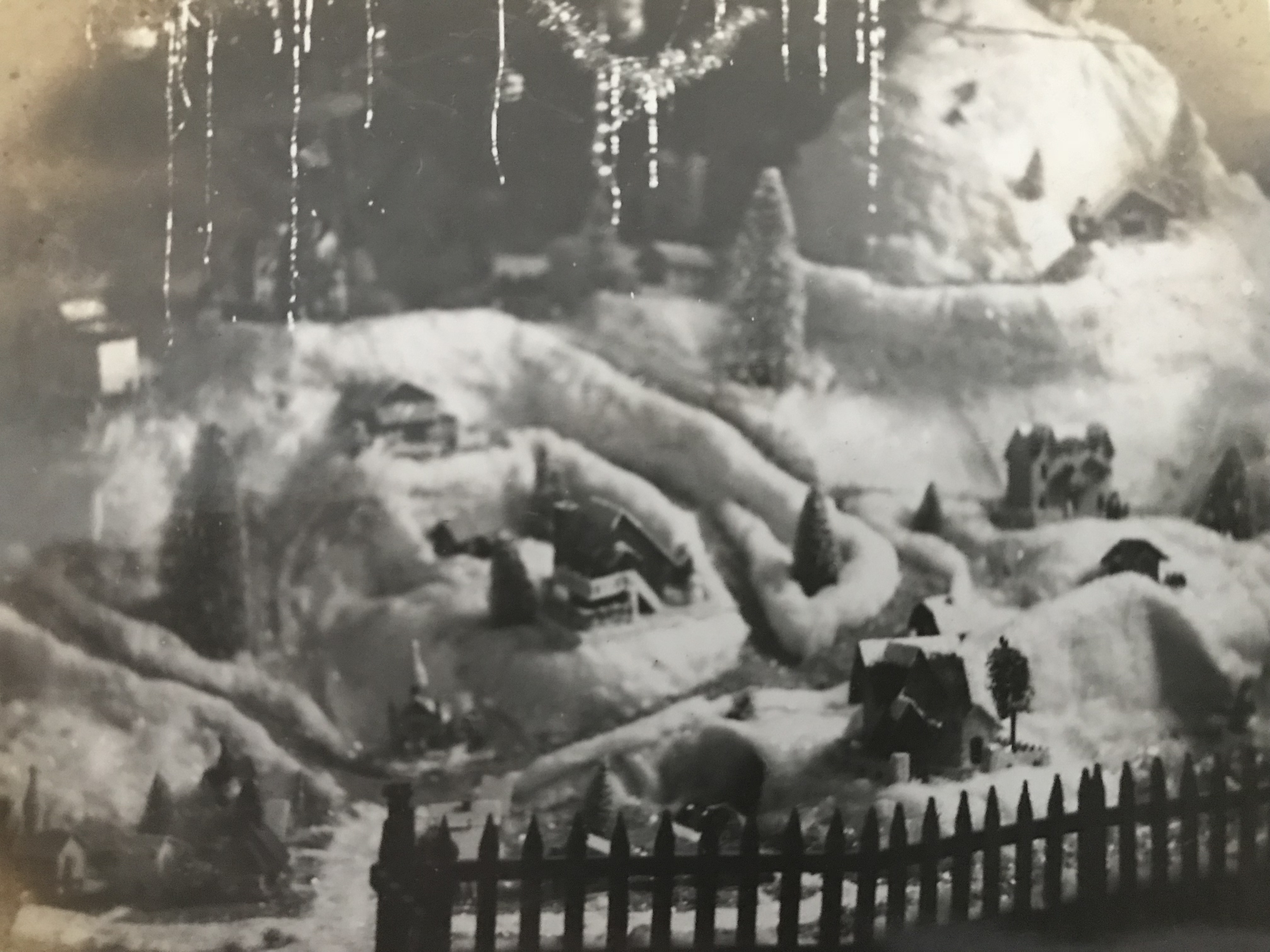
A rustic picket fence is used to set off the village display. Dangling strands of tinsel hang below the tree. Photo by Lewis Reed
The snow villages were set up in Lewis Reed’s basement on top of a big table beneath a small Christmas tree. He made the snow scenes entirely by hand using wire-covered cardboard and balled up paper to make hills and pathways. The little houses and figurines would fit into the landscape with cotton ‘snow’ all around; and lights would be wired underneath.

Little houses, churches, fences, trees, and pathways were added to the scene. Some of the houses have charming light effects in the windows. The roofs of the houses were decorated with fake snow. Photo by Lewis Reed
These Christmas villages were precursors of the Holiday Villages that were made popular by Department 56 that you see today.
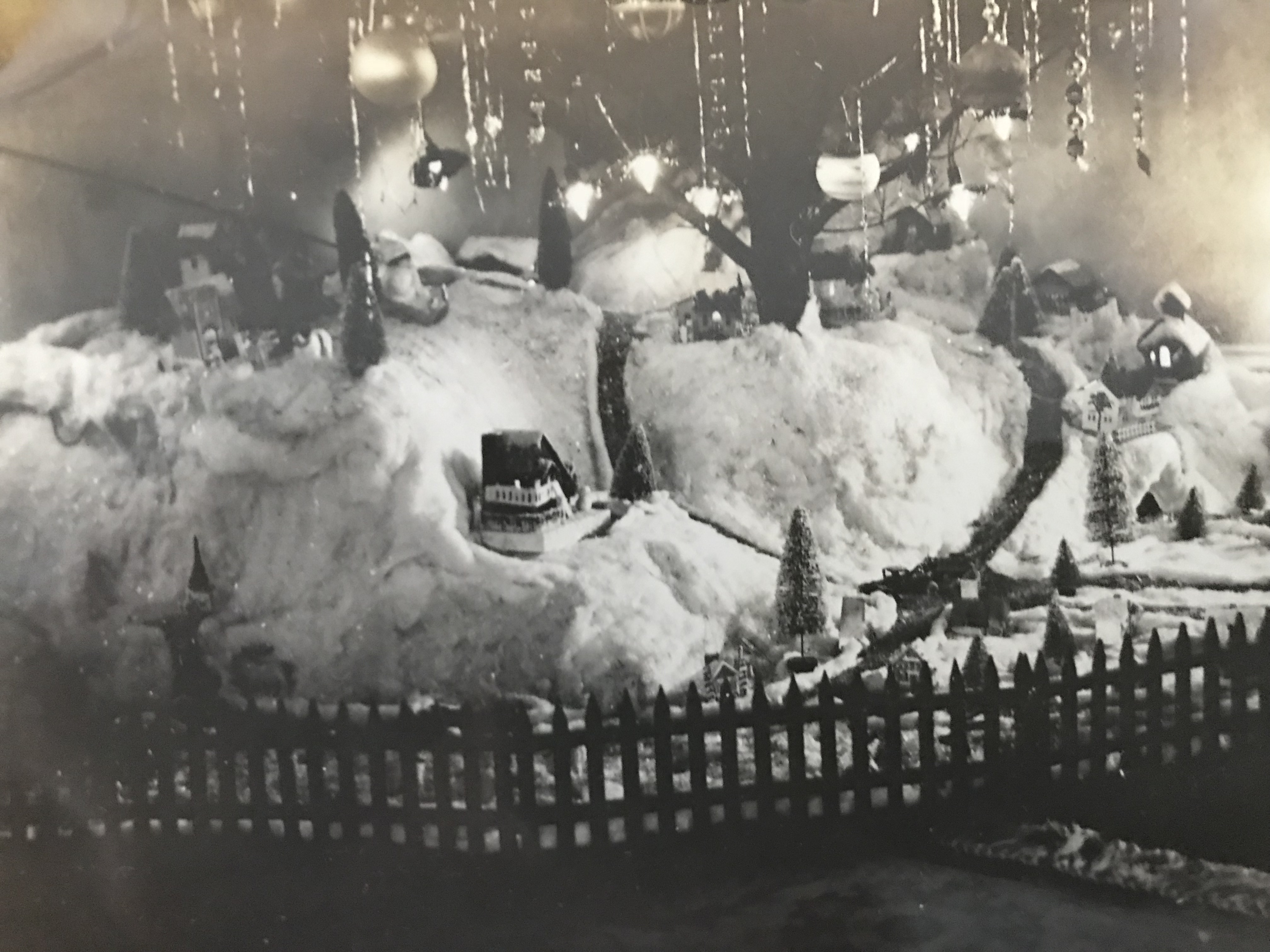
Old-fashioned lights can be seen on the tree, along with lit windows in the houses. The miniature houses usually had holes in the back or the bottom through which tiny lights were placed to provide illumination. Photo by Lewis Reed
Wishing all of you who have stopped in to visit a very Merry Christmas and Happy New Year! Stay safe and enjoy the holiday season with friends and family!

Dear Santa, Please Pause Here
This special post doesn’t have anything to do with Reed Brothers Dodge history, but it does have a lot to do with the founder’s daughter, Mary Jane (Reed) Gartner. In her younger years, Lewis Reed’s daughter (my mother) was a very talented ceramic and china painter. She painted the ceramic tray of Santa (below) for me Christmas of 2000 and entered it in the Montgomery County Agricultural Fair. Seventy-eight years old at the time, she won First Premium Prize. The tray is currently displayed in my dining room china cabinet and evokes memories of my childhood and makes me happy every time I look at it. I hope you enjoy this special post.

“Dear Santa, Please Pause Here” 2000 oil painting on ceramic tile by Mary Jane (Reed) Gartner.
Some background about the image
Have you ever heard of an artist named Haddon Sundblom? No? Well you’ve seen his work. You could say he’s one of the most famous character designers ever. He created the iconic Santa we all know and love. The image, “Santa, Please Pause Here” was originally created by Haddon Sundblom who was commissioned by Coca-Cola company to develop advertising images using Santa Claus. He may have been paid as much as $1,000 per painting—a lot of money at that time (you could buy a car for $700). Based on Clement Clark Moore’s descriptions of St. Nick in “’Twas the Night Before Christmas,” Sundblom’s Santa Claus emphasized the rosy cheeks and snow white beard along with the now familiar suit and hat. A wide leather belt and brown boots completed the look.
From 1931 to 1964, Sundblom’s creations for Coca-Cola had Santa pictured as doing everything from delivering toys (and playing with them!), pausing to read letters, visiting with children who had waited up to meet him on Christmas Eve, raiding the refrigerators of several homes, warming his feet by the fire, and other activities — always with a bottle of Coke in hand or nearby. The Sundblom Santa became so popular that the images spread from print ads onto billboards, posters, calendars, plush dolls, and more.
Below, is the original Coca-Cola Santa Claus painting and sketches by Haddon Sundblom.


In 2001, Haddon Sundblom’s Santa Claus was creatively brought to life in a Coca-Cola ad video tribute, animated by the Academy Award-winning animator Alexandre Petrov.
So the next time you envision Santa Claus and maybe even have a simultaneous unexplained craving for a Coca-Cola, please give a wink and nod to the artist Haddon Sundblom. He was instrumental in defining the image of Santa Claus for us all.
Wishing the very best of the holiday season to everyone, and of course, Merry Christmas!
Reference: Coca-Cola.com
Then & Now: Barnesville (Sellman’s Depot”) Train Station, 1912
BARNESVILLE (“Sellman’s Depot”) B&O TRAIN STATION (THEN): Barnesville Station, constructed circa 1873, this frame building apparently housed the post office as well. The station house in 1874 was referred to as “Sellman’s Depot”, and was named for William 0. Sellman, owner of the lands on which the station was built. Development began around 1873 when the railroad came through and the town was gradually abandoned with the advent of interstate highways and automobiles. The station was demolished in the 1950’s.
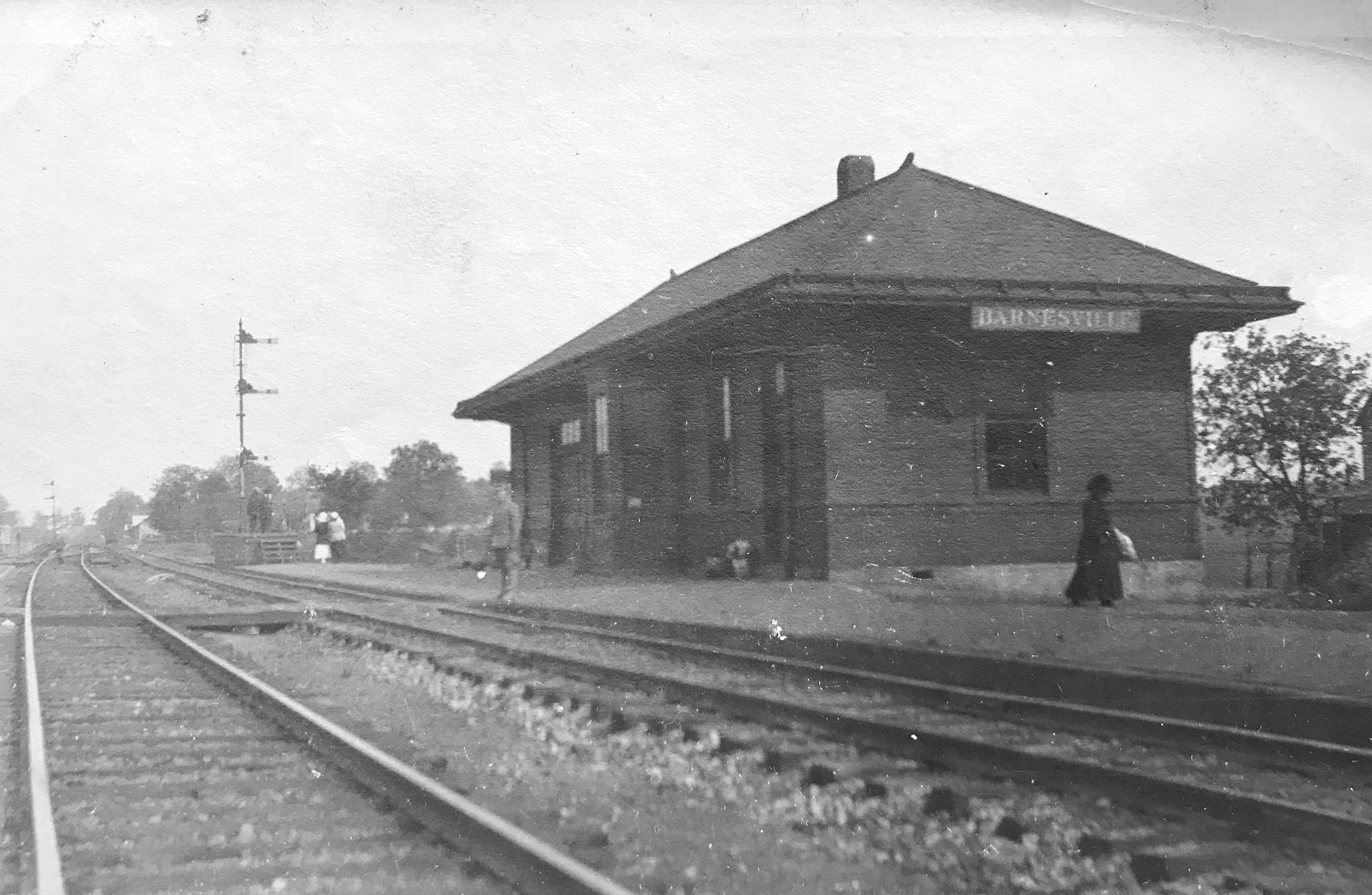
Barnesville (Sellman’s Depot”) Train Station. Photo by Lewis Reed, 1912.
BARNESVILLE MARC STATION (NOW): Built about 1930 as the first metering station for the Washington area gas supply, this building was saved from imminent destruction by concerned citizens dedicated to both the preservation of the visible past and revitalization of the railroad. On February 16, 1977 the historic metering station owned by the Washington Gas Light Company traveled 23 miles by road from Rockville to begin a new existence as the Barnesville railroad station. The squarish little structure had a makeover after the move. It was painted inside and out and and a wide overhanging roof was added just below the original roof line, giving the building more an authentic “train station” look, and it was re-dedicated on October 10, 1977. Snuggled up against the woods, surrounded by trees and shrubbery in a rural area just south of Barnesville on Route 109 (Beallsville Road), the station today is a pretty sight.

The metering station installed at Sellman station by the tracks which today serves as the Barnesville (MARC) Station. It was moved here from Rockville in 1977 for preservation. Image from Wikimedia Commons.
Source: The Montgomery County Story Newsletter, Vol. 37, No.1, February 1994. “Train Stations and Suburban Development Along the Old Baltimore and Ohio Railroad” by Jo Beck
Third Annual Goodyear Dealers Zeppelin Race July-August 1931
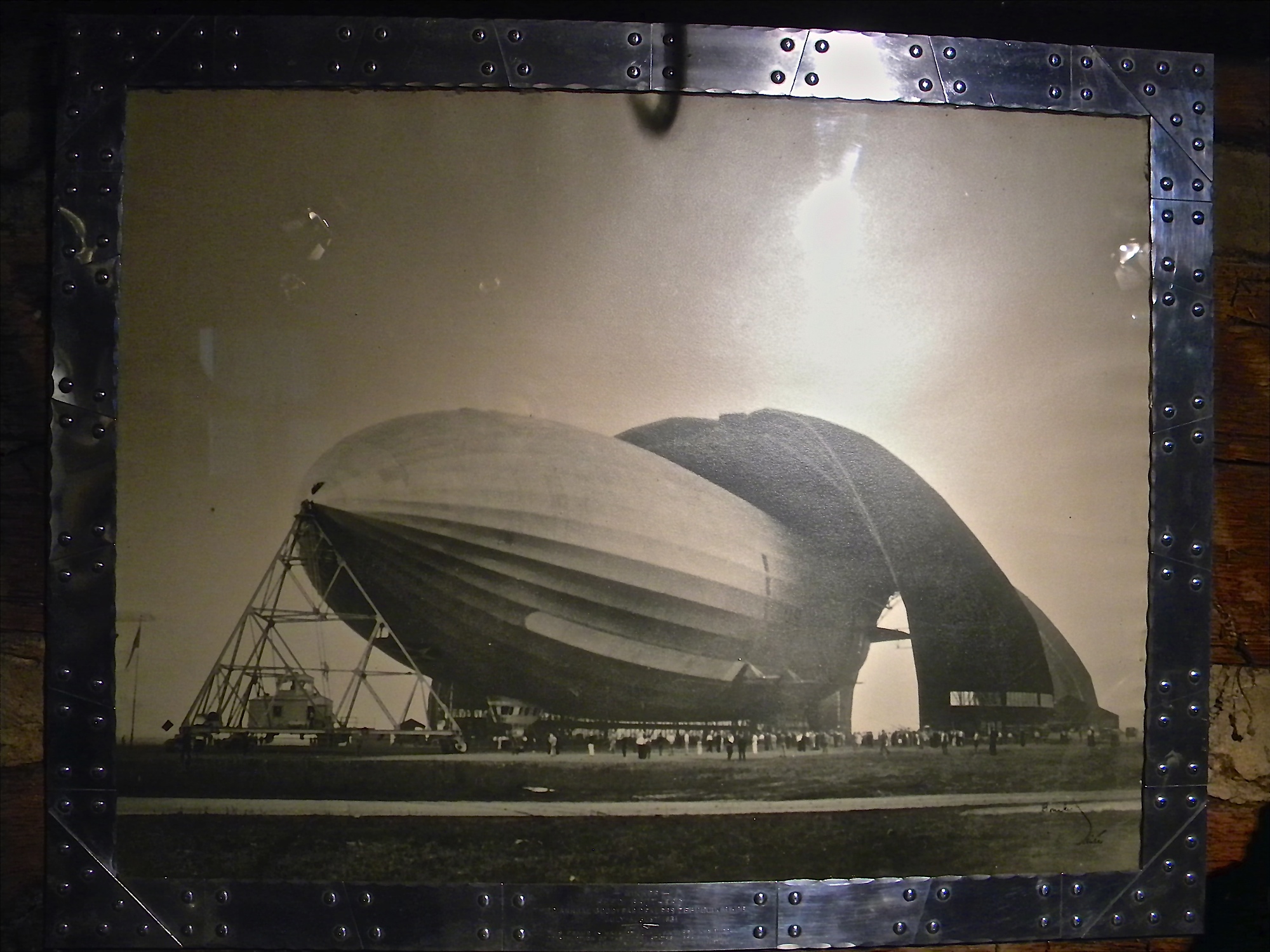
MARGARET BOURKE-WHITE, 1931 REED BROTHERS THIRD ANNUAL GOODYEAR DEALERS ZEPPELIN RACE WINNER
In 1931, the Goodyear Zeppelin Company produced a series of framed prints as rewards for Goodyear dealers as prizes for high sales. Sales was based on a two months quota, and participated in by thousands of dealers all over the country. The print shows the maiden launch of the USS Akron leaving the Goodyear Zeppelin air dock at Akron, Ohio. The engraved plaque at the bottom center of the frame reads, “Winner – Reed Brothers, Third Annual Goodyear Dealers Zeppelin Race. July – August 1931.” This frame is made of duralumin used in the girder construction of the United States Airship “AKRON” built by the Goodyear Zeppelin Corporation”. The print is signed in the lower right-hand corner by the famed 20th century photographer, Margaret Bourke-White. During the early years of the Depression, Goodyear was one of Bourke-White’s most important clients. She made this image of the airship Akron when it was removed from its hangar for the first time.
Built in 1929, the almost unbelievably huge Goodyear air dock in Akron, Ohio, was created as a space where blimps, airships, and dirigibles could be constructed. Evidently building such a massive space created problems, such as indoor rain, and putting the whole thing on rollers so that it could expand and contract with the seasons.
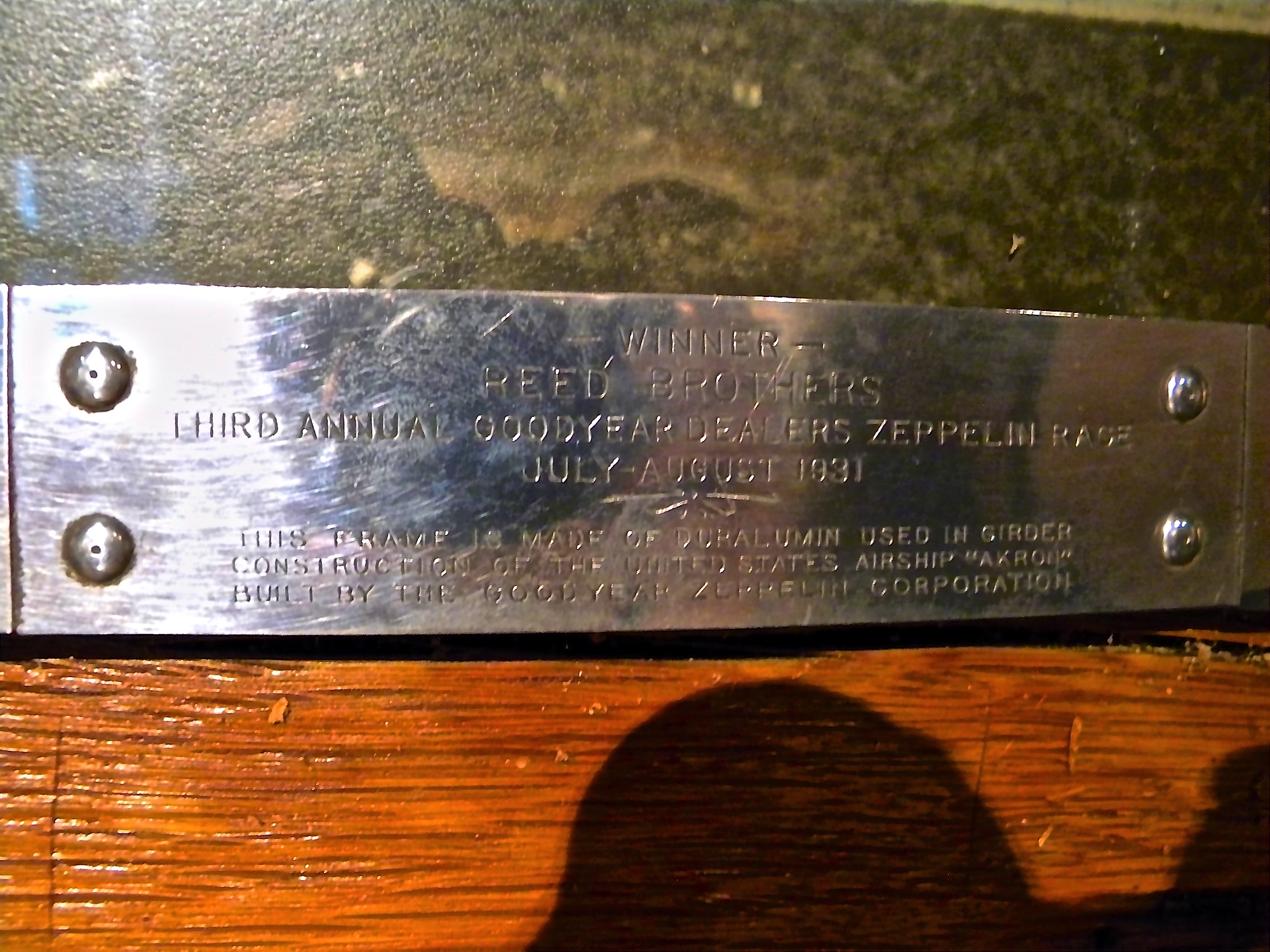
Inscription Plaque

Photo is signed in the lower right corner by famed 20th century photographer, Margaret Bourke White
The USS Akron, first of a class of two 6,500,000 cubic foot rigid airships, was built at Akron, Ohio. Commissioned in late October 1931, she spent virtually all of her short career on technical and operational development tasks, exploring the potential of the rigid airship as an Naval weapons system. During the remainder of 1931 and the early part of 1932, the Akron made flights around the eastern United States and over the western Atlantic, including one trial of her capabilities as a scouting unit of the fleet. While beginning a trip to the New England area, Akron encountered a violent storm over the New Jersey coast and, shortly after midnight on 4 April 1933, crashed tail-first into the sea. Only three of the seventy-six men on board survived this tragic accident. During the search for other possible survivors, the Navy non-rigid airship J-3 also crashed, killing two more men.
Note: Margaret Bourke-White (1904 1971) is best known as the first foreign correspondent to be permitted to take photographs of Soviet industry, the first female war correspondent, and the first female correspondent permitted to work in war zones.
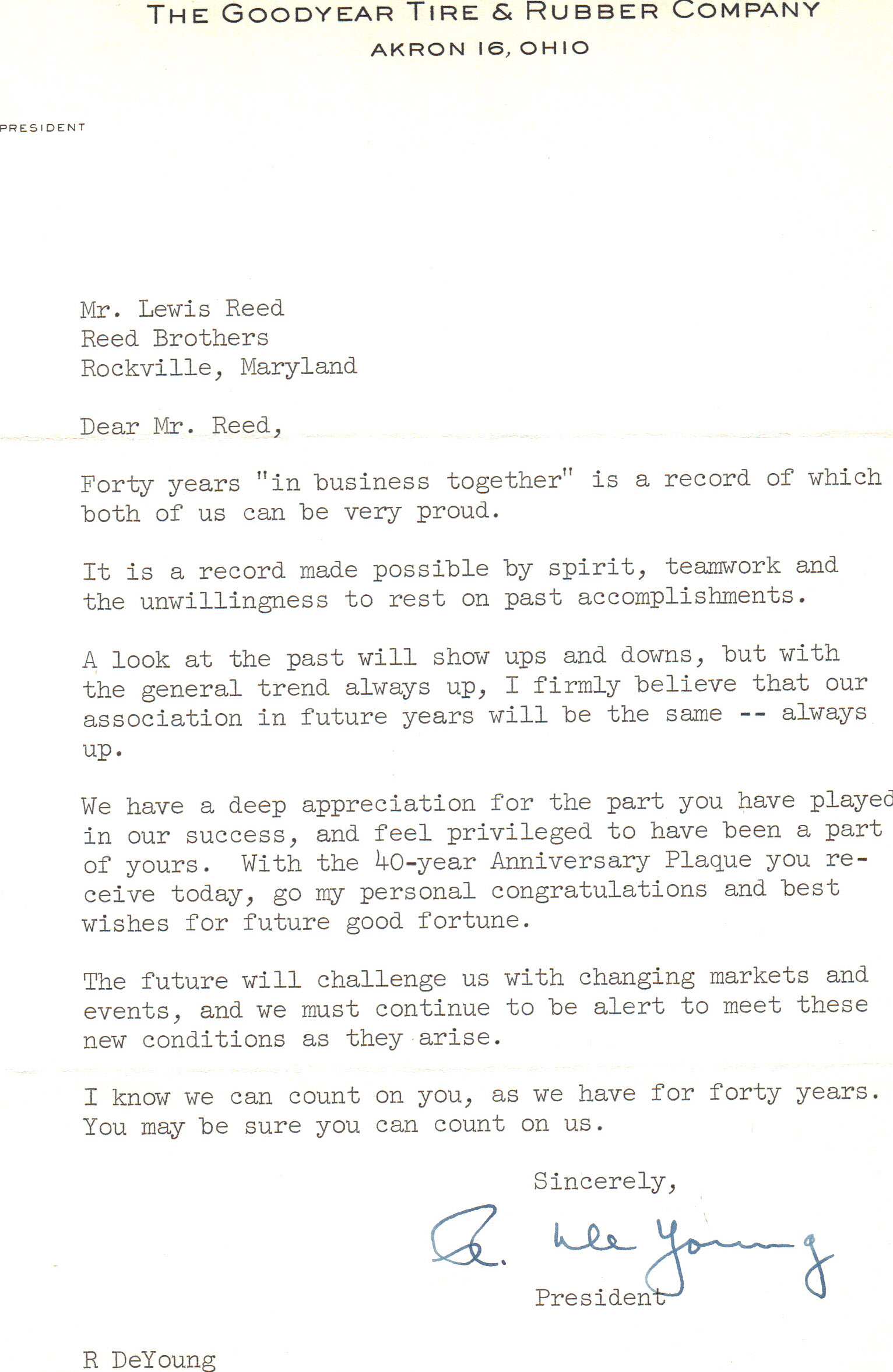
40th Anniversary with Goodyear
Lewis Reed was recognized by Goodyear Tire & Rubber Co. for reaching his 40th year as a Goodyear dealer. Reed Brothers Dodge began selling Goodyear tires in the 1920s. Below is a letter from Russell DeYoung thanking Lewis Reed for his 40 years “in business together”.
Books

Related Resources


Copyright Notice

Reed Brothers Dodge History (1915-2012) by Jeanne Gartner is licensed under a Creative Commons Attribution-NonCommercial 3.0 Unported License.
 Reed Brothers Dodge History 1915 – 2012
Recent Comments