
Happy Birthday Edgar Reed!
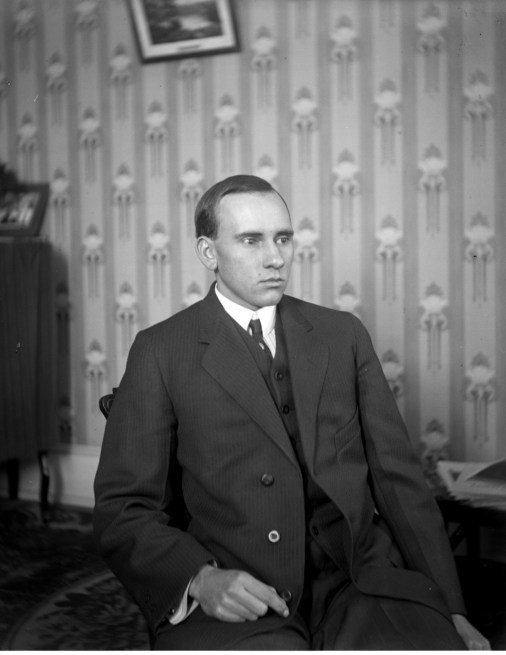
Edgar Reed as a young man.
Edgar was born in Darnestown, Maryland on October 17, 1890. If he were still around he would be 129 years old today. Edgar was a veteran of World War I and an active citizen of Rockville. He served as a Sergeant in the Army Medical Corps and had been posted to General Hospital No. 11 in Cape May, New Jersey. Previous to his enlistment he had been employed by R.W. Vinson, Rockville druggist for eight years. In 1919, Edgar joined his brother Lewis Reed in the business and the name changed to Reed Brothers Dodge. Edgar was in the automobile business with his brother for 35 years.
As a prominent businessman active in local commercial, civic, and religious institutions, Edgar was a respected community leader. For many years, he served on the Town Council and was Chairman of Stewards at the Rockville Methodist Church. Edgar was an original incorporator and charter member of the Rockville Volunteer Fire Department when the fire company was organized in 1921. He was a charter member and Past President of the Rockville Rotary Club and was a director of the Farmers Banking & Trust Company in Rockville until the time of his death. He was the first President and one of 30 original members of the Dealers Automotive Association of Montgomery County.
Edgar was the executive of Reed Brothers and handled all of the technicalities of the business. He was generally in charge of new car and truck sales. Edgar Reed passed away on October 24, 1951 after a prolonged illness.
Rare Photos of the Wright Brothers at Fort Myer
On this day in September 17, 1908, Orville Wright and Lt. Thomas E. Selfridge test flew the Wright Flyer in a demonstration for the U.S. Army at Fort Myer, Virginia. Less than a thousand people witnessed the first flight at Fort Myer, because the general public was still doubtful that powered flight had been achieved. But Lewis Reed was there… and to commemorate that milestone, I have posted six original snippets of history that Lewis Reed captured through the lens of his camera that day.
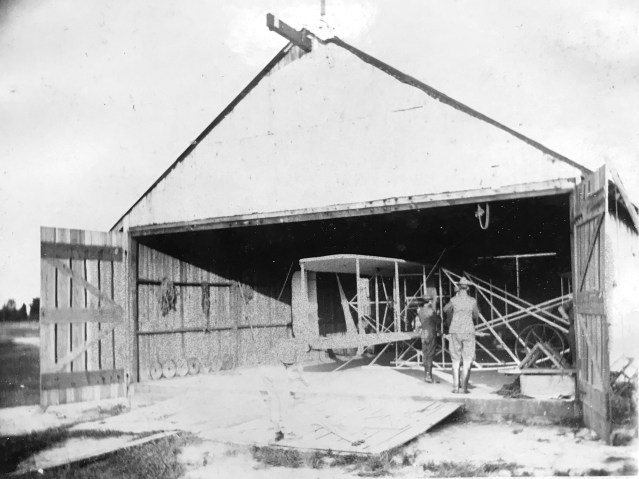
Soldiers at Fort Myer prepare to pull the Wright Military Flyer out of its temporary hangar. Photo by Lewis Reed

Curtiss Model D with tricycle undercarriage. Photo by Lewis Reed

Curtiss Model D. Photo by Lewis Reed

Wright Model B with skids. Photo by Lewis Reed

Another early aircraft from 1909 was the Bleriot XI monoplane. In the background a Rex Smith Aeroplane Company School is advertised on the side of a building. Photo by Lewis Reed
A Rex Smith Aeroplane Company School can be seen on the side of the building in the background. The founder, Rex Smith, was an inventor and a patent attorney. The Rex Smith Biplane was used in the successful April 3, 1911 U.S. Army Signal Corps experiments in wireless communications. The Signal Corps did not buy any Smith Biplanes, they did however use them from time to time to train pilots to fly the Curtiss aircraft at the same field.

Airplane Hangars at Fort Myers, Virginia. Photo by Lewis Reed
The Wrights would prove their machine’s qualifications at Fort Myer. They met or exceeded all of the Army’s specifications, including flying at 40 miles per hour, carrying a combined passenger weight of 350 pounds, maneuvering in any direction in the air, landing without damage, and flying for at least an hour non-stop, which was a world record at the time.
Today, the Wright brothers are legends, with their accomplishments being the storybook example of American perseverance and ingenuity.
The First Plymouth was Introduced by Chrysler on This Date in 1928
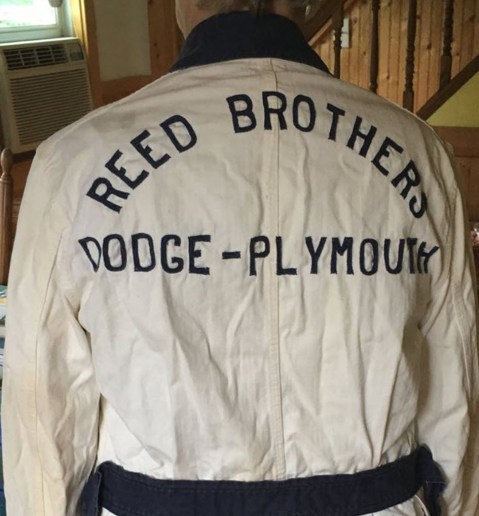
Plymouths were sold at Reed Brothers from 1930-1969.
The first Plymouth automobile was introduced on July 7, 1928. Plymouth was Chrysler Corporation’s first entry in the low-priced field, which at the time was already dominated by Chevrolet and Ford. Plymouths were actually priced slightly higher than their competition, but offered all standard features such as internal expanding hydraulic brakes that the competition did not provide. While the original purpose of the Plymouth was to serve a lower-end marketing niche, during the Great Depression of the 1930s, the marque helped significantly in ensuring the survival of the Chrysler Corporation in a decade when many other car companies failed. Beginning in 1930, Plymouths were sold by all three Chrysler divisions (Chrysler, DeSoto, and Dodge).
Plymouth sales were a bright spot during this dismal automotive period, and by 1931 Plymouth rose to the number three spot among all cars. Plymouth almost surpassed Ford in 1940 and 1941 as the second most popular make of automobiles in the U.S.
In 1957, Virgil Exner’s new Forward Look design theme, produced cars with much more advanced styling than Chevrolet or Ford. 1957 total production soared to 726,009, about 200,000 more than 1956, and the largest output yet for Plymouth. However, the 1957–1958 Forward Look models suffered from poor materials, spotty build quality and inadequate corrosion protection; they were rust-prone and greatly damaged Chrysler’s reputation.
Most Plymouth models offered from the late 1970s onward, such as the Volaré, Acclaim, Laser, Neon, and Breeze, were badge-engineered versions of Chrysler, Dodge, or Mitsubishi models. By the 1990s, Plymouth had lost much of its identity, as its models continued to overlap in features and prices with Dodges. Plymouth’s product offerings and buyer appeal, and sales continued to fall.
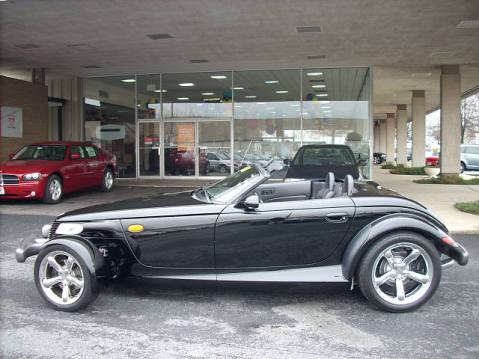
1999 Plymouth Prowler
By the late 1990s, only four vehicles were sold under the Plymouth name: the Voyager/Grand Voyager minivans, the Breeze mid-size sedan, the Neon compact car, and the Prowler sports car, which was to be the last model unique to Plymouth. The Prowler came about as part of Chrysler’s efforts (the last as it turned out) to differentiate Plymouth from the rest of its lineup in hopes of keeping the brand alive. It was hoped that it would be received well enough to garner some attention, some of which might spill over into some of their other models.
Plymouth rarely exceeded 200,000 cars per year after 1990. Consequently, DaimlerChrysler decided to drop the make after a limited run of 2001 models. This was announced on November 3, 1999.
7 Years, 296 Posts & Thank You
 Today marks the 7-year anniversary of this blog. It’s been an honor to share the history of Reed Brothers Dodge – whether you’ve read our blog, followed us on Twitter, or “liked” us on Facebook. I would like to thank those mentioned below, and many others, for their kind words and the visibility they have provided.
To help review the past year I thought I’d search around on the Internet and see what others have been saying about us.
Included among the posts on our Facebook page:
“I love pictures, especially the old ones. People, places and things…the pictures bring such cool history and personal ones, the fond memories.
Online and in print:
Antique Motorcycle Club of America, Forum: “Reed Brothers was a pretty important local business owners in my area. The Reed Brothers, shown in the photo attached, are the two center riders with touring caps and ties started a garage in Rockville in 1915 and received a Dodge Motors contract to sell and service the new automobile….. Lewis was a pretty extraordinary amateur photographer.”
Meadow Brook Hall: For the second year, to show support to preserving the Dodge legacy, the author of this blog has “adopted” a Dodge car — a 1915 Dodge Brothers Touring Car — one of the historic vehicles in the Meadow Brook Hall Dodge Brothers automobile collection. Meadow Brook Hall in Rochester Hills, Michigan was the estate of one of the world’s wealthiest and influential women of her time, Matilda Dodge Wilson. Matilda was the wife of John F. Dodge, co-founder of the Dodge Brothers Motor Car Company.
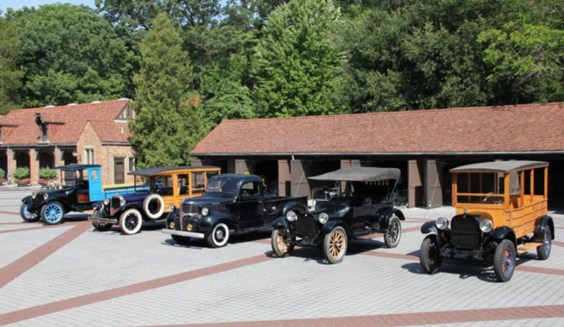
Photo courtesy of Meadow Brook Hall
The inscription on the Adoption Certificate reads:
adopted by Jeanne Gartner in memory of her grandfather, Lewis Reed, who founded Reed Brothers Dodge in Rockville, Maryland in October 1915.
The vehicle was adopted for a period of one year, beginning November 14, 2018 through November 13, 2019 (November 14 is the anniversary of the day John and Horace Dodge revealed their first car in 1914). The adoption will help Meadow Brook make necessary repairs, provide preventative maintenance and pay insurance for the Depot Hack, ensuring it’s there to inspire, educate and “drive” this and future generations. Lewis Reed is a perfect and most fitting parent.
“Just A Car Guy”: It’s pretty cool to see a well-known car blog like “Just A Car Guy” has noticed our history blog and has been sending visitors our way via a link on their page under, “Sites I recommend for their quality”: Reed Brothers Dodge History. I am proud and honored to be regarded among these terrific automotive websites.
On National Television!
- Lewis Reed Photo Featured on Maryland Public Television (MPT): Lewis Reed’s aerial photograph of entire original Reed Brothers Dodge dealership at the intersection of Veirs Mill Road and Rockville Pike was used in the Maryland Farm & Harvest series which was aired on December 18, 2018 at 7:00 pm on MPT. The photo illustrated what Rockville Pike looked like at the time, during a segment about 97-year-old farmer Charles Koiner who grew up in the Rockville area.

Screen shot of credits from Maryland Farm & Harvest video on MPT
- Lewis Reed Photo on Discovery’s Science Channel, Impossible Engineering: A Lewis Reed’s photo from the 1923 Rockville Fair Auto Races was a part of the Episode 4 ‘London Array’ Series of Impossible Engineering that was broadcast on Thursday, January 24, 2019 on Discovery’s Science Channel. The photograph was used on the program that featured a segment on the development of the race car.

Lewis Reed’s photo extracted from the Science Channel Impossible Engineering DVD
Last, but certainly not least, many thanks to all of you who have visited, followed, shared, or commented on this blog. I appreciate all of you for your continued support and making Reed Brothers Dodge History one of the places you visit during the course of your day.

Iconic Advertising Slogans by Dodge
Like any major business that’s been around throughout the evolution of television advertising, Dodge has been on the point of many trends and gimmicks over the decades. At the same time, they’ve also set an advertising tone that challenges other manufacturers to try and keep up. Whether you’re a young buck or an ol’ timer, you’re bound to remember at least a few of these Dodge advertising slogans over the past five decades.
Through the years the ads have definitely improved from a timeless, artistic aspect; however the older ads definitely transport you back to a simpler time, both in the car world and in American history.
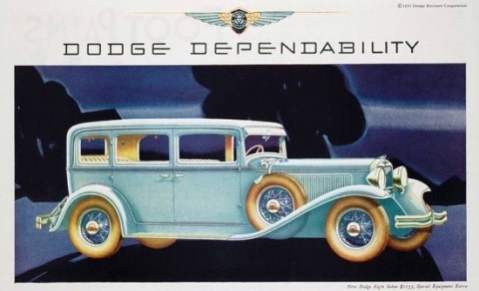
1. Dependability, The Dependables. (1920s–1967)
Capitalizing on their reputation, the Dodge Brothers used their name, “Dodge Brothers” followed by “Reliable, Dependable, Sound” to market their products. Devoted Dodge customers raved about the rugged construction, quality, and power of their vehicles. Buyers consistently commented that this was a car that could be depended upon. In a Dodge marketing stroke of genius, Theodore MacManus coined the word “dependability.” Dodge was using the term in advertising from around 1914, and by the 1930’s, the word was appearing in dictionaries, and soon found its way into common, everyday usage.
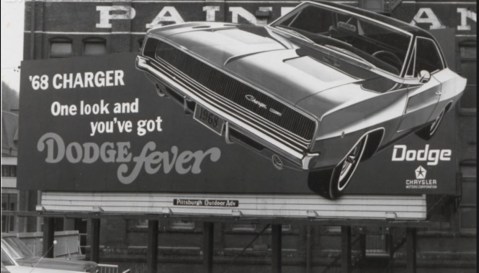
2. Dodge Fever. (1968–1969)
It was the fall of 1967, and for the 1968 model year, Dodge introduced the all-new second-generation Charger that was an instant hit with car buyers and would eventually become an iconic symbol of the muscle car era. In 1968, Dodge started the successful Dodge Fever campaign. A prospective buyer could check off the desired performance options when ordering a new Dodge, work out the terms for a manageable down payment and monthly installments, and drive out with one of the bumblebee striped Dodges. If a twin tail striped Charger R/T was purchased, the new owner now owned one of the “five from the hive” Dodges, which included the Swinger 340, Dart 340 GTS, Coronet R/T, Super Bee, and the Charger R/T. Picking up one of these Dodges authorized the owner to “Run with the Dodge Scat Pack,” which was always a cure for the fever.
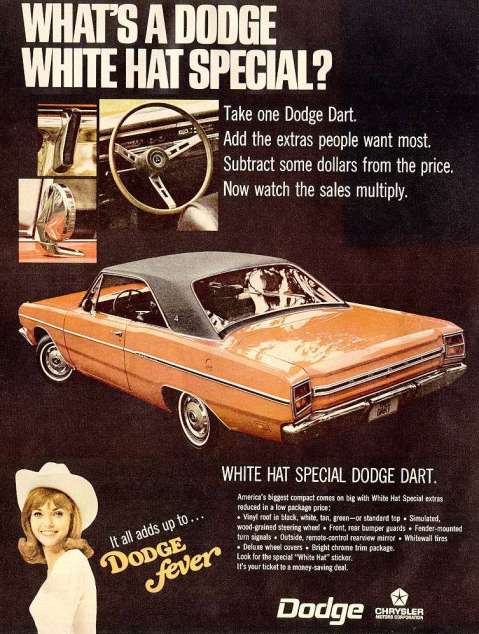
3. Dodge White Hat Specials (late 1960s)
Banking on the height of the popular spaghetti westerns of the late 1960′s, Dodge launched the 1969 “White Hat Special” editions of their lineup. Named after the old Roy Rodgers maxim that, “The good guys wore the white hats,” the White Hat Specials were more about the look and comfort than say, the more performance heavy R/T packages. Vinyl tops, seats, light packages, wheel covers, and remote-controlled side-view mirrors were par for the course. The White Hat Special package was also made available on Darts, Polaras, and Coronets in addition to the sporty Chargers.
4. You Could be Dodge Material. (1970–1971)
Advertising has changed a lot over the years, but it doesn’t even feel like too long ago that this commercial for the 1970 Dodge Charger 500 was airing on the networks. Nowadays, though, a spot like this ends up being more hilarious than most of the ads that are intentionally funny. In this spot, you can see for yourself just how attractive the 1970 Dodge Charger really was. So much so that it could change your whole image, therefore causing you to leave your lady stranded on the beach.
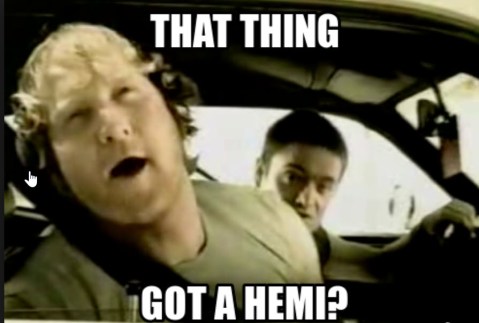
5. That Thing Gotta Hemi?
The actor Jon Reep launched his career by uttering, “That thing got a Hemi?” in a Dodge Ram television ad. In the video, we see two scuzzy dudes in a scuzzy Plymouth Duster. They stop at a light and find themselves next to a gleaming Dodge Ram pickup—which in turn tows behind it a gorgeous, vintage Dodge Charger. The scuzzy passenger leans out of his window and asks, “Hey, that thing got a Hemi?” The Ram owner answers, “Yeah.” The scuzzy driver says, “Sweeeeeeeeeeeet,” and revs his engine. Cue green light. The pickup waxes the scuzzmobile. At the next light, the Ram driver turns to the Plymouth. “Did you mean the Charger?” he asks. ” ‘Cause, you know that’s got a Hemi, too.”
6. An American Revolution. (1982–1989)
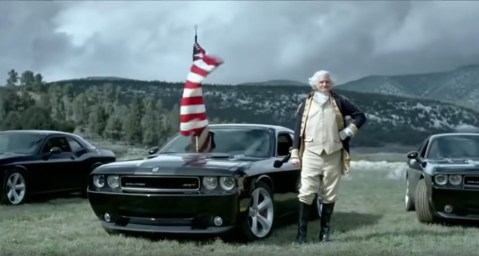
If George Washington drove back in the 1700s, he would be driving a Dodge Challenger. At least that’s what a new commercial wants you to think. A running commercial for the Challenger, which debuted during the World Cup, shows Washington scaring off the Redcoats in the muscle car, effectively winning the American Revolution.
7. The Pride is Back (1980)
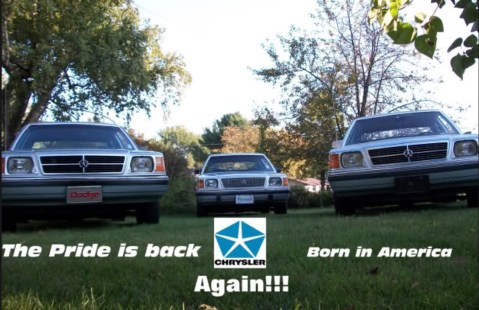
Lee Iacocca saves Chrysler. Reeling from the combined effects of a recession and a global energy crisis, in 1979 Chrysler was forced to seek government loan guarantees. Meanwhile, Chrysler chairman Lee Iacocca took the company’s case straight to the people in a series of television commercials. Looking straight into the camera, the legendary auto executive pitched the company’s new K-cars with total conviction, asserting, “America, if you can find a better car, buy it.”
Buyers took up Iacocca’s challenge, flocking to the showrooms to buy their own K-cars. Nearly one million Aries were sold (and another million Reliants), allowing Chrysler to pay off its loans a full seven years early. Soon Iacocca was back on the airwaves with another ad campaign. This one was called “The Pride Is Back.”
8. The New Dodge. (1992–2000)
In 1992, Dodge moved their performance orientation forward substantially with the Viper and all Dodge cars and trucks were shown in bright red ads. This was the first step in what was marketed as “The New Dodge”, which was an aggressive advertising campaign with a litany of new models, with television ads that pointed out the innovations in the vehicles and challenged their competitors.

9. Dodge. Different. (2000–2001)
“The New Dodge” signature was replaced by “Dodge Different”. Dodge found the way to success was to offer products that were bolder and more exciting than its competitors. In other words, by being different. It was the largest and most comprehensive print and television campaign in the company’s 85-year history.

10. Grab Life By The Horns. (2001–2007, mainly for Dodge truck market)
The slogan “Grab life by the horns” started appearing in Dodge commercials in 2001.
11. Grab life. (2007 – mid-June 2010, in Ram pickup truck ads)
The whole idea of ‘Grab Life’ as opposed to ‘Grab Life by the Horns’ kind of disenfranchises it from the Dodge Ram. The slogan shift was planned by Dodge to coincide with its car sales growth. The automaker is rolling out cars to circumvent the declining sales of pickups due to the volatile gasoline prices. If they cut off ‘by the horns,’ you’re less likely to think Ram and more likely to think maybe a Caliber or Avenger.
12. Never neutral. (2010–present)
The 2012 Dodge Charger advertisement called Never Neutral takes a swing at one of the major issues of the car industry: their tendency to take out driver involvement on the actual act of driving. The Never Neutral commercial says that the new model will always be an alternative to hands free driving, cars that park themselves, and to the unmanned car driven by a search engine company. In essence, the main point of Dodge’s new TV spot is to say that the 2012 Charger is a car made for driving, and for being driven in.

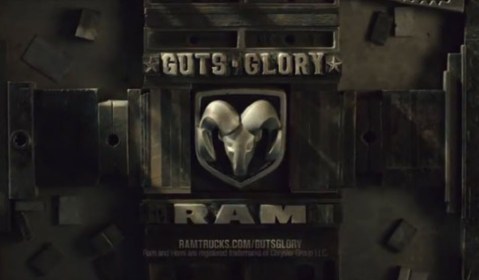
13. Guts. Glory. Ram. (2010–present, Ram Truck division)
“Guts. Glory. Ram,” with an old western theme—a perfect setting for what Ram suggests its brand portrays. Of course, the only forms of transportation back then consisted of horses, trains and wagons, but the spots foster the idea that if an automobile existed during these times of courageousness and survival, it would be the Ram pickup.
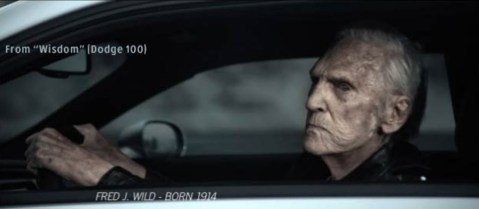
14. Wisdom (2014, commemorating Dodge’s 100-year anniversary )
In “Wisdom,” commemorating the century mark of the Dodge brand, a one-minute spot honored centenarians who laughed heartily and grinned big in front of the camera while handing out timely nuggets of wisdom on life and fast cars. “Live for now … Because life is good, you make it good.” Each person from the era when Dodge Brothers was still independent was identified by name and their birth year. The theme was simple but earnest: “You learn a lot in a hundred years … Here’s to the next hundred. Born Dodge.” So, here’s to putting the pedal to the metal … and never, ever forgetting where we came from. “Wisdom” was named 2015’s Automotive Ad of the Year during the 10th Nielsen Global Automotive Advertising Awards.
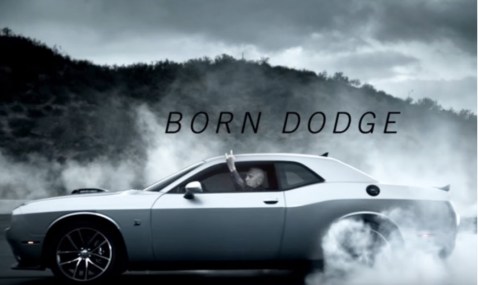
15. Born Dodge. (2014–present)
The Dodge car brand turned 100 years old in 2014. For this they released special 100th anniversary edition cars, re-designed the Charger and Challenger and released this epic commercial. Featuring timeless advice from people who’ve been around as long (or nearly as long) as the Dodge brand itself.
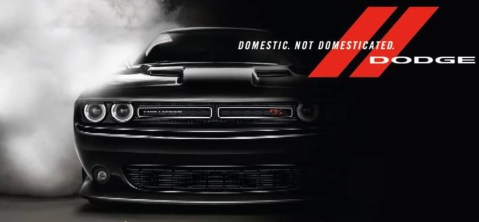
16. Domestic. Not Domesticated. (2016–present)
The tagline, “Domestic. Not Domesticated.” aims to capture the passion and attitude of Dodge. ‘Domestic. Not Domesticated.’ means that Dodge vehicles can handle grocery runs and recital pickups just as well as they can handle laps around the race track. You don’t have to sacrifice pleasure for practicality. You can have both.
Books

Related Resources


Copyright Notice

Reed Brothers Dodge History (1915-2012) by Jeanne Gartner is licensed under a Creative Commons Attribution-NonCommercial 3.0 Unported License.
 Reed Brothers Dodge History 1915 – 2012
Recent Comments