
Lewis Reed Photos to Appear on Science Channel ‘Impossible Engineering’
 I recently received an e-mail from the researcher on the new Science Channel series ‘Impossible Engineering’. They found Lewis Reed’s collection of early dirt track race photos that were taken at the Rockville Fairgrounds and asked permission to use a couple of them in an upcoming episode they are making on the development of the race car.
The following 1923 dirt track race shots taken by Lewis Reed will be used on the program.
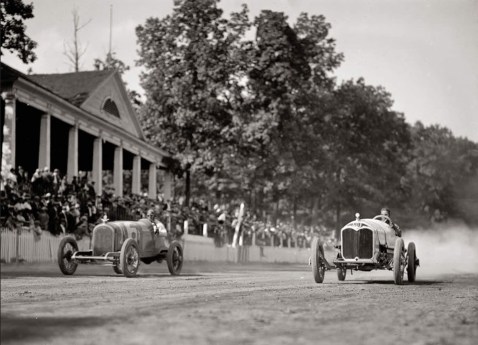
Rockville Fair, August 1923. Photo by Lewis Reed
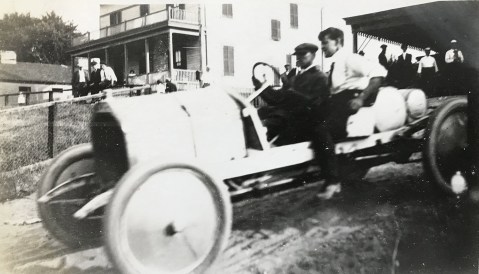
Rockville Fair, August 1923. Photo by Lewis Reed
About Impossible Engineering
Behind every seemingly impossible marvel of modern engineering is a cast of historic trailblazers who designed new building techniques, took risks on untested materials and revolutionized their field. Brand new series, ‘Impossible Engineering’, is a tribute to their achievements. Each episode details how giant structures, record-beating buildings, war ships and space crafts are built and work. As the show revels in these modern day creations, it also leaps back in time to recount the stories of the exceptional engineers whose technological advances made it all possible. How would they have ever existed without the historical work of their ancestors? Interviews with their great advocates bring engineering history to life and retell how these incredible accomplishments shaped the modern world.
“Impossible Engineering” is produced for Science Channel by Twofour Broadcast. No mention of when it will be aired, so stay tuned!
Then & Now: Lucy the Elephant Atlantic City, New Jersey
This post is a continuation of a series of “Then & Now” images that will show photographs of buildings, street scenes, and other historical locales from Lewis Reed’s Photo Collection alongside photographs of how they appear today.
Lucy the Elephant (THEN): Through the first half of the 20th century, Lucy served as a restaurant, business office, cottage, and tavern (the last closed by Prohibition). The building was depicted on many souvenir postcards, often referred to as “The Elephant Hotel of Atlantic City.” (The actual hotel was in a nearby building, not inside the elephant.)
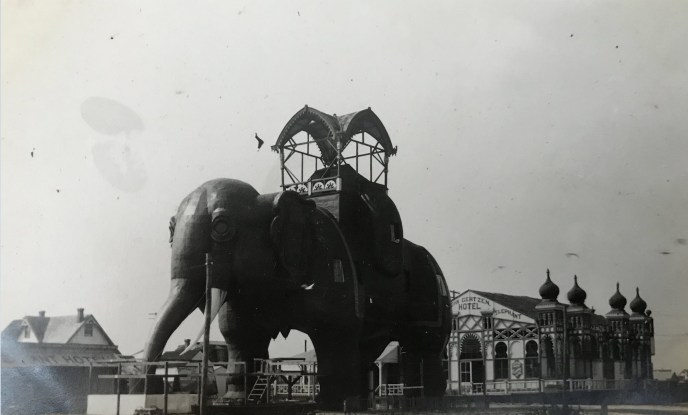
Lucy the Elephant. Photo by Lewis Reed, 1910.
Lucy the Elephant (NOW): The Elephant Hotel was neglected in more recent years, and eventually fell into a sad state of disrepair. In 1966, “Lucy” was saved from the wrecking ball when she was designated as a National Historic Landmark. On July 20, 1970 Lucy was moved about 100 yards to the west-southwest to a city owned lot and completely refurbished. In October, 2012, Hurricane Sandy made landfall near Margate. Lucy remained unscathed, although the surge reached the building’s toes and a small booth in the parking lot was blown over. On July 23, 2016, Lucy announced her candidacy for President of the United States at a celebration for her 135th birthday.

Lucy the Elephant, National Historic Landmark, November 20, 2011
Photo Manipulation Without a Computer
If you take a look at the state of photography today, such as the advances of digital cameras and the artful image manipulation by Photoshop, it is easy to forget that back in the 1900s photographers couldn’t just go into a computer program and change their images any way they wanted. Instead of retouching an image on a computer, as it’s done now, it originally took place on the negative.
Photo manipulation was one tool Lewis Reed had in his photography tool belt. He was 100 years ahead of his time by creating special effects to images long before the convenience and efficiency of digital photography and Photoshop were ever imaginable.
I was hugely interested in how this was undertaken, and by the fact that the modification looked so seamless in the printed image. Spotting these manipulated photos in his extensive collection has been both easy and difficult. Some were simple double exposure images or hand colored images. The addition of these hand-drawn backgrounds was a little more difficult. It wasn’t until I viewed the high resolution scan that this modification jumped out at me.
Reading up on the subject I have become aware that retouching is in fact an art that evolved right alongside the birth of photography. The photographs below were retouched by hand (also known as “handwork”) on the glass negative using a hard graphite pencil and pieced together in the darkroom from separate photographs. The two photographs, one of the people standing on the edge of a cliff, and the other of the hand-drawn mountains, appear to be joined at the edge of the cliff where the mountains begin. All of this required a degree of artistic skill and access to a darkroom. Lewis Reed developed his own photographs in a darkroom in his house — in the kitchen, to be exact — and worked at night to develop the negatives.
The photographs below show two unknown people posing on a cliff in front of a hand-drawn background of mountains.

An original photograph retouched with hand-drawn mountains by Lewis Reed

Same photo as above, different angle, retouched by Lewis Reed.
Today, we can look back and appreciate the time and creativity it took to edit these photos without Photoshop.
Montgomery County Maryland Almshouse aka Poor Farm

The Montgomery County Maryland Almshouse aka Poor Farm was established in 1789 and torn down in 1959. A modern jail is on its site on Seven Locks Road near Falls Road. Photo taken by Lewis Reed.
A Poor Farm in Montgomery County? Yep. Although a lot of people have never heard of “poor farms,” they were once common across the nation. Various terms have been used to describe the “house for the poor,” and often the titles were unique to the part of the country where the house was located.
This is the Almshouse (aka Poor Farm). The 50-acre tract which includes the pauper’s graveyard was once part of the Montgomery County Poor Farm, established in 1789 as a place where the poor and homeless went to live, work, and, if they died, to be buried.
At the time, the farm was located well beyond the bounds of what was then the town of Rockville. But growth eventually caught up with the property. The farm house was razed in 1959 to make way for a county jail, and another chunk of property was dedicated for I-270. At least 75 graves were identified during a 1983 survey of the property by state archeologists, but according to George R. Snowden, funeral director, there may be as many as 500 people buried in the potter’s field.
Although the county’s poor farm existed for almost 170 years, virtually nothing has been documented about it, said Jane Sween, a librarian with the Montgomery County Historical Society. The property was deeded to the county in 1789 and expanded in 1825. After the Civil War, the farm’s almshouse was rebuilt, and until it was razed a century later it was home to an average of 40 indigent people, she said. The state paid for burial but did not pay for grave markers or upkeep on the property.
The Montgomery County Poor Farm Cemetery is no longer in existence. The National Park Service conducted an archaeological dig in 1987, which resulted in the removal of 38 bodies to Parklawn Cemetery in Rockville, Maryland. Montgomery County sold the land to a private developer.
Then & Now: Reed Brothers Dodge 80 Years Ago
Reed Brothers Dodge and the surrounding area sure has changed a lot in its almost century-long history. You might not realize how much things have changed until you look back and see what it looked like in the past. For this post, I have used one of Lewis Reed’s original photographs for “then” and a Google Maps street view image from today for “now”.
THEN: Aerial view showing Reed Brothers Dodge at its original location at the triangle close to 80 years ago. The connector street behind the dealership was later named “Dodge Street” commemorating Reed Brothers’ presence from 1914-1970. Photo taken by Lewis Reed from a Goodyear Blimp that came to the dealership in 1938 to promote tires.
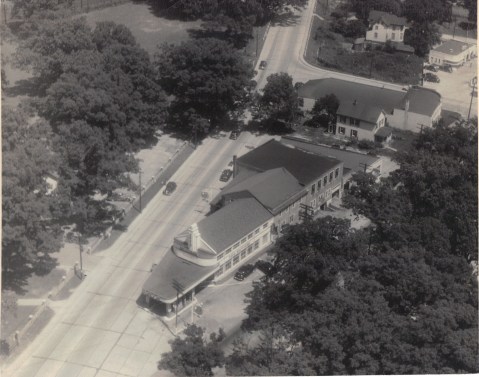
Aerial view of entire original Reed Brothers dealership at the intersection of Veirs Mill Road and Rockville Pike, ca. 1940. A two-story house stands behind the dealership. Photo by Lewis Reed.
NOW: The color photograph below, is the dealership’s location today, now known as Veterans Park. In the 1970s the site was known as the Francis Scott Key Memorial Park, and later in 1988, it was permanently rededicated as Veterans Park. In the late 1960s, the state of Maryland acquired the land to widen 355 and donated the remaining sliver to the City. The state named the connector street behind the dealership’s location “Dodge Street” because Reed Brothers Dodge dealership was located there for more than 50 years.

Reed Brothers Dodge original location at the triangle today. Google Image Capture, 2018
Books

Related Resources


Copyright Notice

Reed Brothers Dodge History (1915-2012) by Jeanne Gartner is licensed under a Creative Commons Attribution-NonCommercial 3.0 Unported License.
 Reed Brothers Dodge History 1915 – 2012
Recent Comments