
UPDATE: Lewis Reed Photos to Appear on Science Channel ‘Impossible Engineering’

I just got word from the Production Assistant at Discovery that the new season of Impossible Engineering Series 4 is about to start airing in the US. Lewis Reed’s race car photographs will be a part of the “London Array Wind Farm” episode which is the second episode of the series. The show is scheduled to be broadcast on Thursday, January 10, 2019 on Discovery’s Science Channel.
The following 1923 dirt track race shots taken by Lewis Reed at the Rockville Fair will be used on the program that will feature a segment on the development of the race car.
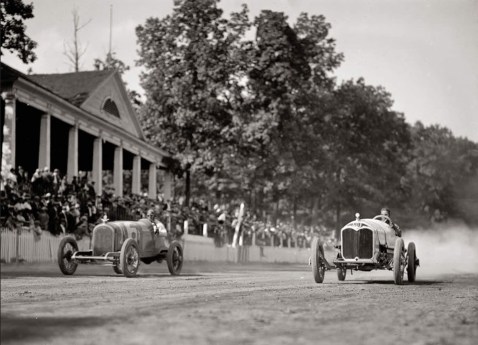
Photo by Lewis Reed
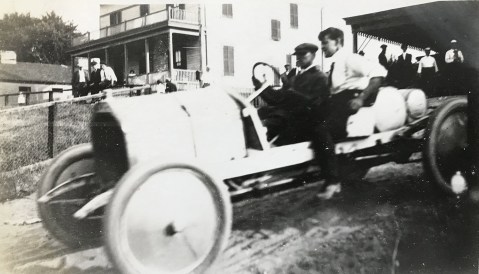
Photo by Lewis Reed
About Impossible Engineering
Behind every seemingly impossible marvel of modern engineering is a cast of historic trailblazers who designed new building techniques, took risks on untested materials and revolutionized their field. Brand new series, ‘Impossible Engineering’, is a tribute to their achievements. Each episode details how giant structures, record-beating buildings, war ships and space crafts are built and work. As the show revels in these modern day creations, it also leaps back in time to recount the stories of the exceptional engineers whose technological advances made it all possible. How would they have ever existed without the historical work of their ancestors? Interviews with their great advocates bring engineering history to life and retell how these incredible accomplishments shaped the modern world.
“Impossible Engineering” is produced for Science Channel by Twofour Broadcast.
Then & Now: Walker Avenue Gaithersburg
This post is a continuation of a series of “Then & Now” images that will show photographs of buildings, street scenes, and other historical locales from Lewis Reed’s Photo Collection alongside photographs of how they appear today. These photos show the same view of Walker Avenue in Gaithersburg about 98 years apart.
Walker Avenue (THEN): This photo of Walker Avenue in Gaithersburg was taken by Lewis Reed from the steeple of Grace United Methodist Church in the late 1920s. The street is named after John Walker, whose farm became Walker Avenue when he decided to subdivide the front end in 1904. Walker was mayor of Gaithersburg from 1906 to 1908 and again from 1918 to 1924. In June 1913, Walker Avenue was the first street in Gaithersburg to have electric streetlights installed along its full length. This period saw major advances in technology, communication, and transportation.
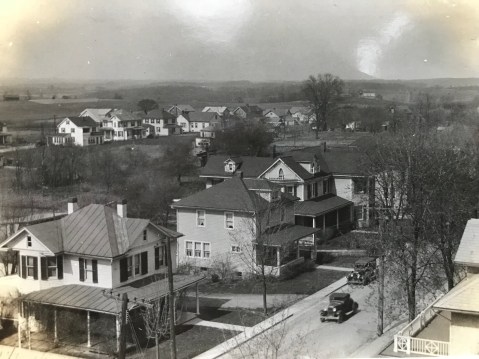
Walker Avenue in Gaithersburg taken from the steeple of Grace United Methodist Church, late 1920s. Photo by Lewis Reed
Walker Avenue (NOW): Walker Avenue is the most cohesive street in Gaithersburg’s historic district. Most of its houses were built between 1904 and 1930.
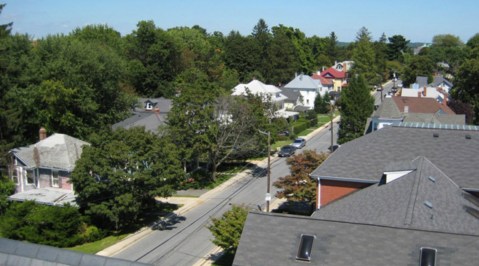
Walker Avenue in Gaithersburg today
Source: Maryland Historical Trust
Then & Now: Saylorsburg Lake House & Hotel of Horror
With Halloween just around the corner, I thought it would be fun to feature a photograph that Lewis Reed took of the Saylorsburg Lake House Hotel, now the site of Hotel of Horror. The aging Lake House Hotel in Saylorsburg, Pennsylvania, once a vibrant Poconos retreat, was a popular hotel for the region’s tourists who were looking for fun on nearby Saylors Lake. During the hotel’s heyday, its staff was booking rooms a year in advance. Today, the former hotel’s fame is generated from its annual Halloween haunted-house attraction.
Lake House Hotel (THEN): The legend of the Lake House Hotel spans more than two-hundred years. According to local folklore, during World War II, many of the employees at the Lake House were called to assist in the Pennsylvania National Guard, leaving the local asylum with one lone security guard to watch over the entire building. The inmates escaped, made their way to the hotel and took it over. The insane patients performed experiments on the guests. What was once a renowned resort for the rich and famous, became a torture chamber.

Saylorsburg Lake House Hotel. Photo taken by Lewis Reed, 1915.
Hotel of Horror (NOW): This 2018 season will celebrate the 26th year that the Hotel of Horror has been fascinating and horrifying legions of fans from the far reaches of the United States and even internationally. To all the readers of this blog: Have a spooky, enjoyable and very safe Halloween!

Welcome to The Hotel of Horror, The Pocono Mountains Premier Haunted House Attraction

Then & Now: Library of Congress
You might not realize how much Washington DC has changed until you look back and see what it looked like in the past. In this “Then & Now” feature, I have combined one of Lewis Reed’s original photograph’s for “then” and matched it with a corresponding contemporary shot for “now”.
Library of Congress (THEN): The Library of Congress was relocated to Washington, DC, in 1800, having previously been housed in New York and Philadelphia, which had each served as temporary capitals of the early United States of America. It is the research library serving the U.S. Congress as well as the national library of the United States, and it holds over 23 million volumes in its collection, making it the world’s largest library. The structure as it stands today was erected between 1888 and 1894, following the 1851 fire that destroyed 35,000 of the Library’s books (two-thirds of its holdings at that time), including much of Thomas Jefferson’s donated collection.
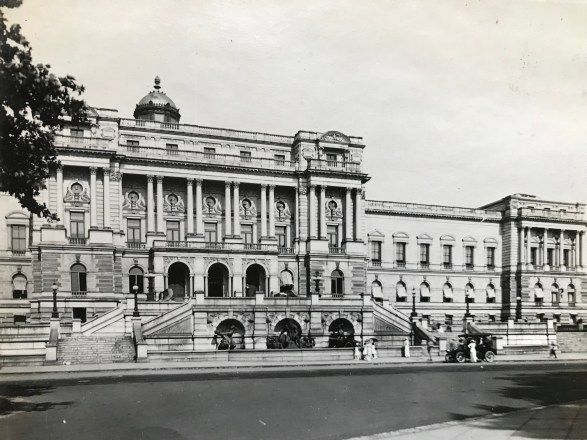
Library of Congress. Photo by Lewis Reed, ca. 1910
Library of Congress (NOW): The same view 108 years later. Now, the Library of Congress is one of the largest and best-equipped libraries in the world. It houses approximately 90 million items on 540 miles of shelves. The Library of Congress is physically housed in three buildings on Capitol Hill and a conservation center in rural Virginia. The Library’s Capitol Hill buildings are all connected by underground passageways, so that a library user need pass through security only once in a single visit.

Library of Congress today
Source: Wikipedia
Then & Now: Clinton Zion AME Church, Rockville
In 1867, several of Rockville’s African American families left Jerusalem Methodist Episcopal Church to start the African Methodist Episcopal (A.M.E.) Zion Church under the leadership of Reverend Charles Pipkins. In 1890, Pipkins and his congregation cut timbers and erected. a frame church on Middle Lane. Taken approximately 100 years apart, these photos show the Clinton Zion A.M.E. Church then and now.
Clinton Zion A.M.E. Church (THEN): In 1904, the congregation moved to the brick church seen in this black & white photograph located on North Washington Street and today’s Beall Avenue. The church was named Clinton A.M.E. Zion in honor of Reverend George Wylie Clinton (1859-1921), a prominent member and editor of the church’s periodical, Star of Zion.

Zion A.M.E. Church, Rockville, Maryland. Photo by Lewis Reed, ca. 1912.
Clinton Zion A.M.E. Church (NOW): The congregation sold the brick church in 1955 to make way for a shopping center, dedicating their present church on Elizabeth Avenue in Lincoln Park in the fall of 1956. The growth of Clinton was the impetus for the most recent expansion effort. Construction of the new sanctuary began in 1989 and the newly renovated edifice was dedicated on Sunday, May 13, 1990.
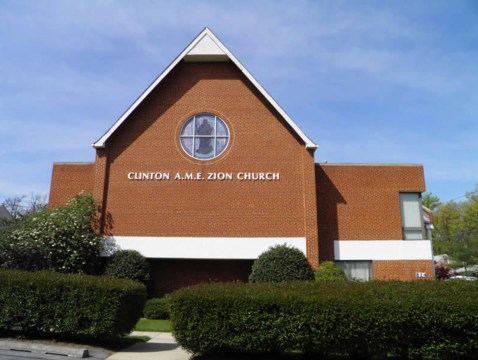
Zion A.M.E. Church, Rockville, Maryland. 2012
Source: Clinton AME Zion Church
Books

Related Resources


Copyright Notice

Reed Brothers Dodge History (1915-2012) by Jeanne Gartner is licensed under a Creative Commons Attribution-NonCommercial 3.0 Unported License.


Recent Comments