
Back in Time: Roadside Springs
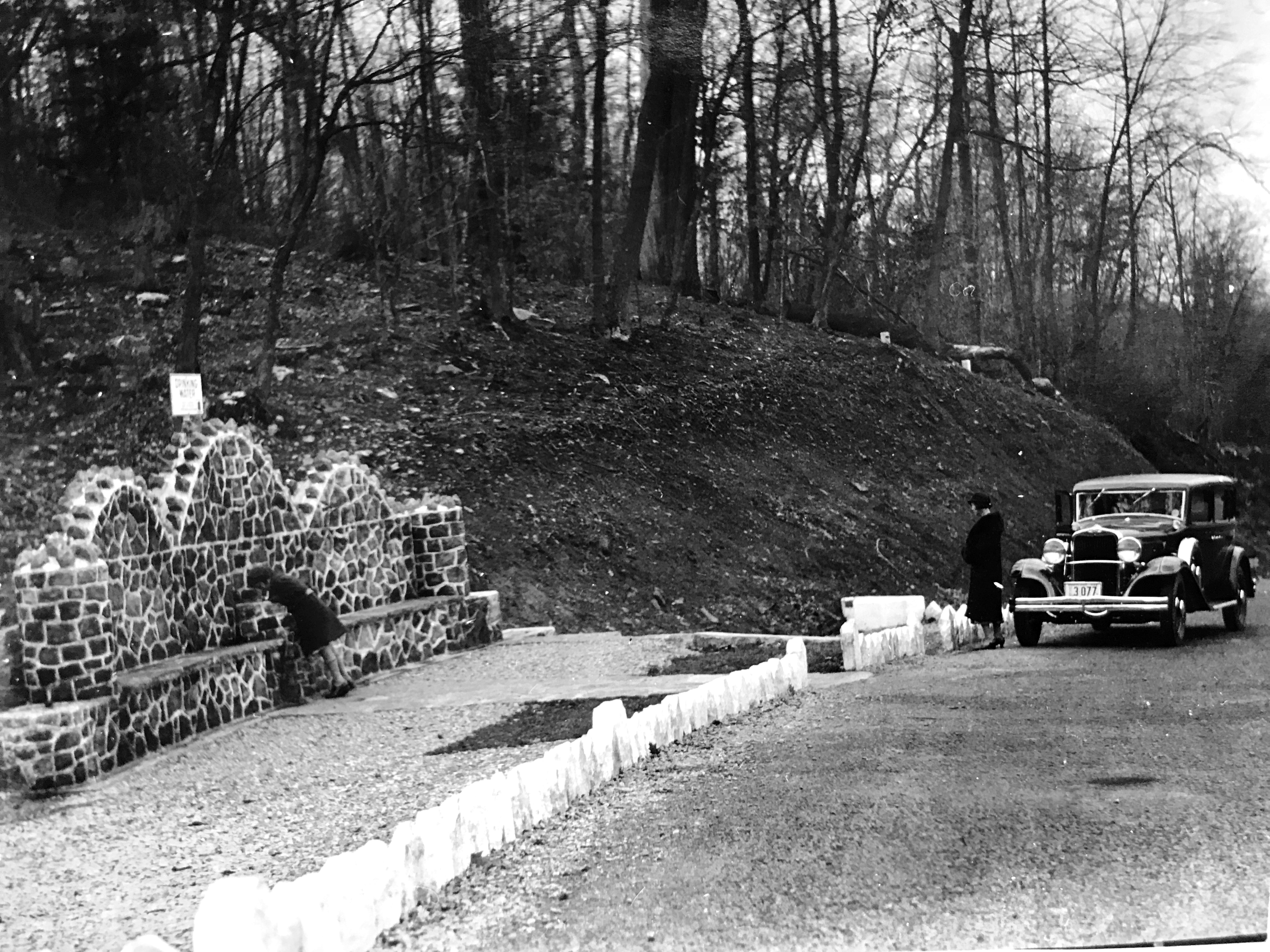
Early 1930s roadside spring. The sign above the wall reads, “drinking water”. Fountains like these were placed along roads to give motorists an opportunity to stop for a drink. The child at the fountain is Lewis Reed’s daughter, Mary Jane, and the woman standing next to the circa 1930s Dodge Sedan is his wife, Ethelene. Photo by Lewis Reed.
Imagine a time when automobiles lacked air conditioning, highway travel was young and life moved at a much slower pace. Back in the day, it was more about the journey than the destination. As better roads allowed motorists to travel increased distances it became apparent that they would need places to stop along the way. The model of place that led to the establishment of waysides and roadside parks was initiated by the traveling public. Stopping sites emerged in rural areas where commercial establishments were not available. Often they appeared in areas of scenic interest or merely in places where there was room for a car to pull off the roadway. These earliest waysides materialized out of necessity, when motorists needed to wanted to stop they pulled off and parked along the roadside.
The photo was taken by Lewis Reed on one of his many cross country road trips. This unknown roadside rest area with water fountain gives us a real sense of a bygone era. We don’t travel like this anymore. Now we’re just trying to get from point A to point B as quickly as possible.
During the 1930s, the State Road Commission was engaged in a program to improve the road infrastructure, which included beautification efforts as well as road paving and bridge construction. Numerous roadside fountains were constructed across the state. No statewide inventory exists.
Ice Cold History in Montgomery County (1910)
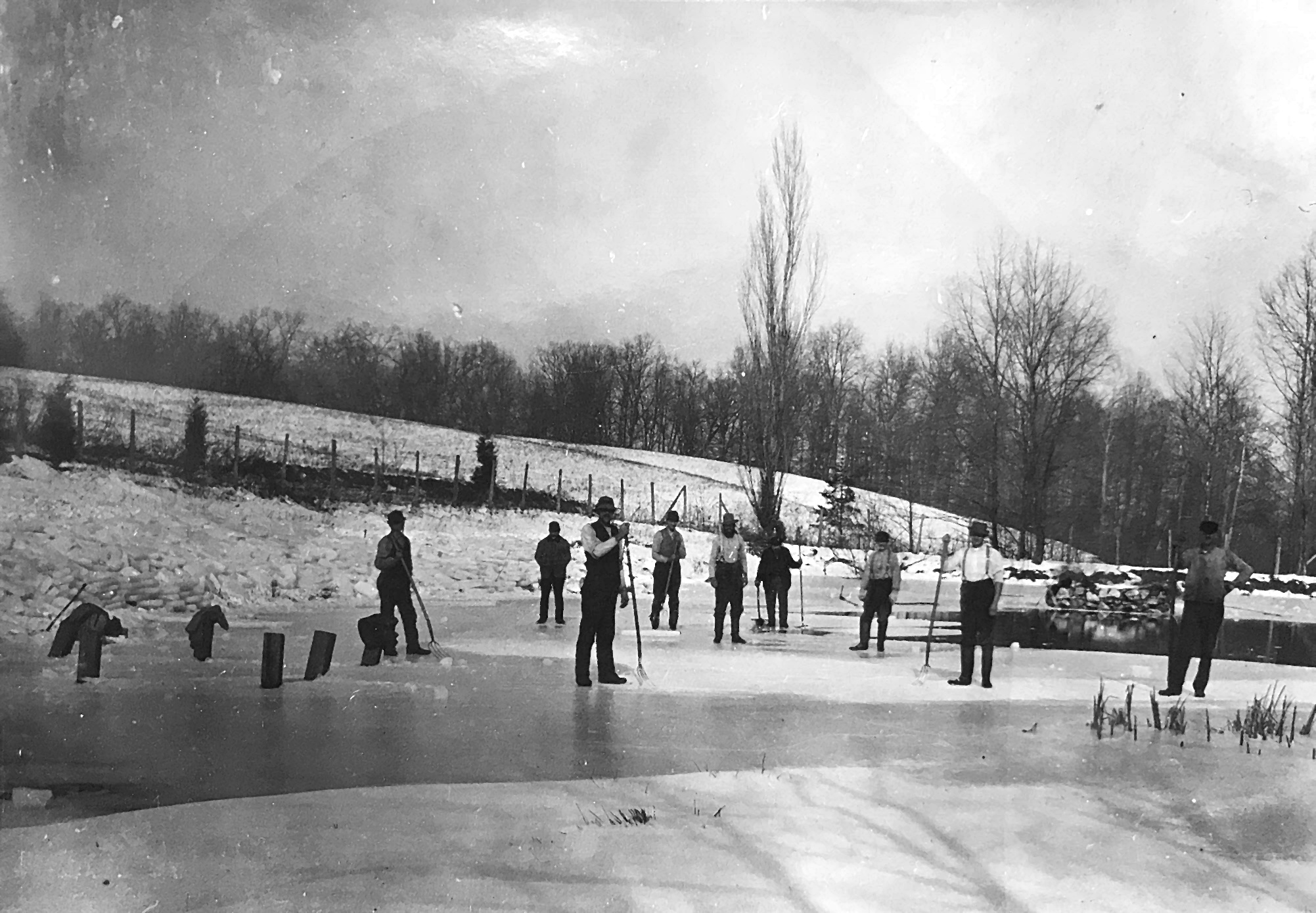
Men harvesting ice with pitchforks and hand saws in Darnestown, Maryland. Photo taken by Lewis Reed in 1910. Note the blocks of ice stacked up along the shoreline. The exact location of the pond is unknown.
Most people wouldn’t consider the months of January and February a season of harvest in Montgomery County. But in our not so distant past, this was harvest time for—ICE. Rivers, lakes and ponds were generally frozen and ice was harvested like a winter crop to keep food cold all summer long.
Before the first successful ice-making machines were built, ice for refrigeration was obtained through a process called “ice harvesting.” Ice cutters used to risk their lives by going out onto frozen ponds with saws, tongs, and pitchforks and methodically cut and dragged blocks of ice which would be stored in hay-packed ice houses. But people did not put ice in drinks as we do now. The possibility of debris having been in the water as it froze – even a bug now and then – discouraged the idea.
Ice houses were dug into the ground to keep the temperature low; double-thick walls were often filled with sawdust for further insulation, and the blocks themselves were packed in sawdust or straw. When you wanted some ice for drinks or to make ice cream, you wouldn’t pull out a whole block; ice picks, chisels, hatchets and shavers were used to get just what you needed.
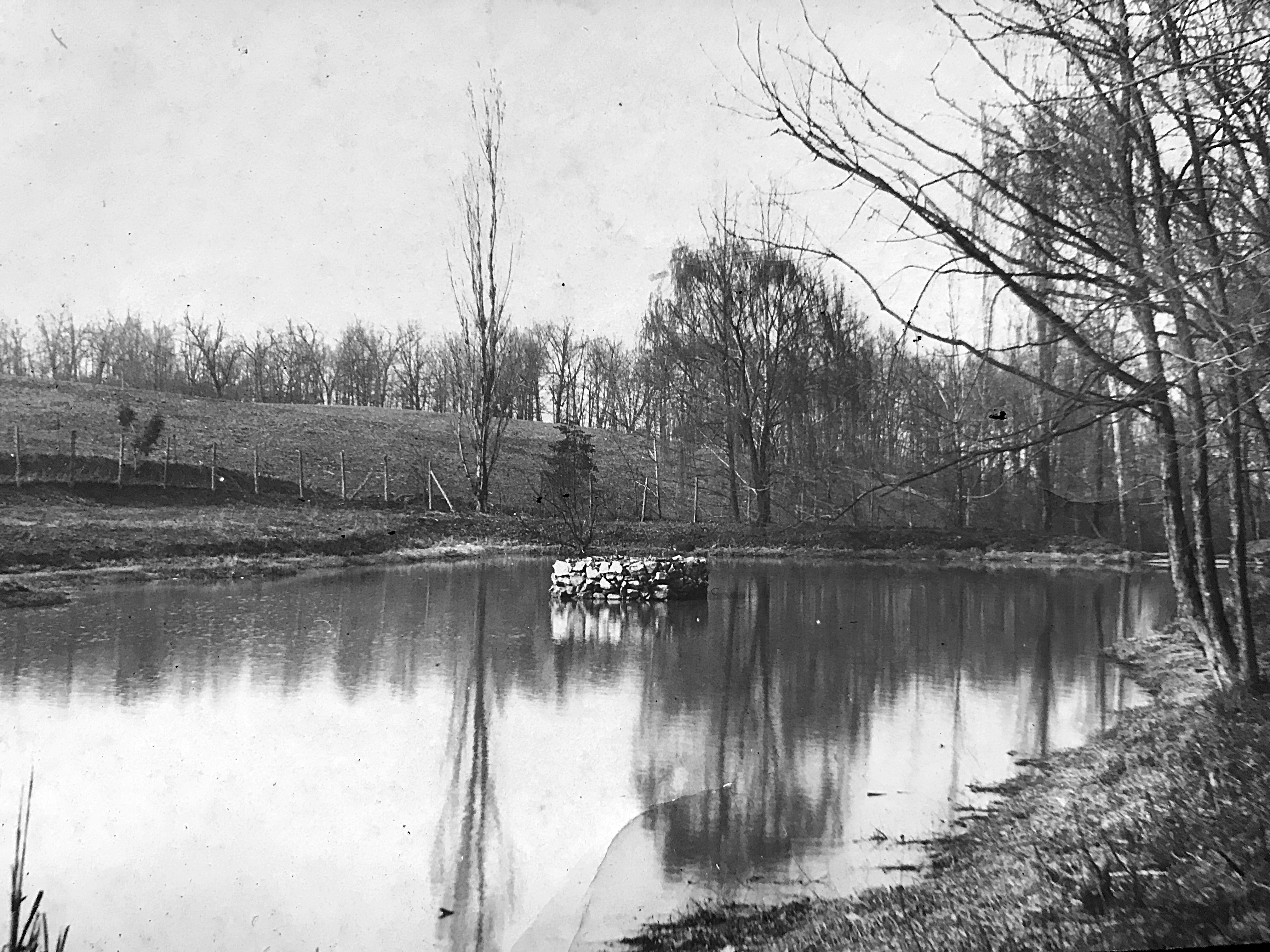
Same pond in summertime without ice. Photo by Lewis Reed, 1910.
I’m not exactly sure what the stone structure is in the middle of the pond, but “google” said it could be an outlet structure to keep the water surface in the pond at its optimum level, which usually coincides with the maximum water level designed for the pond. It is connected to a pipe allows water to exit the water body. This pond must have been on a creek or stream and is very likely no longer in existence.
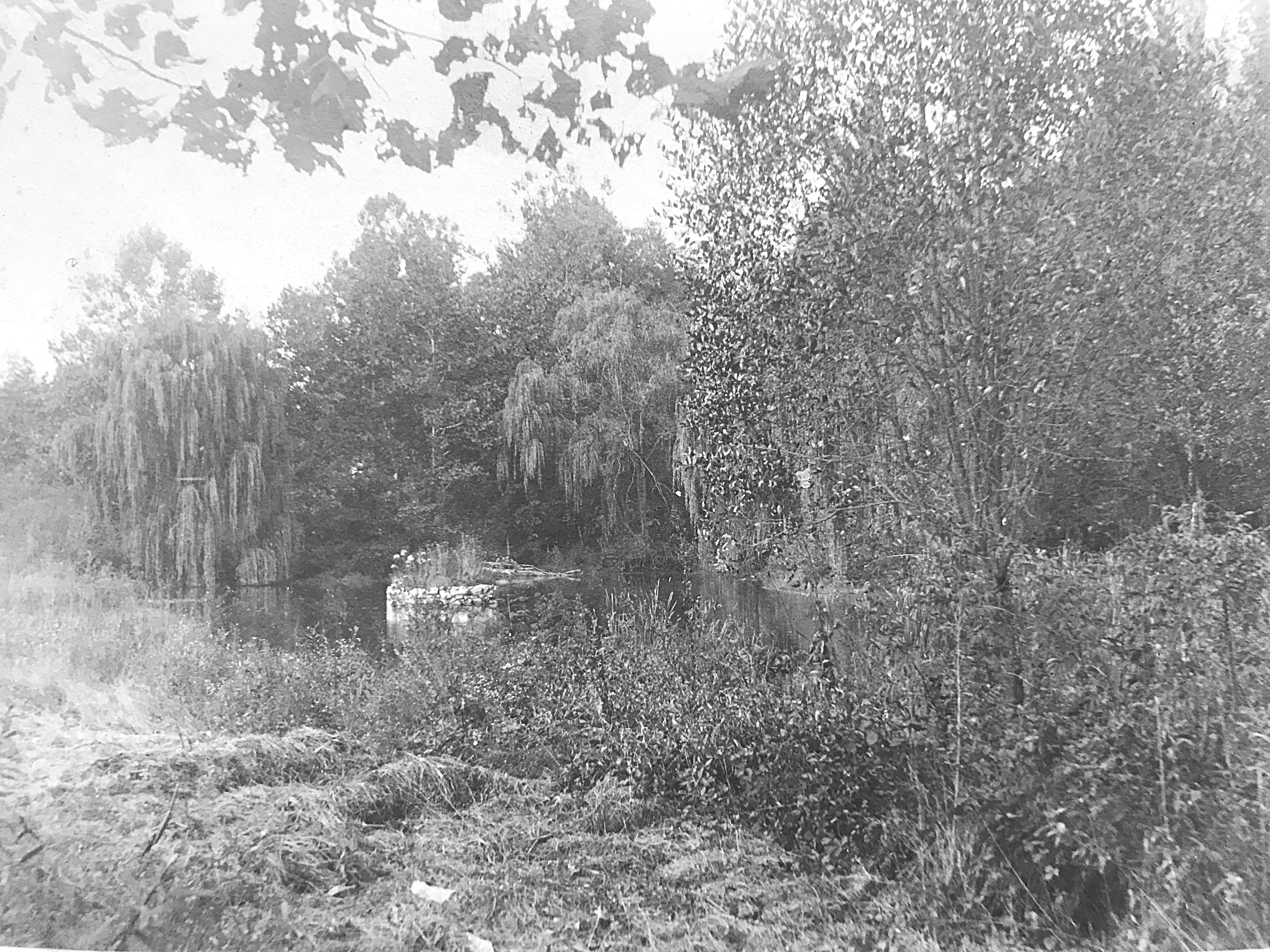
Same pond in summertime from a different perspective. Photo by Lewis Reed, 1910.
From The Evening Star, Washington, D.C. December 22, 1904
ROCKVILLE AND VICINITY GENERAL NEWS
The cold weather of the past ten days has frozen the ponds and creeks throughout this county to a thickness of six or seven inches, and the ice harvesting is now the order of the day. The quality of the ice is not regarded as first-class, however, and for this reason many persons will defer filling their houses until later in the winter.
Next time you drop a few ice cubes into a glass or take out a frozen piece of meat from the freezer, perhaps give a momentary thought to how much we take for granted the ability to have ice cold drinks, preserved foods that can be stored for months, ice cream, cold frothy beer, and so many perishable food products. Refrigeration is a modern convenience that we just can’t live without and certainly one that I took for granted until I wrote this!
Lewis Reed Photos Featured on WETA’s “If You Lived Here” Rockville
Several of Lewis Reed’s photos were featured on a historical segment of “If You Lived Here” series on Rockville that aired on December 4, 2023 on WETA. While in Rockville, viewers learn about the history of Rockville, Maryland and the town’s transformation after World War II. The post-war era brought about a wave of growth and change.
This video is part of WETA’s house-hunting “If You Lived Here” series, which spotlights a wide array of neighborhoods and properties throughout the national capital area while celebrating each area’s history, culture, notable places and flavor. Hosts, best friends and longtime Washingtonians Christine Louise and John Begeny tour homes and communities with local realtors, exploring the D.C. Metro region one neighborhood at a time.
The following photos are screenshots of Lewis Reed’s photographs that appeared in the video. (click any image to view photo gallery)

Lewis Reed (at left) using a tripod and five-by-four box camera to shoot photos of an arriving B&O train near Germantown in 1913

Rockville B&O Railroad Station pictured here at the turn of the century.

Rockville Trolley car #596, 1908

Tenallytown and Rockville Pike Trolley Line, 1910
The “If You Lived Here” series is now WETA PBS’ most popular local show ever produced. Follow the link to watch the video of Episode 16 of Season 3 on WETA/PBS series, “If You Lived Here” Rockville.
Then & Now: Clarksburg Main Street, 1913
This post is a continuation of a series of “Then & Now” images from Lewis Reed’s Photo Collection alongside photographs of how they appear today. Lewis Reed worked hard to preserve a visual history of Montgomery County, Maryland and surrounding area long before automobiles were even around. As early as 1910, he toured on his motorcycle across the state of Maryland and took photographs of many historic locations. Taken approximately 109 years apart, these photos takes us back in time to Clarksburg, Maryland at the intersection of the main road between Georgetown and Frederick and an old Seneca trail. The corresponding color photo is a google maps screenshot from the same location more than a century later.
CLARKSBURG MAIN STREET (THEN): In the early 20th century, Clarksburg was the third largest town in Montgomery County, after Rockville and Poolesville. Clarksburg had four general stores, two hotels, and an academy of learning. It also had a blacksmith, a doctor’s office, tanneries, shoemakers, winemakers, tailors, wheelwrights, fertilizer businesses, skilled farmers, master carpenters, and two town bands.
The black and white image was taken by Lewis Reed in 1913, where Clarksburg Road (to Boyds) met Frederick Road (Rt 355). Frederick Road has also been known as The Georgetown Road and the Great Road. The town of Clarksburg was laid out along Frederick Road. The road was used as the stagecoach line from Frederick to Georgetown and it remains as the present main street through Clarksburg. Turning wagon ruts/tire tracks are visible in the lower left corner. The first house on the right was the Horace Willson House (still standing). Left of the Willson house was Willson’s Store, built on the site of the town’s first trading post, established by town founder John Clark (still standing). Established April 1, 1800, this was the location of the first post office in Clarksburg, the second oldest in Montgomery County. In 1842, the old trading post building was replaced with a two-story general store. The dwelling beyond the pole served as a church parsonage (still standing) and just beyond stands the Clarksburg United Methodist Church. The church was used for church dinners, 4-H meetings, and community gatherings. The vehicle appears to be a very early Ford Model T.

Clarksburg Main Street (Frederick Road Rt 355). Photo by Lewis Reed, 1913.
CLARKSBURG MAIN STREET (NOW): Over 109 years have passed and three buildings in Lewis Reed’s photo still remain. The structure on the right in the current day photo below was the Lewis General Store and the yellow vacant house a little further down the road was the church parsonage. The recently renovated Lewis General Store received an award for best restoration of a historic commercial property from the county. The charming building boasts a tin ceiling, original counters; original beams from 1750 are exposed in some areas, wood floors, and many historic details throughout. The steps to the ME Church South are still visible today on Rt 335 near where it intersects with Spire Street (about where the car is in the image). The congregation claims to be the “oldest continuous Methodist congregation in Montgomery County”. Today, Clarksburg remains a small rural town, retaining many of its 19th century structures. It is among Montgomery County’s earliest, most intact historic towns.
Due to the Clarksburg Square Road extension that now connects to Frederick Road, the Horace Willson House was relocated approximately 70 feet to the south to preserve it. The building is currently a wine and beer shop.
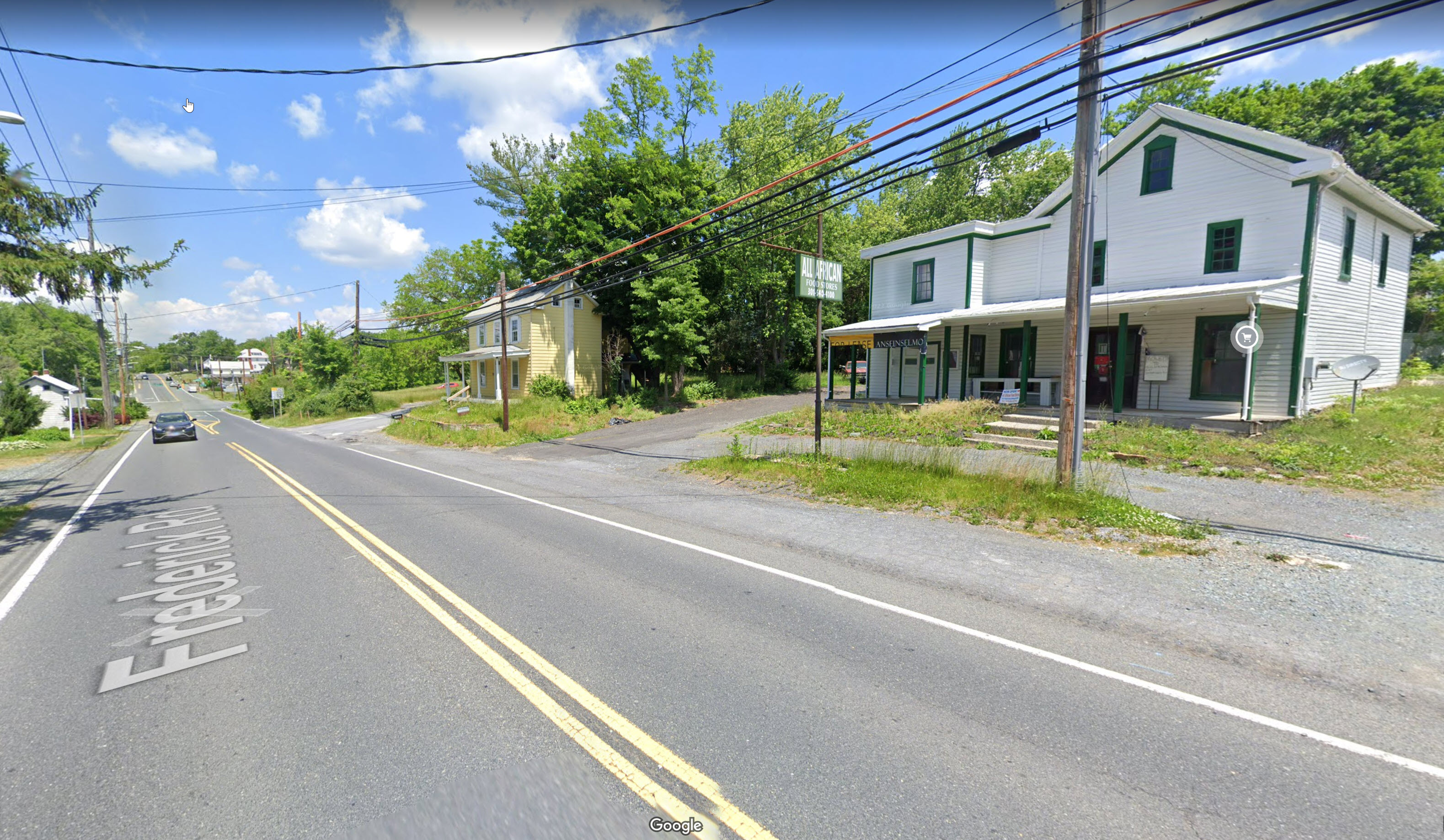
This current day image is a google maps screenshot from the corner of Redgrave Place and Rt 355.
Sources of Information:
Joan Edwards Ruff, Resident of Clarksburg for 45 years and granddaughter of Lillian and Elwood Barr
“The History of Clarksburg, King’s Valley, Purdum, Browningsville and Lewisdale Maryland” by Dona L. Cuttler
MHT Inventory Form13-10 Clarksburg Historic District
Some of the Earliest Occupations in Montgomery County
Do you know what a Qwylwryghte, a Stock Maker, or a Hackneyman does? These are some of the old occupations, of which many are archaic, that may show up on old documents relating to our ancestors. Some of the occupations do not exist today or are called other names. Below you can find representations of many varied occupations that Montgomery County residents engaged in during the early 20th Century, though the list is not at all comprehensive.
Blacksmith/Wheelwright/Cabinet Maker
A qwylwryghte — don’t ask me to pronounce it! — is one who makes wheels, or works with wood.

Philip Reed (1845-1918) outside his blacksmith shop in Darnestown, ca. 1901
Formerly located on Darnestown Road near the intersection of Seneca Road, Philip Reed operated a blacksmith, wheelwright, and cabinet making business next to his home. These occupations overlapped due to the similar skills they required: the same metal-working tools that were used for horseshoeing could be used to make wheel-rims and other metal wagon parts; the same woodworking skills that created wagons could be used to make pieces of furniture for the home. As late as 1910, there were still approximately 60 blacksmith shops in the county.
Stock Maker

Philip Reed (1845-1918), Maker of Gunstocks for Sportsmen
From the June 13, 1940 edition of The Montgomery County Sentinel:
We also read that Philip Reed built up great fame for the town as a maker of gun stocks for sportsmen – he was the father of the Reed Brothers, our local auto dealers. Edgar Reed tells us his grandfather was a cabinet maker and wood carver, but that the wood working talent no longer seems to run in the family.
A Stock Maker carves gun stocks from wood (usually walnut) and fits them to the metal parts of the gun (receiver and barrel). Very high grade firearms may have stocks fashioned from very costly blanks, mostly of one of the walnut varieties, specially chosen for its rare and highly figured grain. The fashioning of high end gun stocks calls for an extremely high level of skill and craftsmanship.
Liveryman
The meaning of Hackneyman is a man who hires out horses and carriages.

An unidentified livery stable in Montgomery County.
Closely related to the blacksmithing and wheelwrighting industry, the livery-stable keeper provided horses that were used in everyday tasks and transportation. The liveryman boarded horses for rent and also provided carriages and wagons. Compared to our modern world, the blacksmith-wheelwright correlates to the auto repair shop, and the livery to the car rental business.
School Teacher

Ethelene Reed
At the turn of the century, teaching was one of the only respectable fields open to educated women who wanted to work. Many unmarried women worked as teachers during the 1900s, and in the early days, they were often required to leave the profession once they were married. The 1920 census indicates that Lewis Reed’s wife, Ethelene (pictured above), was a teacher in the Maryland public school system until her daughter Mary Jane was born in 1922.
Ice Cutter
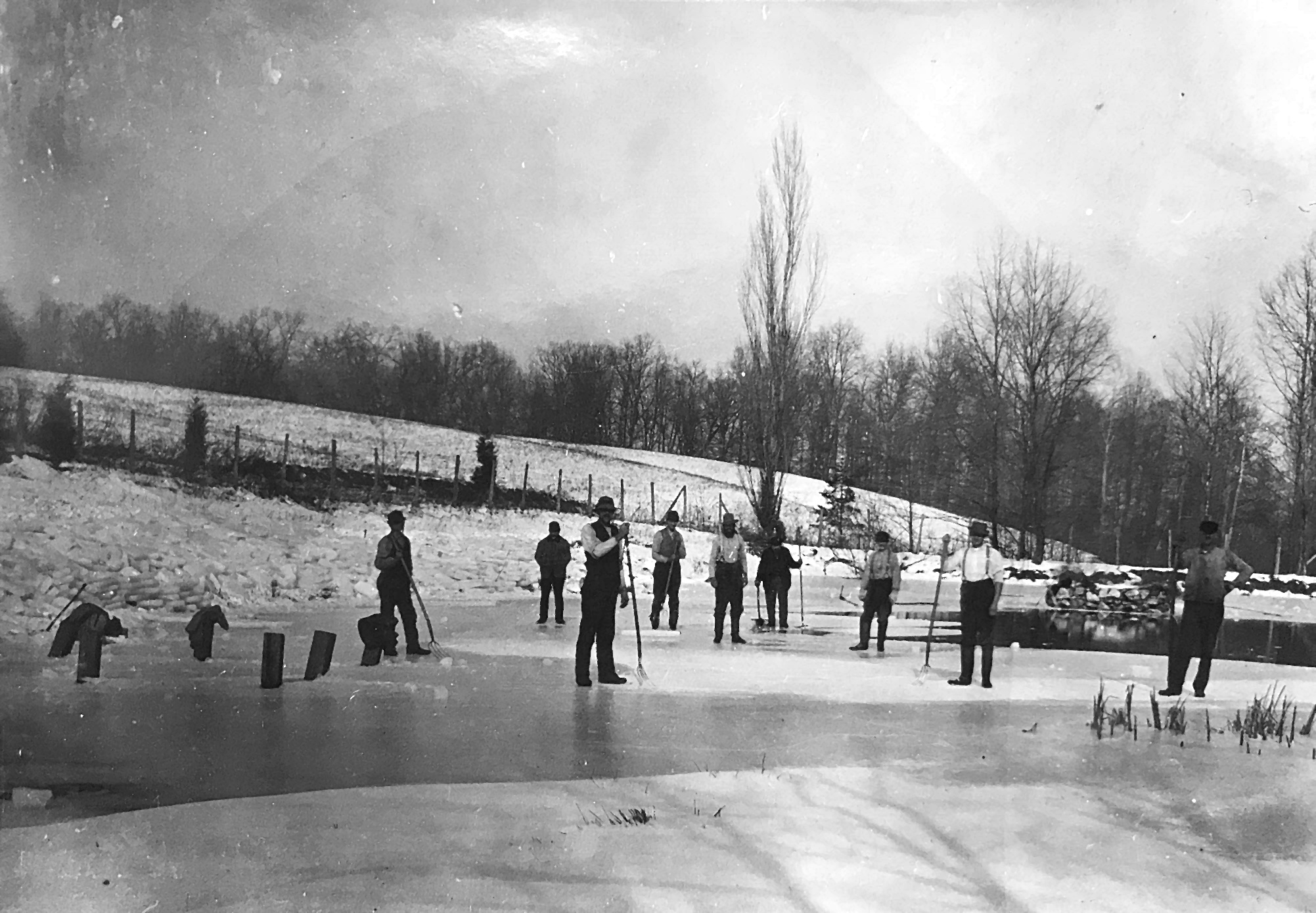
Men harvesting ice with pitchforks and hand saws on a pond in Darnestown, 1910. Note the blocks of ice stacked up along the shoreline.
Most people wouldn’t consider the months of January and February a season of harvest in Darnestown, Maryland. But in our not so distant past, this was harvest time for—ICE. Rivers, lakes and ponds are generally frozen and ice was harvested like a winter crop to keep food cold all summer long. Before modern refrigeration, ice for refrigeration was obtained organically through a process called “ice harvesting.” Ice cutters would risk their lives going out with saws, tongs, and pitchforks to methodically cut and drag blocks of ice from a nearby frozen pond. Those blocks would then be stored in hay-packed ice houses, later distributed throughout towns and cities during the heat of summer. However, people did not put ice in their drinks as we do now. The possibility of debris having been in the water as it froze – even a bug now and then – discouraged the idea.
Store Clerk/Cashier

Clerks at J. F. Collins General Store on East Montgomery Avenue in Rockville, 1914. At left is A. F. “Seen” Beane, who bought this store from Collins in the 1920s and continued doing business in downtown Rockville until his retirement in the 1960s.
The cash register was invented in the late 1800s, and by the 1900s almost every retail organization had one. Store owners sometimes conducted business with their customers, but the more lucrative establishments would hire one or more clerks as assistants to interact with the public. By 1915, more than half of all clerical workers tended to be young women.
Chauffeur-Mechanics

Chauffeur Lewis Reed is tending to the motor, 1910
Chauffeur-mechanics of the early 1900s were the first group to earn a living working on automobiles. At the dawn of the early 20th century, society was transitioning from horse-drawn carriages to automobiles. Having grown up in a blacksmith family, Lewis Reed was well positioned to move to the new technology. The 1910 census indicated that 23-year-old Lewis Reed was working as a machinist. Lewis Reed worked as a chauffeur from roughly 1910-1914, before he became involved in the business of selling and repairing automobiles.
Motorman and Conductors
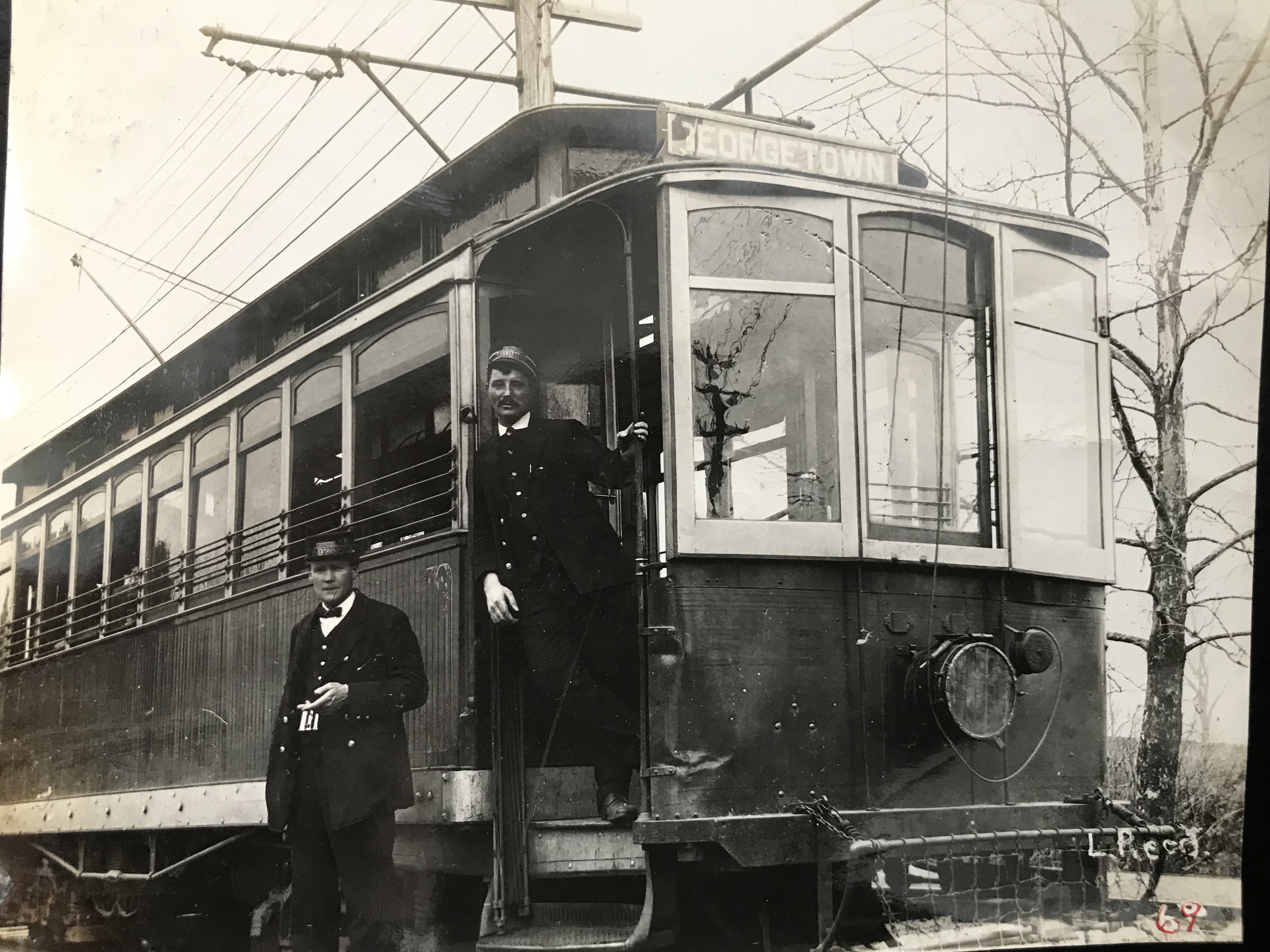
Motorman and conductor on a Georgetown trolley car, ca. 1908
The debut of Rockville’s trolley cars in 1900 marked the beginning of a golden age of local mass transit. Each car had a two-man crew (a conductor and a motorman) one to operate the car and the other to collect fares.
Mill Worker

Two workers pose inside an unknown mill.
A mill is a building equipped with machinery that processes a raw material such as grain, wood, or fiber into a product such as flour, lumber, or fabric. In the 18th and 19th centuries, mills were powered by water in creeks or rivers. In a flour mill, water flowing over the mill wheel was converted by gears into the power to turn one of two burr stones. Kernels of wheat were then ground between the two stones. The grinding removed bran (the outer husk) from the wheat kernel, and then crushed the inner kernel into flour.* Flour mills were an important part of rural communities across the country, including Montgomery County, and millers were respected members of their community.
Farmer
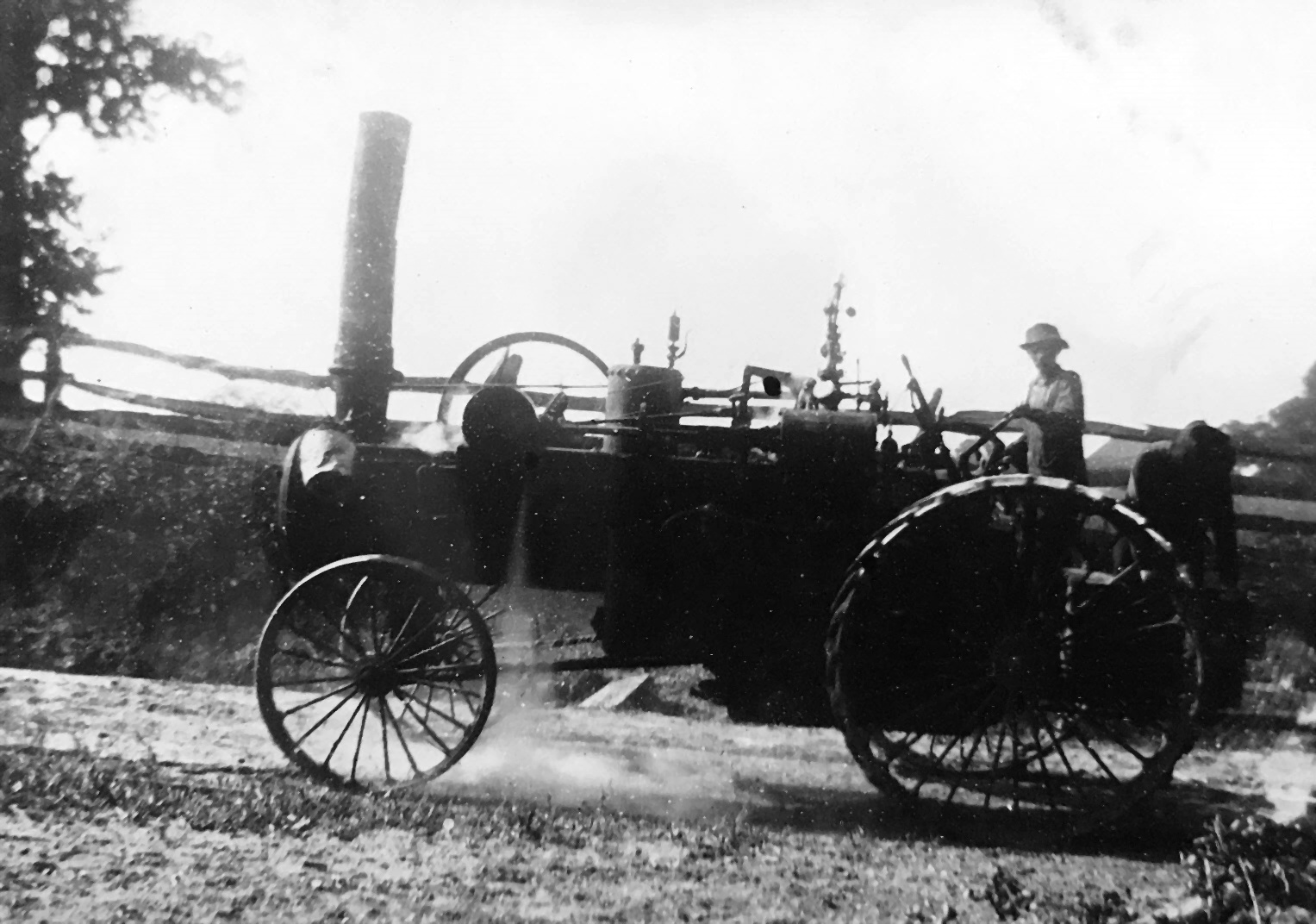
An agricultural tractor powered by a steam engine, a design used extensively in the late 19th and early 20th centuries.
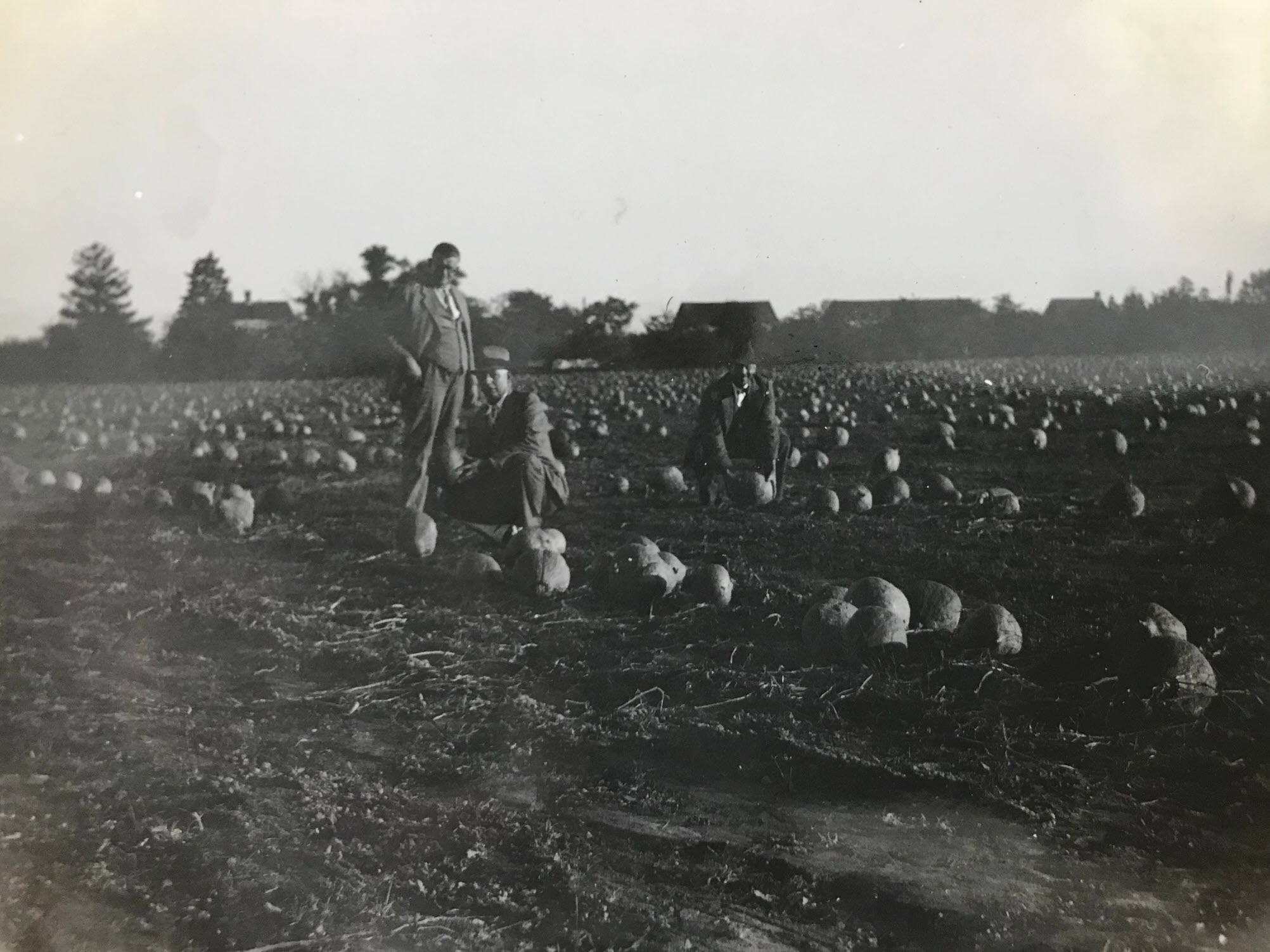
Thomas Kelley’s Pumpkin Field, early 1920
Above is a photograph of three men in suits pumpkin picking in Thomas Kelley’s field of pumpkins in Pleasant Hills, circa 1920. Tom Kelly farmed much of the land around the Pleasant Hills homestead and was famous for his “Kelly Corn” farm wagon of fresh dairy produce during the summer months, as well as the corn that fed visitors to the Montgomery County Fair each August and, of course, his pumpkin patch in the fall.The turn of the century was a time of transition, and the families who went from horses to tractor horsepower witnessed the birth of mechanization on the farm. The newest farm machinery to hit the market near the turn of the 20th century were traction engines powered by steam; essentially the predecessor to today’s modern farm tractor. They could plow, they could haul, and you could put a big belt on the fly wheel and drive a saw mill. The engines would normally run on coal, wood, or even straw: whatever would sustain a fire.
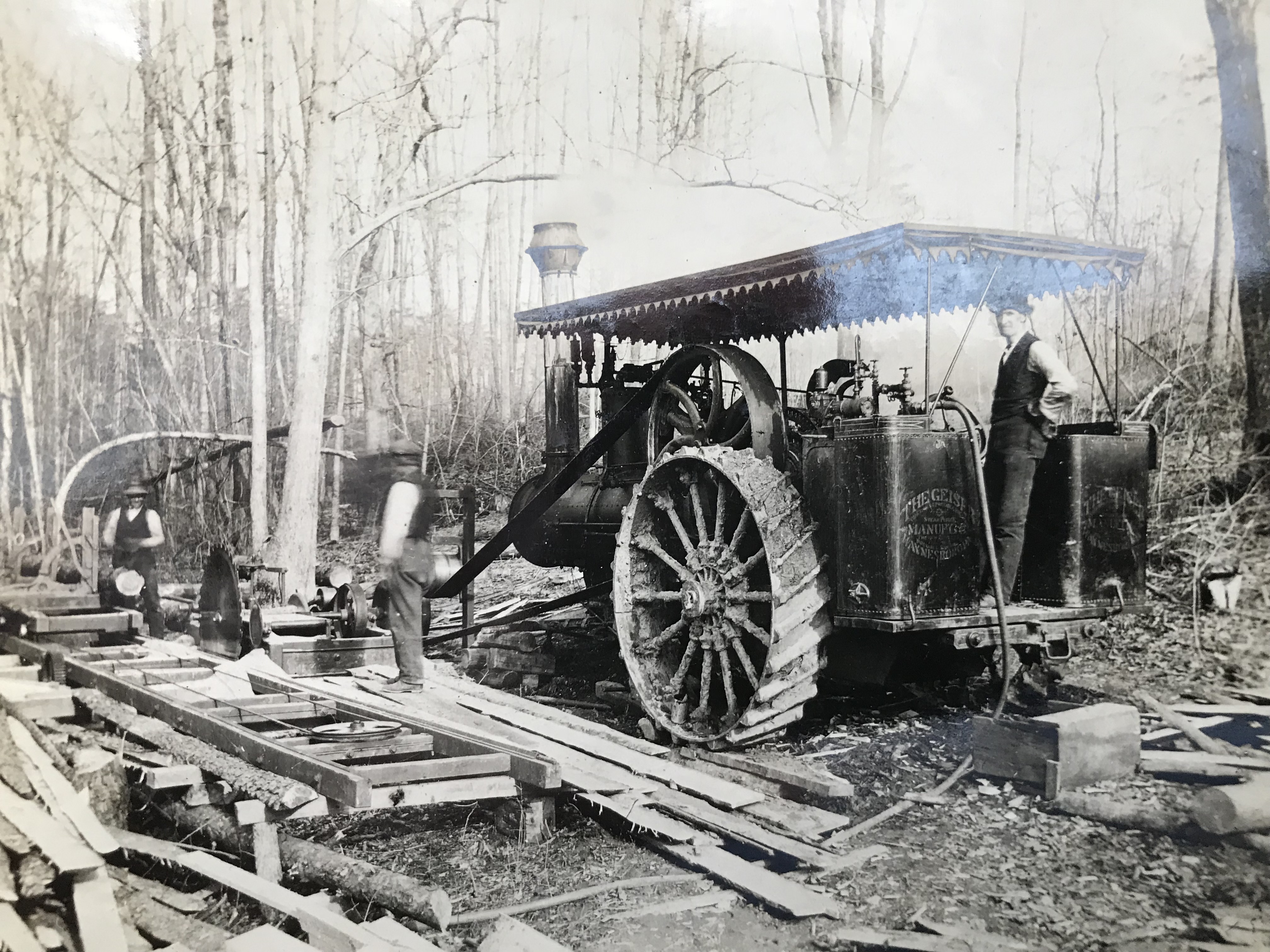
Francis Flack of Montrose on steam tractor with roof, 1909. Built by Geiser Manufacturing Company, makers of the Peerless line of steam tractors.
Steam helped improve the efficiency of most farm chores, including plowing, planting and harvesting. And steam-powered equipment also was used for other heavy duty tasks, including rock crushing and wood cutting, to aid in clearing the land. Francis A. Flack (1875-1961), a life-long resident of Montgomery County, was a successful farmer in the lower section of the county near Garrett Park. The work depicted below–sawing felled trees into usable lumber–took place on his farm in 1909. Flack is pictured in the lower left photo.
I remember that engine as though I had seen it only yesterday, for it was the first vehicle other than horse drawn that I had ever seen. It was intended to drive threshing machines and power sawmills and was simply a portable engine and a boiler mounted on wheels.
It was the steam traction engine that inspired Ford to design and manufacture automobiles. By the early 1930s, gasoline-powered farm equipment, evolved from the automobile industry, had mostly replaced steam powered machines.
Road Worker (Heavy Equipment Operator)


Building a road requires moving earth and rocks, leveling the roadbed and digging trenches for drainage ditches. These tasks fell to those who operated the large steam-powered excavating machines and steam shovels. Pictured above are rare, historical photographs that Lewis Reed took of the construction of Massachusetts Avenue in Washington, DC as it was being graded in 1912. (click on thumbnails to view gallery)
A steam shovel is a large steam-powered excavating machine designed for lifting and moving large amounts of heavy material such as rock and soil. Steam shovels played a major role in public works in the late 19th and early 20th centuries. When digging at a rock face, the operator simultaneously raises and extends the dipper stick to fill the bucket with material. When the bucket is full, the shovel is rotated to load the railway car. Steam shovels usually had a three-man crew: engineer, fireman and ground man.
Census Taker
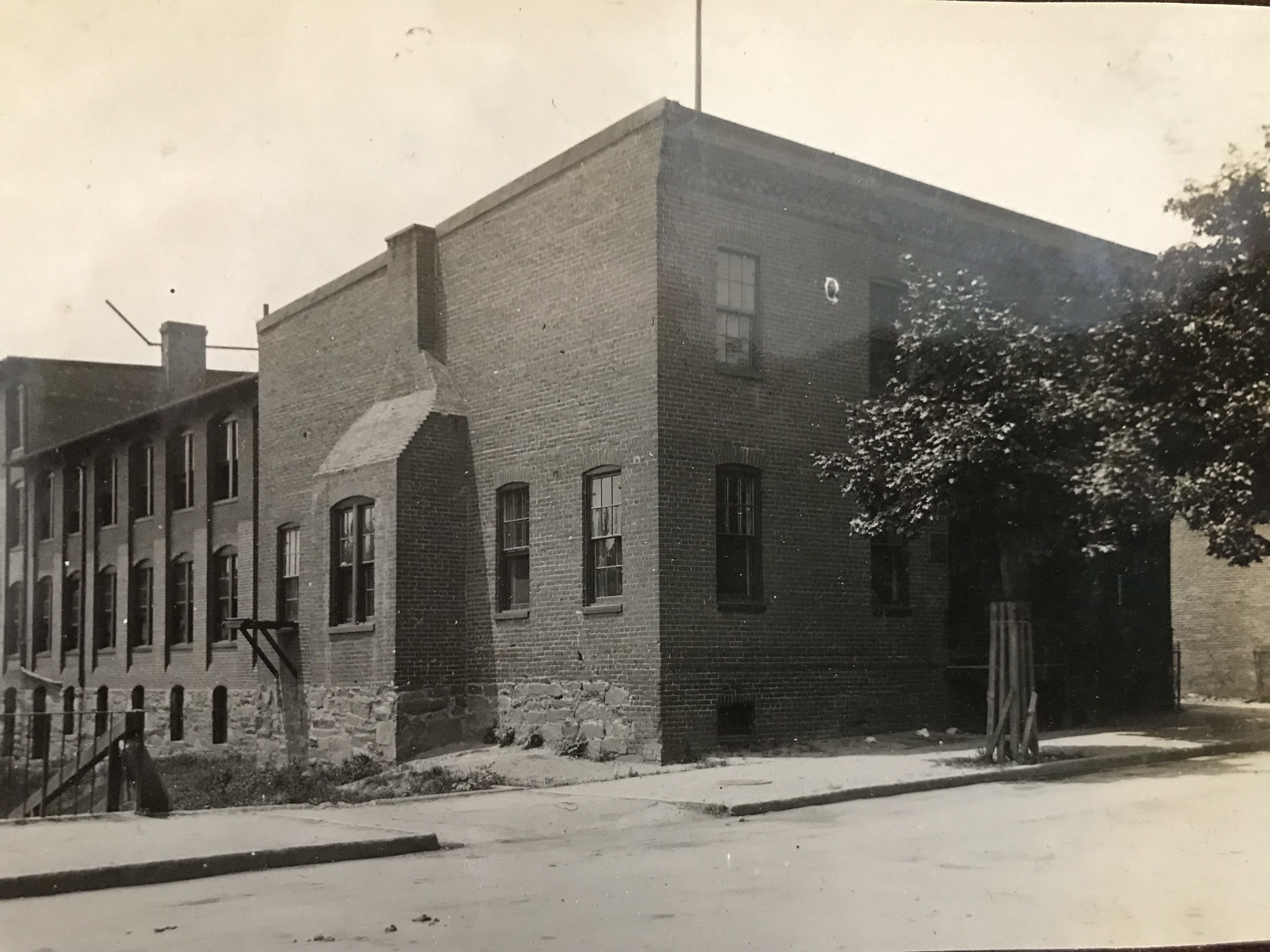
Two-story building that housed Hollerith’s card manufacturing plant, assembly plant, repair shop, and development laboratory, as it appeared in 1911.
Books

Related Resources


Copyright Notice

Reed Brothers Dodge History (1915-2012) by Jeanne Gartner is licensed under a Creative Commons Attribution-NonCommercial 3.0 Unported License.
 Reed Brothers Dodge History 1915 – 2012
Recent Comments