
Then & Now: Andrew Small Academy Darnestown, 1908
“Then and Now” photos are an excellent way to explore the passage of time. In this special post, I have combined one of Lewis Reed’s original photograph’s for “then” and matched it with a corresponding contemporary shot for “now”. Taken over a century apart, these photos show the Andrew Small Academy in Darnestown, then and now.
Andrew Small Academy (THEN): In 1869, longtime member of the community and Scottish immigrant Andrew Small left a bequest for the establishment of a school for Darnestown. Named for its benefactor, the Andrew Small Academy was the largest school building in Montgomery County at that time. The building was used as a private educational institution until 1907, then used as a public high school for almost the next 50 years. The building was demolished in 1955 to make way for a new elementary school.
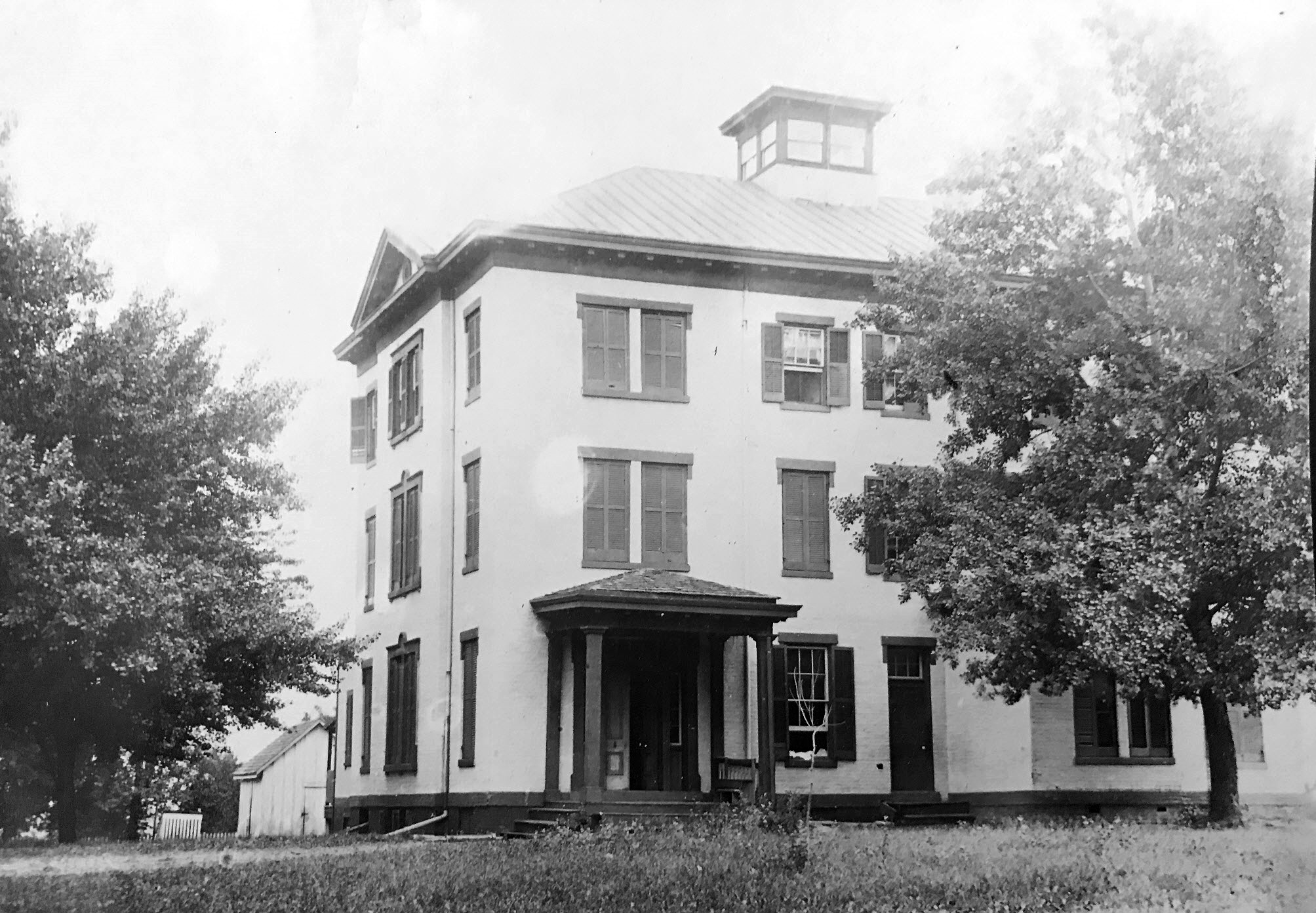
Andrew Small Academy building in 1908, shortly after it was closed. Photo by Lewis Reed
Andrew Small Academy (NOW): No longer standing. Site was located at 15030 Turkey Foot Road directly behind Darnestown Elementary School where a blacktop play area is now located. The tree shown in front of the Academy in Lewis Reed’s photo still stands north of the blacktop. The drive to the Academy came off Darnestown Road (Rt 28) sharing the same entrance to the northwest of the site still in use by Darnestown Presbyterian Church. The Academy was demolished in 1955 and replaced by the existing Darnestown Elementary School, which stands only a few hundred feet from where the academy was once located.

Darnestown Elementary School, which replaced the academy building in 1955.
Historical Marker https://www.hmdb.org/m.asp?m=69716
The Academy was named for its benefactor, Andrew Small (a native of Scotland), who became attached to the neighborhood while working on the C & O Canal. The Andrew Small Academy is no longer standing. The school was located directly behind the Darnestown Elementary School, on Turkey Foot Road. The Andrew Small Academy was an important early private educational institution that was constructed in 1869 and used as a private school until 1907, when it was converted into a public high school.
This was the largest and finest academy in Montgomery County. It had boarding as well as local students, and went up through three years of high school. Up until 1892 the minister of the church was also principal of the academy and received a salary of $600. The school became the cultural center of the community with concerts, plays, recitals, and a literary society. In 1892 the academy got its first full time principal. Then in 1907 it was taken over by the Montgomery County school system, and in 1927 it was changed into an elementary school. This ended its service as a cultural center. A new elementary school (now Darnestown Elementary) was built to replace it in 1955.
Source: Maryland Historical Trust
Third Annual Goodyear Dealers Zeppelin Race July-August 1931
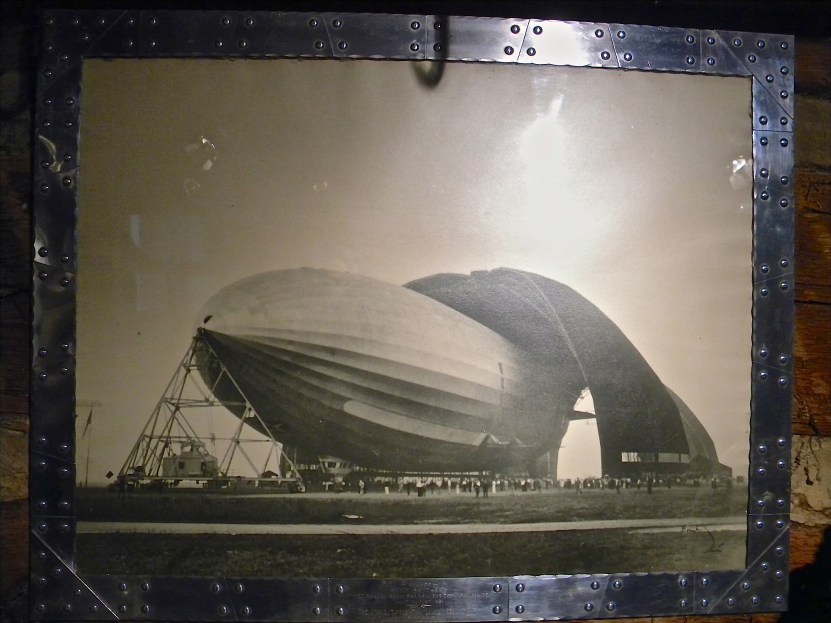
MARGARET BOURKE-WHITE, 1931 REED BROTHERS THIRD ANNUAL GOODYEAR DEALERS ZEPPELIN RACE WINNER
In 1931, the Goodyear Zeppelin Company produced a series of framed prints as rewards for Goodyear dealers as prizes for high sales. Sales was based on a two months quota, and participated in by thousands of dealers all over the country. The print shows the maiden launch of the USS Akron leaving the Goodyear Zeppelin air dock at Akron, Ohio. The engraved plaque at the bottom center of the frame reads, “Winner – Reed Brothers, Third Annual Goodyear Dealers Zeppelin Race. July – August 1931.” This frame is made of duralumin used in the girder construction of the United States Airship “AKRON” built by the Goodyear Zeppelin Corporation”. The print is signed in the lower right-hand corner by the famed 20th century photographer, Margaret Bourke-White. During the early years of the Depression, Goodyear was one of Bourke-White’s most important clients. She made this image of the airship Akron when it was removed from its hangar for the first time.
Built in 1929, the almost unbelievably huge Goodyear air dock in Akron, Ohio, was created as a space where blimps, airships, and dirigibles could be constructed. Evidently building such a massive space created problems, such as indoor rain, and putting the whole thing on rollers so that it could expand and contract with the seasons.
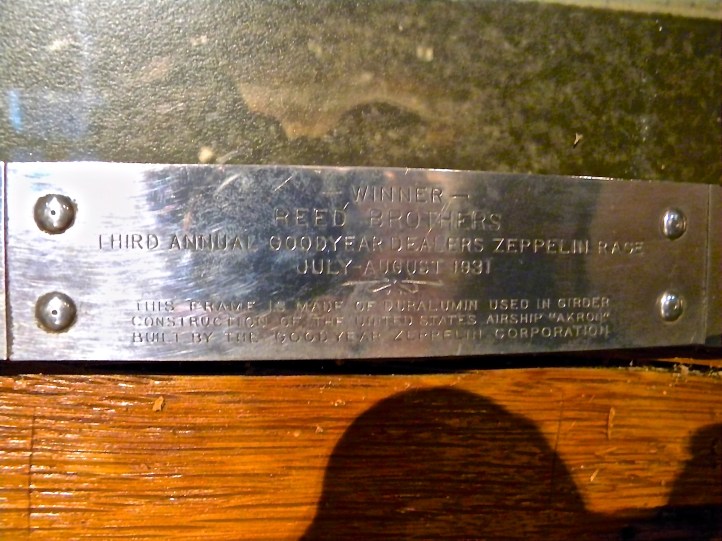
Inscription Plaque
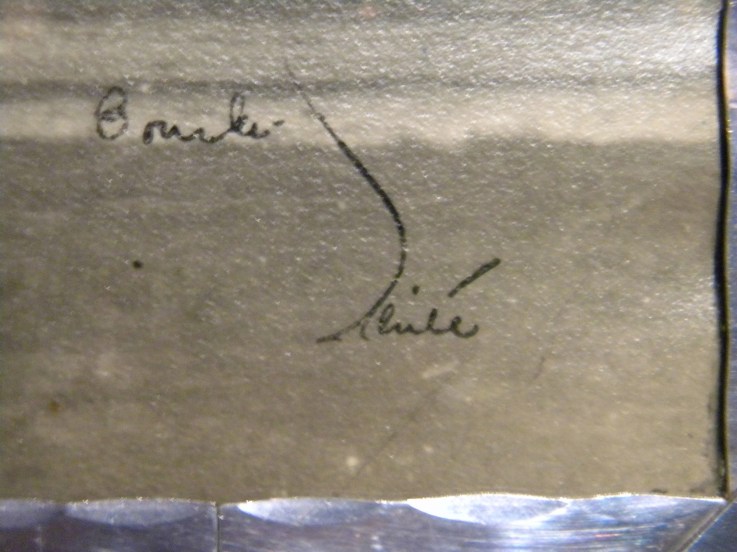
Photo is signed in the lower right corner by famed 20th century photographer, Margaret Bourke White
The USS Akron, first of a class of two 6,500,000 cubic foot rigid airships, was built at Akron, Ohio. Commissioned in late October 1931, she spent virtually all of her short career on technical and operational development tasks, exploring the potential of the rigid airship as an Naval weapons system. During the remainder of 1931 and the early part of 1932, the Akron made flights around the eastern United States and over the western Atlantic, including one trial of her capabilities as a scouting unit of the fleet. While beginning a trip to the New England area, Akron encountered a violent storm over the New Jersey coast and, shortly after midnight on 4 April 1933, crashed tail-first into the sea. Only three of the seventy-six men on board survived this tragic accident. During the search for other possible survivors, the Navy non-rigid airship J-3 also crashed, killing two more men.
Note: Margaret Bourke-White (1904 1971) is best known as the first foreign correspondent to be permitted to take photographs of Soviet industry, the first female war correspondent, and the first female correspondent permitted to work in war zones.
40th Anniversary with Goodyear
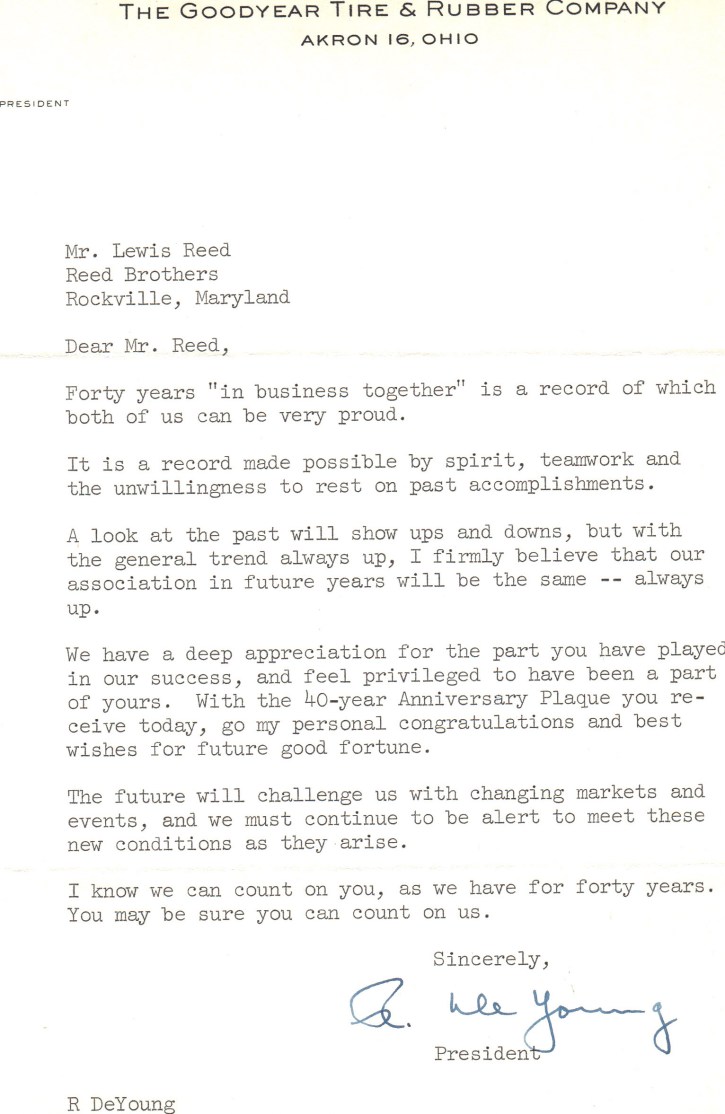
Lewis Reed was recognized by Goodyear Tire & Rubber Co. for reaching his 40th year as a Goodyear dealer. Reed Brothers Dodge began selling Goodyear tires in the 1920s. Below is a letter from Russell DeYoung thanking Lewis Reed for his 40 years “in business together”.
Reed Brothers Third Annual Goodyear Dealers Zeppelin Race Winner July-August 1931
MARGARET BOURKE-WHITE, 1931 REED BROTHERS THIRD ANNUAL GOODYEAR DEALERS ZEPPELIN RACE WINNER
In 1931, the Goodyear Zeppelin Company produced a series of framed prints as rewards for Goodyear dealers as prizes for high sales. Sales was based on a two months quota, and participated in by thousands of dealers all over the country. The print shows the maiden launch of the USS Akron leaving the Goodyear Zeppelin air dock at Akron, Ohio. The engraved plaque at the bottom center of the frame reads, “Winner – Reed Brothers, Third Annual Goodyear Dealers Zeppelin Race. July – August 1931.” This frame is made of duralumin used in the girder construction of the United States Airship “AKRON” built by the Goodyear Zeppelin Corporation”. The print is signed in the lower right-hand corner by the famed 20th century photographer, Margaret Bourke-White. During the early years of the Depression, Goodyear was one of Bourke-White’s most important clients. She made this image of the airship Akron when it was removed from its hangar for the first time.
Built in 1929, the almost unbelievably huge Goodyear air dock in Akron, Ohio, was created as a space where blimps, airships, and dirigibles could be constructed. Evidently building such a massive space created problems, such as indoor rain, and putting the whole thing on rollers so that it could expand and contract with the seasons.
Inscription Plaque
Photo is signed in the lower right corner by famed 20th century photographer, Margaret Bourke White
The USS Akron, first of a class of two 6,500,000 cubic foot rigid airships, was built at Akron, Ohio. Commissioned in late October 1931, she spent virtually all of her short career on technical and operational development tasks, exploring the potential of the rigid airship as an Naval weapons system. During the remainder of 1931 and the early part of 1932, the Akron made flights around the eastern United States and over the western Atlantic, including one trial of her capabilities as a scouting unit of the fleet. While beginning a trip to the New England area, Akron encountered a violent storm over the New Jersey coast and, shortly after midnight on 4 April 1933, crashed tail-first into the sea. Only three of the seventy-six men on board survived this tragic accident. During the search for other possible survivors, the Navy non-rigid airship J-3 also crashed, killing two more men.
Note: Margaret Bourke-White (1904 1971) is best known as the first foreign correspondent to be permitted to take photographs of Soviet industry, the first female war correspondent, and the first female correspondent permitted to work in war zones.
40th Anniversary with Goodyear
Lewis Reed was recognized by Goodyear Tire & Rubber Co. for reaching his 40th year as a Goodyear dealer. Reed Brothers Dodge began selling Goodyear tires in the 1920s. Below is a letter from Russell DeYoung thanking Lewis Reed for his 40 years “in business together”.
Rockville Academy Basketball Team 1915-1916
Before opening his Dodge dealership in 1915, Lewis Reed was a well-known amateur photographer in Montgomery County. He would occasionally get phone calls local high schools asking him to take pictures of their athletic teams and graduating classes.
This photo taken by Lewis Reed depicts the Rockville Academy Basketball Team of 1915-1916. Finding photos and information of basketball teams before the 1920s is a difficult task. The only information on this team that I could find was in the May 1981 edition of “The Montgomery County Story” and the news clipping just below it from the Washington Times. From the newsletter:
In 1915, Rockville High School organized an athletic association. They planned teams in baseball, football, and basketball. They quickly lost their first game of basketball to Rockville Academy, 29 to 26.

Rockville Academy Basketball Team 1915-1916. Photo Lewis Reed
Back: Roy Hilton, Lester Witherow, Grubb, Hamilton, Edmonds
Middle: Lawrence Higgins, Joe Dawson, Brownell (Buck) Riggs, J. Vinson Peter, John McDonald
Front: John Dawson

The Washington Times January 24, 1915
The Montgomery County Historical Society has identified several people in the photograph. If anyone can help put a name to a face, please leave a comment.
Source: The Montgomery County Story
Then & Now: Hagerstown Public Square
This post is a continuation of a series of “Then & Now” images that will show photographs of buildings, street scenes, and other historical locales from Lewis Reed’s Photo Collection alongside photographs of how they appear today.
Hagerstown Public Square (THEN): Hagerstown Public Square looking north on Potomac Street, circa 1913. D. Ramacciotti’s fruit and candy store dominated the left side of the square. Trolleys roll down the middle of the street and a piano store is on the right. Winding the giant clock in the background (still there today) was done by a line from the tower attached to a horse on the ground that pulled the clock’s weights up through the tower.

Hagerstown Public Square, 1913. Photo by Lewis Reed
Hagerstown Public Square (NOW): Traffic heads south on Potomac Street on the square in downtown Hagerstown 105 years later.

Hagerstown’s Public Square, looking north on Potomac Street, as it is today.
Books

Related Resources


Copyright Notice

Reed Brothers Dodge History (1915-2012) by Jeanne Gartner is licensed under a Creative Commons Attribution-NonCommercial 3.0 Unported License.
 Reed Brothers Dodge History 1915 – 2012
Recent Comments