
35 Years Ago Today, Chrysler Invented the Minivan, And Changed History
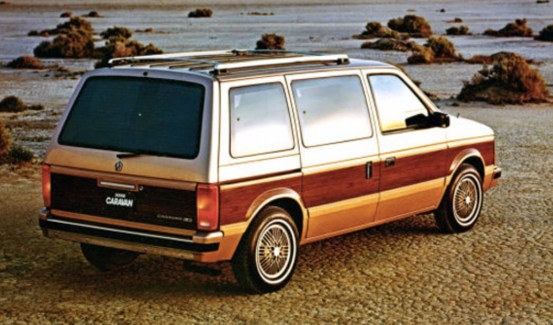
1984 Dodge Caravan
On November 2nd, 1983, the world’s first minivan rolled off of Chrysler’s assembly line. It was the vehicle that saved Chrysler from financial doom. When Ronald Reagan was president — the economy was far from robust and Chrysler was on death’s doorstep. Chrysler needed a home run, and Lee Iacocca, who was running the company at the time, gambled that the first wave of baby boomers who were starting families would likely want something roomier and far more practical than the traditional family hauler, the station wagon. Iacocca practically bet the company on the fact that a new automotive segment dubbed “the minivan” would catch on with the boomers. It was a $660-million gamble, only made possible by money acquired earlier from Washington’s $1.5-billion bailout of Chrysler.
Sales improved dramatically with the debut of the well-received K-car platform and the introduction of the Dodge Caravan and Plymouth Voyager. Chrysler paid off government loans seven years early. Reed Brothers successfully navigated through numerous Chrysler setbacks during the 1970’s and 80’s, including the first Chrysler Bailout and resurgence under Lee Iacocca.
The 1984 Dodge Caravan was designed specifically with families in mind. The early design looked like station wagons at the time, featuring a wood panel along the sides. The Caravan was essentially a big, roomy box on wheels, utilizing maximum form efficiency — small on the outside, huge on the inside.
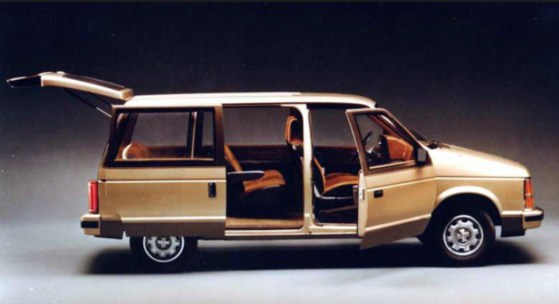
1984 Dodge Caravan
The other distinguishing features of the new minivan were its car-like features – notably including power windows, comfortable interiors, a nice dashboard, and front-wheel drive. These also explain the appeal of the vehicle. Not only did it fit in a garage like a car, but it actually drove like a car, while also providing plenty of room for the kids and luggage and giving mom a nice, high view of the road. The sliding door made it easy to for people to quickly enter or exit the vehicle and, with its lack of hinges, the sliding door was seen as a safer option for children.
After The 1984 Dodge Caravan was released, it became an immediate success. The minivan helped bring the company back from the brink of bankruptcy, and it reinvigorated the automotive market. Many buyers had to wait weeks to have their orders filled because there was so much demand. Dodge created an entirely new market with the minivan, and other models soon followed suit.
Lee Iacocca, the mastermind of the minivan era, presented this 12,000-mile Voyager at the assembly line in Windsor, Canada on November 2, 1983. A truly game-changing vehicle…
Then & Now: Saylorsburg Lake House & Hotel of Horror
With Halloween just around the corner, I thought it would be fun to feature a photograph that Lewis Reed took of the Saylorsburg Lake House Hotel, now the site of Hotel of Horror. The aging Lake House Hotel in Saylorsburg, Pennsylvania, once a vibrant Poconos retreat, was a popular hotel for the region’s tourists who were looking for fun on nearby Saylors Lake. During the hotel’s heyday, its staff was booking rooms a year in advance. Today, the former hotel’s fame is generated from its annual Halloween haunted-house attraction.
Lake House Hotel (THEN): The legend of the Lake House Hotel spans more than two-hundred years. According to local folklore, during World War II, many of the employees at the Lake House were called to assist in the Pennsylvania National Guard, leaving the local asylum with one lone security guard to watch over the entire building. The inmates escaped, made their way to the hotel and took it over. The insane patients performed experiments on the guests. What was once a renowned resort for the rich and famous, became a torture chamber.

Saylorsburg Lake House Hotel. Photo taken by Lewis Reed, 1915.
Hotel of Horror (NOW): This 2018 season will celebrate the 26th year that the Hotel of Horror has been fascinating and horrifying legions of fans from the far reaches of the United States and even internationally. To all the readers of this blog: Have a spooky, enjoyable and very safe Halloween!

Welcome to The Hotel of Horror, The Pocono Mountains Premier Haunted House Attraction

Then & Now: Library of Congress
You might not realize how much Washington DC has changed until you look back and see what it looked like in the past. In this “Then & Now” feature, I have combined one of Lewis Reed’s original photograph’s for “then” and matched it with a corresponding contemporary shot for “now”.
Library of Congress (THEN): The Library of Congress was relocated to Washington, DC, in 1800, having previously been housed in New York and Philadelphia, which had each served as temporary capitals of the early United States of America. It is the research library serving the U.S. Congress as well as the national library of the United States, and it holds over 23 million volumes in its collection, making it the world’s largest library. The structure as it stands today was erected between 1888 and 1894, following the 1851 fire that destroyed 35,000 of the Library’s books (two-thirds of its holdings at that time), including much of Thomas Jefferson’s donated collection.
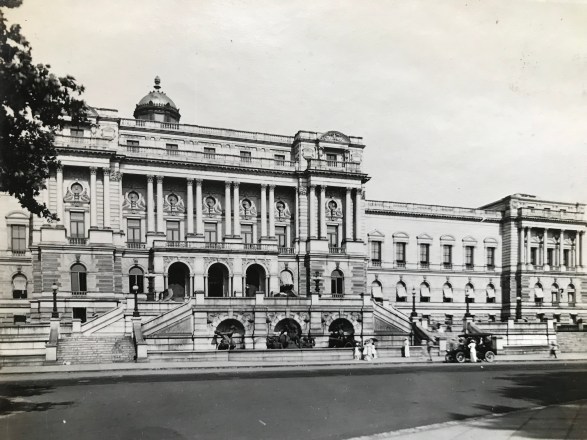
Library of Congress. Photo by Lewis Reed, ca. 1910
Library of Congress (NOW): The same view 108 years later. Now, the Library of Congress is one of the largest and best-equipped libraries in the world. It houses approximately 90 million items on 540 miles of shelves. The Library of Congress is physically housed in three buildings on Capitol Hill and a conservation center in rural Virginia. The Library’s Capitol Hill buildings are all connected by underground passageways, so that a library user need pass through security only once in a single visit.

Library of Congress today
Source: Wikipedia
Got Milk? Mrs Phillip Reed Endorses Cream Top Milk in This 1931 Ad
They say that the cream always rises to the top. What rose to the top of my internet search this week was this advertisement of cream top milk endorsed by Mrs Phillip Reed (Mary Zelda Reed) of Rockville. Phillip Reed was a brother of Lewis Reed and a part of the dealership’s first work force. Phillip came to work for the dealership as a mechanic in 1916. Characteristic is this compliment from Mrs. Phillip Reed of Rockville, MD:
I wish to tell you that I like your ‘Cream Top’ Milk better than any I have ever bought in the eleven years that I have been buying milk … The Cream whips wonderfully.
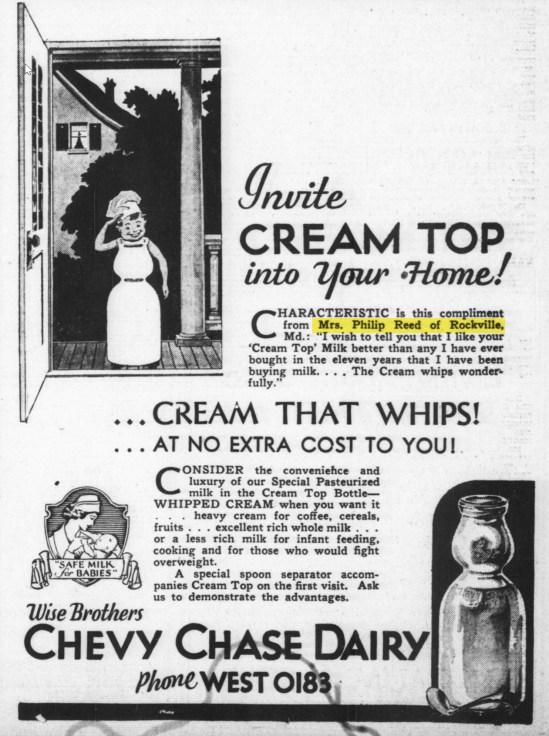
The Sunday Star, Washington D.C. March 8, 1931
The Chevy Chase Dairy resulted from the merger of two companies. Brothers George and Joseph Wise started Chevy Chase Dairy in 1885. The Dairy was utilized to supply milk to the Chevy Chase/Bethesda, Maryland and the Washington DC area with fresh milk. The dairy was started by H. G. Carroll who owned the farm in 1897. Sometime around 1913-1915 he sold the dairy to George, Joseph and Raymond Wise who added the “Wise Brothers” to the Chevy Chase Farm name. There first retail location in the District was at 3306 P Street NW. They later moved to 3206 N Street NW (adjacent to Martin’s Tavern which fronts Wisconsin Avenue in Georgetown) where it remained until it was sold to National Dairy Products in January 1931.
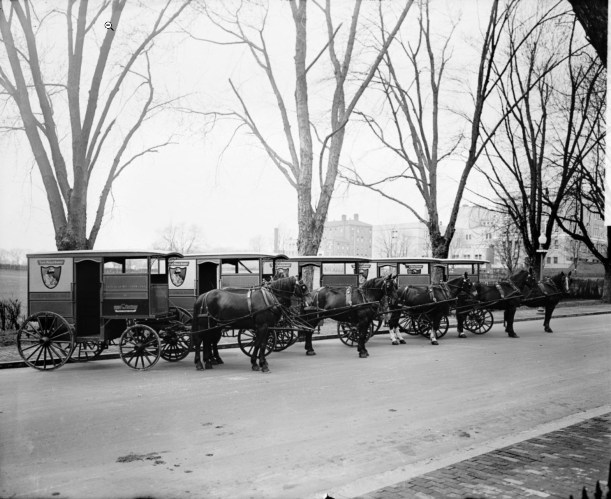
Chevy Chase Dairy delivery wagons, circa 1918-28. (LIBRARY OF CONGRESS PRINTS AND PHOTOGRAPHS DIVISION)
The Chestnut Farms, Chevy Chase Dairy may be gone, but an unexpected descendant remains. Dairies used to sponsor all sorts of extracurricular activities for employees, from baseball teams to orchestras. Chestnut Farms, Chevy Chase Dairy had a brass band. In 1938, the band played in the stands of Griffith Stadium during a football game. The owner of the team liked the idea of entertaining the fans so much that he signed them up to play regularly. The owner was George Preston Marshall, the team was the Redskins and the band became the Redskins Marching Band.
Source: The Washington Post
Then & Now: Clinton Zion AME Church, Rockville
In 1867, several of Rockville’s African American families left Jerusalem Methodist Episcopal Church to start the African Methodist Episcopal (A.M.E.) Zion Church under the leadership of Reverend Charles Pipkins. In 1890, Pipkins and his congregation cut timbers and erected. a frame church on Middle Lane. Taken approximately 100 years apart, these photos show the Clinton Zion A.M.E. Church then and now.
Clinton Zion A.M.E. Church (THEN): In 1904, the congregation moved to the brick church seen in this black & white photograph located on North Washington Street and today’s Beall Avenue. The church was named Clinton A.M.E. Zion in honor of Reverend George Wylie Clinton (1859-1921), a prominent member and editor of the church’s periodical, Star of Zion.

Zion A.M.E. Church, Rockville, Maryland. Photo by Lewis Reed, ca. 1912.
Clinton Zion A.M.E. Church (NOW): The congregation sold the brick church in 1955 to make way for a shopping center, dedicating their present church on Elizabeth Avenue in Lincoln Park in the fall of 1956. The growth of Clinton was the impetus for the most recent expansion effort. Construction of the new sanctuary began in 1989 and the newly renovated edifice was dedicated on Sunday, May 13, 1990.
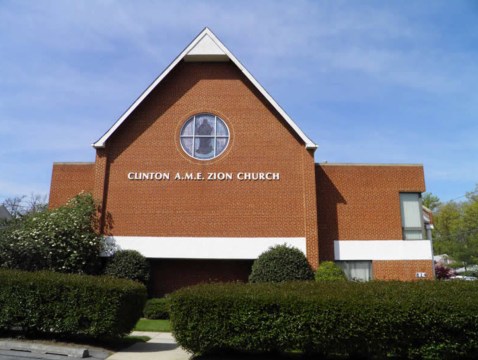
Zion A.M.E. Church, Rockville, Maryland. 2012
Source: Clinton AME Zion Church
Books

Related Resources


Copyright Notice

Reed Brothers Dodge History (1915-2012) by Jeanne Gartner is licensed under a Creative Commons Attribution-NonCommercial 3.0 Unported License.


Recent Comments