
Montgomery County’s Trolley Era 1900-1935
Trolleys existed in American cities before the Civil War, but a line did not connect Washington, DC to Rockville, Maryland, until 1900. Lewis Reed had the foresight to aim his camera at early trolley cars, providing rare glimpses of these unique vehicles, as well as views of Montgomery County’s rapidly changing landscapes in the early 20th century.
From the “Washington Star,” regarding the Rockville cars:
The cars do not differ materially from those found on other lines – except no place to hitch horses …. The interior of the car is fitted up with mahogany …seats with springs are upholstered in slate-colored plush.
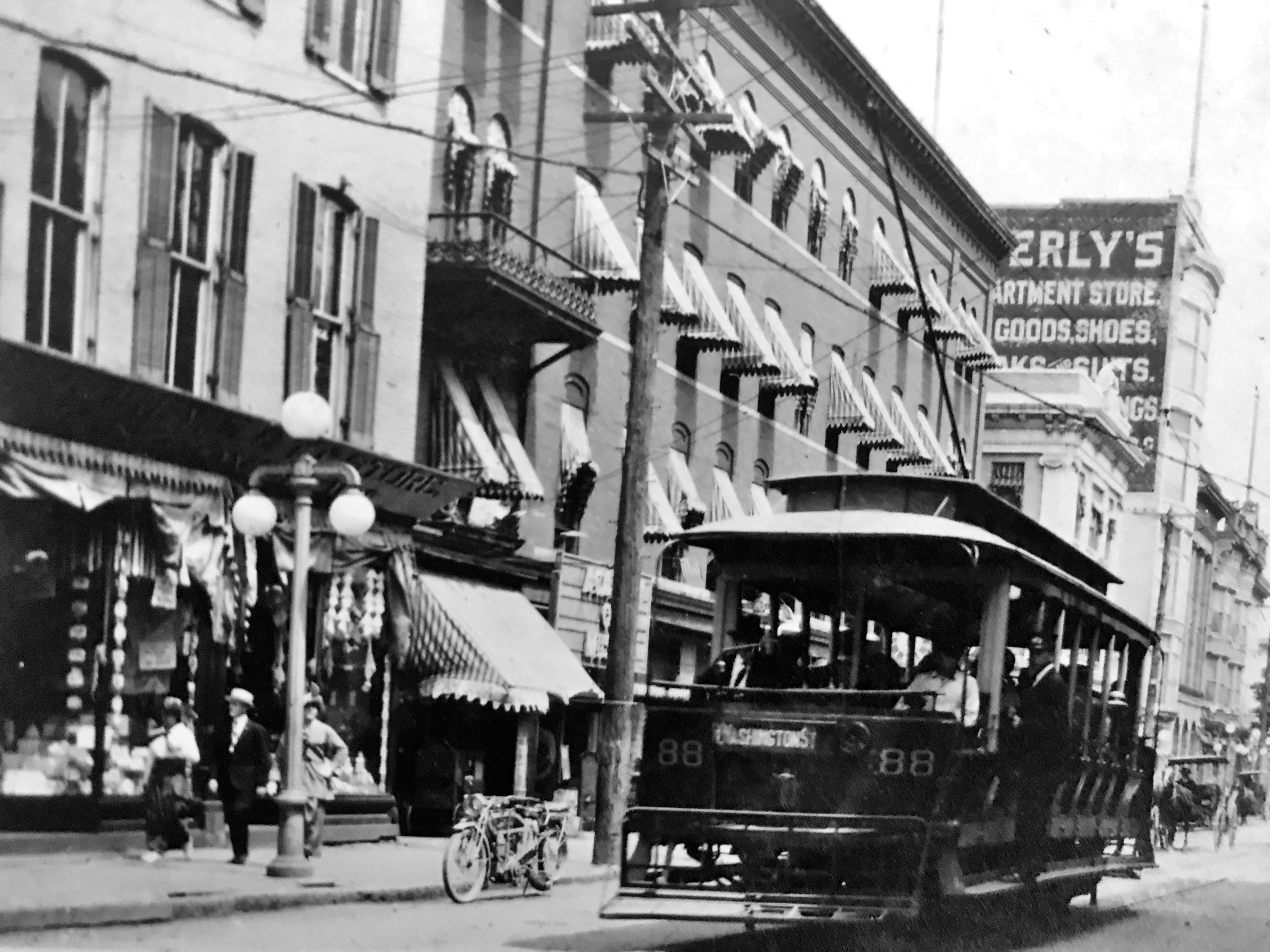
Trolleys were at home both in the open countryside and in city streets, mingled with pedestrians, cyclists, and horse-drawn vehicles. This scene, taken by Lewis Reed in Baltimore in 1913, shows the trolley in its more typical urban habitat.
Trolley cars played a big part in early county travel. From 1900 to 1935, street cars plied the track from the Washington terminus at Wisconsin and M Streets, NW, up Wisconsin and then Old Georgetown Road, over a steel trestle just before the cars approached Georgetown Prep, through dense woods at Montrose and onto the Rockville Pike, through Rockville on Montgomery Avenue, to Laird Street, and back again. The cars could be driven from either end. In 1929, W&R ran 24 trips a day between 6:30 a.m. and 12:30 a.m. to connect Rockville and Washington. Major stops along the line included Georgetown, Alta Vista, Bethesda, Montrose, Halpine, the Fairgrounds, Courthouse Square, and Chestnut Lodge. Six switching stations and side tracks enabled street cars to pass as they went in different directions. As automobiles and buses rose in popularity and availability, trolleys began their descent into the history books and by 1935, they were pretty much gone from Montgomery County.
Below is a collection of photographs taken by Lewis Reed that shows what the old trolley cars looked like, highlighting what riding the trolley car was like in the early 1900s. From wood-paneled exteriors with ceiling fans to advertisements, here’s a nostalgic look back at Montgomery County’s Trolley era through the lens of Lewis Reed. (click on photos to enlarge)
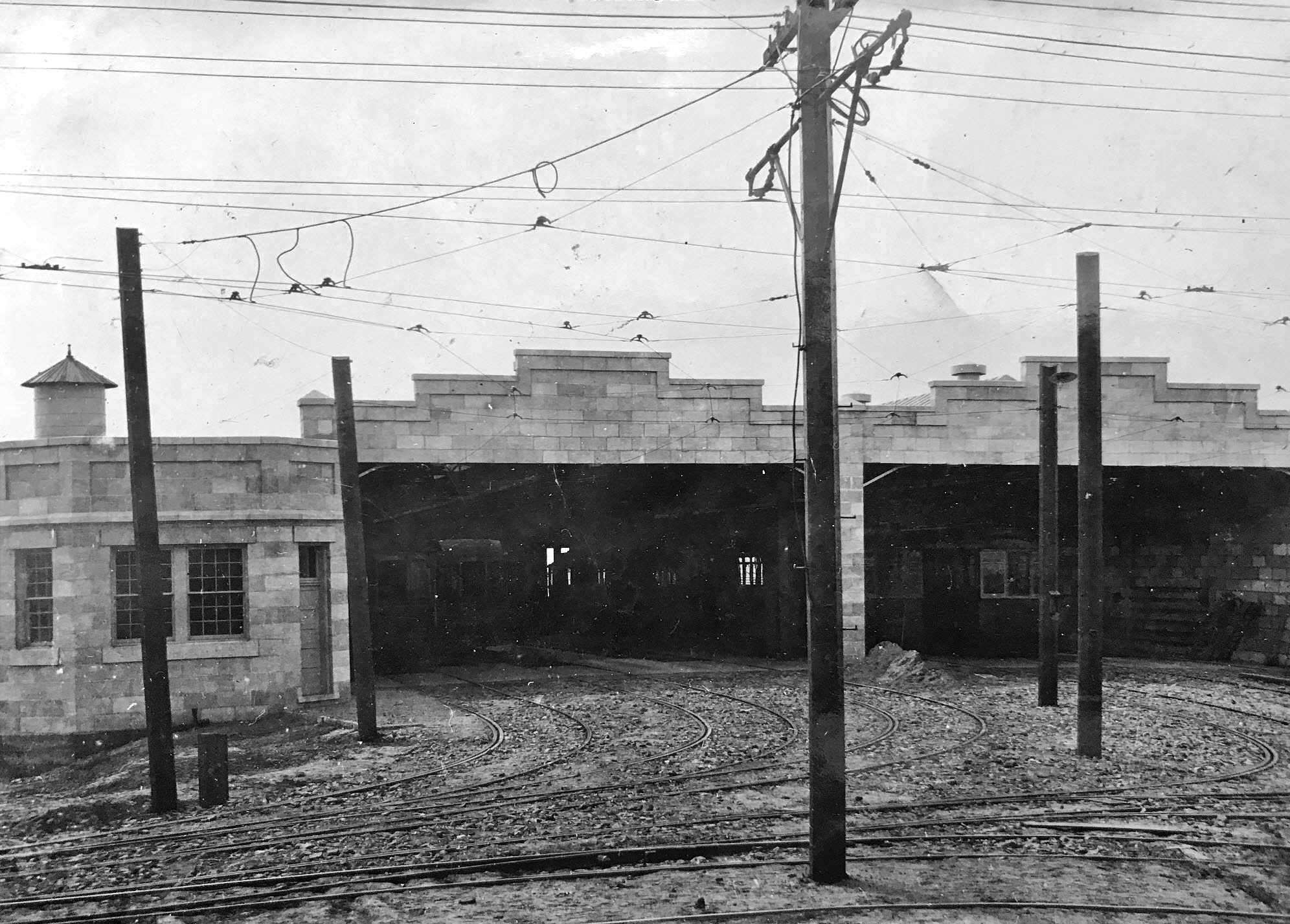
Western Avenue car barn for the streetcars that served the Georgetown-Tenelytown-Bethesda-Rockville line. Photo by Lewis Reed
A car barn is the streetcar equivalent of a garage for buses. It’s a covered facility in which streetcars were stored overnight, cleaned and given light repairs before the next day’s run. The car barn for the trolleys at the time was the second Western Avenue car barn for the streetcars that served the Georgetown-Tenelytown-Bethesda-Rockville line. It was located at on west side of Wisconsin at between Harrison and Jennifer. It was demolished and later replaced by a purpose-built bus garage which is still in use by WMATA. The National Capital Trolley Museum was instrumental in helping to identify the car barn in the photo above.
Leroy King described the street car below as one of Washington Railway’s majestic “Rockville” cars, at 4 switch in 1908. Note multiple unit jumper box under center front window.
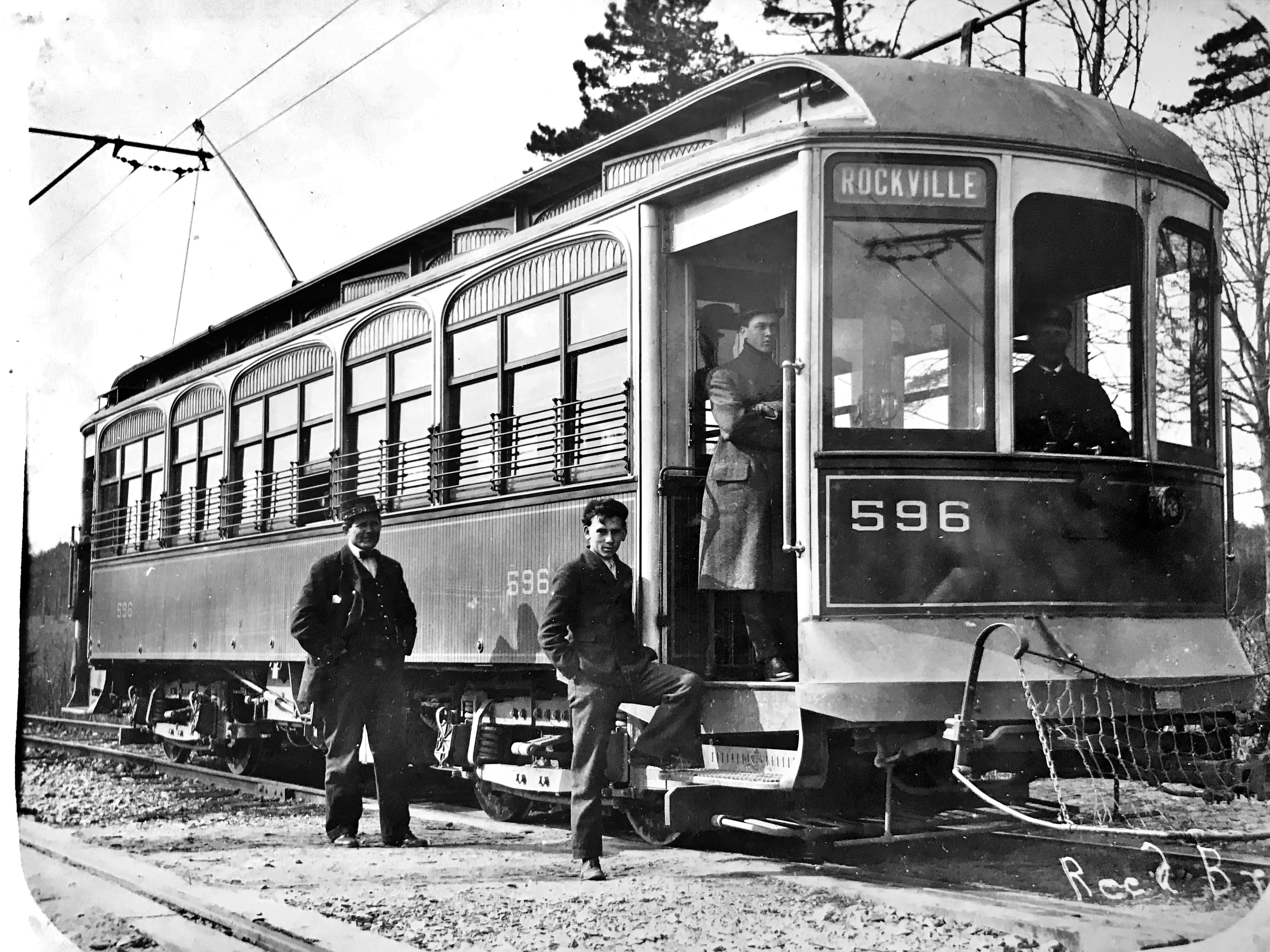
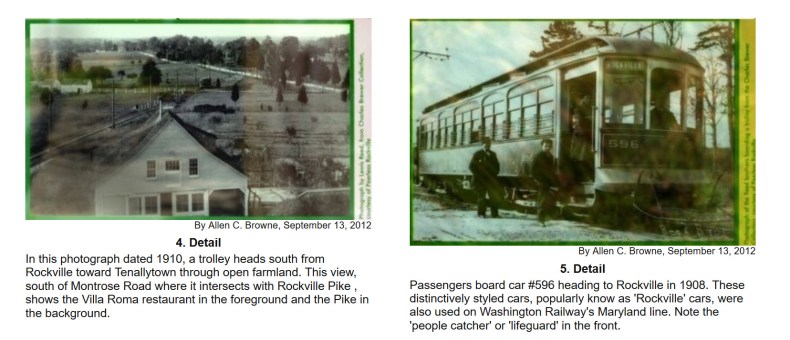
Passengers board car #596 heading to Rockville in 1908. These distinctively styled cars, popularly known as ‘Rockville’ cars, were also used on Washington Railway’s Maryland line. Photo by Lewis Reed, 1908
Traveling in snow was sometimes hazardous to trolley cars, as evidenced by the trolley pictured below which derailed the train tracks and plowed into a telephone pole at Montrose Road and Rockville Pike. Lewis Reed was there to capture the accident from two different perspectives using a five-by-four box camera which produced images on a glass plate.
In populated areas, street cars kept speeds to 12 mph (6 mph at intersections), but in open country they could get up to 40 mph.
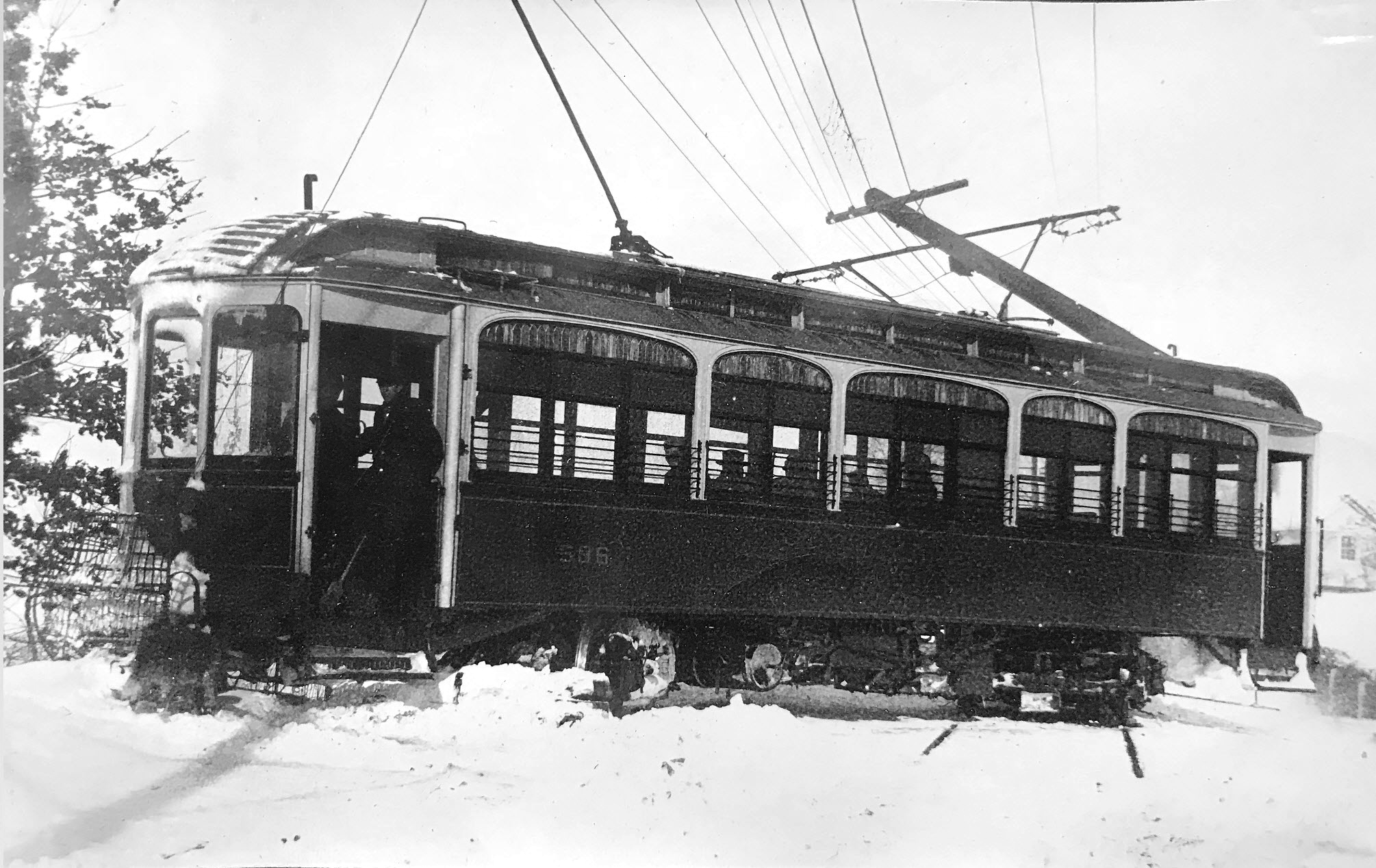
Derailed trolley at Montrose Road and Rockville Pike. Photo by Lewis Reed
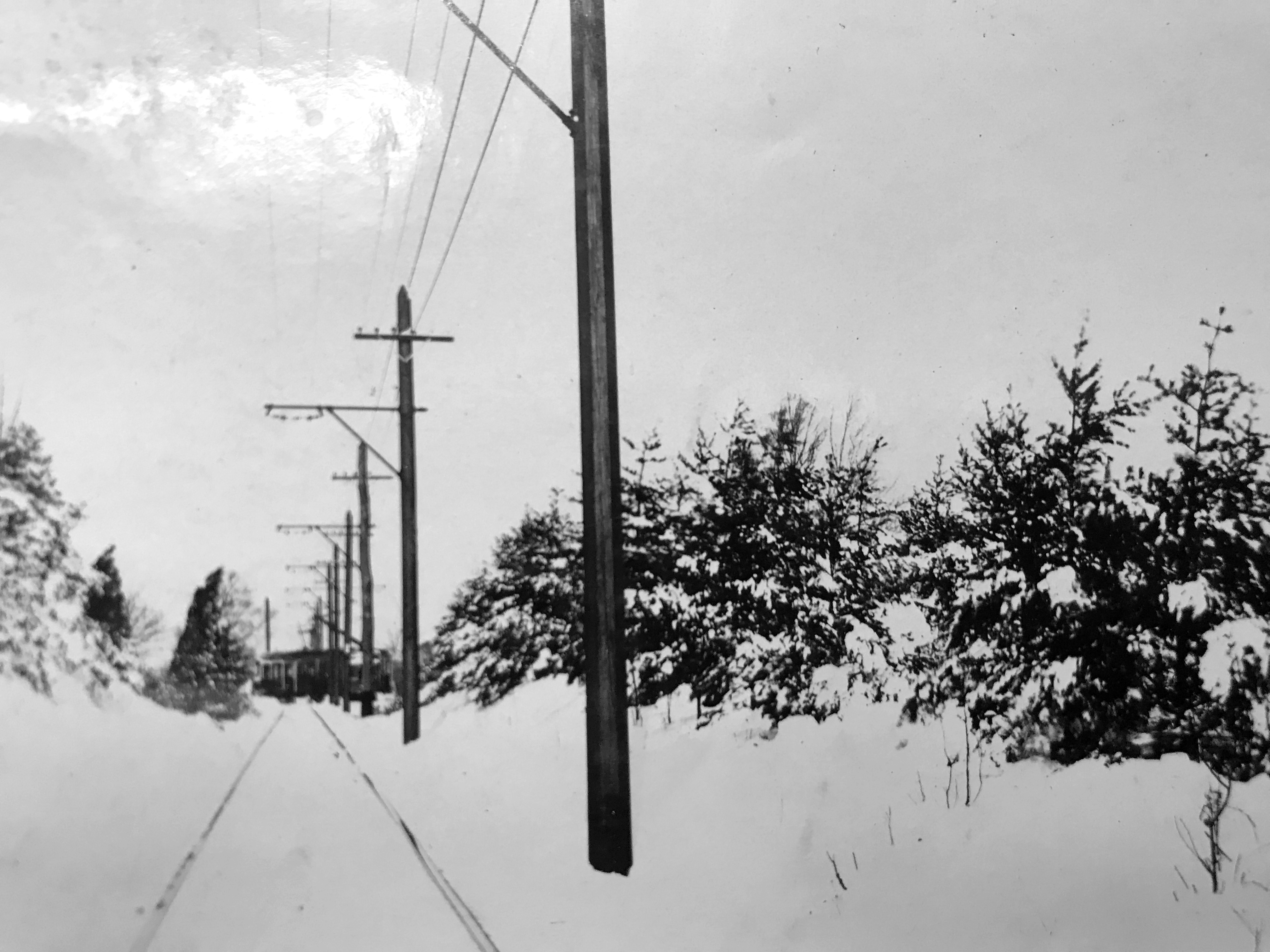
Derailed trolley through dense woods at Montrose Road and Rockville Pike. Photo by Lewis Reed
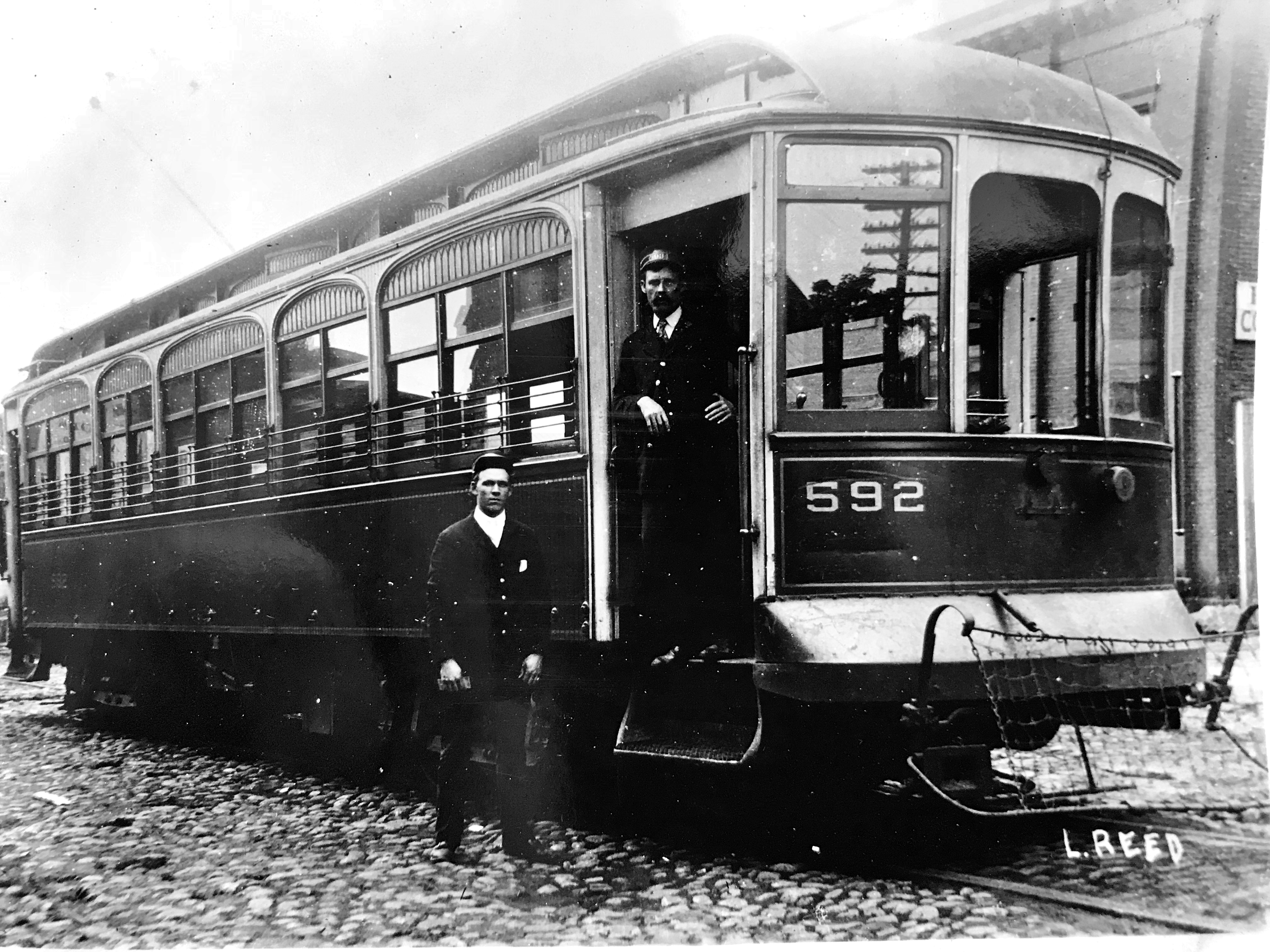
Rockville Trolley Car #592. Photo by Lewis Reed
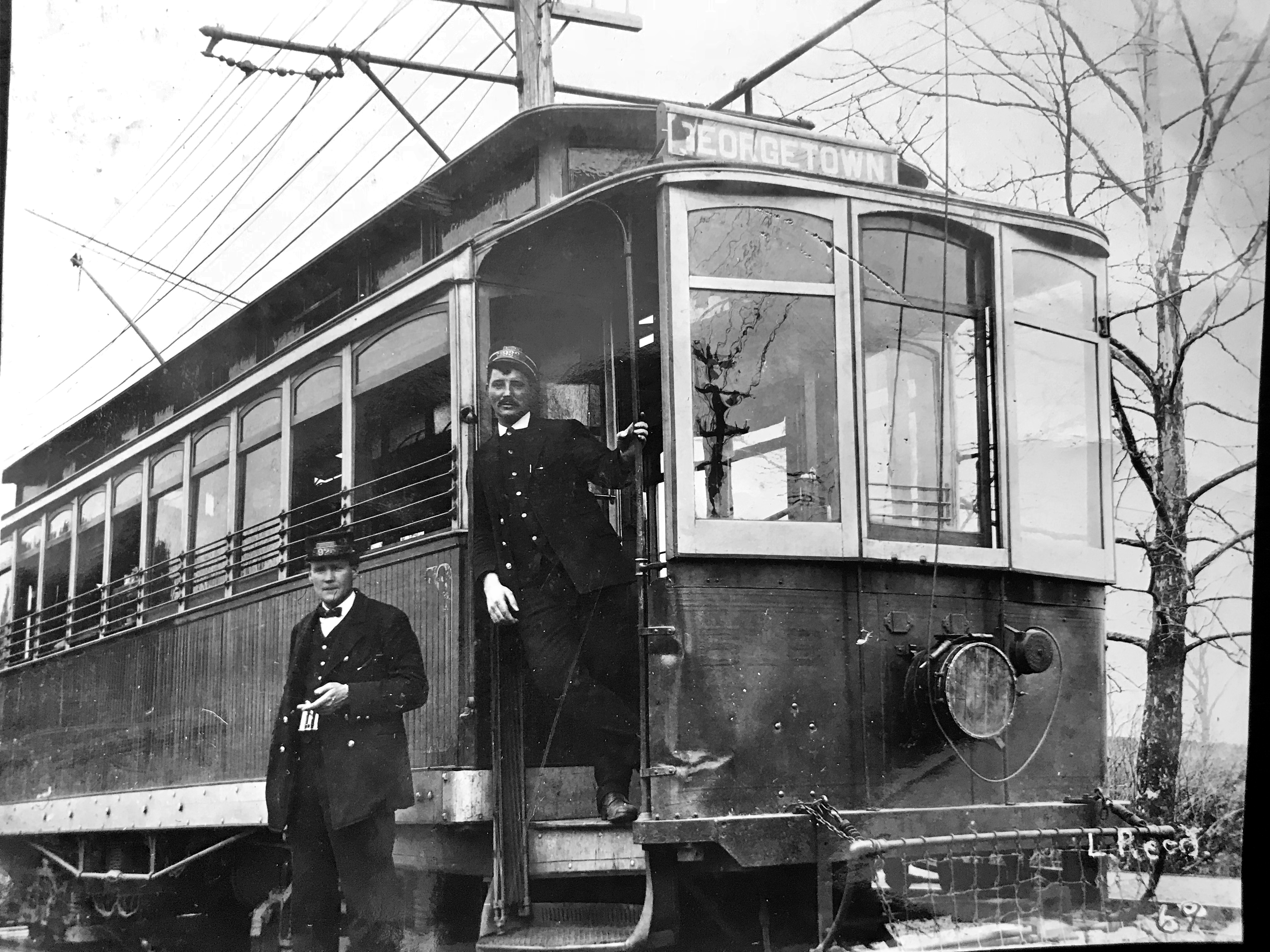
A motorman and conductor on a Georgetown trolley car. Photo by Lewis Reed, ca. 1908
Note the “cow catcher” in the front, and the multiple unit jumper box under the center front window. Each car had a two-man crew (a conductor and a motorman) one to operate the car and the other to collect fares.
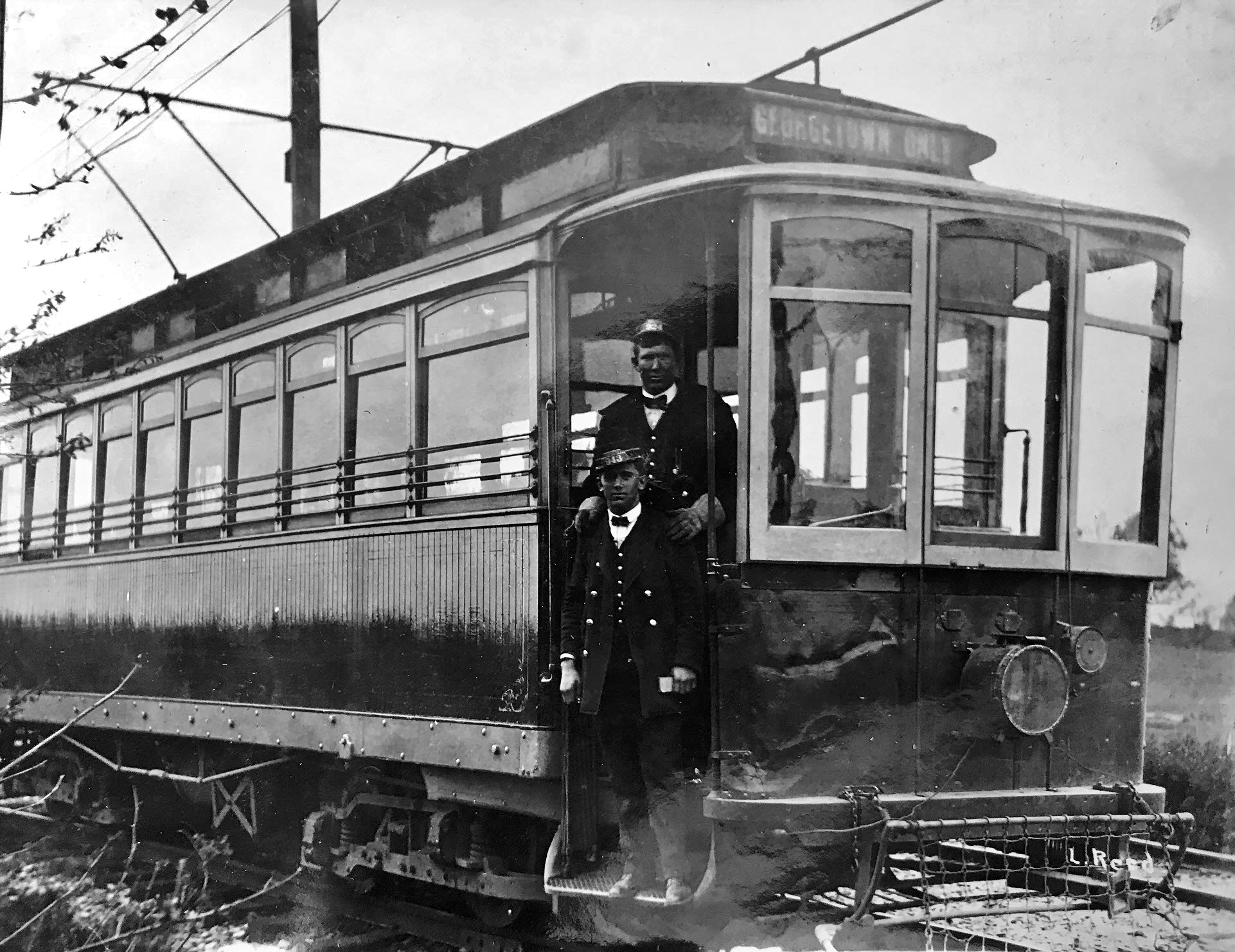
Two carmen aboard the “Georgetown Only” trolley car. Photo by Lewis Reed
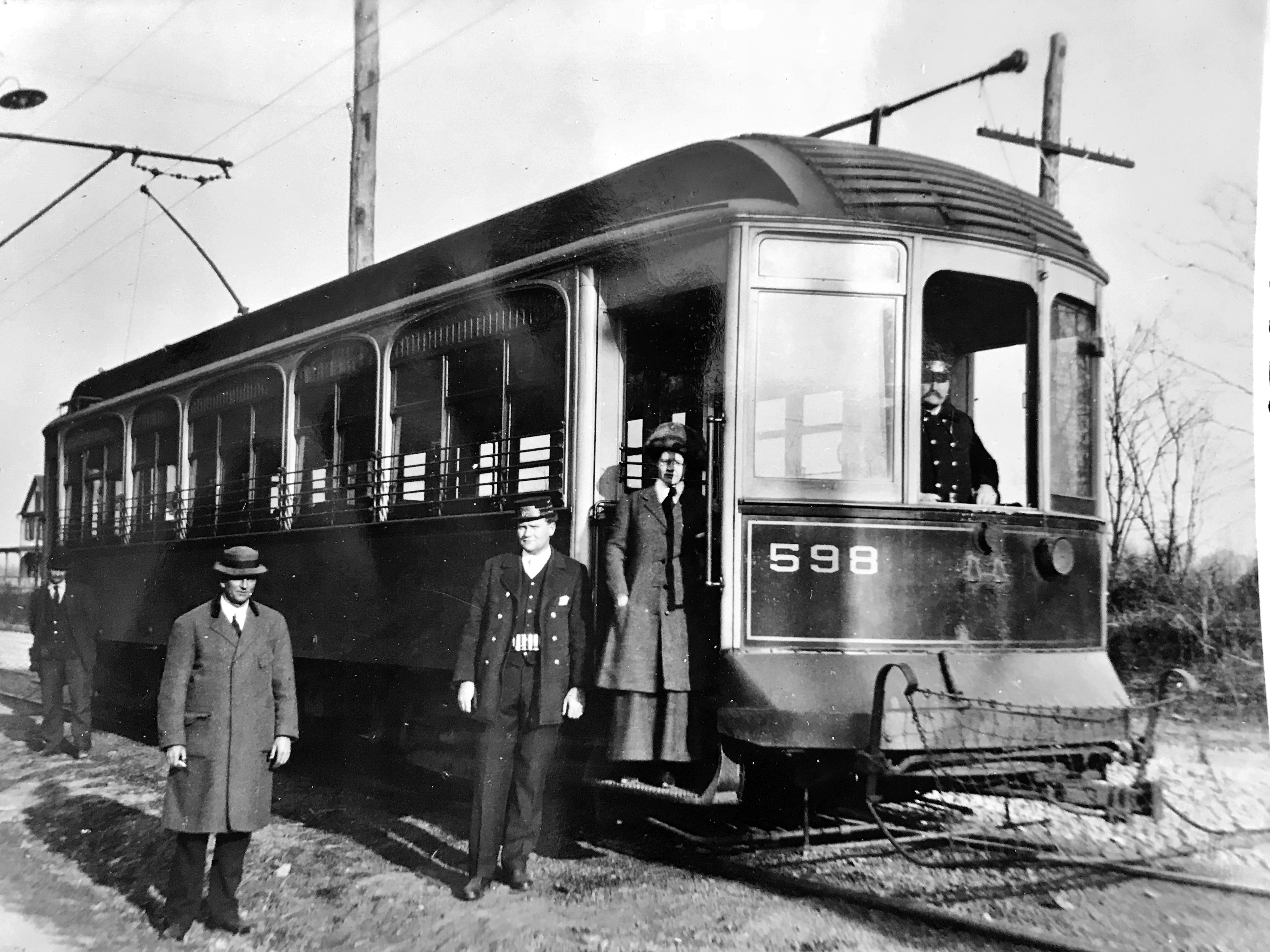
Crew and passengers pose near a Rockville car. Photo by Lewis Reed
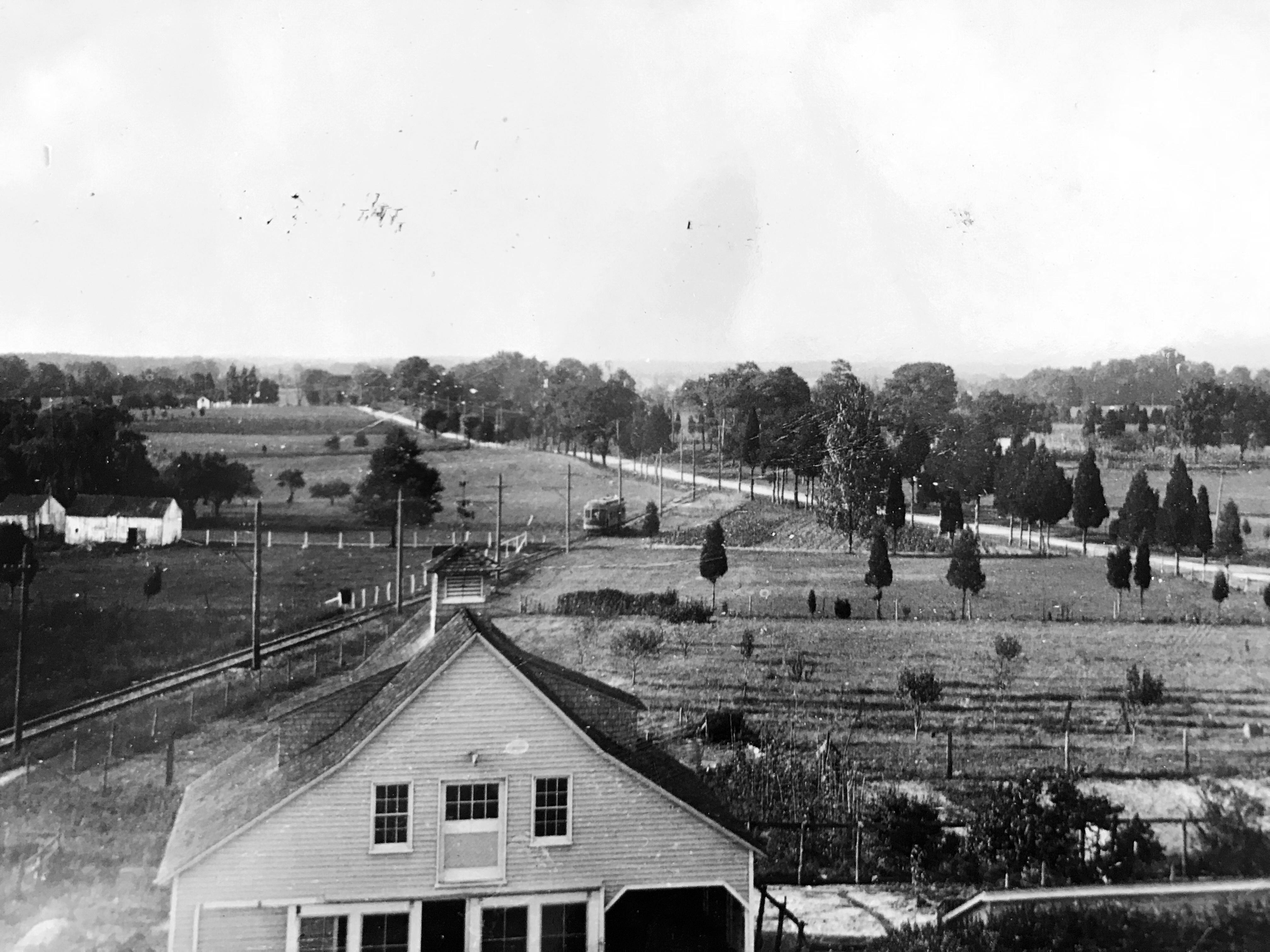
Trolley heading south after diverging from Rockville Pike. Photo by Lewis Reed, 1910
In the photo above c. 1910, a trolley (at center) heads south from Rockville toward Tenallytown (as it was spelled then) through open farmland. The view appears to be looking north and shows the area south of where Montrose Road intersects with Rockville Pike. The Pike is the white strip running diagonally behind the trolley car. To the left of the Pike is the William Scherrer farm. The Curtain farm is near the white buildings to the left of the Trolley line. The building in the foreground is the garage for the Villa Roma hotel and restaurant. The elevated vantage point, possibly from an adjacent rooftop or the roof of a barn, affords an excellent view of the rural countryside.
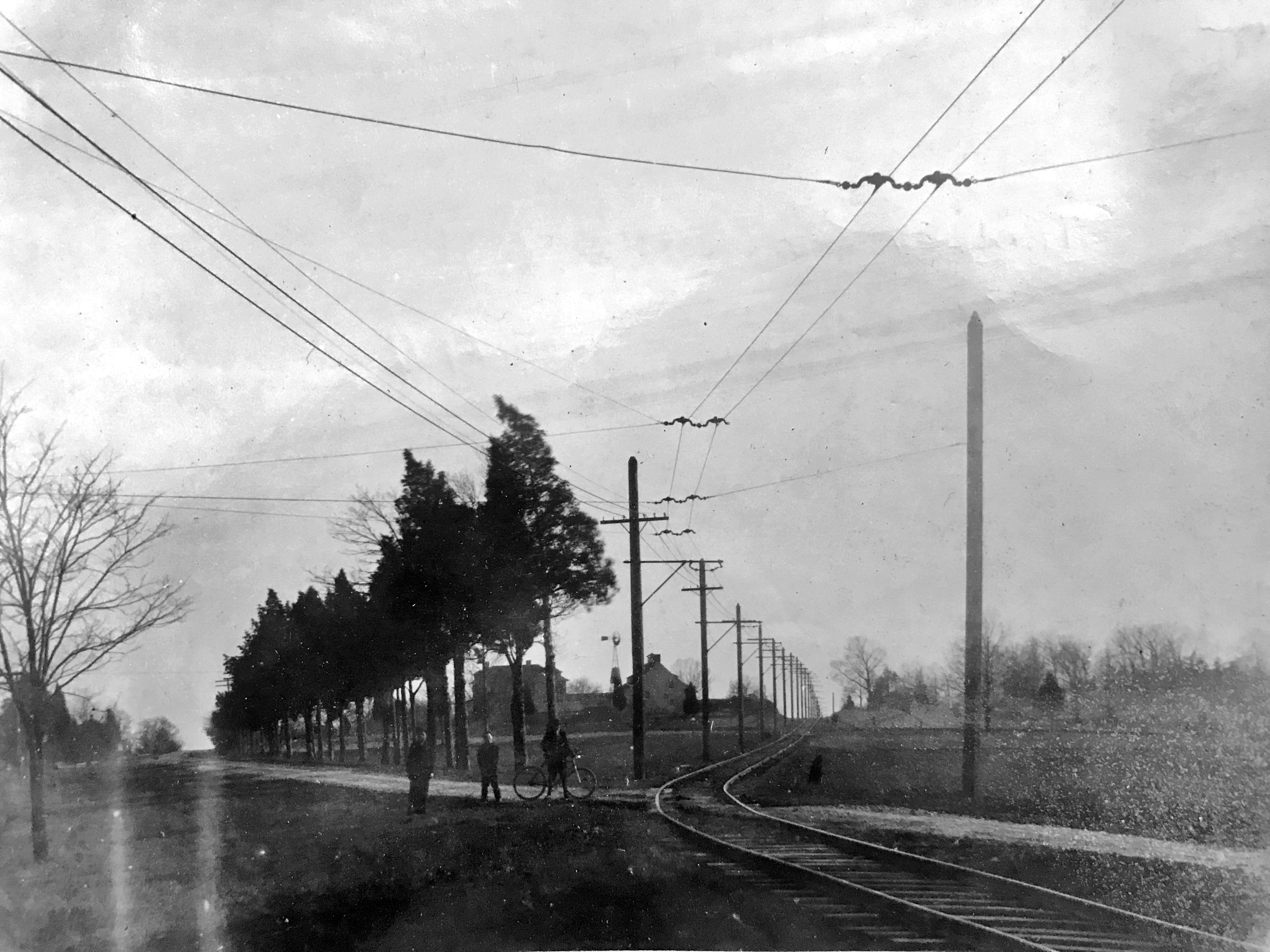
This photo, c. 1911, captures the trolley tracks on Rockville Pike south of Sherrer Farm. Note that one of the young men is holding a bicycle. Photo by Lewis Reed
The photograph below was featured on PBS’s “The American Experience” documentary, “The Great War” that premiered on April 10, 2017 in conjunction with the 100th anniversary of America’s entry into World War I.
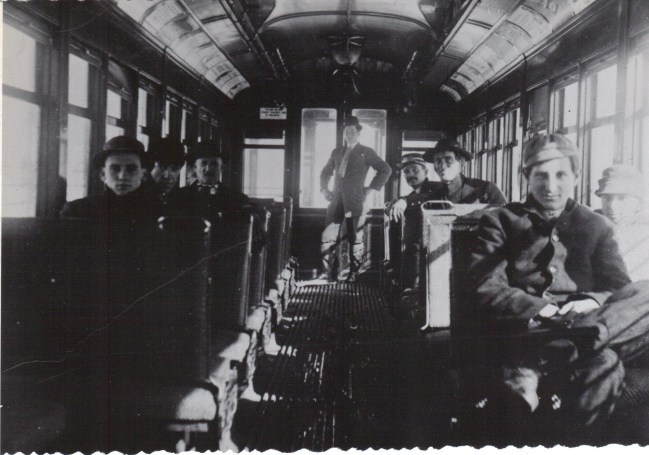
Interior of 1920’s Rockville trolley car. Photo taken by Lewis Reed
Panels for advertising line the edge of the ceiling on both sides of the trolley. Instead of AC, the interiors were cooled with wooden ceiling fans.
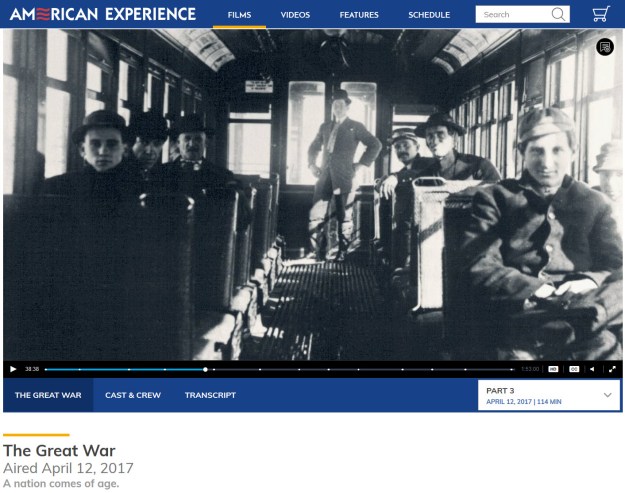
Rare peak of the inside of a 1920’s trolley car and passengers featured in PBS documentary “The Great War”. Photo taken by Lewis Reed
The rise and decline of trolleys and street railways is another example of the inevitability of change. Now there are no street car lines in Montgomery County and all the car barns and charming little waiting stations have been razed.
In March 1965, ground was broken for construction of the Trolley Museum in Wheaton, Maryland. Built with donated funds, materials and labor, it is run by volunteers under the aegis of the Maryland-National Capital Park and Planning Commission.
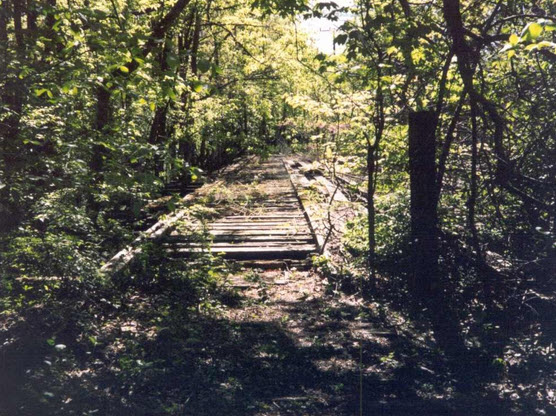
Abandoned trolley tracks off MacArthur Boulevard, 100 years after Lewis Reed’s time. [Photo by Sue Houser]
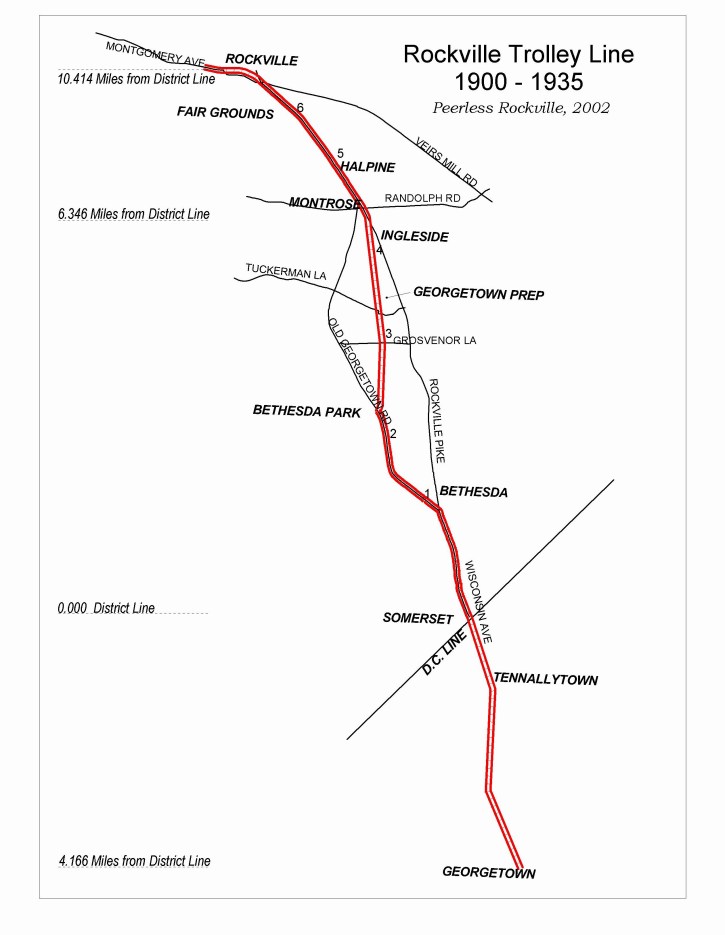
Rockville Trolley Line 1900-1935 – Peerless Rockville 2002
Sources: Rockville Pike History – City of Rockville
History of the Street Car Lines of Montgomery County
Peerless Rockville
Then & Now: Tenallytown & Rockville Pike Trolley Line
The latest installment in my Then & Now series takes us to south of Montrose Road where the Tenallytown and Rockville Pike trolley line intersects with Rockville Pike. The black & white photo was taken by Lewis Reed in 1910. The corresponding color photo is a Google Maps image, more than 100 years later. Matching the photos was a bit difficult as the location has changed so much, but you get the idea.
The Tennallytown and Rockville Railroad, which opened in 1890, was an extension of the Georgetown & Tenallytown Railway. The street car line was extended to Rockville in 1900 terminating at the fairgrounds. During the fair each fall, traffic was so heavy that two-car trains were run to accommodate the crowds. Later a further extension was made through Rockville on Montgomery Avenue to the Chestnut Lodge Sanitarium on the far side of town. In 1935, the Rockville trolley line ceased operation, leaving gasoline-powered buses as the only mode of public transportation serving this corridor until the Metrorail Red Line opened in 1984.
THEN: Tenallytown and Rockville Pike Trolley Line, 1910
In this photograph dated 1910, a trolley heads south from Rockville toward Tenallytown through open farmland. The view appears to be looking north and shows the area south of where Montrose Road intersects with Rockville Pike. The Pike is the white strip running diagonally behind the trolley car. The elevated vantage point, possibly from an adjacent rooftop or the roof of a barn, affords an excellent view of the rural countryside.

A trolley heads south from Rockville toward Tenallytown through open farmland. This view appears to be looking north and shows the area south of where Montrose Road intersects with Rockville Pike. The Pike is the white strip running diagonally behind the trolley car. Photo by Lewis Reed, 1910
NOW: The Bethesda Trolley Trail
Today, the six-mile Bethesda Trolley Trail connects Bethesda and Rockville for bicyclists, runners and pedestrians, following the route of the Tenallytown and Rockville Railroad, the former trolley line.

Woodglen Drive follows the old Bethesda Trolley Trail route today. The junction now is far from the tranquil road it once was. Google Maps image.
If there’s an historic wayside marker on the side of the road in Montgomery County, chances are, one of Lewis Reed’s images is on it. From Trolley to Trail Marker in Bethesda is one of many markers in Montgomery County that feature images from Lewis Reed’s collection of photographs.
From Trolley to Trail Marker in Bethesda
Location: Marker is in Bethesda, Maryland and can be reached from Norfolk Avenue near Rugby Avenue.
Duplicate: Another nearly identical marker is located at the exit ramp from westbound Montrose Parkway to northbound Rockville Pike (MD 355).
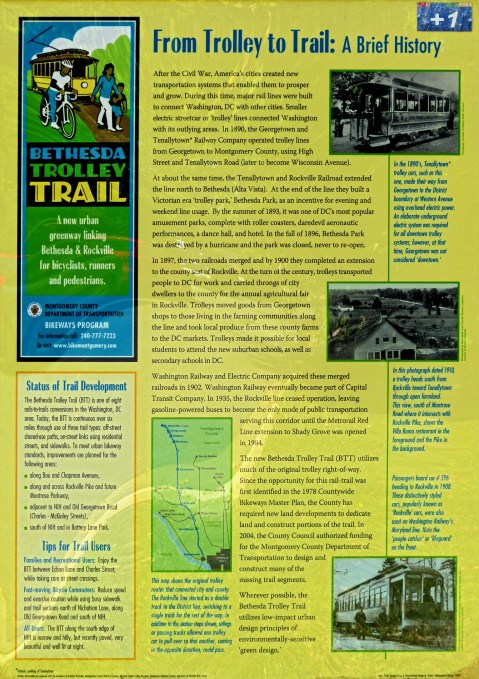
From Trolley to Trail Marker in Bethesda
From Trolley to Trail Wayside Marker in Bethesda. Close up of photos on marker taken by Lewis Reed.
Here’s How Rockville’s Trolley Era Looked Over 115 Years Ago
This special post is a collection of early trolley car photos that were taken by Lewis Reed in the early 20th century. Trolleys existed in American cities before the Civil War, but a line did not connect Washington, DC to Rockville, Maryland, until 1900.
The agreement between the town of Rockville and the W&R Railway Co. ran for 35 years. From 1900 to 1935, street cars plied the track from the Washington terminus at Wisconsin and M Streets, N.W., up Wisconsin and then Old Georgetown Road, over a steel trestle just before the cars approached Georgetown Prep, through dense woods at Montrose and onto the Rockville Pike, through Rockville on Montgomery Avenue, to Laird Street, and back again. The cars could be driven from either end. In 1929, W&R ran 24 trips a day between 6:30 a.m. and 12:30 a.m. to connect Rockville and Washington. Major stops along the line included Georgetown, Alta Vista, Bethesda, Montrose, Halpine, the Fairgrounds, Courthouse Square, and Chestnut Lodge. Six switching stations and side tracks enabled street cars to pass as they went in different directions.
Below are a collection of photographs taken by Lewis Reed that shows what the old trolley cars looked like, highlighting what riding the trolley car was like in the early 1900s. From wood-paneled exteriors with ceiling fans to advertisements, here’s a nostalgic look back at Rockville’s Trolley car era through the lens of Lewis Reed. (click on photos to enlarge)

Western Avenue car barn for the streetcars that served the Georgetown-Tenelytown-Bethesda-Rockville line. Photo by Lewis Reed
A car barn is the streetcar equivalent of a garage for buses. It’s a covered facility in which streetcars were stored overnight, cleaned and given light repairs before the next day’s run. The car barn for the trolleys at the time was the second Western Avenue car barn for the streetcars that served the Georgetown-Tenelytown-Bethesda-Rockville line. It was located at on west side of Wisconsin at between Harrison and Jennifer. It was demolished and later replaced by a purpose-built bus garage which is still in use by WMATA. The National Capital Trolley Museum was instrumental in helping to identify the car barn in the photo above.
Leroy King described the street car below as one of Washington Railway’s majestic “Rockville” cars, at 4 switch in 1908. Note multiple unit jumper box under center front window.

Passengers board car #596 heading to Rockville in 1908. These distinctively styled cars, popularly know as ‘Rockville’ cars, were also used on Washington Railway’s Maryland line. Note the ‘people catcher’ or ‘lifeguard’ in the front. Photo by Lewis Reed, 1908
Traveling in snow was sometimes hazardous to trolley cars, as evidenced by the trolley pictured below which derailed the train tracks and plowed into a telephone pole at Montrose Road and Rockville Pike. Lewis Reed was there to capture the accident from two different perspectives using a five-by-four box camera which produced images on a glass plate.
In populated areas, street cars kept speeds to 12 mph (6 mph at intersections), but in open country they could get up to 40 mph.

Derailed trolley at Montrose Road and Rockville Pike. Photo by Lewis Reed
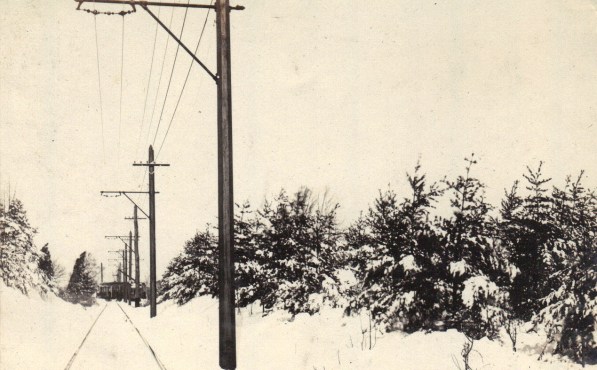
Derailed trolley through dense woods at Montrose Road and Rockville Pike. Photo by Lewis Reed
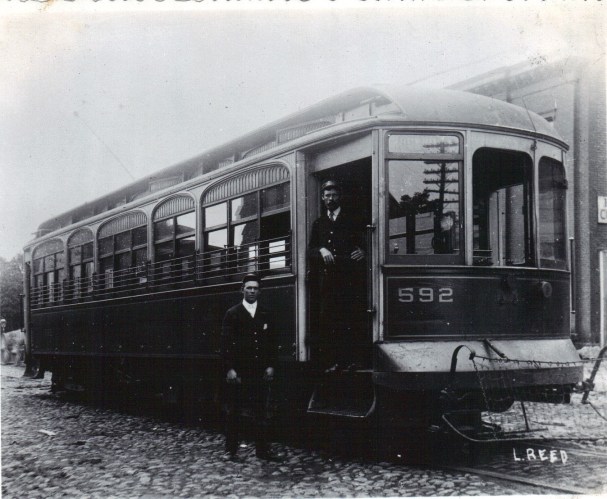
Rockville Trolley Car 592. Photo by Lewis Reed
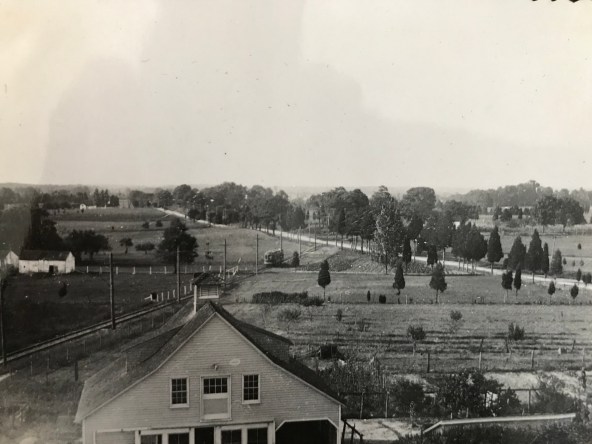
A trolley heads south from Rockville toward Tenallytown through open farmland. This view appears to be looking north and shows the area south of where Montrose Road intersects with Rockville Pike. The Pike is in the background. Photo by Lewis Reed, 1910

Trolley tracks on Rockville Pike south of Sherrer Farm. Note that one of the young men is holding a bicycle. Photo by Lewis Reed, ca. 1911
The Archival Producer for television’s most-watched history series, AMERICAN EXPERIENCE on PBS, found the photograph of the 1920’s trolley interior on this blog and asked permission to use it in the documentary, “The Great War,” a six-hour, three-night event, that premiered April 10-12, 2017 in conjunction with the 100th anniversary of America’s entry into WWI.
All of these prints were originally made from a glass plate negative, an early photographic technique which was in common use between the 1880s and the late 1920s. The early 1900s were considered by many to be the golden era of early photography, because of its new availability to the public and somewhat simplified production methods. Many of Lewis Reed’s early photographs are now part of the Montgomery County Historical Society photo archives.
Interior of 1920’s Rockville trolley car. Photo taken by Lewis Reed
Panels for advertising line the edge of the ceiling on both sides of the trolley. Instead of AC, the interiors were cooled with wooden ceiling fans.
Rare peak of the inside of a 1920’s trolley car and passengers featured in PBS documentary “The Great War”. Photo taken by Lewis Reed
Rockville Trolley Line 1900-1935 – Peerless Rockville 2002
Sources: Rockville Pike History – City of Rockville
History of the Street Car Lines of Montgomery County
1922 Bus Stop Scene on Rockville Pike

1922 GMC Hagerstown Bus taking on passengers at a bus stop across the street from Reed Brothers Dodge in Rockville, Maryland
Vehicles from this era are fascinating and are often photographed with equally fascinating surroundings. The photograph above is a unique, early photograph of a Hagerstown Bus owned by Forsyth’s Garage & Transfer of Rockville. The bus is an early GMC. The tag on bus is dated 1922 and behind the bus on the left is the bus station with signs that say “Pay Gate” and “Pass Gate”. The banner across the road says “Montgomery County Fair, Rockville, MD” and the dates. Directly across the street is Reed Brothers Dodge. The photograph was found on WorthPoint.com, an online resource for researching art, antiques and collectibles, etc.
The photograph below was taken by Lewis Reed during the same time frame only from a different perspective. It is also dated 1922, and the bus stop would have been right in front of the boarded fence across the main road (later the Rockville Pike). The Rockville Fair Grounds are just beyond the boarded fence. Buses and trolleys used to go past Reed Brothers as they traveled up Rockville Pike. The Fairgrounds was one of the stops along the line.
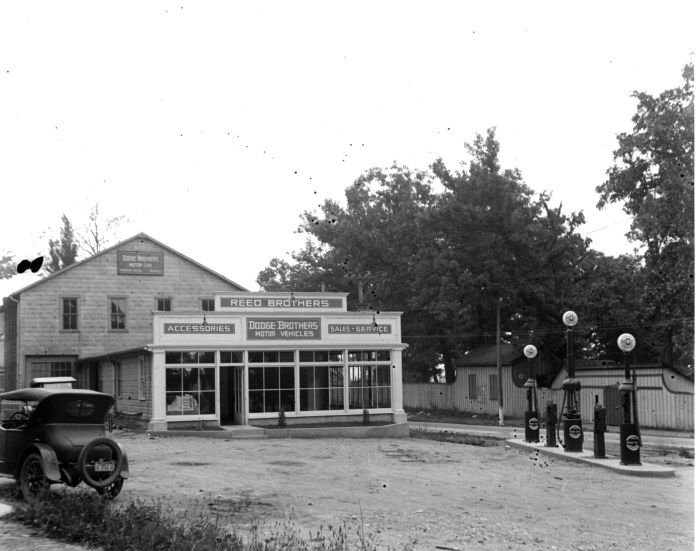
Reed Brothers Dodge, 1922. The original part of the garage was converted into a new car showroom and the service operation was moved out into the rear portion of the building. Note the “modern” gas pumps. The Rockville Fair Grounds are beyond the boarded fence.
I enjoy solving mysteries and digging deep to find information on vintage motor vehicles and today I am sharing what has turned up in my research.
I found an interesting article in the Motor Age, Volume 41, March 23, 1922 on page 16, titled – General Motors Develops Motor Bus, and I have extracted the article as follows:
A twenty-passenger motor bus was introduced by the General Motors Truck Company, Pontiac, Michigan, which is mounted on a chassis designed for this type of body. By combining a long wheelbase with long, flexible semi-elliptic springs together with 36 by 6 in. cord tires, easy riding qualities have been the result. The body overhangs the frame slightly which, it is said, eliminates much of the side-sway and whipping more or less common with buses mounted on a wheelbase length considerably shorter than the body. The frame on the chassis overhangs the rear axle but slightly.
The standard G.M.C. 2-ton powerplant is used and it is claimed that a road speed of 30 miles an hour, to which the bus is governed, is readily obtainable. In test, the bus fully loaded, was driven at 25 miles per hour up to a 4% grade on high gear. The G.M.C. 4 x 5 1/2 in. powerplant, which has been described in these pages, incorporates features such as removable cylinder sleeve, removable valve lifter assemblies, pressure lubrication, dual cooling, hot-spot vaporization, etc, and the governor equipment is a fly-ball type which has also been described.
The bus body for this new equipment is furnished with two seating arrangements, one adapted particularly to inter-urban bus operation and the other designed for city passenger work. The body is built of oak reinforced with metal and is finished outside in smooth paneled surfaces. In order to accommodate the narrow roads, the bus has been built to a width of 74 in. and the seating arrangement has been made to correspond with this width without sacrifice to comfort of balance.
The interior of the bus is finished in paneled oak with rattan seats. The equipment is complete including non-rattling adjustable windows, complete buzzer signal system, front entrance door controlled from the driver’s seat and rear emergency door. The equipment also includes a rear vision mirror, dome lights and an advertising card rack. The fuel tank is located outside and is filled from outside without inconvenience or fire risk. The fuel is fed to the engine by vacuum system.
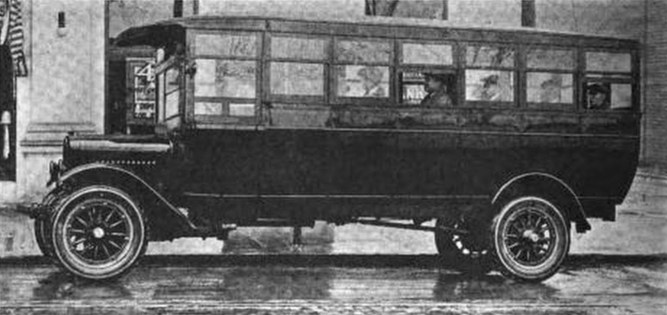
1922 GMC 20-passenger motor bus
Lewis Reed Photo to Appear in PBS Documentary
Rare peak of the inside of an early 1920’s trolley car taken by Lewis Reed, a well-known photographer in Montgomery County, as well as owner and founder of Reed Brothers Dodge of Rockville, Maryland.
The photo will be featured on PBS “American Experience” documentary, “The Great War” a three-night event exploring how World War I transformed America starting Monday, April 10 on PBS. The trolley image is in Episode 3, Wednesday night, between 38-40 minutes into the show. From 1900-1935, the trolley cars – or street cars, as they were also known – went past Reed Brothers Dodge as they traveled up Rockville Pike. Major stops along the line included Georgetown, Alta Vista, Bethesda, Montrose, Halpine, the Fairgrounds, Courthouse Square, and Chestnut Lodge. Panels for advertising line the edge of the ceiling on both sides of the trolley. Instead of AC, the interiors were cooled with wooden ceiling fans. (click on image to enlarge)
The print was originally made from a glass negative, an early photographic technique which was in common use between the 1880s and the late 1920s. The early 1900s were considered by many to be the golden era of early photography, because of its new availability to the public and somewhat simplified production methods. Many of Lewis Reed’s early photographs are now part of the Montgomery County Historical Society photo archives.
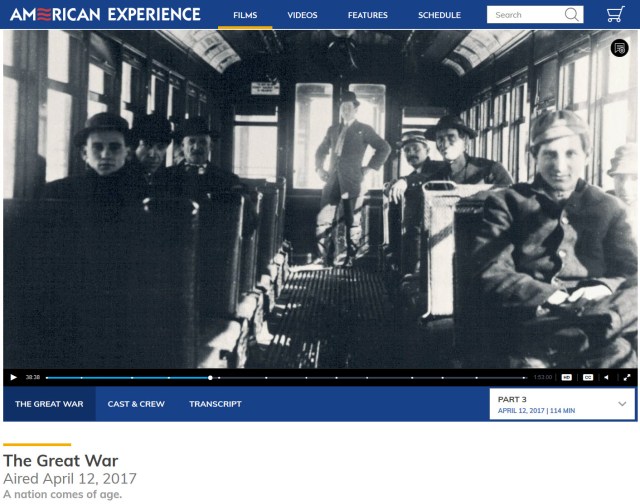
Rare peak of the inside of a 1920’s trolley car and passengers featured in PBS documentary “The Great War”. Photo taken by Lewis Reed

Screen shot of credits from The American Experience series, “The Great War” on PBS
Books

Related Resources


Copyright Notice

Reed Brothers Dodge History (1915-2012) by Jeanne Gartner is licensed under a Creative Commons Attribution-NonCommercial 3.0 Unported License.
 Reed Brothers Dodge History 1915 – 2012
Recent Comments