
Then & Now: Emmanuel Episcopal Church (Cumberland, Maryland) 1912
Cumberland is known as the “Queen City of the Alleganys.” The National Road, the Baltimore and Ohio Railroad, and the Chesapeake and Ohio Canal pass through the town, which was once an Ohio Company outpost and the westernmost part of the British Empire in North America. Cumberland has changed from a trading site to a manufacturing locality, to a tourist haven over many generations.
For this post, I have used one of Lewis Reed’s original photographs for “then” and a google stock image for “now”. Taken over 113 years apart, you can see how the Emmanuel Episcopal Church in Cumberland, Maryland looks almost the same from over a century ago.
Emmanuel Episcopal Church (THEN): The Emmanuel Episcopal Church of Cumberland, Maryland in Cumberland’s Historic District is built on the foundations of Fort Cumberland, where George Washington began his military career. Although the Emmanuel parish dates from 1803, the cornerstone of the current native sandstone building was laid in 1849 and completed in 1851.
Standing at the eastern end of the Washington Street Historic District, it is one of Maryland’s examples of early Gothic Revival architecture. The church is on the former site of Fort Cumberland, and earthwork tunnels remaining from the fort run under the church. The church was constructed around 1850 and designed by Philadelphia architect John Notman.

Emmanuel Episcopal Church Cumberland, 1912. Photo by Lewis Reed
Emmanuel Episcopal Church (NOW): Emmanuel Episcopal Church is active and continues to service the city of Cumberland. Emmanuel Church is part of the Episcopal Diocese of Maryland. The church allows self-guided tours of the stained glass; the church also offers guided tours of the tunnels. Make contact with the church in order to arrange a tour. Emmanuel Episcopal Church is part of the Washington Street Historic District, which is on the National Register of Historic Places.
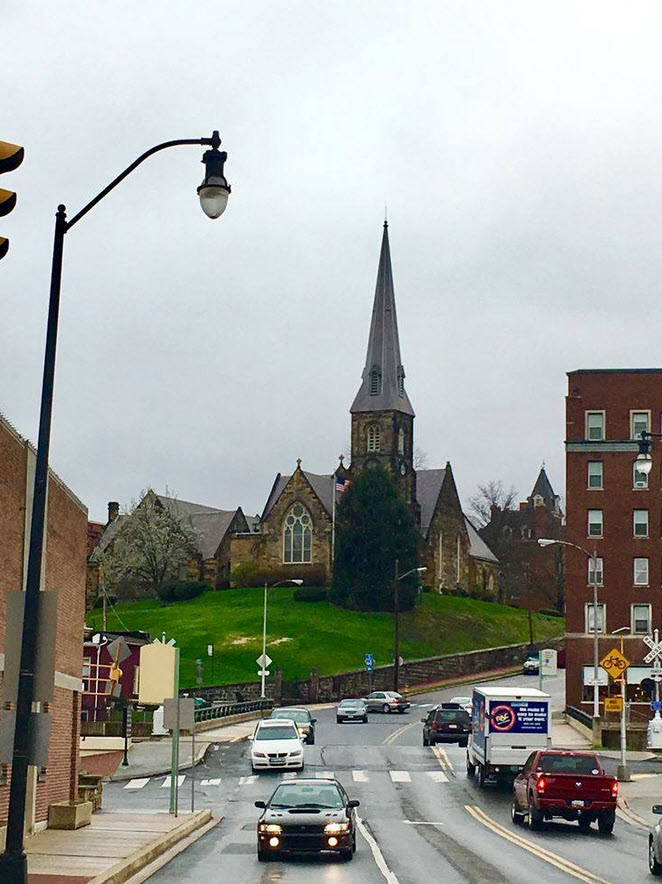
Emmanuel Episcopal Church Cumberland today. Google image.
Source: Wikipedia
Then & Now: The New Raleigh Hotel Washington DC, 1912
Some of the city’s oldest hotels not only have a long history of storied visitors and impressive tales, but they’ve shaped the city’s landscape for decades and perhaps centuries. However, for every Hay-Adams, Willard Continental and Morrison-Clark, there’s a hotel like the the Raleigh Hotel that’s either been converted and or destroyed entirely.
Raleigh Hotel (THEN): Along with the Willard, the Raleigh Hotel was one of the largest and grandest hotels in Washington in the first part of the twentieth century. It held a commanding position on Pennsylvania Avenue across from the Old Post Office Building and was famous as a Mecca for patrons of the performing arts. In 1911, the building was razed and rebuilt as a 13-story Beaux Arts hotel.
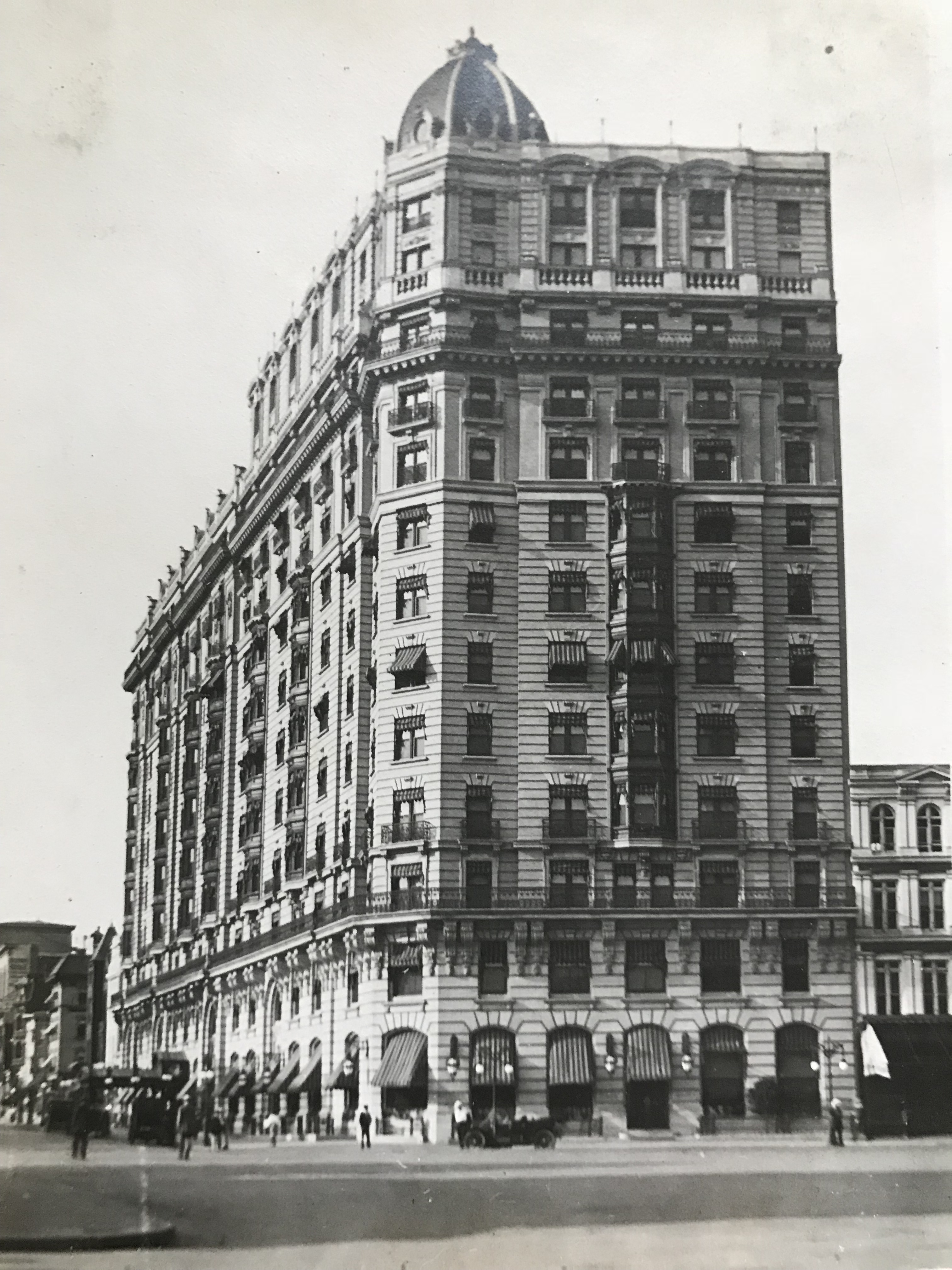
The recently completed Raleigh Hotel at Pennsylvania Ave and 12th Street NW, built on the site of the previous Raleigh Hotel. Photo taken by Lewis Reed, ca. 1912
Raleigh Hotel (NOW): The hotel closed in 1963, its furnishings were sold off, and it was demolished a year later. Its replacement, a 14-story office building at 1111 Pennsylvania Avenue, was completed in 1968, and it still stands on the site today.

The site of the Raleigh as it appears today.
Montgomery History Online Exhibit: Montgomery County, Then and Now
Montgomery County, Then and Now: Photography of Lewis Reed and Barry Gartner
Opened December 6, 2023
Curated by Jeanne Gartner and Sarah Hedlund
Montgomery County: Then and Now, offers a captivating visual journey through more than a century of local history, told through rare photographs by Lewis Reed and his grandson Barry Gartner. This site presents side-by-side comparisons of historic scenes photographed by Reed between 1900 and 1930 and contemporary color images recreated from those same vantage points by Gartner in 2023, illustrating the dramatic changes, and sometimes surprising continuities, in the landscape, infrastructure, and community life of Montgomery County, Maryland.
Visitors are invited to explore stories behind each image, discovering the evolving character of familiar places as trees mature, buildings disappear, roads shift, and horse-drawn buggies give way to automobiles. The exhibit also delves into the personal histories of its featured photographers: Lewis Reed, remembered for his pioneering photography before founding Reed Brothers Dodge in 1915, and Barry Gartner, a third-generation owner who honors his grandfather’s legacy through both automotive restoration and modern photography.
A unique feature of the exhibit is the interactive map links accompanying each photo pair, allowing viewers to pinpoint the exact locations where history meets the present moment. Through this dynamic blend of archival and modern visuals, Montgomery County: Then and Now deepens our appreciation for local heritage and the passage of time, connecting generations through the lens of two accomplished photographers dedicated to capturing the changing face of their community.
This online exhibit opened December 6, 2023, and is thoughtfully curated by Jeanne Gartner and Sarah Hedlund, providing rich historical context and insight into the fascinating process of recreating these historical photographs. The full exhibition is available online at https://sites.google.com/view/mocothenandnow/home
Then & Now: Baltimore & Ohio Railroad, Point of Rocks Tunnel
This post is a continuation of a series of “Then & Now” images from Lewis Reed’s Photo Collection alongside photographs of how they appear today. Lewis Reed worked hard to preserve a visual history of Montgomery County, Maryland and surrounding area long before automobiles were even around. As early as 1905, he toured on his motorcycle across the states of Maryland, Virginia, and Washington, D.C. and took photographs of many historic locations. Taken over 112 years apart, you can see how the Point of Rocks Train Tunnel in Maryland looks almost the same from over a century ago.
Point of Rocks Tunnel (THEN): Just west of the Point of Rocks Train Station is the Point of Rocks Tunnel. The original single-track main line is the track on the far left which goes around the cliff. A boxcar is visible just to the left of the tunnel opening. The tunnel was completed in 1902 when it became necessary to add a second track. The tunnel portal has a brick facade with the bricks forming the words, “Point of Rocks” above the opening. Just over the river bank from the original main line was the Chesapeake & Ohio Canal (C&O). Space is tight there and the railroad and canal folks were often at odds. A wall between the two was constructed to help ensure the trains did not scare the mules pulling the canal boats.
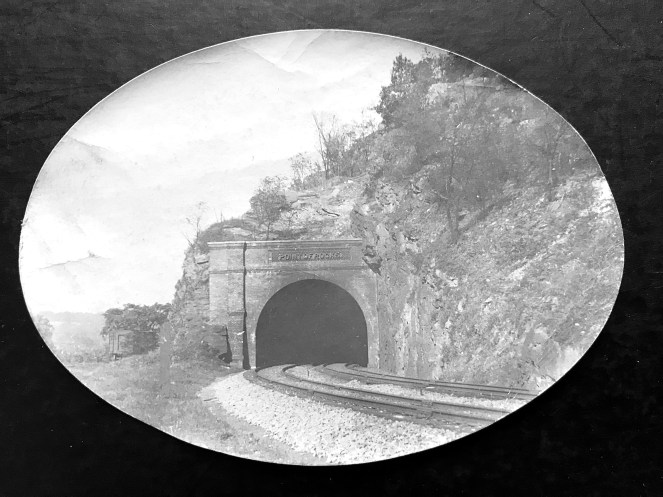
Point of Rocks Train Tunnel, 1911. Photo by Lewis Reed
Point of Rocks Tunnel (NOW): The tunnel was enlarged in 1902 to accommodate larger trains. In the early 1960s, the eastbound track was moved to the outside of the tunnel to accommodate still larger trains. This was done by blasting the rocks on the old alignment outside the tunnel, enlarging the road bed, and dumping the excavation rocks into the canal bed, where they remain today.
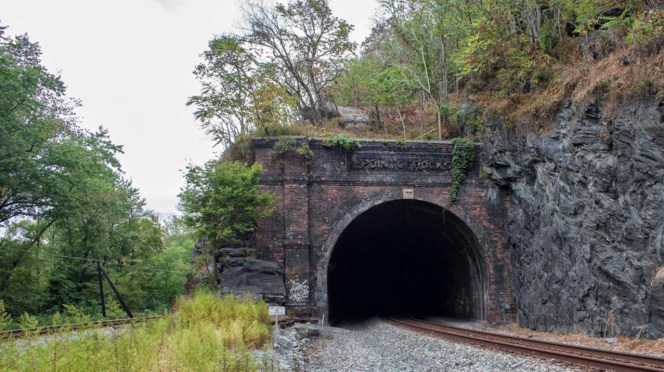
Point of Rocks Train Tunnel today
Then & Now: 1st National Bank of Monrovia
This post is a continuation of a series of “Then & Now” images from Lewis Reed’s Photo Collection alongside photographs of how they appear today. Lewis Reed worked hard to preserve a visual history of Montgomery County, Maryland and surrounding area long before automobiles were even around. As early as 1905, he toured on his motorcycle across the states of Maryland, Virginia, and Washington, D.C. and took photographs of many historic locations. Taken approximately 113 years apart, you can see how the 1st National Bank of Monrovia Maryland looks almost the same from over a century ago.
1st National Bank of Monrovia (THEN): In 1908, the First National Bank of Monrovia was founded and the Renaissance Revival bank building was erected. The bank was merged with the Central Trust Company in 1916 and closed in the early 1930’s in the aftermath of the 1929 stock market crash and ensuing Great Depression of the 1930’s.

1st National Bank of Monrovia. Photo by Lewis Reed, 1910
1st National Bank of Monrovia (NOW): The bank is now the office of a construction company.
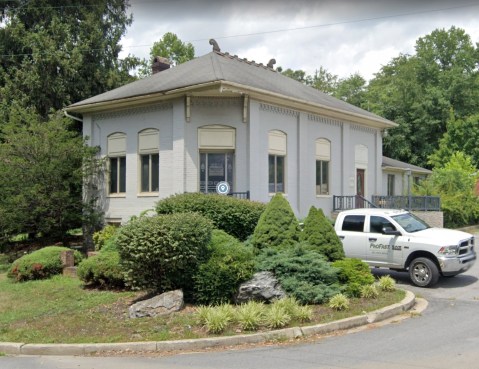
The 1st National Bank of Monrovia today is still very recognizable
Source: Monrovia, Maryland – Wikipedia
Books

Related Resources


Copyright Notice

Reed Brothers Dodge History (1915-2012) by Jeanne Gartner is licensed under a Creative Commons Attribution-NonCommercial 3.0 Unported License.
 Reed Brothers Dodge History 1915 – 2012
Recent Comments