
Rockville Academy Basketball Team 1915-1916
Before opening his Dodge dealership in 1915, Lewis Reed was a well-known amateur photographer in Montgomery County. He would occasionally get phone calls local high schools asking him to take pictures of their athletic teams and graduating classes.
This photo taken by Lewis Reed depicts the Rockville Academy Basketball Team of 1915-1916. Finding photos and information of basketball teams before the 1920s is a difficult task. The only information on this team that I could find was in the May 1981 edition of “The Montgomery County Story” and the news clipping just below it from the Washington Times. From the newsletter:
In 1915, Rockville High School organized an athletic association. They planned teams in baseball, football, and basketball. They quickly lost their first game of basketball to Rockville Academy, 29 to 26.

Rockville Academy Basketball Team 1915-1916. Photo Lewis Reed
Back: Roy Hilton, Lester Witherow, Grubb, Hamilton, Edmonds
Middle: Lawrence Higgins, Joe Dawson, Brownell (Buck) Riggs, J. Vinson Peter, John McDonald
Front: John Dawson

The Washington Times January 24, 1915
The Montgomery County Historical Society has identified several people in the photograph. If anyone can help put a name to a face, please leave a comment.
Source: The Montgomery County Story
Lewis Reed Photo: Old Country Store

Circa 1900s country store on a dirt road. Note the sign advertising Battle Axe Shoes. Two ladies standing on the porch. Location Unknown. Photo by Lewis Reed
This early 1900s photo taken by Lewis Reed is a flashback to a time when the clip-clop of horses could be heard going down the street, kids would walk to school, and people took the time to care about and create things that would last. This old store would have been considered not very clean from modern standards and the roads outside were unpaved.
While every store was different, there were similarities among many, including a front that was decorated by tin sign advertising, tobacco, cigars, shoes, hardware, and more. The sign in front advertises Battle Axe Shoes, Stephen Putney Shoe Company. I did a little research and found out Samuel and Stephen Putney were father and son shoe manufacturers of Battle Axe Shoes in Richmond, Virginia.
Usually, country stores featured double doors that opened inward and lots of barrels that might contain any number of items — from pickles, to crackers, potatoes, flour and candies. The store was usually an unpainted, two-story frame building fronted by a raised porch for convenient loading and unloading.
One thing in this photo I can’t explain are the steps seemingly leading to nowhere on side of the building. And I wonder what the tall pole is for? It seems to be bracketed on the side of the building. Ideas, folks?
The Putney’s owned and ran Battle Axe Shoes, and had this factory on 2200 West Broad Street as touted by the 1909 Postcard below.
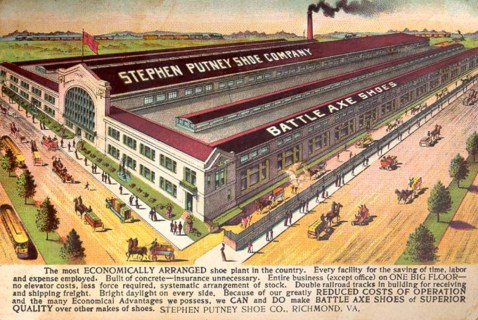
By the way, it appears as if the writer of this postcard was a big fan of CAPS-lock to get his point across.
Impressive….
And environmentally friendly to boot! (Pun intended)
The postcard reads:
“The most ECONOMICALLY ARRANGED shoe plant in the country. Every facility for the saving of time, labor and expense employed. Built of concrete – insurance unnecessary. Entire business (except office) on ONE BIG FLOOR – no elevator costs, less force required, systematic arrangement of stock. Double railroad tracks in building for receiving and shipping freight. Bridge daylight on every side. Because of our greatly REDUCED COSTS OF OPERATION and the many Economical Advantages we posses, we CAN and DO make BATTLE AXE SHOES of SUPERIOR QUALITY over other makes of shoes. STEPHEN PUTNEY SHOE CO., RICHMOND, VA.”
Reed Brothers Baseball Team, 1920
Rockville’s first experience with baseball was during the Civil War on the fields where Richard Montgomery High School now stands. It was known as “Camp Lincoln” because of the Union encampment there, and Federal soldiers helped popularize the new game they brought from the North. One little known part of the history of the grounds is that during the Civil War, President Abraham Lincoln was afraid that Maryland would secede from the Union and that the District of Columbia would thus be bordered on both sides by Confederate states. He used the land of the fairgrounds for tents to maintain up to 10,000 Federal soldiers at a time in order to do his utmost to keep Maryland, especially via the major thoroughfare of Rockville Pike, within the Union.
After the Civil War, those fields – known as the Rockville Fairgrounds – continued to be a popular place for baseball. At the dawn of the 20th century, Reed Brothers Dodge had their own company baseball team that played on those same fields. The photos below were taken by Lewis Reed on a field at the Rockville Fairgrounds in the early 1920s.
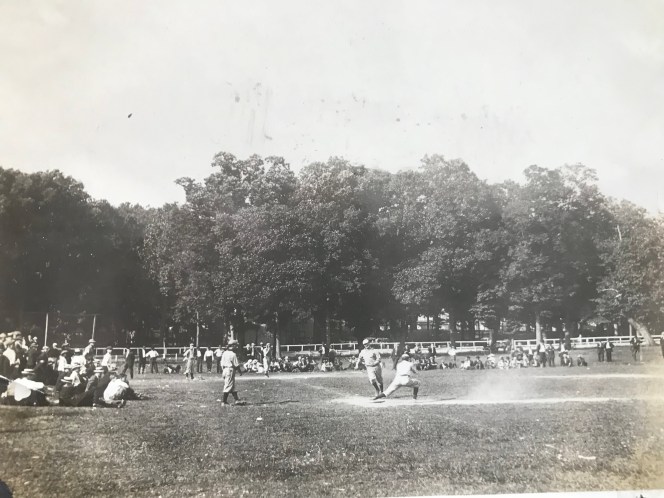
Reed Brothers Dodge Baseball Team on field at Rockville Fairgrounds, circa early 1920s. Photo by Lewis Reed
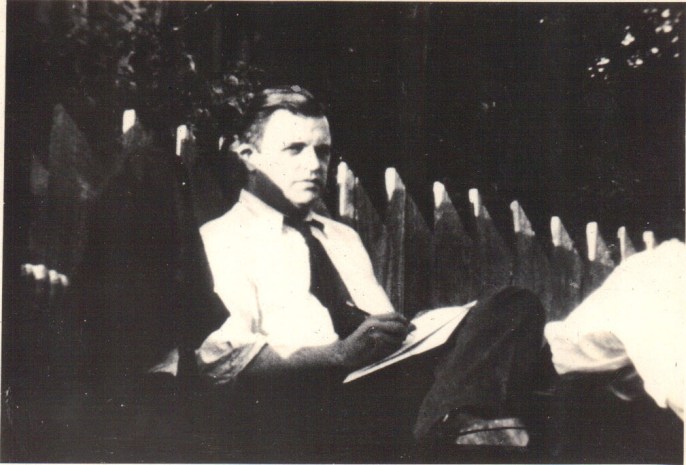
Leo (Pat) Murray (Parts Department Manager), keeping score. Photo by Lewis Reed

Reed Brothers Dodge Baseball Team on field at Rockville Fairgrounds, circa early 1920s. Photo by Lewis Reed
Note the player with the five finger glove in the photo above. Out of all of these photos, this is the only glove that can be seen on a player. The use of gloves wasn’t original to the first years of the game; needing a padded glove was viewed as pretty wimpy. (According to this article in the Smithsonian Magazine, one of the first players to wear a glove tried – and failed – to find one that would be invisible to fans.) By the 1880s gloves were accepted equipment, however, and soon inventors and manufacturers were coming up with new and improved gloves (more padding, deeper webbing…)

Reed Brothers Dodge Baseball Team, circa early 1920s. This photo was taken at Welsh Field, which is the site of the County Office Building. The house in the background was in right field. Photo by Lewis Reed
Lewis Reed: Enters 1936 Amateur Photo Contest
The Star published a series of pictures reproduced from photographs taken by local amateurs. The pictures were selected and judged each week and the best one chosen on its merits and published the following Sunday. Lewis Reed submitted his photo, “Sunset Over the River”, in the Washington Star Best Snapshots of the Week in The Star’s Amateur Contest. There was no indication where the photo was taken, but I’m guessing it was probably on the Potomac River, Maryland. At the time, Lewis Reed would have been 49 years old. There was no mention of whether or not he won a prize for his photograph, but I’m not surprised he entered this contest. He was a passionate photographer and always had his camera with him.
The full page image below is from the Sunday Gravure Section of The Washington Star newspaper. When looking at the top of the page, I wondered what the term “Gravure” meant, so I “googled” it. Turns out gravure refers to the special newspaper sections of photographs which were printed with this process starting around the late 1800s. In the 1930s, newspapers published relatively few photographs and instead published separate gravure sections in their Sunday editions. These sections were devoted to photographs and identifying captions, not news stories.

Full page image from The Sunday Star, Washington, D.C. – Gravure Section – June 28, 1936.

“Sunset Over the River” taken by Lewis Reed in 1936
Lewis Reed was a well-known photographer in Montgomery County and many of his photographs are now part of the Montgomery County (Maryland) Historical Society photo archives. His photography has appeared in highly regarded history books such as, “Montgomery County: Two Centuries of Change” by Jane C. Sween, “Montgomery County (Then & Now)” by Mark Walston, “Montgomery County (MD) Images of America”, by Michael Dwyer, “Rockville: Portrait of a City” by Eileen S. McGuckian, and “Gaithersburg: History of a City”. His photographs have been featured in the Norris-Banonis Automotive Wall Calendar, on the national television show, American Pickers, and on television’s most watched history series, American Experience on PBS.
Wright Flyer Test Flights at Fort Myer, VA
On this day in September 17,1908, the first military airplane in the world, built by the Wright brothers for the Army Signal Corps, made its first flight at Fort Myer, Virginia. Less than a thousand people witnessed the first flight at Fort Myer, because the general public was still doubtful that powered flight had been achieved. But Lewis Reed was there… and to commemorate that milestone, I have posted six original snippets of history that Lewis Reed captured through the lens of his camera that day.

Wright Brothers Military Flyer in its hangar at Fort Myer, Virginia. Photo by Lewis Reed
Five years after the first successful flight at Kitty Hawk, Orville Wright and Thomas E. Selfridge test flew the Wright Flyer in a demonstration for the U.S. Army at Fort Myer, VA. The Army was considering contracting Wright’s aircraft to use as a military airplane, but, in order to win the contract, he needed to demonstrate the plane’s ability to carry a passenger. Twenty-six-year-old Lt Thomas E. Selfridge volunteered to be a passenger that day. Orville Wright succeeded in keeping the Wright Flyer aloft for one minute and 11 seconds. After more than four minutes in the air, the airplane crashed to the ground from a height of about seventy-five feet after a propeller blade broke and the machine went out of control. Orville Wright was severely cut and bruised and his passenger, Lt. Thomas Selfridge, became the first powered-aviation fatality.

Another early aircraft from 1909 was the Bleriot XI monoplane. Photo by Lewis Reed

Curtiss Model D. Photo by Lewis Reed

Curtiss Model D with tricycle undercarriage. Photo by Lewis Reed

Wright Model B with skids. Photo by Lewis Reed
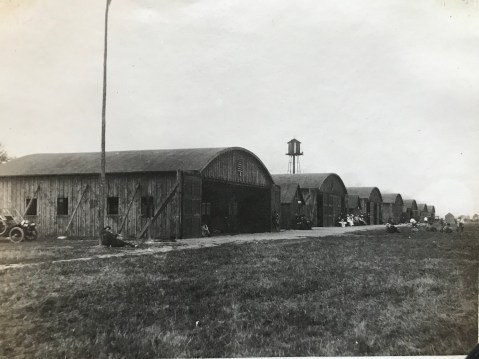
Airplane Hangars at Fort Myers, Virginia. Photo by Lewis Reed
The Wrights would prove their machine’s qualifications at Fort Myer. They met or exceeded all of the Army’s specifications, including flying at 40 miles per hour, carrying a combined passenger weight of 350 pounds, maneuvering in any direction in the air, landing without damage, and flying for at least an hour non-stop, which was a world record at the time.
Books

Related Resources


Copyright Notice

Reed Brothers Dodge History (1915-2012) by Jeanne Gartner is licensed under a Creative Commons Attribution-NonCommercial 3.0 Unported License.
 Reed Brothers Dodge History 1915 – 2012
Recent Comments