
Lewis Reed Photo: Lady & Toddler on a 1913 Excelsior
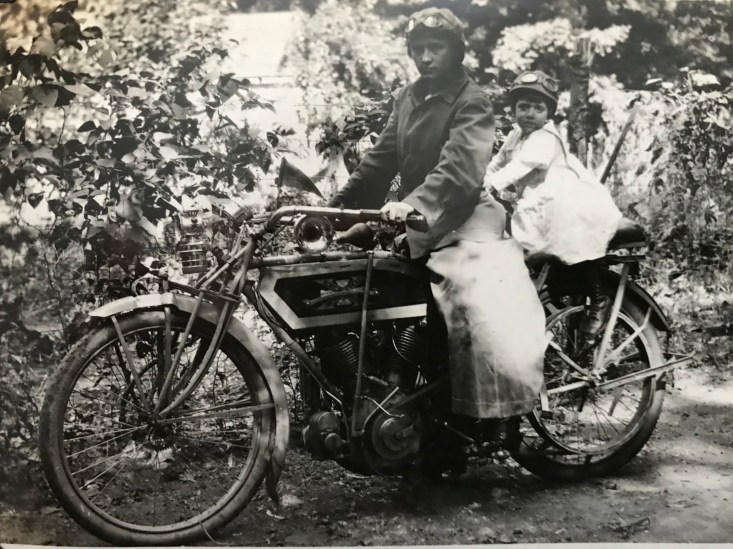
Unknown lady and toddler posing on an Excelsior motorcycle. Photo by Lewis Reed
Back in the early part of the last century when the motorcycle was still new and a novelty, it was often used for Kodak moments.
Lewis Reed has a number of photographs showing relatives and other unknown people on their motorcycles in the period of the early 1900s through the early 1920s. This photo taken by Lewis Reed is an unknown lady and a toddler (mother/daughter?) posing on an Excelsior motorcycle. The motorcycle was easy to identify because of the logo, but I could not pinpoint the exact year it was made. I tend to think it might be a circa 1913-1914 model Excelsior.
This is, without question, one of the best posed photos on a motorcycle that I have come across in my grandfather’s albums. The toddler’s sporty little cap and goggles make the image. Just imagine how excited she must have been to sit on that big machine.
The motorcycle seems to be well equipped with extras including: a headlamp, a handlebar-mounted Klaxon horn, and a well padded passenger seat on the back.
Early Car Starters: How Did Old Cars Start?

Lewis Reed hand cranking an old car. The hammer in Lewis Reed’s right hand is for straightening the hand crank. Apparently they can bend when starting big engines. The license plate is MD 10307 dated 1913.
Today, we take the starting of automobiles for granted. Simply place the key in the ignition, turn, and VROOM, the engine starts. Vintage cars from from the 1900s and 1910s were comparatively archaic and limited in their mechanical features. Even starting these old relics was difficult because the process involved a number of complicated steps that the driver had to perform in the correct order.
However, this was not always the case. Hand cranks were the most common type of engine starters in the early days of the automobile. Cars in the early parts of the century had to be started by hand. This was accomplished by turning a crank, usually located in the front of the automobile. The driver would literally “crank the engine” by turning the handle, which would allow the process of internal combustion to begin. After a given number of cranks, the engine would begin to run on its own, and the crank could be removed.
Although hand crank starters were simple and reliable, they suffered from a handful of drawbacks. The main issue with this method of starting an engine is that it is inherently dangerous to the operator. For instance, if an engine kicks back during the cranking process, the operator could get TKO’d by the hand crank. Although many of these cranks used overrun mechanism, there was also a potential for injury if the handle continued to turn after the engine started running.
The other main issue with hand crank starters is that it took a certain degree of physical effort to turn them. That meant anyone who lacked the necessary physical strength or dexterity was incapable of starting a vehicle equipped with this type of starter.
By 1920, nearly all manufacturers were producing cars equipped with starters making it easy for anyone, regardless of physical abilities, to start a car by pressing a button mounted on the dash or floor. An ignition on and starter engage switch operated by a key was introduced by Chrysler in 1949.
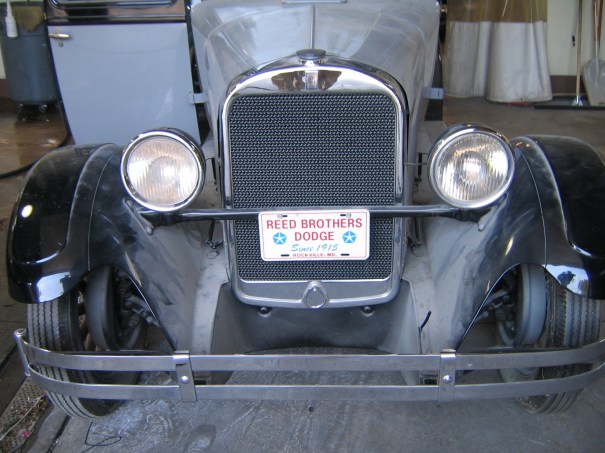
1928 Dodge Brothers Standard Six had both hand crank and starter. I’m assuming the crank was a backup in case the starter failed. The crank hole cover can be seen just below the front grill. Photo by Reed Brothers Dodge
Several new mechanical innovations were included in the 1946 Dodge Deluxe models. Among them were the introduction of the famous Fluid-Drive, a push-button starter system. The dash-mounted button on the 1946 Dodge Deluxe pictured below activated a solenoid, which in turn engaged the starter. For the first time since 1928 there was no provision made to manually hand crank the engine.

The push button starter on this 1946 Dodge Deluxe Fluid Drive was located on the far left, below the instrument gauges. Photo by Reed Brothers Dodge.
Kensington VFD Firetruck Truck from Reed Brothers Dodge

This photo was on the Kensington VFD web page. The trucks in front appear to be c. 1920s.
I was doing some online research and stumbled upon the Kensington (Maryland) Volunteer Fire Department’s web page. Their history is quite amazing, actually. Especially when I realized that their first truck was purchased from Reed Brothers Dodge. It was not a complete truck when purchased, however.
From the Kensington Volunteer Fire Department’s “History” webpage:
1922 was the birth of the Kensington Volunteer Fire Department. With little money, a Dodge truck was purchased from Reed Brothers Dodge in Rockville. A custom fire body was then built and fitted on the truck by Jacobs Brothers in Gaithersburg who ran the Wheelwright Shop on East Diamond Avenue. To raise money, the volunteers held carnivals. The Fire Department incorporated in 1925, and two years later moved into a permanent home in the basement of the National Guard Armory.

Photo of a c. 1920 Dodge fire truck
Lewis Reed later became a charter member and President (Feb.1933 – Feb 1937) of the Gaithersburg – Washington Grove Volunteer Fire Department.
“In My Merry Oldsmobile” …100 Years Ago
Come away with me, Lucille: In my merry Oldsmobile: Down the road of life we’ll fly: Automo-bubbling, you and I….
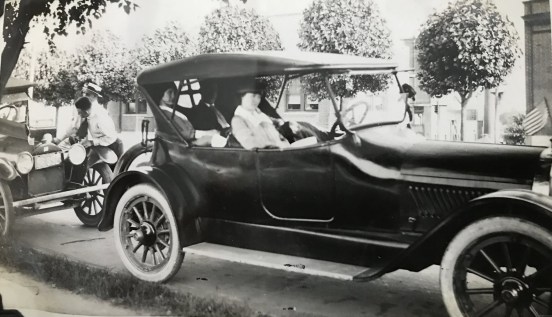
Ethelene Thomas Reed, who married Lewis Reed in 1921, is sitting in passenger seat of a circa 1918 Oldsmobile Club Roadster and her sister, Celeste Thomas Brown, is sitting behind her in the back seat. Photo by Lewis Reed
One of the things I enjoy doing is looking through all of the old photographs in my grandfather’s albums and trying to figure out who and what they are. I came across these two photographs and recognized the passengers, so thought it would be fun to try and identify the car, so I went on a quest. After spending some time viewing images of four brands of cars of the period with a similar appearance, I found it looks a lot like the two-door, four-passenger 1918 Oldsmobile Club Roadster pictured below. Looks the same to me. What do you think?
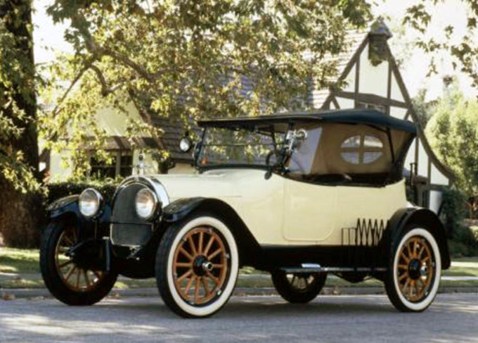
Fully restored 1918 Oldsmobile Model 45A Club Roadster – Reference Vehicle
Back in the early part of the last century when the automobile was still new and a novelty, it was often used for Kodak moments. Both old photographs show the same two young women posing in them – one is my grandmother, Ethelene Reed, who married Lewis Reed in June 1921, and the other is her sister, Celeste Thomas Brown.
Vehicles from that era are fascinating and are often photographed with equally fascinating surroundings. I wonder what the two dapper young men were repairing on the car in the top photo?

1918 Oldsmobile Roadster shown with Ethelene and her sister Celeste behind the wheel. Photo taken by Lewis Reed at the Clinton Clay Thomas family farm which was located on Butterfly Lane in Braddock, Maryland.
Lewis Reed’s Rockville Garage sold more than just Dodges. During the early years, Reed Brothers represented several franchise nameplates along with Dodge, including Oldsmobile, Hudson and Essex. The Hudson and Oldsmobile were sold at Reed Brothers from roughly 1917 through 1923.
The first advertisement below, distributed by the Oldsmobile Sales Company in the Sunday, June 29, 1919 edition of The Washington Post is the very first ad in which the Rockville Garage appeared. Dealers are listed in fine print at the bottom: note “Rockville Garage, Rockville, Md” which is highlighted in yellow.
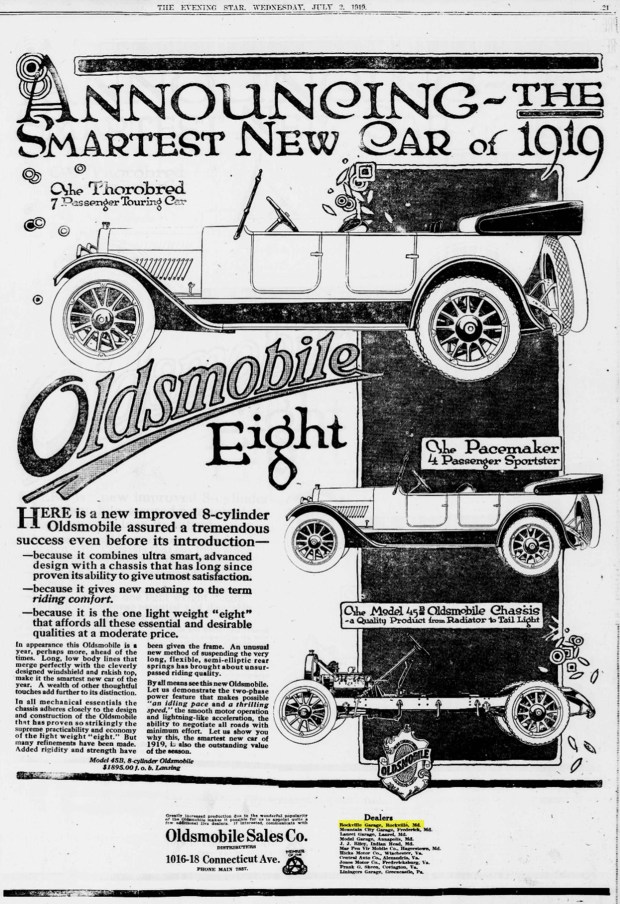
1919 Oldsmobile Model 45-B Rockville Garage Ad – The Washington Post – Sunday, June 29, 1919, Washington, District Of Columbia
This is a fun little song recorded in 1909. An Oldsmobile must have been quite the toy when this was recorded. From an old single sided VICTOR RECORD COMPANY 78 rpm record. Enjoy!
Dodge Made a Car Just for Women
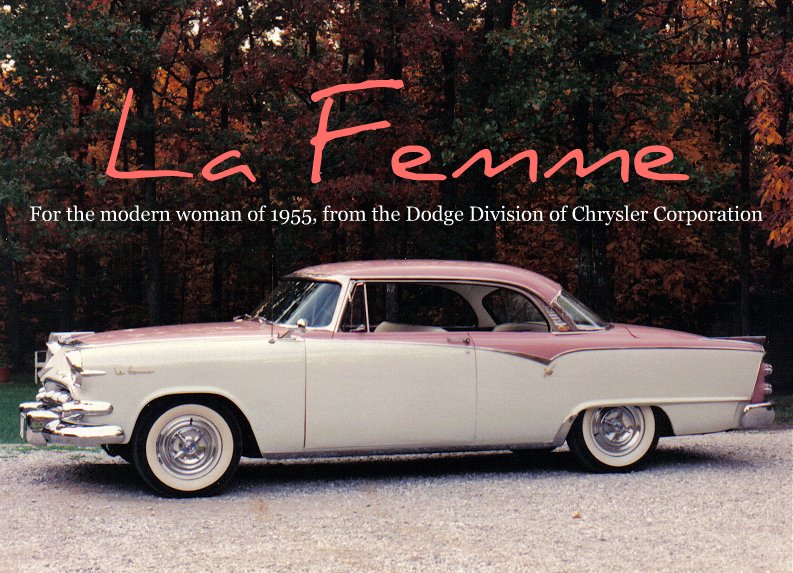 The Dodge La Femme stemmed from Chrysler’s marketing department’s observation that more and more women were taking an interest in automobiles during the 1950s, and that women’s opinions on which color car to buy was becoming part of the decision making process for couples buying an automobile. The La Femme was an attempt to gain a foothold in the women’s automobile market.
Dodge introduced the new La Femme option package in 1955: For $143, you could have the Custom Royal Lancer feminized, with rose paint, gold script, and a nauseating shade of Pepto-pink interior complete with rosebuds.
The accessories which came with the car as standard equipment were where things started getting weird. The car came with a calfskin purse in the same shade of pink as the car’s interior. There was a special compartment behind the passenger seat for this purse, where it could sit with the buckle facing outward. This buckle was large enough for owners to have their name engraved on them, and this is what they were encouraged to do. Inside the purse there was a makeup compact filled with pale pink powder, a lipstick holder, a gold-toned cigarette lighter and case, an imitation tortoiseshell comb, a cigarette lighter, a vanity mirror and silk change purse.
These accessories were all finished in gold-color metal and (you guessed it) pink. For those who wanted them, Dodge also offered an umbrella, boots, a cape (seriously?) and a hat, all matching the seat upholstery.
It went nowhere. La Femme became La Flop. Women stayed away in droves and men weren’t about to be seen driving around in the darling Rosebud. The Dodge La Femme was sold for two years in the U.S. — 1955 and 1956
(Line from a long-lost episode of “Leave it To Beaver”)
“Gee Wally…. all the guys are callin’ me a sissy…. a pink and white car and it says La Femme on the side …. I just can’t be driven to school in mom’s new car anymore …. Yeah, Beave …. I know what ya mean …. that’s why I ride with Eddie …. and besides, mom’s not all that thrilled with the car either!”
Info Source: Dodge La Femme Wikipedia
Books

Related Resources


Copyright Notice

Reed Brothers Dodge History (1915-2012) by Jeanne Gartner is licensed under a Creative Commons Attribution-NonCommercial 3.0 Unported License.
 Reed Brothers Dodge History 1915 – 2012
Recent Comments