
Original 1940s Reed Brothers Dodge-Plymouth Shop Coat
Pictured below is an original 1940s Reed Brothers Dodge-Plymouth three-pocket, service station shop coat made by Anderson Bros. of Danville, VA. The coat was previously worn by Marvin Shultz, Manager of Reed Brothers full service Gulf Gasoline and Service Station when it was located at the intersection of Veirs Mill Road and Rockville Pike. Marvin started working at Reed Brothers in 1941, and worked for 43 of the company’s 97 years before retiring in 1984 as a new car salesman.
I would like to express my sincere thanks to the Shultz family for sending me this shop coat, as it is the first, and only one, I have ever seen.

Plymouths were sold at Reed Brothers from 1930-1969, when the Plymouth brand was given to the Chrysler dealers.
The coat is made of Herring-Bone-Twill with dark blue cotton collar and cuffs. There is one large chest pocket with a thread embroidered “Shultz” sewn on. The coat has two large front hip pockets, hidden snap buttons on the center line, and snaps on the cuffs. It has a matching belt with side waist buckle and side vent openings. The metal buttons are concealed to prevent scratching cars, and the belt buckles on the side of the waist for this same reason. It is in excellent condition considering it is 70+ years old.
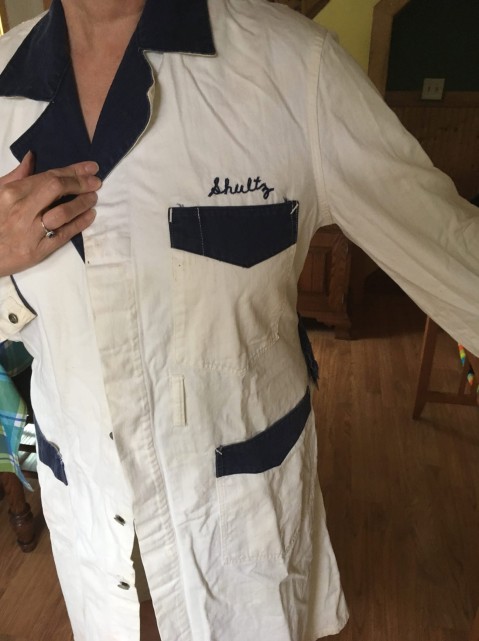
Service Station Work Coat for “Shultz”

Hemmed sleeves with snap buttons
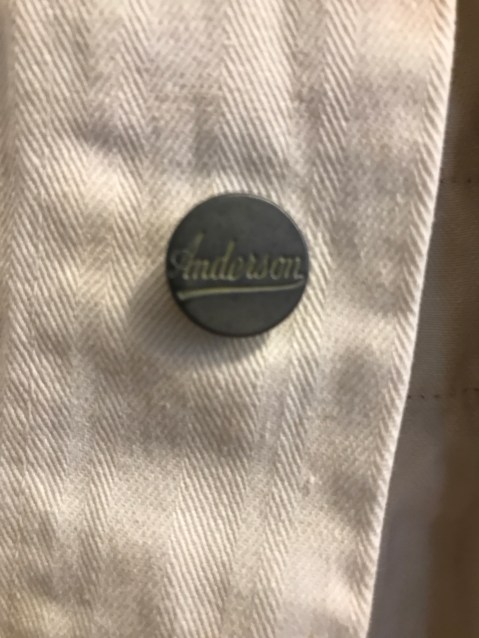
The metals buttons are stamped “ANDERSON”

Side waist buckle
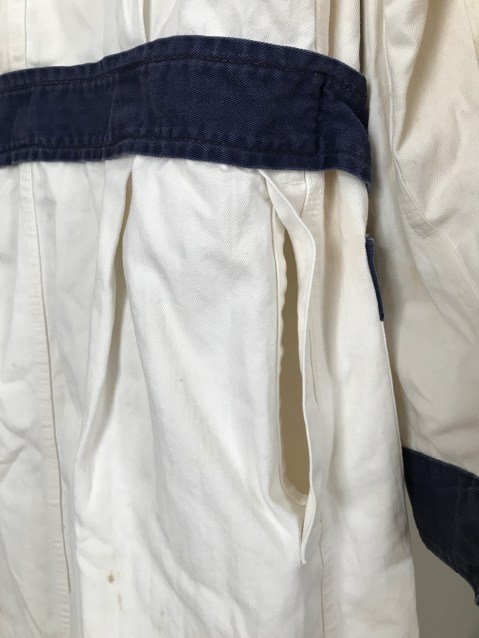
Side vent openings
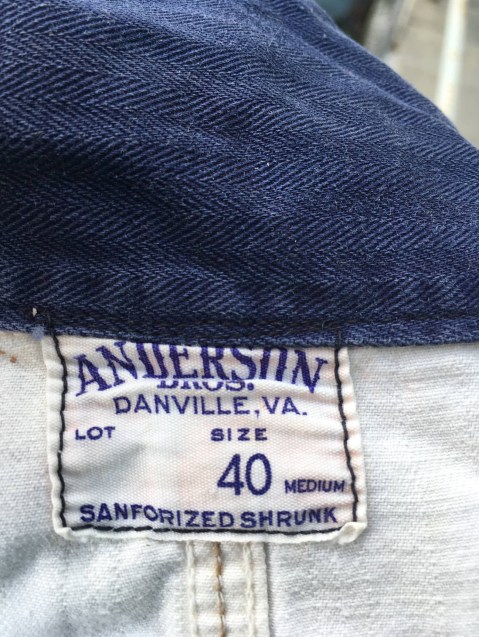
The tag in the neck reads as follows: “ANDERSON BROS. DANVILLE, VA., SIZE 40 MEDIUM, SANFORIZED SHRUNK”.
What is SANFORIZED SHRUNK? Good question… I had to “google” it to find out. Sanforization is a process that stabilizes the fabric before it is cut by stretching and shrinking it. Named after its inventor, Sanford Lockwood Cluett, it was patented in 1930. During the sanforization process, the material is fed into a sanforizing machine and moistened with water or steam to promote shrinkage. It is then stretched through a series of rubber belts and cylinders before it is finally compacted to its final size. Sanforizing ensures that the fabric will not shrink during production or wear.
Early uniforms were created to protect an employee’s arms, legs, and underclothes from getting grease, oil and other automotive related by-products on them. Similar styles of this uniform is still seen in many automotive garages today, as they protect an employee’s underclothing from the grease and oil workers are exposed to when working on cars. Almost all automotive uniforms today still include an embroidered name patch on one breast and a brand logo patch on the opposite breast of the shirt.
Dodge Made a Car Just for Women
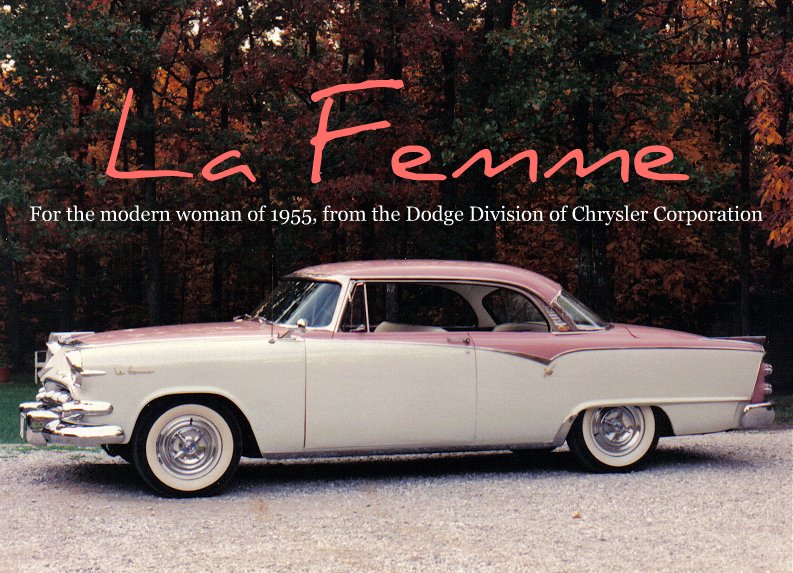 The Dodge La Femme stemmed from Chrysler’s marketing department’s observation that more and more women were taking an interest in automobiles during the 1950s, and that women’s opinions on which color car to buy was becoming part of the decision making process for couples buying an automobile. The La Femme was an attempt to gain a foothold in the women’s automobile market.
Dodge introduced the new La Femme option package in 1955: For $143, you could have the Custom Royal Lancer feminized, with rose paint, gold script, and a nauseating shade of Pepto-pink interior complete with rosebuds.
The accessories which came with the car as standard equipment were where things started getting weird. The car came with a calfskin purse in the same shade of pink as the car’s interior. There was a special compartment behind the passenger seat for this purse, where it could sit with the buckle facing outward. This buckle was large enough for owners to have their name engraved on them, and this is what they were encouraged to do. Inside the purse there was a makeup compact filled with pale pink powder, a lipstick holder, a gold-toned cigarette lighter and case, an imitation tortoiseshell comb, a cigarette lighter, a vanity mirror and silk change purse.
These accessories were all finished in gold-color metal and (you guessed it) pink. For those who wanted them, Dodge also offered an umbrella, boots, a cape (seriously?) and a hat, all matching the seat upholstery.
It went nowhere. La Femme became La Flop. Women stayed away in droves and men weren’t about to be seen driving around in the darling Rosebud. The Dodge La Femme was sold for two years in the U.S. — 1955 and 1956
(Line from a long-lost episode of “Leave it To Beaver”)
“Gee Wally…. all the guys are callin’ me a sissy…. a pink and white car and it says La Femme on the side …. I just can’t be driven to school in mom’s new car anymore …. Yeah, Beave …. I know what ya mean …. that’s why I ride with Eddie …. and besides, mom’s not all that thrilled with the car either!”
Info Source: Dodge La Femme Wikipedia
Tent Sales: What 90 Years of Change Looks Like
Pictured below are Reed Brothers tent sales 90 years apart, in 1918 and 2008. The black and white photograph below was taken by Lewis Reed in 1918 showing Rockville Garage displaying their new models at the Rockville Fair Grounds. The annual County Fair used to be held for four days in the month of August at the old Fairgrounds of Rockville, Maryland. Families came from every section of the Montgomery County in wagons and carriages, and stayed for the duration of the Fair. The Fair gave automobile dealers the opportunity to display their new models.

1918 Rockville Garage tent displaying Hudson Super Six, Oldsmobile, and Dodge Brothers Motor Cars at the Rockville Fair Grounds
The color photo below was taken some 90 years later in 2008, “Let’s Refuel America!” Tent Promo at Reed Brothers Dodge that let consumers lock in gas prices at $2.99 for three years. The novel Chrysler incentive offer was introduced at a time when high gas prices hammered sales of SUVs and trucks that dominated Chrysler’s line-up and was a way to help move the 2008 model gas guzzlers off the lot.

2008 Tent Promo at Reed Brothers Dodge
Featured Photo: 1914 Indian Motorcycle With Sidecar

Photo by Lewis Reed
This is a photograph taken by Lewis Reed of an Indian motorcycle with his brother, Edgar, seated in the sidecar next to Uncle Bernie Hanshew. From what I’ve been able to research, I believe it’s a 1914 Indian. The handle bars on a 1913 had no cross bar, the 1914 model had a cross bar that can be seen on this one. The tool box was mounted on the rear of the carrier in 1913 and moved to the top of the fuel tank in 1914. If anyone can help to date or confirm the identity of this machine please leave a comment.
In the early days, motorcycles were a staple of transportation, and both Lewis and Edgar Reed rode them.
Motorcyclists in the 1920s were more likely to wear a tie, goggles, and a sporty little cap than the leather of today.

A 1915 advertisement for the Indian Motocycle (spelling motocycle without the “r”)
Plymouth Automobile First Introduced July 7, 1928
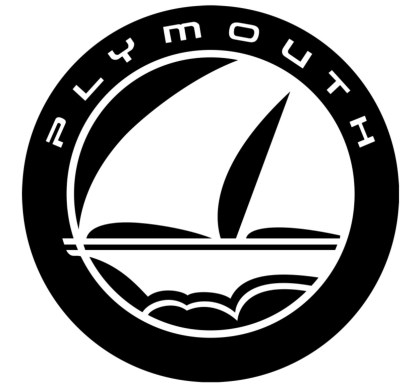
The logo featured a rear view of the ship Mayflower which landed at Plymouth Rock. However, the Plymouth brand name came from Plymouth Binder Twine, chosen by Joe Frazer (a 20th-century American automobile company executive employed in succession by Chrysler, Willys-Overland, Graham-Paige and Kaiser-Frazer Corporation).
The first Plymouth automobile debuted on July 7, 1928, to help Chrysler Corporation compete with Chevrolet and Ford in the entry-level market. The name was inspired by Plymouth Rock and the first Pilgrim colony in the United States, and the Mayflower ship was stamped on the radiator.
In 1928, Walter P. Chrysler took over after Horace and John Dodge died and Lewis Reed became an original member of the Chrysler family.
Plymouth went on to become Chrysler’s top-selling brand from 1930 to 1978.
Some notable Plymouths:
• Barracuda: The muscle car had a decadelong run from 1964 to 1974, though the last generation, 1970-74, is considered the true Mustang and Camaro competitor and remains a popular collector car today.
• Road Runner: Dubbed Plymouth’s “muscle car icon” by FCA, the Road Runner was introduced in 1968. It was based on the Plymouth Belvedere. Plymouth paid Warner Brothers $50,000 for the rights to use the Road Runner and Coyote characters throughout the car’s run, according to Ateupwithmotor.com. Chrysler’s engineering department modified the car’s horn to sound like the cartoon bird’s “beep-beep” as well.
• Superbird: Created to entice stock car racing’s Richard Petty back to Plymouth for NASCAR, the Superbird was a modified Road Runner hardtop with an iconic large wing and nose for aerodynamics.
• Voyager: Plymouth was also at center stage when Chrysler CEO Lee Iacocca introduced a new product in November 1983: front-wheel-drive minivans in the form of the Plymouth Voyager and Dodge Caravan.
Plymouth went defunct at the end of the 1999 model year in Canada and consequently, DaimlerChrysler decided to drop the make after a limited run of 2001 models. This was announced on November 3, 1999. Plymouths were sold at Reed Brothers until 1969, when the Plymouth brand was given to the Chrysler dealers.
Plymouth production ended on June 28, 2001, when the last car, a silver Neon, rolled off the line at a plant in Belvidere, Illinois.
Anyone grow up with a Plymouth in their driveway?
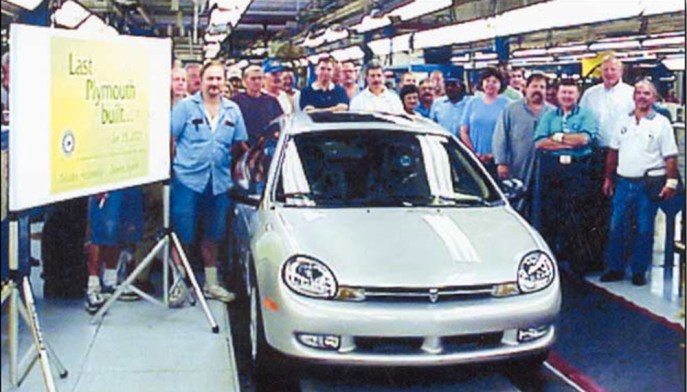
The last Plymouth Neon — and the last Plymouth — was built on June 28, 2001.
Books

Related Resources


Copyright Notice

Reed Brothers Dodge History (1915-2012) by Jeanne Gartner is licensed under a Creative Commons Attribution-NonCommercial 3.0 Unported License.
 Reed Brothers Dodge History 1915 – 2012
Recent Comments