
Reed Brothers Beginnings at the “Triangle”
Woodrow Wilson was President of the United States; the Green Bay Packers did not yet exist; the United States was two years away from joining World War I; the cost of a stamp was two cents, and Reed Brothers Dodge in Rockville, Maryland was founded. It is a family business history that parallels the evolution of the American automobile industry itself.
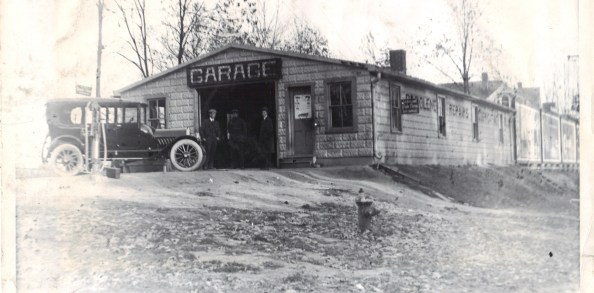
1915 Rockville Garage located at the intersection of Veirs Mill Road and Rockville Pike. The sign on the right side of the Garage reads Gasoline, Fisk Tires and Supplies. Note the single gas pump in front. Rockville Garage had the first Gulf gas station in the still-rural Washington D.C. area.
One hundred years ago, the direction of the auto industry was uncharted territory to be explored by many people. Lewis Reed was an enterprising young man who put his future in the fledgling automobile industry. Although the specific motivation for Lewis Reed to go into the automobile business is not clear, the 1910s was a period of exponential growth in the American automobile industry, and with a location on the major east-west route through Rockville, a town that was on its way to becoming a satellite community of Washington, D.C., he was well positioned for success.
The 1910 census indicates that 23-year old Lewis Reed was working as a machinist. In 1915, Lewis Reed and brothers Robert L. and Griffith Warfield established Rockville Garage after acquiring the building from Lee Ricketts and Sons who had the Overland Agency. In 1918, Lewis Reed bought out Rockville Garage from the Warfield’s and changed the name to Reed Brothers Dodge. Soon after opening the doors to his dealership, Lewis Reed started to expand. In 1917, a two-story addition was added. The first floor housed the Service Department and upper floor was used for parts storage. At the left side of the two story building was a narrow vehicle entrance that led to the service department in the rear. A house can be seen behind the addition. Lewis Reed later purchased the remaining five residential lots to expand his dealership in the back.
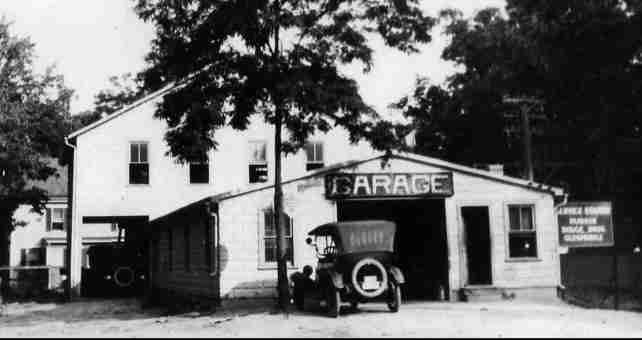
1917 Rockville Garage with two-story addition. Photo by Lewis Reed
In addition to Dodge Brothers Motor Cars, Rockville Garage carried Hudson and Oldsmobile. To survive the early days in the automobile business, most dealerships sold several makes of cars. Cross-selling was an acceptable business practice until the late 1940s when brand loyalty took hold. Also by then, the vast number of automobile manufacturers had been pared down. Reed Brothers got a new remodel in 1921, and an island with three new modern gas pumps were added. By this time, gasoline retailers had determined that placing gas pumps on an “island” in front of the station, where drivers could approach from either side, provided the most efficient station layout.
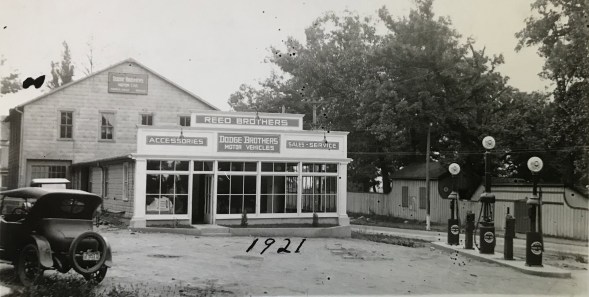
Reed Brothers Dodge got a new remodel in 1921. The original part of the garage was converted into a new car showroom and the service operation was moved out into the rear portion of the building. Note the modern gas pumps. Photo by Lewis Reed.
In the late 1920s, a second story was added to the showroom with a glazed front looking out onto Rockville Pike on the right. A modern drive-through canopy was added along with new gasoline pumps and Dodge Brothers Motor Car and Graham Brothers Truck signage. “That Good Gulf” was one of the the Gulf Refining Company’s marketing slogans for a number of years during the twenties and thirties. Another interesting detail is the placement of floodlights on the canopy roof pointing at the signs.

That Good Gulf Gasoline drive-through filling station with canopy and gasoline pumps were added in the late 1920s. Photo by Lewis Reed
The new car showroom below is filled with late 1920s Dodge Brothers new car models. The high ceilings and mezzanine floor gives an air of elegance to the showroom and the expanse of windows on the front extends the full width of the building. Locating a showroom “in relation to traffic” was of the utmost importance. The showroom faced the triangle at Veirs Mill Road and Rockville Pike which gave the dealership maximum visibility to the largest volume of cross traffic. Behind the large plate glass windows and an awning above was the product — the new car. It appears the showroom could accommodate 4-5 new automobiles. An upper floor mezzanine housed the dealership’s Parts Department and storage area. This level was accessed by a wide, open staircase. All of the elaborate design features inside, such as the high ceiling, wood railings, and mezzanine were usually reserved for upscale dealerships. To find this level of construction expense in a dealership selling mid-priced cars was extremely rare.
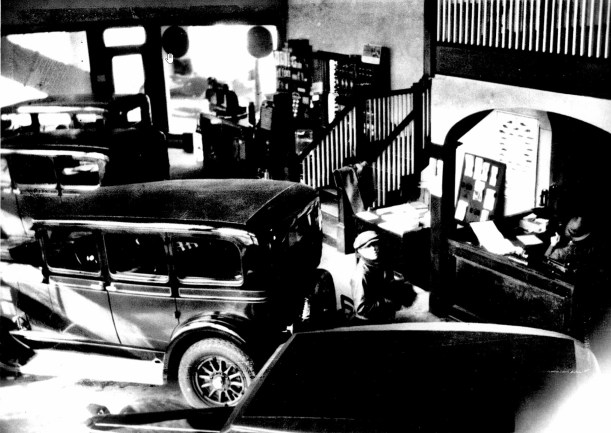
Late 1920s New Car Showroom. Photo by Lewis Reed
In 1930, Reed Brothers added the Plymouth line. Even though times were tough during the Great Depression, Reed Brothers was doing well enough to finance another facelift and renovation; the front of the Gulf Gasoline Station and the canopy was remodeled as shown below during the mid-thirties.
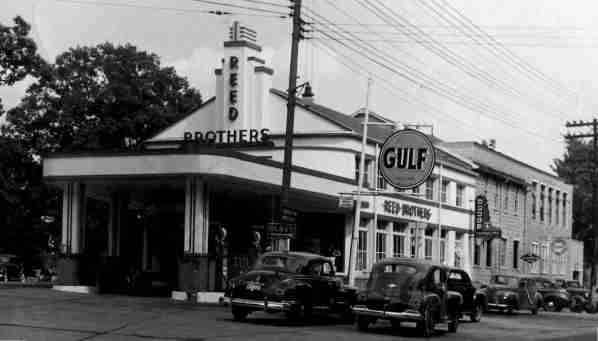
The forth update to the showroom and Gulf Gas Station during the mid-thirties. Plymouth signage can now be seen on the side of the building along with Dodge. Photo by Lewis Reed
After years of hard work that also helped to establish an excellent reputation, once again Reed Brothers Dodge needed to expand. At about the same time as the gas station was remodeled, Lewis Reed split up the sales and parts and service operations by constructing a complete new building; it was located at the intersection of at East Montgomery Avenue and Dodge Street. The showroom was ideally located at the intersection of two streets, with a large curving window placed within the field of vision of approaching traffic and designed in such as way as to increase drivers’ viewing time. The corner showroom window simulated a “corner statement.”
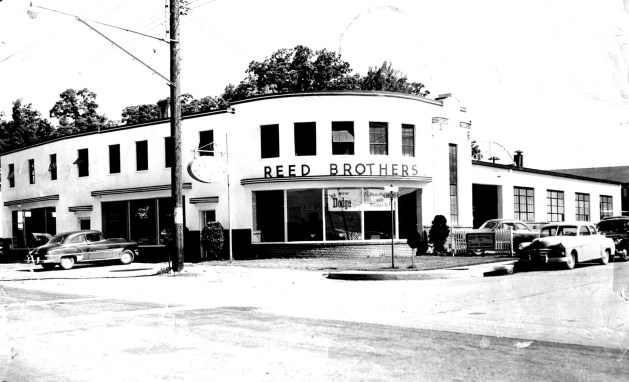
In 1936 Reed Brothers constructs a complete new building for the Parts and Service Departments. Photo by Lewis Reed.
At this point, eight new cars and trucks were being sold each month, along with a number of used car sales. Many purchases at the time, as had been the custom for years in the automobile business, were still initiated at a prospect’s home or job site; as many of the customers were farmers, the Reed’s had an active team of salesman in place who called on prospects right on their property.
Due to changes in the highway, Reed Brothers began an extensive remodeling and rebuilding program. Two-thirds of the original location at the junction of then Route 240 and Veirs Mill Road was razed and a modern Gulf Service Station was erected. Below is a mid-1960’s photo of the Reed Brothers Dodge Gulf Gasoline station. The famous Gulf “ice box” design dates back to late 1930’s and there were probably more of these built than any single one of the later Gulf designs.

The fifth update after 1953 reconstruction of new Gulf Gas Station. Photo by Lewis Reed.
Two great entrepreneurs, Lewis and Edgar Reed, built and sustained a business that lasted for more than a half-century at one location under one ownership, and earned a place not just in the history of Maryland, but in American automobile history as well. For 55 years at the triangle, Reed Brothers Dodge became a community icon and a local landmark for motorists traveling to and through Rockville.
Original 1928 Incorporators: Gaithersburg-Washington Grove Volunteer Fire Department
Fire protection has been a recognized need in Montgomery County since the early 1800s, although there were not any formal organized volunteer or career fire departments until almost 100 years later.
Organization began to take place in Gaithersburg in the late 1880s as the town grew in response to the coming of the railroad and by September 1892, the town wanted a more formal fire organization. Six citizens were appointed to find a way and the means to organize a volunteer fire department, which they did immediately. A month later, the Volunteer Fire Company of Gaithersburg was responding to fires. There were, of course, no firehouses that housed on-duty firefighters of scheduled shifts for volunteers, and when the alarm rang all volunteers would come running. Eden Selby, who was the town barber around 1900, would drop what he was doing when he heard the church bells ring and run to duty, which would often leave customers with unique hairstyles unless they chose to wait in the chair for him to return. During the 1920s, fires destroyed much of Gaithersburg’s downtown – the Post Office, Etchison’s Store, Brewer’s Real Estate offices and Thomas Hardware, Feed and Fertilizer – and in 1928 the present Gaithersburg-Washington Grove Fire Department was created by charter.
Original incorporators when the fire company was chartered were Lewis Reed, William Barnett, Garry Bell, Herbert Diamond, William Dutrow, Ernest C. Gartner, Merle Jacobs, Frank Severance, Clyde Thomas and Thomas Troxell.

The Frederick Post, Frederick, MD April 2, 1928
I was doing some online research and stumbled upon the Kensington (Maryland) Volunteer Fire Department’s web page. Their history is quite amazing, actually. Especially when I realized that their first truck was purchased from Reed Brothers Dodge. It was not a complete truck when purchased, however.
From the Kensington Volunteer Fire Department’s “History” webpage:
1922 was the birth of the Kensington Volunteer Fire Department. With little money, a Dodge truck was purchased from Reed Brothers Dodge in Rockville. A custom fire body was then built and fitted on the truck by Jacobs Brothers in Gaithersburg who ran the Wheelwright Shop on East Diamond Avenue. To raise money, the volunteers held carnivals. The Fire Department incorporated in 1925, and two years later moved into a permanent home in the basement of the National Guard Armory.
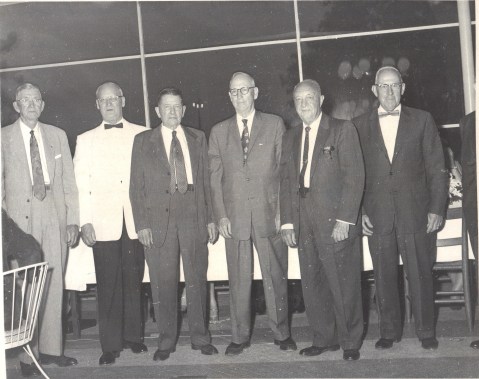
Past Officers of the Gaithersburg-Washington Grove Fire Department. Pictured left to right: name unknown, Ernest C. Gartner, Charles Fox, Clyde Thomas, Dr. Frank Broschart, Lewis Reed
Lewis Reed was a Charter Member and Past President of the Gaithersburg-Washington Grove Volunteer Fire Department. The wall plaque below displays Past Presidents and Past Chiefs. Lewis Reed was President from Feb.1933-Feb 1937. His name plate is 5th down on the left.

Gaithersburg-Washington Grove Volunteer Fire Department Past Presidents and Past Chiefs
In 1967, the first career fire fighters joined the department. Today, the brave volunteers, career fire fighters and emergency medical personnel of the Gaithersburg-Washington Grove Fire Department continue in the courageous footsteps of their noble predecessors as they heroically serve our community.
Source: Fire Protection in Montgomery County: Bucket Brigade to High Tech
Then & Now: Computing Tabulating Recording Company (aka IBM)
It might feel like things are always changing in Washington DC. There are always new buildings being built, businesses closing and with every few years. But you might not realize how much Washington DC has changed until you look back at what it looked like in the past. In this “Then & Now” feature, I have combined one of Lewis Reed’s original photograph’s for “then” and matched it with a google street view image for “now”. Taken approximately 108 years apart, these photos show Hollerith’s Plant then and now.
THEN: Before becoming interested in automobiles, Lewis Reed was one of the original employees of the Computing Tabulating Recording Company, a Georgetown-based manufacturing firm that eventually became International Business Machines, Inc. The Tabulating Machine Company was formed by Hermann Hollerith in 1896 and merged to form the Computing-Tabulating-Recording Company in 1911. Seen in the photo below, the two-story building housed Hollerith’s card manufacturing plant, assembly plant, repair shop and development laboratory. Hollerith later incorporated his business as the Tabulating Machine Company. It was consolidated into the Computing-Tabulating-Recording Co. in 1911, and was renamed International Business Machines (IBM) in 1924.

Hollerith’s Plant 1911. Photo by Lewis Reed
NOW: Today the U.S. technology sector is inextricably linked with the West Coast, but the history of data processing actually traces back to an unassuming brick factory in Washington, D.C. This was the Georgetown headquarters of the Tabulating Machine Company, an early analog computer manufacturer that you may know by the contemporary moniker IBM. IBM placed a historical plaque on the corner of the building by 31st Street and the Canal. Hollerith is also buried nearby in the Oak Hill Cemetery.

Front of the old Tabulating Machine Company on 31st Street today
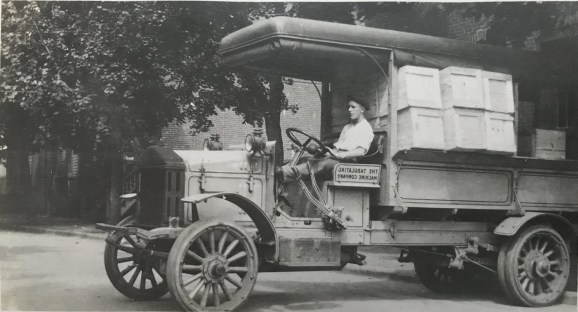
Tabulating Machine Company Delivery Truck. Note that the writing on the side of the truck is in reverse… I have no idea why. Photo by Lewis Reed
The following photographs are interior images.
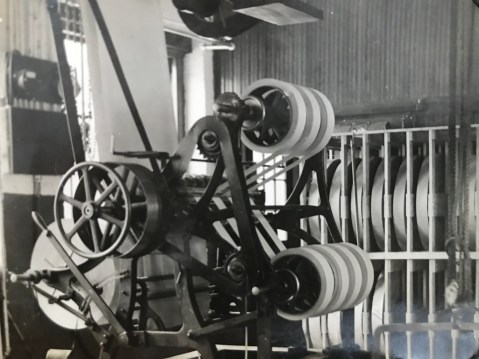
Photo by Lewis Reed

Photo by Lewis Reed

Photo by Lewis Reed
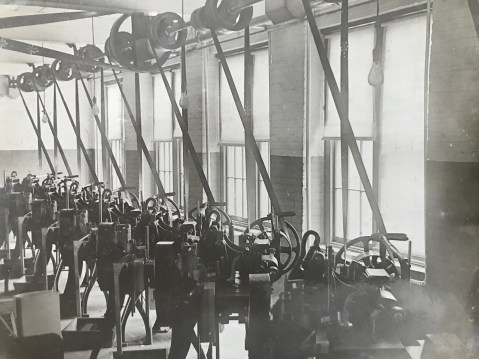
Photo by Lewis Reed

Photo by Lewis Reed
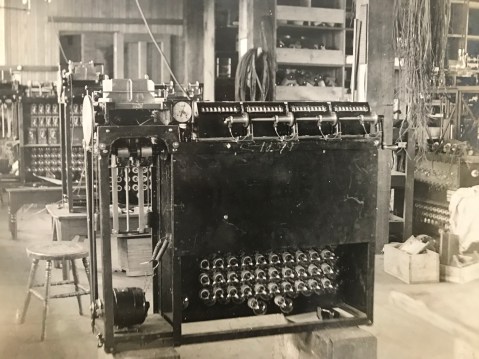
Photo by Lewis Reed
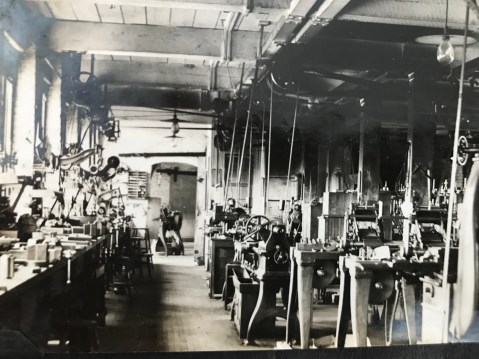
Photo by Lewis Reed

Photo by Lewis Reed
Source: IBM Archives
Valentines Day and Ferris Wheels!

Ferris Wheel at Rockville Fair, circa 1920s. Photo by Lewis Reed
Did you know that February 14th is not only Valentine’s Day, but also Ferris Wheel Day? This unofficial national holiday is held on this day to honor the birth of the inventor of the Ferris Wheel, George Washington Gale Ferris, Jr. What better way to celebrate Ferris Wheel Day than enjoying this old photograph of the Ferris Wheel taken at the Rockville Fairgrounds, courtesy of Lewis Reed. The fairgrounds were just outside Rockville, about where Richard Montgomery High School is today. The Fair lasted four days, from August 21st to the 24th, and drew visitors from local counties, Washington, and Baltimore.
For the singles and the “enough already with the Valentines”, here is your perfect alternative excuse. Go wish all your friends and family a Happy Ferris Wheel Day!
How “Suicide Doors” Got Their Name
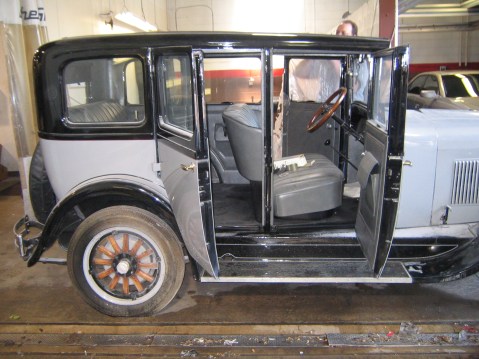
Reed Brothers Dodge owned a 1928 Dodge Brothers Standard Six with rear-hinged “Suicide Doors”.
So why are these doors called suicide doors? Did someone commit suicide with one? What’s suicidal about a door?
The theory is that the forward motion of the car could cause the door to fly open, possibly causing the unlucky person sitting next to the door to be pulled out of the car, or the door itself could be ripped from its hinges. It’s debatable as to whether this was speculation or reality, but cars of this era did not have seat belts, so there was nothing to hold a passenger in the car.
Think about it. Imagine trying to open a conventional front door while you’re driving 70 mph. It’s going to be increasingly difficult because of a simple fact of physics: air pressure. The farther you open the door as you’re sailing down the highway, the more air is going to hit the door, forcing it back. Hopefully, the end result is that it never opens far enough for you to fall out.
Now, imagine accidentally unlatching a door that opens the other way. Instead of working to keep the door shut, the road wind serves as an accelerator, helping to fling the door open and maybe you with it as you grab for the handle in a panic to close it. To add insult to injury, you’ll likely be whopped by the door as you fall out. The term “suicide doors” was therefore placed on vehicles with the rear-hinged door configuration, the theory being that anyone inside was on a suicide mission because of the design.
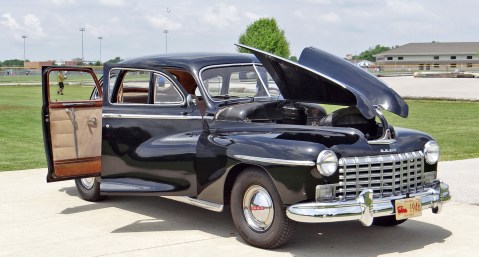
Stock image of a 1946 Dodge Deluxe 4-Door Sedan Fluid Drive with “Suicide Doors”.
Another urban legend about the origins of the suicide doors maintains that 1930s gangsters liked the door design because it made pushing someone out of a moving car easier. If that were true, though, wouldn’t the correct term be “homicide doors”?
Suicide doors were favored in pre-war automobiles throughout the the 1930s. They were fairly common on many domestic and imported car makes in the 1930s. A forward-opening door — either in front or back — permitted easier access and egress — especially for women in long skirts or dresses. Hinging the front door at the rear also facilitated a more slanted windshield.
As a result, manufacturers understandably have tried hard to bury the old “suicide doors” reference. Today, you’ll find such killer names as “RAD” or “rear-access door” (Saturn), “freestyle doors” (Mazda RX-8), “coach doors” (Rolls Royce), “FlexDoors” (Opel), “scissor doors” (Lambo), “clamshell” (Toyota), and “rear-hinged doors” (preferred technical term).
Now, About That Name…
So where did the name “suicide doors” come from, then? You’ll find multiple explanations, none definitive. The fact that no historian can verify the origins of this bit of slang only adds to the mystique.
Source: Wikipedia
Books

Related Resources


Copyright Notice

Reed Brothers Dodge History (1915-2012) by Jeanne Gartner is licensed under a Creative Commons Attribution-NonCommercial 3.0 Unported License.
 Reed Brothers Dodge History 1915 – 2012
Recent Comments