
Then & Now: Rockville Fair Harness Racing
The black and white photographs of the Rockville Fair harness races below were taken by Lewis Reed in 1910. The photographs were from the first incarnation of the Fair, held by the Montgomery County Agricultural Society (1846-1932) in Rockville and often known simply as the “Rockville Fair.” For this “Then & Now” feature, I have combined Lewis Reed’s original photographs for “then” and matched it with a corresponding contemporary shot for “now” to see the difference 109 years can make.
Rockville Fair Dirt Track Oval (THEN): Like many fairgrounds, the Rockville Fairgrounds included an oval track. Fairground race tracks, typically one-mile or half-mile dirt racing ovals with wide, sweeping curves and grandstands for spectators, were easily adapted for bicycles, harness racing, and the sport of car racing. Harness racing was one of the main attractions, but after the introduction of the automobile in the early 20th century, car races took over. The fairgrounds were just outside Rockville, where Richard Montgomery High School is today.

Rockville drew huge crowds for harness races. Photo by Lewis Reed, circa 1910

Harness race at the Rockville Fair, circa 1910. All those throngs of people had plenty to see. Photo by Lewis Reed
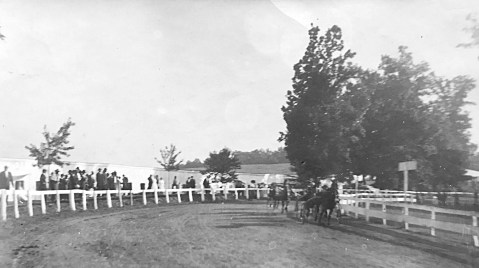
Harness racers rounding the bend on the racetrack, Rockville Fairground circa 1910. Photo by Lewis Reed

Bend on the harness racetrack, Rockville Fairground circa 1910. Photo by Lewis Reed
Rockville Fair Dirt Track Oval (NOW): In 1946, after the construction of Richard Montgomery High School, the old oval race track became a football field and stadium.

RMHS football field and stadium
The First Shenandoah Apple Blossom Festival May 3, 1924

Here the parade participants circle the racetrack as spectators view the parade from a grandstand. There was no caption on this photo, but I’m guessing it might possibly be the VMI Regimental Band. Photo by Lewis Reed, 1924
The first Apple Blossom Festival in Winchester was held 95 years ago on May 3, 1924. It was a one-day event featuring a parade, the crowning of Queen Shenandoah, and a program of interpretative dance. To kick off the celebration, the parade assembled at the old fairgrounds just off Fairmont Avenue and marched through the streets of Winchester to the Royal Pavilion on the grounds of Handley High School.
Beginning in 1925, the first of three pageants was professionally produced by the John B. Rogers Production Company and staged on a dais at the fairgrounds. In 1928 the outdoor pageants were moved to the steps and esplanade of Handley High School. The pageant earned a reputation as being one of the most beautiful outdoor extravaganzas in the nation. The festival was suspended during World War II, and resumed in 1946 with its first celebrity grand marshals, Bing Crosby in 1948 and Bob Hope in 1949.
Since its beginnings in 1924, the festival has grown over the years to a ten-day celebration with over 30 events, including two huge parades, a carnival, dances, concerts, a 10K race, wine festival, golf tournament, and much more.
These photos from Lewis Reed’s album are what appears to be some of the very first photos of the Shenandoah Apple Blossom Festival held at the old fairgrounds in Winchester, Virginia. As always, click on an image to enlarge.

The B&O Railroad had a float in the Apple Blossom Parade. Photo by Lewis Reed, 1924
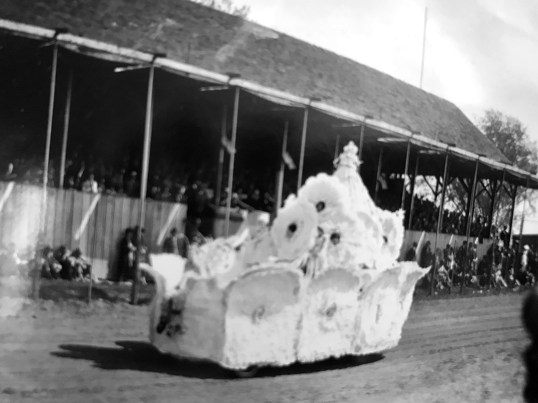
Photo by Lewis Reed, 1924
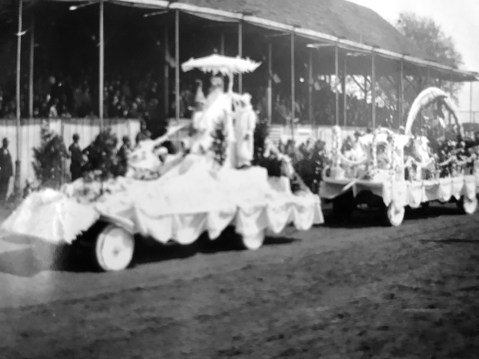
Photo by Lewis Reed, 1924

Photo by Lewis Reed, 1924
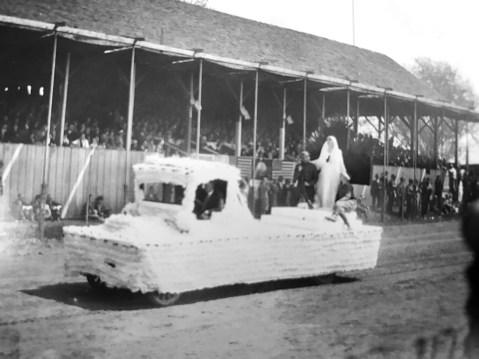
Photo by Lewis Reed, 1924
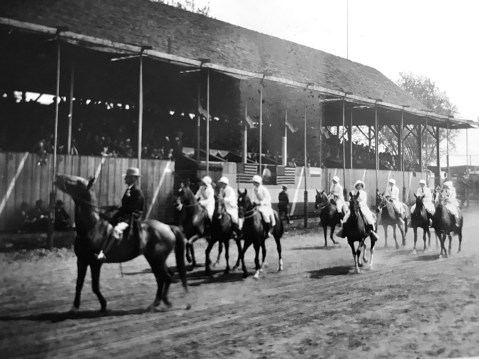
Photo by Lewis Reed, 1924

Photo by Lewis Reed, 1924
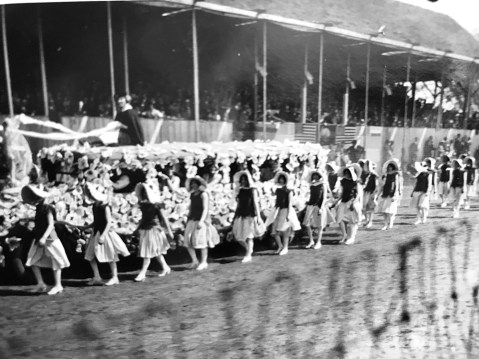
Photo by Lewis Reed, 1924
Source: thebloom.com
May 2, 1929 Montgomery County Tornado Disaster (Aftermath)
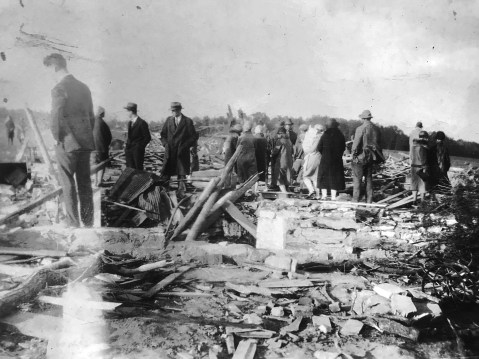
Spectators view the destruction at the Benson farm, May 1929. Photo by Lewis Reed
Ninety years ago today, one of the worst tornado outbreaks in area history devastated a part of Montgomery County Maryland. At about 9 p.m. on Thursday, May 2, 1929, northeastern Montgomery County was struck by an F3 tornado, part of a large storm system that caused devastation from Florida to Ohio. The weekly Montgomery County Sentinel reported on May 10th that the “wind storm of cyclonic power . . . was of limited width and serpentine on its course. Everything in its path met with destruction.” These previously unpublished photographs were taken by Lewis Reed “after the tornado of May 2, 1929”.

May 1929. Photo by Lewis Reed
The damage in the county was limited to the rural Unity area, north of Brookeville. The Sentinel article detailed each affected farm, noting that “thousands of persons from far and near visited the scene for several days to look upon the indescribable wreckage.”

May 1929. Photo by Lewis Reed
From the Sentinel: “The storm showed its first violence upon the farm of Mr. J. William Benson. There it destroyed every building – the dwelling house, large barn, 117 feet long, including an attached shed, and all other outbuildings.” The farm was unoccupied, but furniture belonging to “a prospective tenant” was destroyed. Mr. Benson’s apple orchard was also significantly damaged, and the article claimed that “many [trees] were lifted into the air, carried over woods and landed several miles away.”
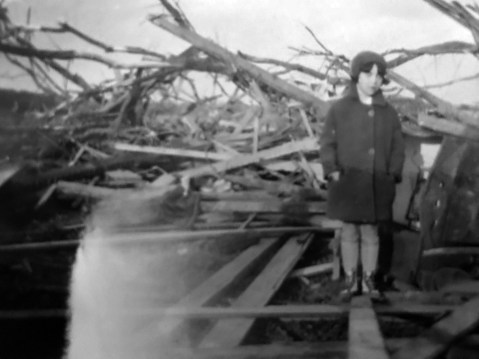
Lewis Reed’s daughter, Mary Jane, May 1929. Photo by Lewis Reed
The fire departments of Rockville, Gaithersburg and Sandy Spring responded to the call made by farm worker James Leizear, who “extricated himself from the wreckage” and ran half a mile to a neighbor’s house to summon help.
The Post reported on May 4th that 28 people in Maryland and Virginia had been killed by tornadoes during the storm; most of the casualties were in Virginia, where an elementary school was struck full-force and at least 18 children died. In Montgomery County, the local Red Cross Chapter formed a citizen committee to raise funds “for relief of the sufferers.”

May 1929. Photo by Lewis Reed
Note: These photographs were undated and unlabeled in my grandfather’s collection. My mother, Mary Jane (Reed) Gartner, who is seen above when she was almost 7 years old, positively identified these photographs and just about pinpointed the location! She is almost 97 years old! It’s amazing the things you remember from your early childhood.
Information Source: A Fine Collection
7 Years, 296 Posts & Thank You
 Today marks the 7-year anniversary of this blog. It’s been an honor to share the history of Reed Brothers Dodge – whether you’ve read our blog, followed us on Twitter, or “liked” us on Facebook. I would like to thank those mentioned below, and many others, for their kind words and the visibility they have provided.
To help review the past year I thought I’d search around on the Internet and see what others have been saying about us.
Included among the posts on our Facebook page:
“I love pictures, especially the old ones. People, places and things…the pictures bring such cool history and personal ones, the fond memories.
Online and in print:
Antique Motorcycle Club of America, Forum: “Reed Brothers was a pretty important local business owners in my area. The Reed Brothers, shown in the photo attached, are the two center riders with touring caps and ties started a garage in Rockville in 1915 and received a Dodge Motors contract to sell and service the new automobile….. Lewis was a pretty extraordinary amateur photographer.”
Meadow Brook Hall: For the second year, to show support to preserving the Dodge legacy, the author of this blog has “adopted” a Dodge car — a 1915 Dodge Brothers Touring Car — one of the historic vehicles in the Meadow Brook Hall Dodge Brothers automobile collection. Meadow Brook Hall in Rochester Hills, Michigan was the estate of one of the world’s wealthiest and influential women of her time, Matilda Dodge Wilson. Matilda was the wife of John F. Dodge, co-founder of the Dodge Brothers Motor Car Company.
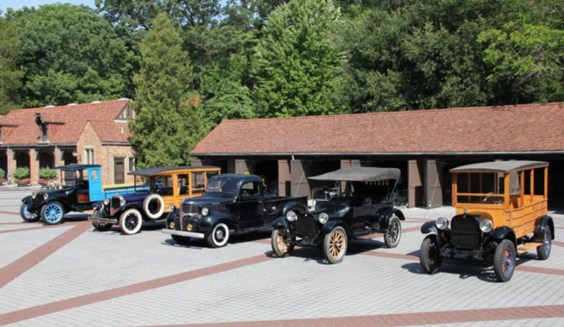
Photo courtesy of Meadow Brook Hall
The inscription on the Adoption Certificate reads:
adopted by Jeanne Gartner in memory of her grandfather, Lewis Reed, who founded Reed Brothers Dodge in Rockville, Maryland in October 1915.
The vehicle was adopted for a period of one year, beginning November 14, 2018 through November 13, 2019 (November 14 is the anniversary of the day John and Horace Dodge revealed their first car in 1914). The adoption will help Meadow Brook make necessary repairs, provide preventative maintenance and pay insurance for the Depot Hack, ensuring it’s there to inspire, educate and “drive” this and future generations. Lewis Reed is a perfect and most fitting parent.
“Just A Car Guy”: It’s pretty cool to see a well-known car blog like “Just A Car Guy” has noticed our history blog and has been sending visitors our way via a link on their page under, “Sites I recommend for their quality”: Reed Brothers Dodge History. I am proud and honored to be regarded among these terrific automotive websites.
On National Television!
- Lewis Reed Photo Featured on Maryland Public Television (MPT): Lewis Reed’s aerial photograph of entire original Reed Brothers Dodge dealership at the intersection of Veirs Mill Road and Rockville Pike was used in the Maryland Farm & Harvest series which was aired on December 18, 2018 at 7:00 pm on MPT. The photo illustrated what Rockville Pike looked like at the time, during a segment about 97-year-old farmer Charles Koiner who grew up in the Rockville area.
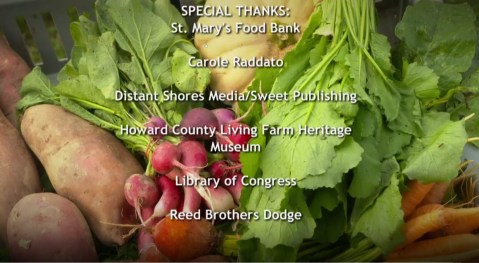
Screen shot of credits from Maryland Farm & Harvest video on MPT
- Lewis Reed Photo on Discovery’s Science Channel, Impossible Engineering: A Lewis Reed’s photo from the 1923 Rockville Fair Auto Races was a part of the Episode 4 ‘London Array’ Series of Impossible Engineering that was broadcast on Thursday, January 24, 2019 on Discovery’s Science Channel. The photograph was used on the program that featured a segment on the development of the race car.

Lewis Reed’s photo extracted from the Science Channel Impossible Engineering DVD
Last, but certainly not least, many thanks to all of you who have visited, followed, shared, or commented on this blog. I appreciate all of you for your continued support and making Reed Brothers Dodge History one of the places you visit during the course of your day.

Then & Now: Thomas & Co. Cannery in Gaithersburg
“Then and Now” photos are an excellent way to explore the passage of time. In this special post, I have combined one of Lewis Reed’s original photograph’s for “then” and matched it with a corresponding contemporary shot for “now”. Taken approximately 100 years apart, these photos show the Thomas and Company Cannery in Gaithersburg, then and now.
Thomas & Company Cannery (THEN): The largest and longest-lived cannery in Montgomery County, the Thomas and Company Cannery operated from 1917 until 1962. While Baltimore had been the center of the canning industry in the 19th century, the outbreak of World War I created a need to rationalize. Frank and Clyde Thomas were leaders in the 20th century canning industry in Maryland. In 1917, the Thomas family opened a cannery in Gaithersburg, the first in Montgomery County. The factory was the focus of local industry and economy, providing an important market for farmers, and employment for local migrant workers.
The factory canned peas, pumpkin and corn, supplied both the local retail market and the war effort during WW I and II. During the war years, the cannery expanded operations and functioned on a three shift schedule to provide vegetables for shipment to troops. After the war, the cannery continued to produce vegetables under the brand names MY-T-NICE, EVER-GOOD, BARBARA FRITCHIE and ON-TOP corn, peas and succotash.
Built along the B & O Railroad to facilitate shipping, the brick cannery had three main parts: the central processing station, the shipping section and boiler plant. The cannery was designated a Gaithersburg landmark in 1987.

Circa 1917 photo taken behind the Thomas and Company Cannery in Gaithersburg. The Cannery was the first and largest vegetable cannery in Montgomery County. It closed in 1963 after fire damage and lay empty until its recent restoration. Photo by Lewis Reed.

Thomas & Company Cannery (NOW): The building saw various uses after the closing of the Cannery, but then lay empty until its recent restoration for office and commercial use.

Source: Maryland Historical Trust
Books

Related Resources


Copyright Notice

Reed Brothers Dodge History (1915-2012) by Jeanne Gartner is licensed under a Creative Commons Attribution-NonCommercial 3.0 Unported License.
 Reed Brothers Dodge History 1915 – 2012
Recent Comments