
Then & Now: Smithsonian Institution Castle
This post is a continuation of a series of “Then & Now” images from Lewis Reed’s Photo Collection alongside photographs of how they appear today. Lewis Reed worked hard to preserve a visual history of Montgomery County, Maryland and surrounding area long before automobiles were even around. As early as 1905, he toured on his motorcycle across the states of Maryland, Virginia, and Washington, D.C. and took photographs of many historic locations. Taken approximately 115 years apart, you can see how the Smithsonian Institution Castle looks both the same and completely different from over a century ago.
Smithsonian Institution Castle (THEN): The Smithsonian Institution Building, popularly known as the “Castle,” was designed by architect James Renwick, Jr. Initially, the Castle was intended to be built in white marble and then in yellow sandstone. The architect and the building committee finally agreed on using Seneca red sandstone from the Seneca Quarry, located in Montgomery County, Maryland. When it was completed in 1855, it sat on an isolated piece of land cut off from downtown Washington, DC, by a canal. In the ensuing decades, the Castle became the anchor for the National Mall, as additional museums and government buildings were constructed around it.

Smithsonian Institution Castle. Photo taken by Lewis Reed in 1907
Smithsonian Institution Castle (NOW): The same view over a century later. The Smithsonian Institution Castle, located near the National Mall in Washington, D.C. behind the National Museum of African Art and the Sackler Gallery, houses the Smithsonian Institution’s administrative offices and information center.

Smithsonian Institution Castle today
Remembering Edgar Reed’s Service This Veterans Day
Veterans Day is a time to recognize the veterans in our lives — to honor their service for our country and show them that we appreciate their sacrifices made in our behalf. World War I began on July 28, 1914 and later ended on November 11, 1918. In commemoration of Veterans Day, this very special post is in honor of the contributions Sergeant Edgar Reed made for our country during World War I.

Edgar Reed, partner with brother Lewis, in Reed Brothers Dodge. Photo taken ca. 1918 by Lewis Reed.
Edgar was a partner with his brother Lewis Reed, in Reed Brothers Dodge. I never got to know my great uncle Edgar like the rest of the Reed family, because he passed away the year after I was born. My mother told me she took me to the hospital right after I was born to meet Edgar, but of course, I have no recollection of that. I do, however, feel like I know him through all of the family stories and photographs I have spent archiving over the last 10+ years.

Edgar, center. Photo taken ca. 1918 by Lewis Reed.

Edgar at Hotel Cape May, New Jersey. Photo by Lewis Reed, 1918
On September 28, 1917 a draft for World War I began and the first 40 men reported for duty at the Montgomery County Court House in Rockville, Maryland. In the photograph below, cars are parked around the court house during the speech-making in the court room to drafted men. Montgomery County’s first recruits left Rockville by train for Camp Meade, Maryland on this same day. They each received a package of smoking tobacco and a rousing send-off from two thousand people after speeches at the courthouse, dinner at the Montgomery House Hotel, and a parade to the depot. About 160 Rockville men served in the eighteen-month war. One of those men was Rockville resident, Edgar Reed.

Montgomery County Court House. Note two tags on the cars; it was necessary to have DC as well as Maryland tags if the car was to be driven in DC. Photo by Lewis Reed, 1917.
Edgar Reed (1890–1951) was born in Darnestown, Maryland on October 17, 1890. On February 26, 1918 at the age of 27 years old, Edgar was enlisted into the U.S. Army as a Private. At this time, he lived on Montgomery Avenue in Rockville. He had been employed by R.W. Vinson, Rockville druggist for eight years.
On April 27, 1918, Edgar was promoted to the rank of Private First Class, and on February 14, 1919, he was promoted to Sergeant. According to “Maryland Military Men, 1917-1918”, Edgar served as a Sergeant in the U.S. Army Medical Corps from February 1918 to August 1919. He had been posted to GENERAL HOSPITAL NO. 16, NEW HAVEN, CONNECTICUT and GENERAL HOSPITAL NO. 11, CAPE MAY, NEW JERSEY.
The spirit of patriotic service which swept the country prompted many persons to offer their properties to the War Department for hospital purposes. These offers included buildings of every conceivable kind, such as department stores, private establishments, hospitals, and properties in large cities. It was found that many of these could be obtained and converted into hospitals much more expeditiously than barrack hospitals could be constructed, and at less cost.
The Surgeon General recommended that the War Department authorize the leasing of the Hotel Cape May in New Jersey for use as a general hospital on December 18, 1917. The Hotel Cape May was located on the Ocean Drive, at the eastern end of the city, and within 100 feet of the beach of the Atlantic Ocean. Opened first as GENERAL HOSPITAL NO. 16, the designation was changed to GENERAL HOSPITAL NO. 11, March 14, 1918. The enlisted personnel were quartered in tents which were located to the rear of the building.
At eleven o’clock on the eleventh day of the eleventh month in 1918, World War I fighting came to an end when an armistice between Germany and the Allied nations went into effect. On August 4, 1919, Edgar was transferred to the Demobilization Center at Camp Lee, Virginia and was honorably discharged on August 6, 1919.
Pictured below is Edgar Reed’s World War I draft card, signed and dated June 5, 1917.


Below is Edgar Reed and friends returning home on the train after the war ended wearing the World War I “Victory Medal” on their lapels.

Edgar Reed, right. Photo by Lewis Reed.
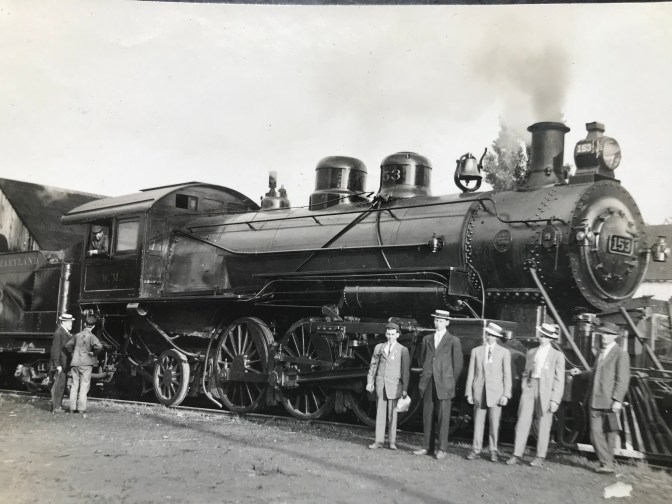
This photo captures the moment Edgar Reed (left) and friends arrived home from World War I. Photo by Lewis Reed.
Edgar was fortunate enough to survive World War I and to settle back in Rockville and enjoy a successful life and career in the automobile business. After returning from the war in 1919, Edgar joined his brother in the business and the name changed to Reed Brothers Dodge. Edgar was in the automobile business with his brother, Lewis, for 35 years until his death in 1951.
So while we honor all who served this Veterans Day, on this day, I salute you Edgar Reed, and thank you for your service to our country.
Sources:
U.S. Army Office of Medical History
Ancestry.com
Maryland Military Men, 1917-1918
Halloween in Montgomery County 100 Years Ago
Ever wondered how Montgomery County families celebrated Halloween 100 years ago? Thanks to the these photographs from Lewis Reed’s collection, we can travel all the way back to 1914.
At the turn of the century, women often wore their regular clothes topped with homemade masks. The first Halloween costumes were usually worn by women and reflected the idea of masquerades that was extremely popular in the early 1900s. People only began to buy manufactured costumes in the second and third decades of the 20th century.

Halloween, ca. 1914. These women are holding homemade Halloween masks for their upcoming celebration. Photo by Lewis Reed
Oh the good ol’ days, when wearing a mask was enough to be dressed up for celebrations! Do you know how your ancestors’ celebrated Halloween? Newspapers are a great source to get a better understanding of life in the past. This special post is a look back through newspaper articles and Lewis Reed’s photographs at how Halloween was celebrated 100 years ago.
Stocked Stores: Stores were stocked with all the Halloween supplies needed for a fun celebration. Below is an ad for costumes and masquerade suits for those participating in Halloween parties and other seasonal affairs.

The Washington Post, October 30, 1916
Dancing and Parties: Halloween parties and dancing were enjoyed by many. Some announcements even included a list of guests in attendance!

The Baltimore Sun, November 3, 1912
Here is the description of a Halloween party from the Society Section of the November, 1916 issue of The Evening Star (Washington, District of Columbia):
A Halloween party was given last evening… and a merry evening spent by those present. The reception hall, living and dining rooms were artistically decorated with autumn leaves, lanterns, chrysanthemums and orange and black streamers. The evening was spent in old-fashioned games, concluding with the entire assemblage gathering about an open fireplace in the dark, while the guests were led by a ghost through various parts of the darkened home. The evening’s entertainment concluded with music, dancing and the serving of refreshments.
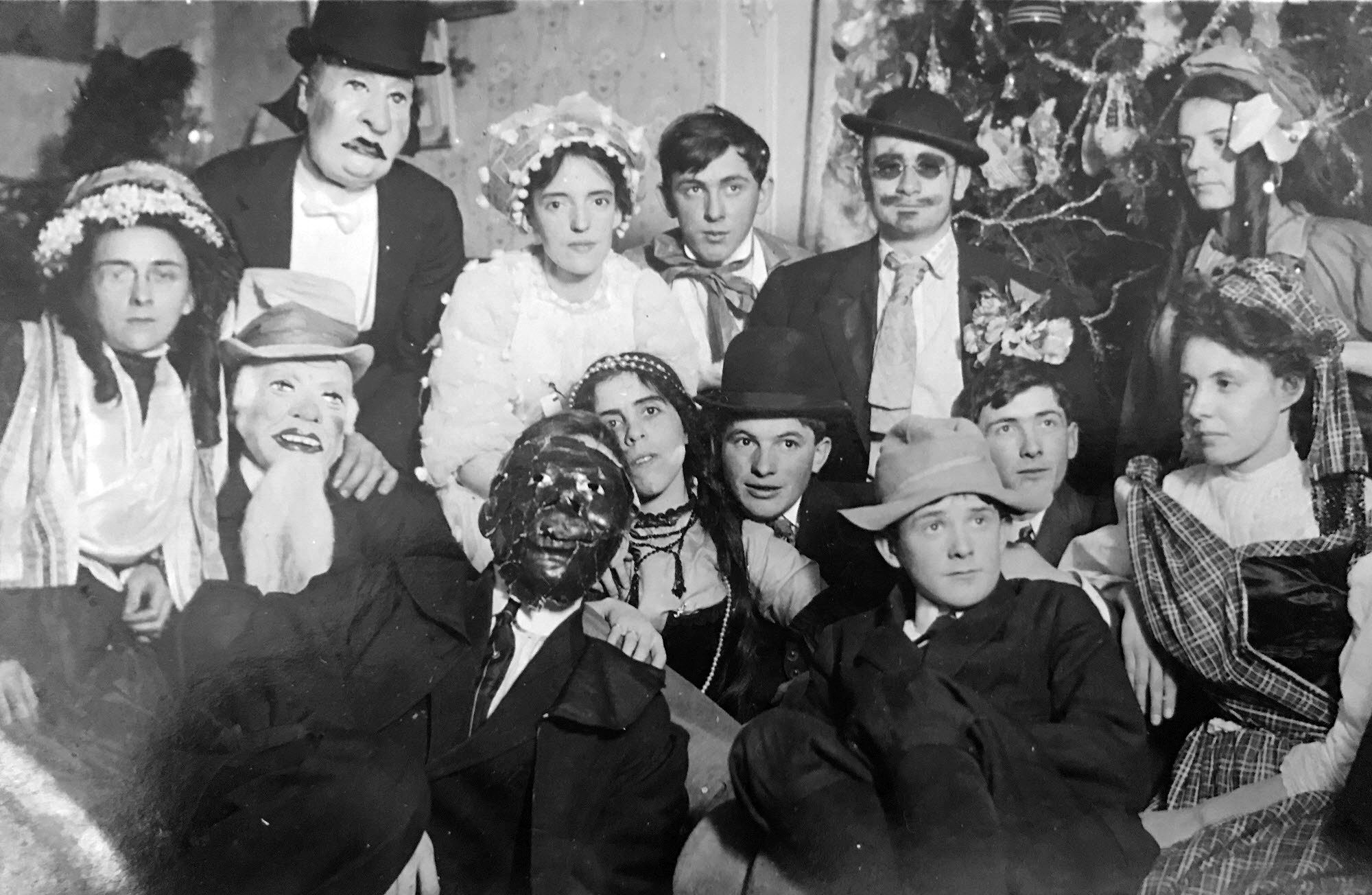
This photo captures a moment from a Halloween gathering over 100 years ago. Photo by Lewis Reed
Any sort of Halloween festivities demanded some sort of refreshment. In addition to traditional pumpkin pies and molasses cookies, a suggested dish to serve at Halloween parties was a Halloween salad.

Halloween Pranks: Witches and goblins, ghosts and mischief-making youngsters were permitted to enjoy all the Halloween revelry they liked … BUT DON’T THROW FLOUR. Yes, apparently in the early 1900s, there wasn’t much to do for entertainment, so kids would knock on doors on Halloween night and throw flour at whoever answered. To the modern observer, some of the traditions of Halloween 100 years ago are downright bizarre.
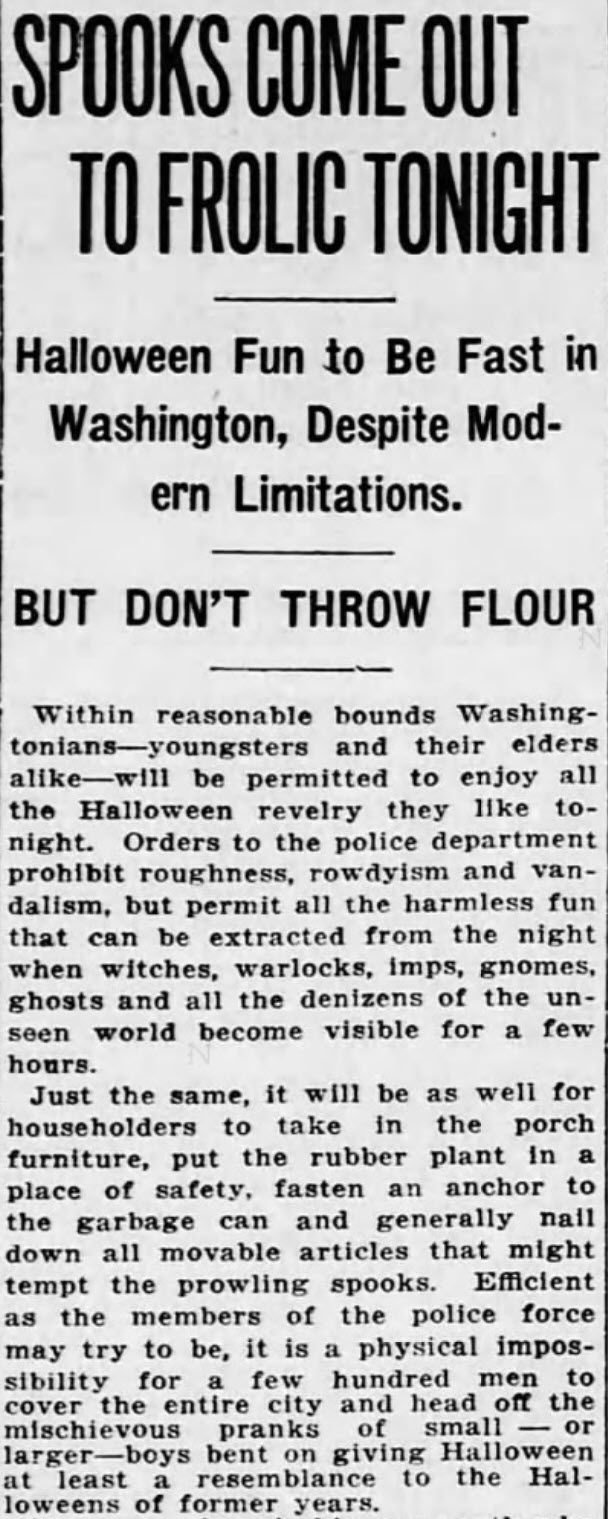
The Evening Star, October 31, 1916
Halloween Parades: Halloween parades actually began because pranks and mischief had gotten out of control. By 1920, there was a push to turn Halloween into a holiday centered around community gatherings and festive Halloween parades, rather than mischief.
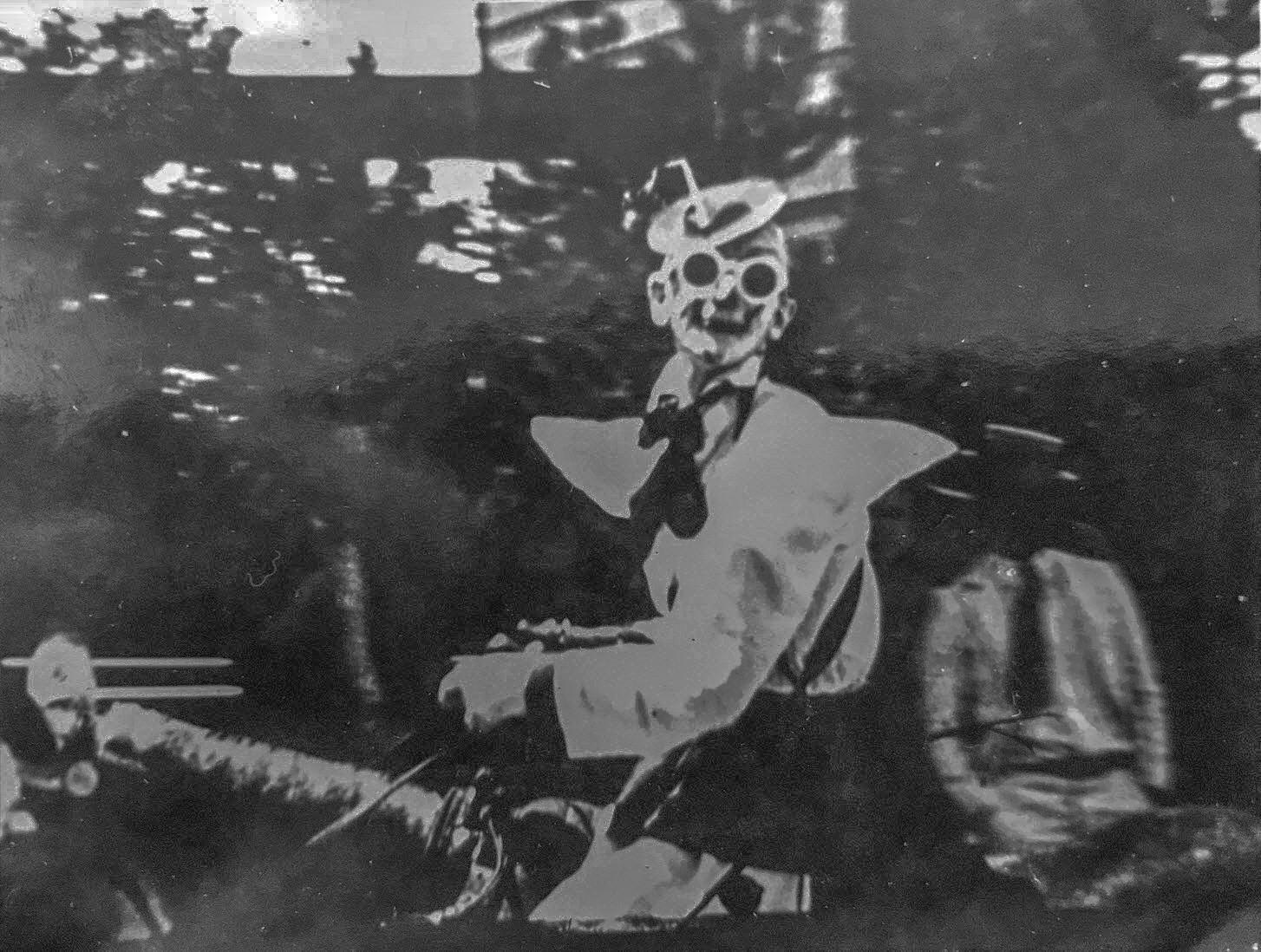
There is something undeniably creepy about this clown in sunglasses riding on a horse in a Halloween Parade. Location is unknown. Photo by Lewis Reed
Wishing all my friends, followers, and visitors of this blog a very safe and happy Halloween!
The Pocono Mountains Premier Haunted House, Then & Now
With Halloween just around the corner, I thought it would be fun to feature a photograph that Lewis Reed took of the Saylorsburg Lake House Hotel, now the site of The Pocono Mountains Premier Haunted House, Hotel of Horror. The aging Lake House Hotel in Saylorsburg, Pennsylvania, once a vibrant Poconos retreat, was a popular hotel for the region’s tourists who were looking for fun on nearby Saylors Lake. During the hotel’s heyday, its staff was booking rooms a year in advance. Today, the former hotel’s fame is generated from its annual Halloween haunted-house attraction.
Lake House Hotel (THEN): The legend of the Lake House Hotel spans more than two-hundred years. According to local folklore, during World War II, many of the employees at the Lake House were called to assist in the Pennsylvania National Guard, leaving the local asylum with one lone security guard to watch over the entire building. The inmates escaped, made their way to the hotel and took it over. The insane patients performed experiments on the guests. What was once a renowned resort for the rich and famous, became a torture chamber.
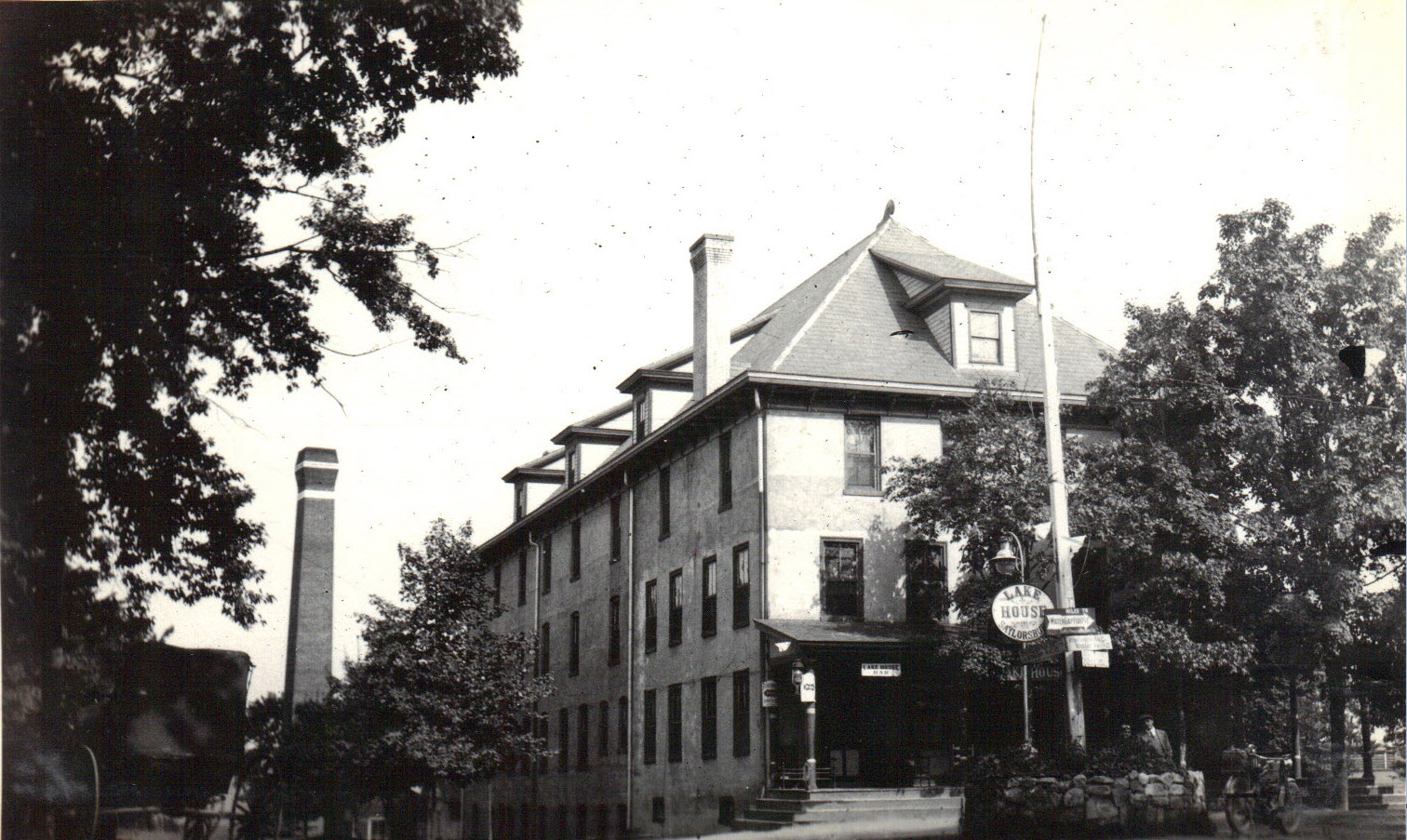
The Lake House Hotel, Saylorsburg, Pennsylvania. Photo taken by Lewis Reed, 1915.
Lake House Hotel (NOW): The hotel was purchased in 1990 and turned into an Antique Co-Op, and then in 1992 saw its first haunted house attraction. The Hotel of Horror and Altered Nightmares are both indoor, walk through Haunted House attractions featuring live actors and paranormal activity housed in the 200 year old “abandoned” Pocono Mountain resort once called The Lake House Hotel in Saylorsburg, Pennsylvania. This 2022 season will celebrate the 30th year that the Hotel of Horror has been fascinating and horrifying legions of fans from the far reaches of the United States and even internationally. To all the readers of this blog: Have a spooky, enjoyable and very safe Halloween!

The Hotel of Horror, The Pocono Mountains Premier Haunted House Attraction
Tribute to Richard Lewis Gartner, Third Generation Dodge Dealer
Co-written by Jeanne Gartner and Barry Gartner

Rick Gartner, 3rd Generation President/Dealer Principal of Reed Brothers Dodge.
This is a very special post in honor of Richard Lewis “Rick” Gartner who passed away on Thursday, October 6, 2022 at the age of 68. Rick fought a short, courageous battle against a relentless and cruel enemy. He was diagnosed with bladder cancer on the day of his birthday on January 25, 2022. Nine months later it took him despite his strong will to live and willingness to do anything to get a chance to beat it.
I am Rick’s older sister, Jeanne Gartner, and author of this blog, and Barry is Rick’s younger brother. To celebrate Rick’s life, Barry and I decided we would co-write a tribute to honor his memory. At first, I hesitated to write such a personal and lengthy post here, but then I realized Rick would have gotten a big kick out of having his older sister and younger brother write about him. Tragically, sometimes we do not get to keep people we love for as long as we want, but though Rick’s life was shorter than we wanted, he lived a full life and accomplished a lot with the time he had. Rick was a large part of Reed Brothers Dodge for more than three decades of his life, so it only made sense to honor him here.
Business path.
In life, it is a rare thing to know where your path is going to lead. For Rick, even as a young man, it was very clear that his path would lead to following in the footsteps of his father, Lee Gartner, and his grandfather, Lewis Reed. Rick started working at Reed Brothers Dodge part-time when he was 15 years old. To learn the business, he started at the bottom of the company in Used Car Get-Ready and the Parts Department, and worked his way up. After graduating from Gaithersburg High School in 1972, he studied dealership management at the prestigious Northwood Institute of Automotive Marketing in Midland, Michigan. He graduated with a Bachelor of Business Administration (BBA) in Automotive Marketing & Dealership Management in 1976. After graduation, he worked as Sales Associate from 1976-1982, and served as Sales Manager from 1983-1992. When his father retired and became Chairman of the Board in 1993, Rick was designated as President/Dealer Principal, making Reed Brothers Dodge a third-generation dealer.
Interests.
Rick’s interests were broad and varied. He enjoyed annual trips such as camping and salmon fishing up north with friends and fraternity brothers, as well as ATV trips to Hatfield-McCoy trails in the Appalachians, and white water rafting at Ohiopyle and Youghiogheny Rivers. Anyone that knew Rick well knew of his love of the water. He enjoyed boating, fishing, crabbing, traveling, and being near the water. As a keen shooter, he also developed an extensive collection of firearms. For many years, he was an avid coin collector. Fascinated with snakes of all kinds, he kept many as “pets” over the decades, including Ringed-neck, Hognose, Black Rat, Eastern Racer, and numerous species of Boa Constrictors.
Younger years.
Rick played Little League Softball with the Colts and Little League Baseball with the Yankees. He loved ice skating and ice hockey in the winter at Summit Hall Turf Farm in his hometown of Gaithersburg, Maryland. Rick was a member of the Cub Scouts and attained Webelos rank at age 8-10. In elementary school, Rick was appointed Lieutenant of the AAA Safety Patrol, which may have very well been his first leadership role. At the age of 11, he joined Boy Scout Troop 937 at Grace Methodist Church and reached the level of Star Scout. Some of the merit badges he earned were in backpacking, cooking, first aid, swimming, lifesaving, and signaling. Rick played trombone throughout junior and senior high school and was a member of the Gaithersburg High School marching band.
Shared childhood memories.
All of us must have done crazy things along with our siblings in childhood. Below, Barry shares a unique insight into Rick’s childhood that only a brother can provide.
We both used to love climbing the Maple tree in the front yard. We also both (hate to say it) used slingshots to kill any bird we could get a bead on in the yard. Mom used to tell us, “Don’t shoot anything unless it’s a Starling”, but when she started finding dead Blue jays, Robins, etc. around the yard, the slingshots were taken away for good (should have picked ’em up, I guess).
Battles around the cherry tree: pocket as many off the ground as you can (the rottener they were, the better), then game on.
When they were building the apartments behind our house, we used to make mud balls and let them dry, then we’d climb up a tree and throw them at the construction workers.
We used to play Mumblypeg all the time (it’s an old Indian knife game). You stand facing each other, with legs apart, and whoever throws the knife closest to the foot (without hitting it), wins. One time (outside in the front yard), we were playing with homemade “spears”. For the first time in all of playing, I put mine right through his tennis shoe and into his foot. After pausing in shock about what had just happened, he pulled the spear out and chased me several times around the house before I finally ran inside and back to our bedroom, where he promptly pummeled me with a football helmet.
Then there’s the time we set the house on fire……Lighting small patches of dead grass where the tomatoes were grown, then putting out the fire with a firecracker. One time it didn’t go out, and while I ran to get a bucket of water on the side of the house, Rick tried to put it out with a dead branch, but it fanned the fire up under a bush in the corner of the house. Mom and Dad weren’t home, so Della (our housekeeper at the time) called the fire department. It burned the bush and siding in that corner. When mom got home, she was so thoroughly beside herself, that she simply said, “wait ’till your father gets home”.
Boy Scout mischief.
The Summer Boy Scout Camp experience would not be complete without a little bit of mischief. Pranks and practical jokes are intertwined with the spirit of Summer Camp and, I believe, in the spirit of childhood in general. And I think I now realize why that is.
At scout summer camp (2 weeks, usually at Goshen or Gambrill), we initiated the “newbies”. Outside of each tent was a bucket of dirt, and a bucket of water. Newbies would get an early morning wake-up, by us, yelling “FIRE” and tossing in the bucket load of dirt, followed by the bucket of water.
One year, we were set up on what was called “Hurricane Hill”. The tents were set up on wood platforms in case there were high waters from rain. A storm did come in one night, and flooded a creek that was very close to our campsite. We looked at this as another opportunity to “initiate”, so we slid the platform and tent (while occupied) over to the creek and sent it floating away.
Another year, a very large group of scouts (several hundred as I recall) had to leave early, and left us (and others) with barrels full of corn. I remember both of us (along with everyone else in our troop) complaining to our scoutmaster as to why we had to use this for literally every meal: corn in the morning pancakes, corn in the mashed potatoes, corn in the soup, and corn on the cob. Needless to say, this led to a backup line at the latrine on many occasions.
Grateful for the memories.
There were many wonderful aspects to Rick’s life, and many ways that he touched our lives. He will be remembered as a loving brother and as a friendly, kind-hearted person who made his mark in the world not with grand gestures or a fancy title, but by the basic goodness of his heart and generosity of his character. Although we feel Rick was taken far too soon from this world, we know that he lived a wonderful and fulfilling life. We will miss him every day and feel so lucky to have shared a lifetime of precious memories with him. Rick, this is for you. May your soul rest in perfect peace.
We love you… Jeanne and Barry
Here is the link to his Obituary for friends and family who follow this blog: https://www.fellerandclark.com/obituary/Richard-Gartner?fbclid=IwAR1JSmYKLOgi_iakH-SGqlSUF9TwD3Z7AIywly1gL5BJ2-qWJqoX863Fz3c#obituary
Books

Related Resources


Copyright Notice

Reed Brothers Dodge History (1915-2012) by Jeanne Gartner is licensed under a Creative Commons Attribution-NonCommercial 3.0 Unported License.
 Reed Brothers Dodge History 1915 – 2012
Recent Comments