
Blog Milestone: 300K Page Views
 If you ever glance at the blog view counter on the right side of this page, you might have noticed that this blog just went over 300,000 views. After reaching this milestone, I would like to take the time to thank all of you who have visited, followed, shared, or commented on this blog. Visitors to this site on a daily basis continue to grow — we have been visited by folks from all fifty of the United States and 187 different countries world wide.
I have often been asked why I started this blog. For me, it’s because history is important. Sometimes we don’t know we need to do something until it’s handed to us, and once we have it, we suddenly see and feel its value. As we were getting ready to close the doors to the dealership for the last time in May 2012, I was standing in the empty showroom thinking about all the history, past achievements, and hardships the dealership had endured over the years. Few businesses can say they’ve lasted almost a century. It seemed a particularly pertinent time to start thinking about such a project, as it was a time of reminiscence, but also looking forward.
When I stop to think about what Reed Brothers Dodge has experienced over the last century, from World War I, The Great Depression, World War II, to three economic recessions, two energy crises, and numerous Chrysler setbacks — including the first Chrysler Bailout, the sale of Chrysler to Daimler, and the sale to the private equity firm Cerberus — I could not be more proud to be a part of such an amazing story. It takes resilience to weather 97 years in business. The dealership adapted itself multiple times in order to survive. Through the good times and the bad, Reed Brothers Dodge held on and prospered.
I felt it was important to take the time to ensure our history remained accessible for those who read it years from now, or decades from now, when I or other family members who know the story firsthand are no longer around to tell it. How Reed Brothers Dodge came into being, and how the company overcame the inevitable changes and challenges throughout almost a century of being in business — all adds up to a great story.
Creating this blog and sharing our business history has been the most rewarding endeavor of my life. I appreciate all of you for your continued support and making Reed Brothers Dodge History one of the places you visit during the course of your day.
Thanks for reading!
Jeanne Gartner, Blog Author
A WWI Tribute to Edgar Reed on Veterans Day
Veterans Day is a time to recognize the veterans in our lives — to honor their service for our country and show them that we appreciate their sacrifices made in our behalf. World War I began 106 years ago and later ended on November 11, 1918. In commemoration of Veterans Day, this very special post is in honor of the contributions Sergeant Edgar Reed made for our country during World War I.

Edgar Reed, partner with brother Lewis, in Reed Brothers Dodge. Photo taken ca. 1918 by Lewis Reed.
Edgar was a partner with his brother Lewis Reed, in Reed Brothers Dodge. I never got to know my great uncle Edgar like the rest of the Reed family, because he passed away the year after I was born. My mother told me she took me to the hospital right after I was born to meet Edgar, but of course, I have no recollection of that. I do, however, feel like I know him through all of the family stories and photographs I have spent archiving over the last ten years.

Edgar, center. Photo taken ca. 1918 by Lewis Reed.

Edgar at Hotel Cape May, New Jersey during World War I. Photo by Lewis Reed, 1918
On September 28, 1917 a draft for World War I began and the first 40 men reported for duty at the Montgomery County Court House in Rockville, Maryland. In the photograph below, cars are parked around the court house during the speech-making in the court room to drafted men. Montgomery County’s first recruits left Rockville by train for Camp Meade, Maryland on this same day. They each received a package of smoking tobacco and a rousing send-off from two thousand people after speeches at the courthouse, dinner at the Montgomery House Hotel, and a parade to the depot. About 160 Rockville men served in the eighteen-month war. One of those men was Rockville resident, Edgar Reed.

Montgomery County Court House. Note two tags on the cars; it was necessary to have DC as well as Maryland tags if the car was to be driven in DC. Photo by Lewis Reed, 1917.
Edgar Reed (1890–1951) was born in Darnestown, Maryland on October 17, 1890. On February 26, 1918 at the age of 27 years old, Edgar was enlisted into the U.S. Army as a Private. At this time, he lived on Montgomery Avenue in Rockville. He had been employed by R.W. Vinson, Rockville druggist for eight years.
On April 27, 1918, Edgar was promoted to the rank of Private First Class, and on February 14, 1919, he was promoted to Sergeant. According to “Maryland Military Men, 1917-1918”, Edgar served as a Sergeant in the U.S. Army Medical Corps from February 1918 to August 1919. He had been posted to GENERAL HOSPITAL NO. 16, NEW HAVEN, CONNECTICUT and GENERAL HOSPITAL NO. 11, CAPE MAY, NEW JERSEY.
The spirit of patriotic service which swept the country prompted many persons to offer their properties to the War Department for hospital purposes. These offers included buildings of every conceivable kind, such as department stores, private establishments, hospitals, and properties in large cities. It was found that many of these could be obtained and converted into hospitals much more expeditiously than barrack hospitals could be constructed, and at less cost.
The Surgeon General recommended that the War Department authorize the leasing of the Hotel Cape May in New Jersey for use as a general hospital on December 18, 1917. The Hotel Cape May was located on the Ocean Drive, at the eastern end of the city, and within 100 feet of the beach of the Atlantic Ocean. Opened first as GENERAL HOSPITAL NO. 16, the designation was changed to GENERAL HOSPITAL NO. 11, March 14, 1918. The enlisted personnel were quartered in tents which were located to the rear of the building.
At eleven o’clock on the eleventh day of the eleventh month in 1918, World War I fighting came to an end when an armistice between Germany and the Allied nations went into effect. On August 4, 1919, Edgar was transferred to the Demobilization Center at Camp Lee, Virginia and was honorably discharged on August 6, 1919.
Pictured below is Edgar Reed’s World War I draft card, signed and dated June 5, 1917.


Below is Edgar Reed and friends returning home on the train after the war ended wearing the World War I “Victory Medal” on their lapels.
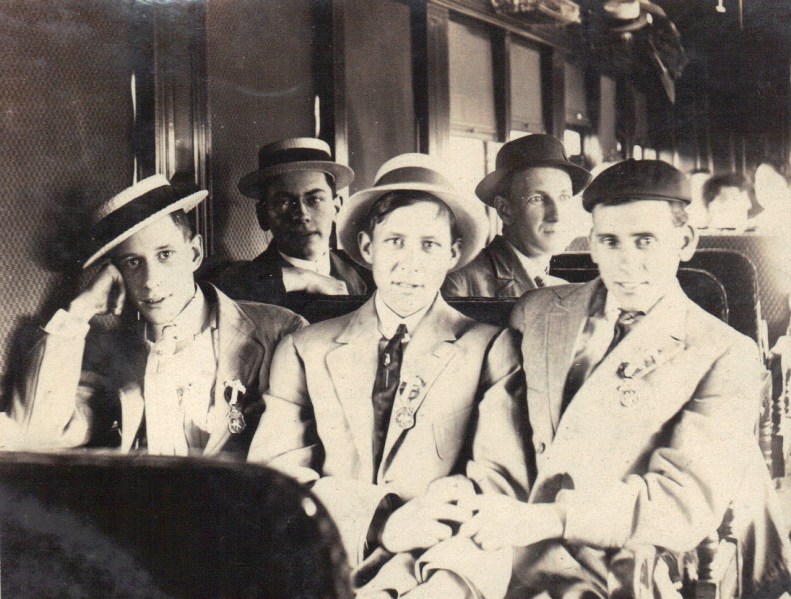
Edgar Reed, right. Photo by Lewis Reed.

This photo captures the moment Edgar Reed (left) and friends arrived home from World War I. Photo by Lewis Reed.
Edgar was fortunate enough to survive World War I and to settle back in Rockville and enjoy a successful life and career in the automobile business. After returning from the war in 1919, Edgar joined his brother in the business and the name changed to Reed Brothers Dodge. Edgar was in the automobile business with his brother, Lewis, for 35 years until his death in 1951.
So while we honor all who served this Veterans Day, on this day, I salute you Edgar Reed, and thank you for your service to our country.
Sources:
U.S. Army Office of Medical History
Ancestry.com
Maryland Military Men, 1917-1918
A Look Back at What Halloween in Montgomery County Looked Like 100 Years Ago
Ever wondered how Montgomery County families celebrated Halloween 100 years ago? Thanks to the these photographs from Lewis Reed’s collection, we can travel all the way back to 1914.
At the turn of the century, women often wore their regular clothes topped with homemade masks. The first Halloween costumes were usually worn by women and reflected the idea of masquerades that was extremely popular in the early 1900s. People only began to buy manufactured costumes in the second and third decades of the 20th century.

Halloween, ca. 1914. These women are holding homemade Halloween masks for their upcoming celebration. Photo by Lewis Reed
Oh the good ol’ days, when wearing a mask was enough to be dressed up for celebrations! Do you know how your ancestors’ celebrated Halloween? Newspapers are a great source to get a better understanding of life in the past. This special post is a look back through newspaper articles and Lewis Reed’s photographs at how Halloween was celebrated 100 years ago.
Stocked Stores: Stores were stocked with all the Halloween supplies needed for a fun celebration. Below is an ad for costumes and masquerade suits for those participating in Halloween parties and other seasonal affairs.

The Washington Post, October 30, 1916
Dancing and Parties: Halloween parties and dancing were enjoyed by many. Some announcements even included a list of guests in attendance!

The Baltimore Sun, November 3, 1912
Here is the description of a Halloween party from the Society Section of the November, 1916 issue of The Evening Star (Washington, District of Columbia):
A Halloween party was given last evening… and a merry evening spent by those present. The reception hall, living and dining rooms were artistically decorated with autumn leaves, lanterns, chrysanthemums and orange and black streamers. The evening was spent in old-fashioned games, concluding with the entire assemblage gathering about an open fireplace in the dark, while the guests were led by a ghost through various parts of the darkened home. The evening’s entertainment concluded with music, dancing and the serving of refreshments.
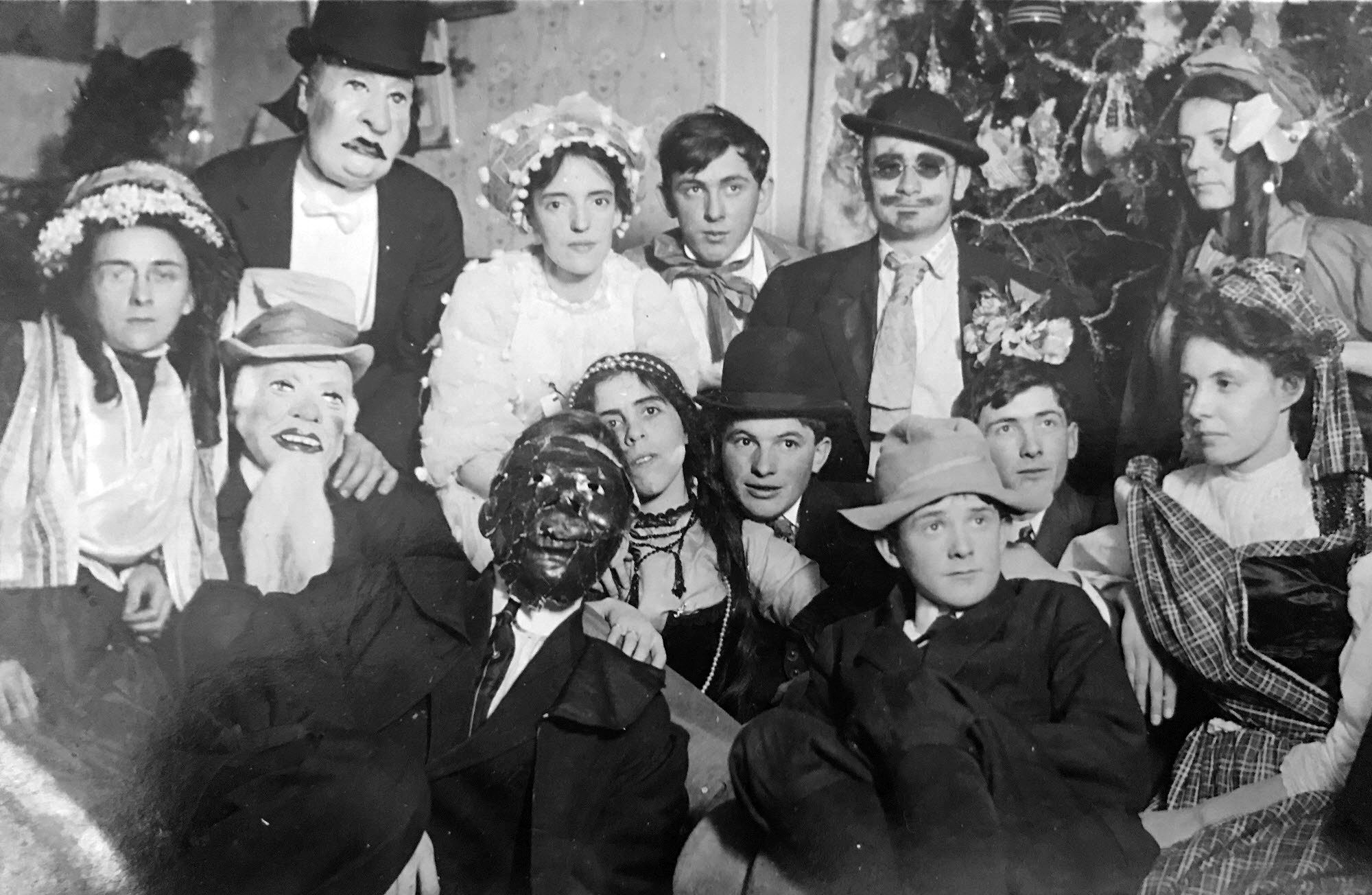
This photo captures a moment from a Halloween gathering over 100 years ago. Photo by Lewis Reed
Any sort of Halloween festivities demanded some sort of refreshment. In addition to traditional pumpkin pies and molasses cookies, a suggested dish to serve at Halloween parties was a Halloween salad.

Halloween Pranks: Witches and goblins, ghosts and mischief-making youngsters were permitted to enjoy all the Halloween revelry they liked … BUT DON’T THROW FLOUR. Yes, apparently in the early 1900s, there wasn’t much to do for entertainment, so kids would knock on doors on Halloween night and throw flour at whoever answered. To the modern observer, some of the traditions of Halloween 100 years ago are downright bizarre.
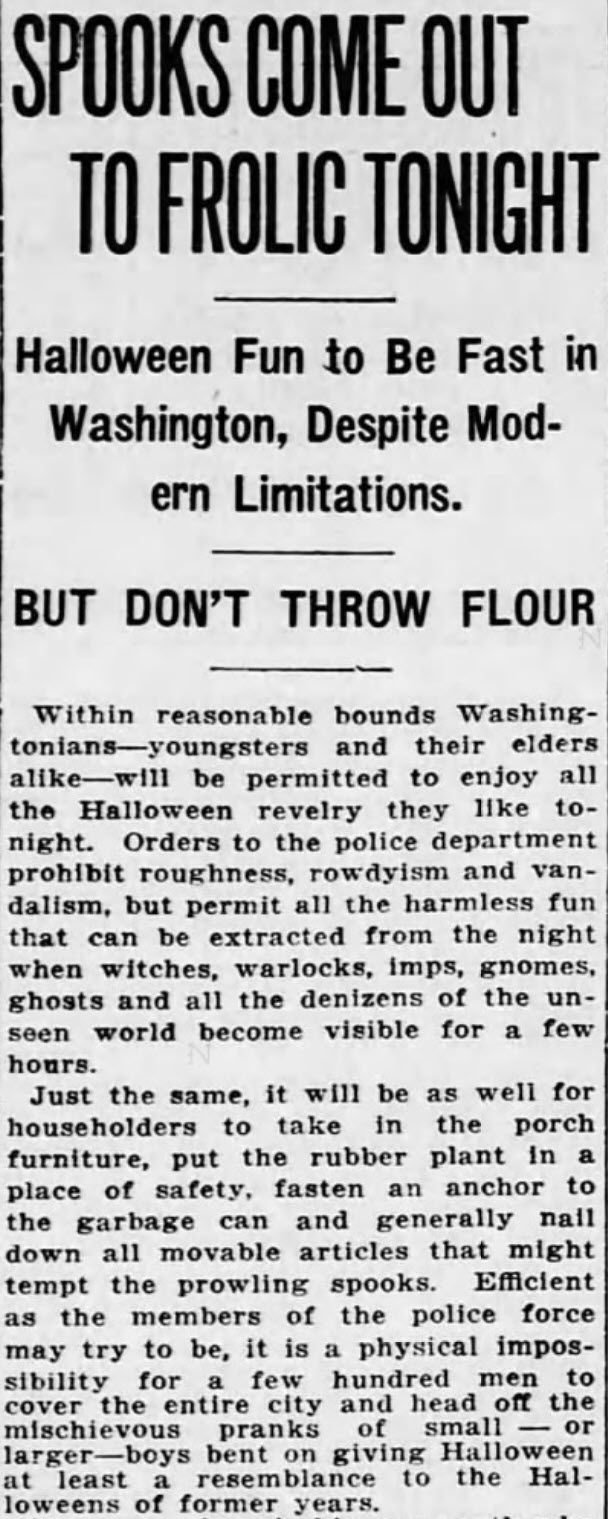
The Evening Star, October 31, 1916
Halloween Parades: Halloween parades actually began because pranks and mischief had gotten out of control. By 1920, there was a push to turn Halloween into a holiday centered around community gatherings and festive Halloween parades, rather than mischief.
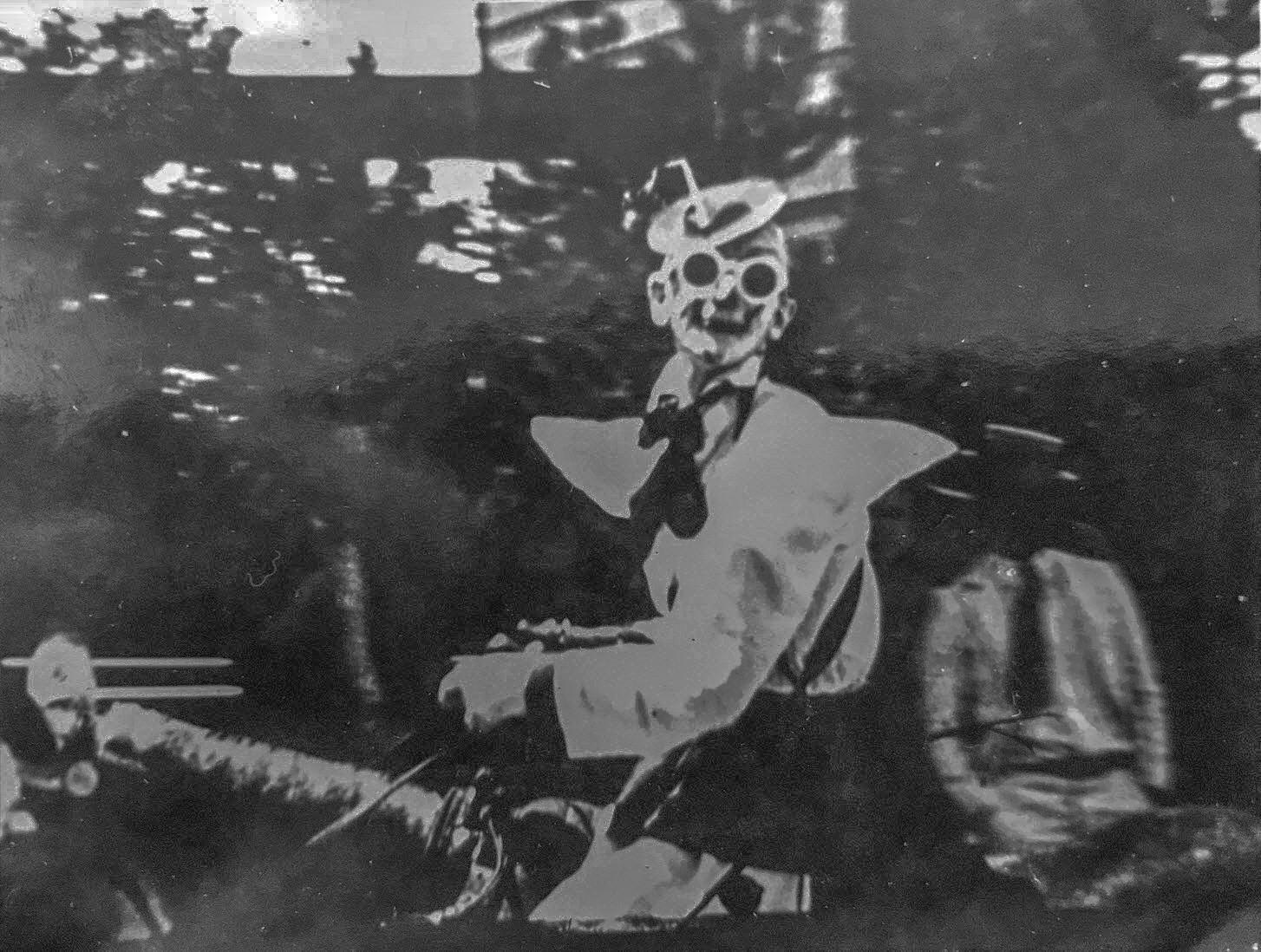
There is something undeniably creepy about this clown in sunglasses riding on a horse in a Halloween Parade. Location is unknown. Photo by Lewis Reed
With the convergence of a full moon, a blue moon, and daylight saving time — plus the unprecedented events of this year — Halloween 2020 will truly be one to remember. In fact, a Halloween such as this won’t happen again for at least another 152 years. Wishing all my friends, followers, and visitors of this blog a very safe and happy Halloween!
The Legendary Lake House Hotel of Horror, Then & Now
With Halloween just around the corner, I thought it would be fun to feature a photograph that Lewis Reed took of the Saylorsburg Lake House Hotel, now the site of Hotel of Horror. The aging Lake House Hotel in Saylorsburg, Pennsylvania, once a vibrant Poconos retreat, was a popular hotel for the region’s tourists who were looking for fun on nearby Saylors Lake. During the hotel’s heyday, its staff was booking rooms a year in advance. Today, the former hotel’s fame is generated from its annual Halloween haunted-house attraction.
Lake House Hotel (THEN): The legend of the Lake House Hotel spans more than two-hundred years. According to local folklore, during World War II, many of the employees at the Lake House were called to assist in the Pennsylvania National Guard, leaving the local asylum with one lone security guard to watch over the entire building. The inmates escaped, made their way to the hotel and took it over. The insane patients performed experiments on the guests. What was once a renowned resort for the rich and famous, became a torture chamber.
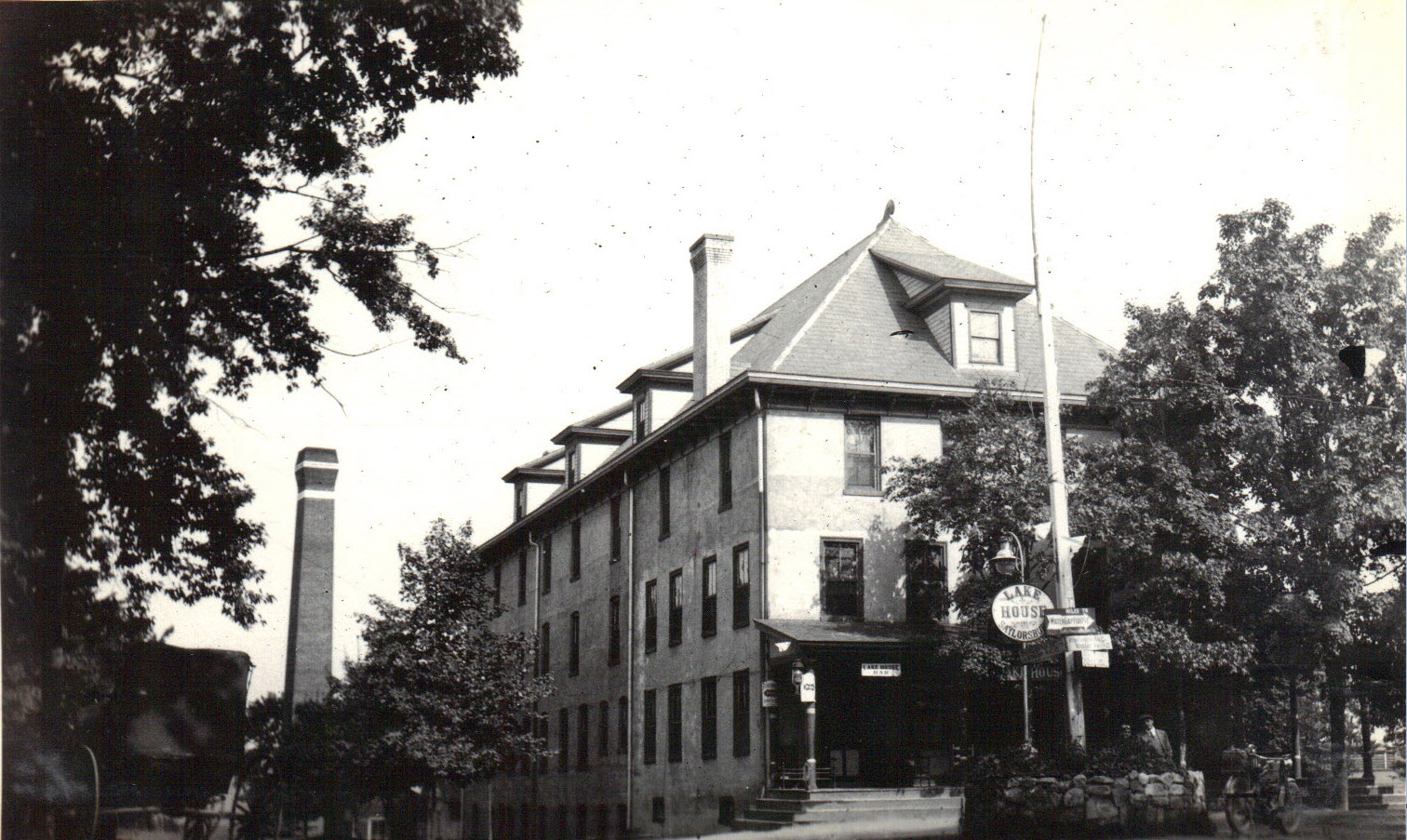
Saylorsburg Lake House Hotel. Photo taken by Lewis Reed, 1915.
Hotel of Horror (NOW): The hotel was purchased in 1990 and turned into an Antique Co-Op, and then in 1992 saw its first haunted house attraction. This 2020 season will celebrate the 28th year that the Hotel of Horror has been fascinating and horrifying legions of fans from the far reaches of the United States and even internationally. To all the readers of this blog: Have a spooky, enjoyable and very safe Halloween!

Welcome to The Hotel of Horror, The Pocono Mountains Premier Haunted House Attraction
Thomas Kelley’s Pumpkin Patch, Early 1900s
When the leaves begin to change and the air takes on a chill that means it’s time for one thing – pumpkin picking! This is a rare photograph of three well-dressed men pumpkin picking in Thomas Kelley’s field of pumpkins in Pleasant Hills, circa early 1900s. Tom Kelley farmed much of the land around the Pleasant Hills homestead and was famous for his “Kelley Corn” farm wagon of fresh dairy produce during the summer months, as well as the corn that fed visitors to the Montgomery County Fair each August and, of course, his pumpkin patch in the fall.
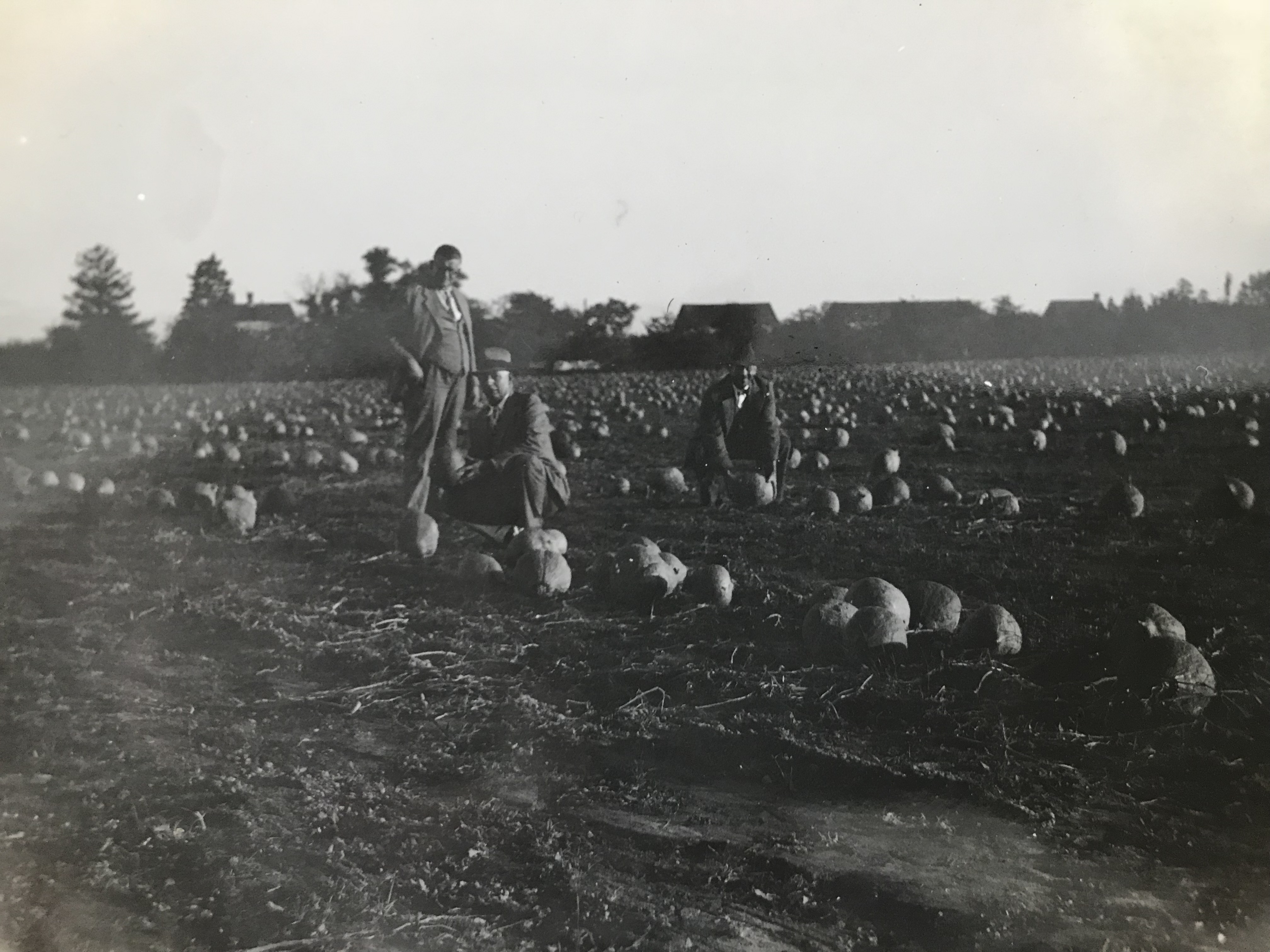
Pumpkin picking in Thomas Kelley’s Pumpkin Patch, Darnestown, Maryland circa. early 1900s. Photo by Lewis Reed
Books

Related Resources


Copyright Notice

Reed Brothers Dodge History (1915-2012) by Jeanne Gartner is licensed under a Creative Commons Attribution-NonCommercial 3.0 Unported License.
 Reed Brothers Dodge History 1915 – 2012
Recent Comments